TL;DR
Lawn care websites have a structural advantage that HVAC and plumbing sites don't: you can quote a recurring service from address + yard size data alone, in 30 seconds, without a site visit. That single capability , an instant online estimate tool that converts a curious homeowner into a recurring customer in one session , is the #1 conversion lever for lawn care operators in 2026. The lawn care sites that win at it are doubling and tripling their lead volume from the same traffic. This post covers the 7 elements that drive lawn care conversion, walks through 12 real examples, and gives you honest 2026 pricing across every build path.
If you'd rather just see what we'd do for your lawn care business, grab a free website audit , we'll send a 10-minute Loom + report within 48 hours.
Why lawn care websites are different from other home-service websites
When a homeowner lands on your lawn care website, the buying intent is usually one of three things:
- Recurring service shopping. They want a weekly or biweekly mowing service, possibly with fertilization and aeration. They're going to sign a 7-month or 12-month contract. They're comparing 3 providers on price + reviews + how easy it is to sign up.
- One-off job request. Spring cleanup, fall cleanup, mulch install, sod installation, snow removal, landscape redesign. Higher AOV but transactional , they'll get one to two quotes and book.
- Commercial / HOA inquiry. Property managers, HOAs, businesses needing landscape maintenance contracts. Long sales cycle, large account size, formal RFP often involved.
The buyer profiles are genuinely different from HVAC or plumbing , there's no "emergency" urgency, but there IS a seasonal urgency (the homeowner shopping for mowing in mid-March needs a provider before their grass gets out of control in April). And there's a recurring-revenue dynamic that doesn't exist for most other home services: lawn care customers stay 3-7 years on average, which means each conversion is worth 5-10× a single transaction.
Your website has to do something HVAC sites don't have to do: make signing up for recurring service feel easier than ignoring the email and not signing up at all. The lawn care operators who win do this with instant online quotes and friction-free signup. The ones who lose force every prospect through a "request a quote" form that gets answered 2 days later, by which point the prospect has already signed with a competitor.
The 7 elements that actually convert lawn care visitors in 2026
We've audited dozens of lawn care websites at SkillMammoth's Lawn Care practice, our playbook on starting a landscaping business, and the high-converters share these 7 patterns. Most are missing from sites built by template-based agencies and many "lawn care marketing" platforms.
1. Instant online quote tool
This is THE single biggest conversion lever for lawn care websites in 2026.
The mechanic: homeowner enters their address → the tool pulls yard square footage from public records or satellite data → quote populates automatically (mowing $X/visit, biweekly = $Y/mo, full season = $Z) → "Sign up now" button.
Lawn care has a structural advantage over almost every other home service for this: yard size + lot dimensions are public data, services are standardized, pricing is formula-driven (price per sq ft + service add-ons). You don't need a site visit for the first quote. The job can be quoted on the website, accepted on the website, and scheduled on the website , all without a human touching the conversation.
Sites with an instant quote tool convert visitor-to-lead at 8-15% (vs 1-3% for sites with a "Request a Quote" form). For most operators, adding this single feature doubles or triples lead volume from the same traffic. It is genuinely the most under-implemented high-leverage thing in lawn care marketing in 2026.
2. Recurring vs one-off CTAs, forked clearly
Recurring contract buyers and one-off job shoppers have different needs. The website has to serve both above the fold:
- Get a Weekly Lawn Care Quote (recurring , instant tool)
- Request Service (one-off , cleanup, mulch, sod, aeration, snow)
If both buyers see the same "Get a Quote" form, the recurring buyer gets confused (they want a price now, not a meeting), and the one-off buyer might not realize you do their specific job. Fork them.
3. Service area + drive-time radius shown clearly
Lawn care is the most drive-time-sensitive home service. A 25-minute drive to a $40 weekly mow is uneconomic; a 7-minute drive to the same job is highly profitable. Your service area needs to be in plain text on the homepage AND mapped visually so homeowners can self-qualify before they fill out a form.
Operators who skip this end up with 30-40% of inbound leads from outside their service area. That's office staff time wasted on leads that can never become customers.
4. Real before / after photos
A finished lawn that's been mowed, edged, and string-trimmed looks dramatically different from one that hasn't. Same for fall cleanup (leaves cleared), spring cleanup (beds mulched), and any landscape work. Before/after pairs convert lawn care visitors at 2-3× the rate of single "after" shots because the transformation is the entire value prop.
Have crews capture before/after on every job (set up a shared Google Drive or use CompanyCam). Your weekly site refresh comes from that feed.
5. Pricing transparency on standard recurring services
You don't have to publish every price. But the standard plans need to be on the page:
- "Weekly mowing starts at $40/visit for lots under 1/4 acre"
- "Biweekly mowing: $35/visit for the same"
- "Full-season program: mow + edge + string-trim + spring cleanup + fall cleanup = $1,650 (saves $400 vs paying per-service)"
Burying pricing behind a "Contact us for a quote" form costs you 30-50% of inbound traffic. Lawn care is competitive enough that price-shy sites lose to transparent ones. The instant quote tool (element #1) handles this cleanly for variable jobs; pricing transparency handles it for standardized recurring services.
6. Reviews , neighborhood-tagged
For most home services, reviews matter because they signal quality. For lawn care, reviews matter because they signal neighborhood familiarity. A homeowner in Edina trusts a reviewer also in Edina more than a reviewer 12 miles away in St. Paul.
Best practice: tag every review with the neighborhood or sub-city it came from ("Sarah K. , Edina , 5★"). NiceJob, Birdeye, and Podium all support this.
For HOA and commercial accounts, surface those reviews separately , different buyer needs different proof.
7. Mobile-first signup + recurring billing portal
80-90% of lawn care site traffic is mobile. The recurring-service signup has to work in 60 seconds on a phone: pick a plan → enter address → enter card → confirm. If signup takes 5 minutes or requires a phone call, you lose the impulse buyer.
The customers who sign up also need a portal: see their schedule, pause service for vacation, update billing, message the crew, see their next service date. Operators who skip the portal end up with office staff answering "when is my next mow?" questions 30+ times a day.
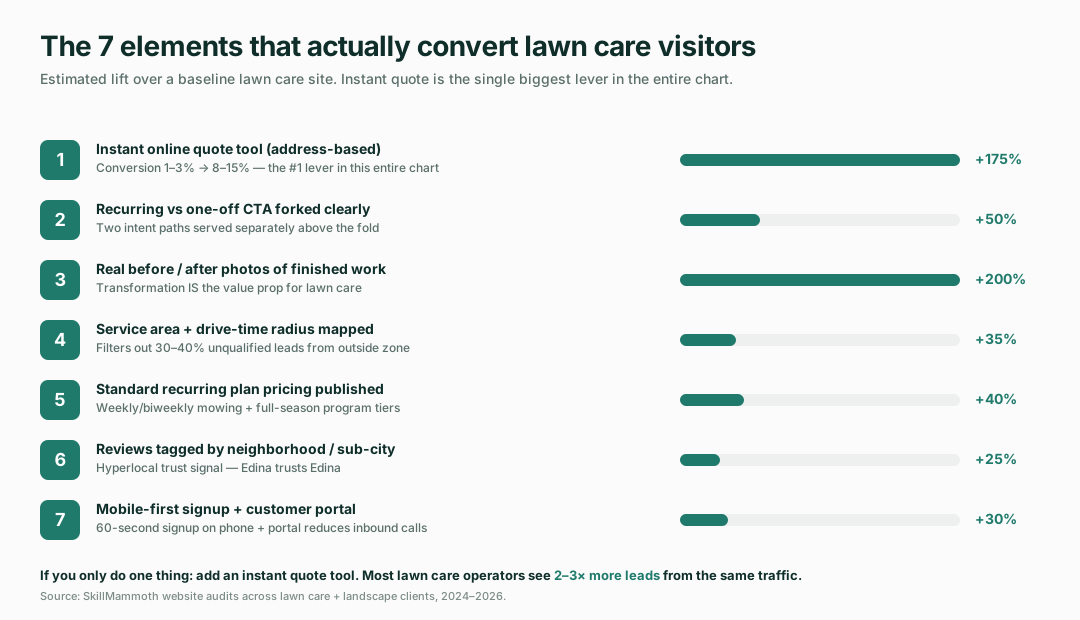 Caption: How each element lifts a baseline lawn care site. The instant quote tool alone roughly triples lead volume , it's the single most under-implemented high-leverage feature in lawn care marketing in 2026.
See it in action: Our Riekel's Lawn Care & Landscaping case study walks through a full website + AI chatbot + instant estimate tool + speed-to-lead system for a lawn care operator. The instant estimate tool generates ~2 leads/day on its own.
12 lawn care website examples (with honest reactions)
Sorted from "actually good" to "expensive train wreck."
The "actually good" tier (4 examples)
1. Mid-sized regional lawn care, custom-built site with instant quote tool (~$15K range) Address-based instant quote front-and-center. Recurring vs one-off clearly forked. Service area mapped with drive-time radius. Before/after gallery refreshed weekly. Customer portal for existing accounts. Loads in 1.4 seconds. Top of the market.
2. Family-owned lawn care + landscape design, Webflow build (~$8K range) Tells the family story ("Three generations growing yards in Cedar Rapids since 1995") with team photos in branded shirts. Instant quote for mowing + lead form for landscape design. Pricing transparent on standard plans. Sweet spot for most independents.
3. Commercial-focused landscape company, lead-gen optimized (~$12K range) No residential CTAs at all. Targeting property managers, HOAs, multi-site businesses. Case studies organized by property type (office parks, multifamily, retail centers). One conversion path: book a 15-min discovery call. Brutally focused.
4. Small two-crew operator, GoHighLevel quick-build (~$2K range) Not pretty but converts. Phone number huge. Online signup widget for weekly mowing. List of services with prices. 5 Google reviews. Service area map. Done. The minimum viable lawn care site.
The "bland but functional" tier (4 examples)
5. Generic Wix template lawn care site Looks like 10,000 other lawn care sites. Stock photos of green yards that aren't theirs. Phone number in tiny font in the top-right corner. Manual "Request a Quote" form (no instant pricing). Conversion rate probably 1-2%. Could be lifted to 4% in a weekend with an instant quote tool alone.
6. Squarespace lawn care site with great photography Beautiful drone shots, real photo shoot of landscape projects. But the signup flow takes 3 clicks to reach a contact form. Lost the impulse buyer. Photo investment was worth it; signup flow needs surgery.
7. WordPress lawn care site by a local agency, built ~2019 8 plugins. Loads in 4.5 seconds. Phone number works. Service pages thin. Schema missing. Page 2 in Google. Needs refresh, not rebuild.
8. ServiceTitan or Jobber-bundled website Comes "free" with the FSM software. Looks like every other FSM-bundled lawn care site. Booking integration excellent. Customization limited. SEO mediocre. Fine if you're a Jobber/Housecall Pro power user; mediocre if you want to differentiate.
The "expensive train wreck" tier (4 examples)
9. The $40K+ agency site that nobody can edit Custom CMS only the agency understands. Owner files a ticket and waits 5 business days to change a phone number. Site looks impressive but conversion is brutal because they can't iterate.
10. The "we built it ourselves with AI" site 3 pages, AI-generated copy that doesn't match the actual business. Hallucinated services. No instant quote tool. Every CTA leads to a contact form.
11. The Scorpion / Hibu / Townsquare "managed" site Locked into a 24-month contract. Owner doesn't own the domain or content. $1,200-$2,500/mo. When the contract ends, they restart from scratch. Most damaging for lawn care specifically because customer-retention SEO compounds heavily , losing all that equity at end-of-contract is brutal.
12. The "let's add live chat to fix conversion" site Bad site + AI chatbot ≠ good site. Chat tools are a multiplier on a foundation that converts. They are not a fix for a foundation that doesn't.
The SkillMammoth lawn care website framework
When we build a lawn care website at SkillMammoth, we use a 9-page architecture optimized for both Google and the homeowner shopping for weekly mowing in March.
Page 1: Homepage
- Above the fold: company name, instant quote widget (address-based), dual CTA (recurring quote + one-off request), photo of real team or trucks, service area indicator
- Below the fold: services grid (mowing, fertilization, aeration, cleanups, mulch, sod, snow removal), before/after gallery, recurring plan tiers, reviews, certifications
- Bottom: secondary CTA, phone, hours, NALP membership badge
Page 2: Service area (the SEO + qualification workhorse)
- One parent page + child pages for each city/sub-city you serve (10-40 child pages depending on metro)
- Each city page: same structure (intro, what we do here, drive-time map, customer reviews from that area, signup widget)
- Crucial for lawn care because drive time is the operational constraint , qualified vs unqualified leads are the difference between a profitable and unprofitable customer
Page 3-7: Service pages
- Weekly/biweekly mowing
- Fertilization + weed control programs
- Aeration + overseeding
- Spring cleanup / fall cleanup / mulch installation
- Landscape design / sod / hardscape
- Snow removal (seasonal regions)
- Commercial / HOA accounts (separate page)
Each page: problem → service description → pricing range → process → reviews → CTA. Schema markup for the service.
Page 8: About / team
- Team photos in branded shirts and trucks, equipment, certifications (pesticide applicator license, NALP, BBB)
- Years in business, # of accounts served, references for commercial buyers
Page 9: Existing customer portal (gated)
- Schedule view, pause/reschedule, billing, message the crew
- Critical for reducing inbound "when's my next mow?" calls
That's it. 9 pages + 10-40 city subpages. We can spin this up in 4-6 weeks for most lawn care operators.
Mobile vs desktop: it's mobile, and the signup flow is the bottleneck
For lawn care sites we audit, 82-90% of traffic is mobile , even higher than HVAC. Homeowners are typically researching from the back deck or while looking at their unmowed yard.
What this means:
- The instant quote tool has to work flawlessly on mobile (most don't)
- Signup forms need 3 fields max
- Tap-to-call should be a one-tap action
- Page speed on 4G under 3 seconds, ideally under 2
- Sticky bottom bar with "Get Instant Quote" + "Sign Up" on every page
Almost every lawn care site we audit fails at least 3 of these. The fixes are usually under $500 in dev work and they pay back in the first week of spring rush.
Local SEO essentials for lawn care websites in 2026
Lawn care local SEO is 60% Google Business Profile, 30% your website's local SEO, 10% backlinks. Get the 60+30 right and the leads come.
Google Business Profile checklist: - Categories: Lawn care service (primary) + landscape designer, lawn mower repair (if applicable), snow removal service (seasonal) as secondaries - Service area: every city/sub-city you serve, listed - Photos: 50+ minimum, refreshed weekly (before/after, trucks, team, equipment) - Posts: 1-2/week (seasonal tips, fertilization timing, snow removal alerts in winter) - Reviews: 1+/week from real jobs, respond to every one - Q&A: pre-seed seasonal questions ("When does mowing season start in your area?")
On-site local SEO checklist: - City pages for every service area - Drive-time map prominently displayed - NAP consistent + LocalBusiness + ServiceArea schema - Embedded Google Map with actual service zone - Customer testimonials tagged by neighborhood - Backlinks from local chamber, BBB, NALP chapter, local newspapers (often free with a "spring lawn care tips" press release)
Technical SEO checklist: - Core Web Vitals all green (Lighthouse 90+) - HTTPS everywhere - Sitemap + robots.txt clean - Schema for: LocalBusiness, Service, Review, FAQ - Image alt text on every before/after photo - One H1 per page
The free new website checklist covers it in printable format.
How much does a lawn care website cost in 2026?
Honest 2026 pricing across every realistic option.
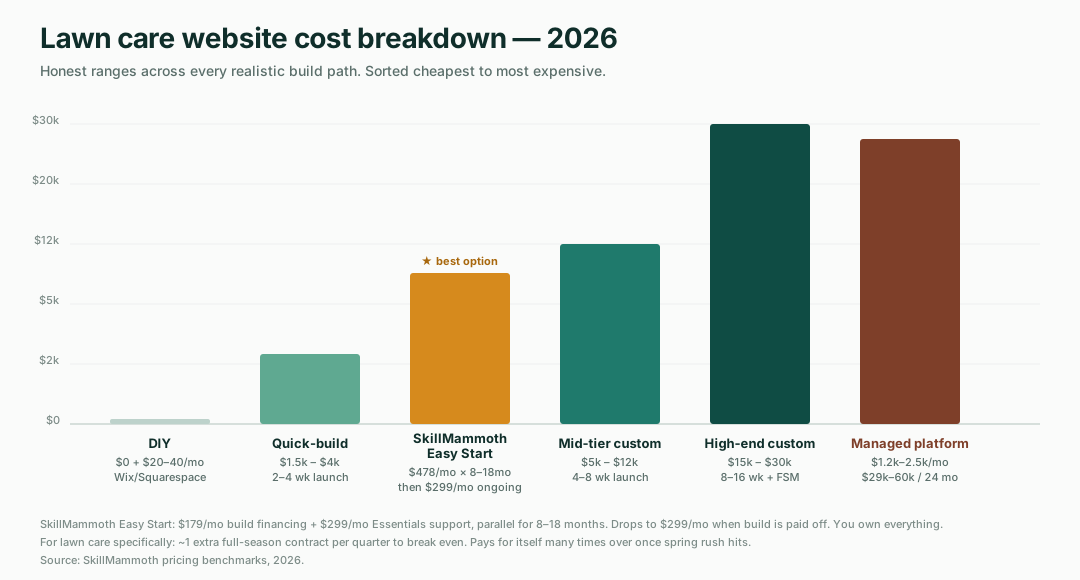 Caption: 2026 cost ranges across every realistic build path. SkillMammoth Easy Start lands between Mid-tier custom and High-end on total spend, with monthly financing built in.
DIY ($0 setup + $20-$40/mo software)
- Tools: Wix, Squarespace, GoDaddy
- Time investment: 20-40 hours for a working site, 60+ for a good one
- Conversion potential: 1-2% of visits become leads
- Best for: Brand new lawn care operators with zero budget who need something online before spring rush
- Honest take: Almost always ends in regret. The math on a single missed weekly mowing contract (worth $1,500-$3,000 over a season) is roughly 50× the cost of skipping DIY.
Quick-build agency or freelancer ($1,500 - $4,000)
- Tools: Webflow, GoHighLevel, WordPress with starter theme
- Time to launch: 2-4 weeks
- Conversion potential: 2-4% if done well
- Best for: 1-2 crew operations
- Honest take: Big leap from DIY. Picks up most of the conversion gains. Doesn't usually include an instant quote tool, which caps the upside.
Mid-tier custom build ($5,000 - $12,000)
- Tools: Webflow, Framer, WordPress with custom theme, or a focused agency
- Time to launch: 4-8 weeks
- Conversion potential: 4-8% with proper local SEO + instant quote tool
- Best for: 3-10 crew operations, multi-location, anyone serious about scaling recurring contracts
- Honest take: This is where most lawn care companies should land. ROI is fast because recurring contract LTV is so high , one extra closed full-season contract pays for the build.
High-end custom build ($15,000 - $30,000)
- Tools: Custom code, headless CMS, integrations to Jobber / Housecall Pro / ServiceTitan
- Time to launch: 8-16 weeks
- Conversion potential: 6-12% with high-volume traffic
- Best for: 10+ crew operations, regional/multi-state, M&A roll-ups
- Honest take: Worth it when monthly traffic is high enough that conversion lift pays back in a single spring season.
SkillMammoth subscription , Easy Start at $500/mo, then $350/mo
(Yes, this is us. We're including it because pretending we don't have skin in this game would be silly, and because the model is genuinely different from anything else on this list.)
- What it is: A custom-built lawn care website (same conversion-quality as our mid-tier Core package) financed at $150/mo for 24 months, paired in parallel with your $350/mo Essentials support plan. Total monthly during build payoff: $500/mo for 24 months, then $350/mo ongoing. A Lite tier exists at $450/mo for 12 months for smaller projects.
- Time to launch: 4-6 weeks (ahead of spring rush if you start by January)
- Conversion potential: 4-8% , same as mid-tier custom build because it is a mid-tier custom build
- What's included: Custom design + build, hosting + maintenance + security, monthly performance reporting, 2 edit requests per month, quarterly strategy session. Growth and Authority support tiers add GBP management, weekly blog, off-page SEO.
- The ownership model: You can buy out the remaining balance at any time and walk with everything , domain, design, content, code. No lockout. The opposite of the managed-platform model below.
- Best for: 3-10 crew lawn care operators who want a custom site without writing a $5K-$12K check up front, want monthly edits handled, and refuse to rent their website forever
- Honest take: Specifically for lawn care, the $500/mo is roughly the cost of one extra full-season contract per quarter. The site pays for itself many times over once spring rush hits.
Managed marketing platform ($1,200 - $2,500/mo, often 24-month contract)
- Tools: Scorpion, Hibu, Townsquare Interactive, Blue Corona
- Time to launch: 4-6 weeks
- Conversion potential: Variable
- Best for: Operators who don't want to think about marketing at all
- Honest take: Predictable monthly cost, but you don't own the asset, and exit is painful. The 3-year math usually favors a one-time custom build OR our Easy Start model. For lawn care specifically, customer-retention SEO compounds heavily , losing all that asset value at the end of a managed contract is unusually painful.
Where most lawn care websites fail (and what to do about it)
| Failure mode | What's actually happening | Fix |
|---|---|---|
| No instant quote tool | Losing 60-70% of ready-to-buy traffic to providers who have one | Add an address-based quote tool. Single highest-leverage move available. |
| Recurring vs one-off not differentiated | Confused buyers, lower conversion both segments | Two clear CTAs above the fold |
| No service-area map with drive-time | 30-40% of leads come from outside your profitable zone | Build a map page, surface drive-time radius |
| No before/after photos | Trust signal missing , visitor can't see the transformation | Have crews capture before/after on every job |
| No pricing transparency on recurring plans | Losing price-shy buyers at the form-fill | Publish standard plan pricing |
| Slow on mobile | 30%+ of mobile visitors leave at 3+ seconds | Compress images, kill plugins |
| No reviews on-site | Trust signal missing | Embed reviews tagged by neighborhood |
| No customer portal | Office staff handling 30+ "when's my next mow" calls/day | Add a portal with schedule + billing + messaging |
A halfway-competent free website audit will surface these in 30 minutes.
Build vs buy vs DIY: which path is right for you
| Your situation | What we'd recommend |
|---|---|
| Brand new, $0 budget, need something before spring | DIY on Wix / Squarespace, plan to upgrade in 6 months |
| 1-2 crews, want results without ongoing fees | Quick-build agency, $1.5K-$4K |
| 3-10 crews, can fund $5K-$12K up front, want full conversion stack | Mid-tier custom build with instant quote tool |
| 3-10 crews, want the same quality without upfront hit | SkillMammoth Easy Start , $500/mo × 24 mo → $350/mo |
| 10+ crews or multi-state | High-end custom with FSM integration, $15K-$30K |
| Want to outsource marketing entirely, willing to pay $30K+ over 24 months | Scorpion / Hibu / Blue Corona, eyes open |
The middle of that table is where SkillMammoth lives. We've seen the platform-locked alternatives and the DIY traps, and the honest math for most lawn care operators puts the sweet spot at either a one-time mid-tier custom build OR our Easy Start subscription.
Run the website cost calculator to see your specific number in 30 seconds.
Your next step
Three free things to grab right now:
- Free website audit , 10-minute Loom + written report within 48 hours
- Free new website checklist , printable PDF covering the 47 things every lawn care website needs before launch
- Free website cost calculator , 30-second personalized estimate
Or book a 30-minute strategy call , we'll quote your project on the call, no follow-up sales sequence.
FAQ
How long does it take to build a lawn care website?
For a custom mid-tier site: 4-8 weeks from kickoff to launch. The variables are content + photos from your team and revision cycles. Quick-build sites launch in 2-3 weeks. If you're targeting spring rush (March-April booking surge), start by January at the latest.
Should lawn care operators use Wix, WordPress, or Webflow?
Webflow for most lawn care operators in 2026. The instant quote tool integrations are easier, page speed is better, the CMS is cleaner. WordPress is fine with a developer relationship; Wix is fine if you're starting from scratch on a tiny budget.
Do I need separate pages for each service?
Yes. Weekly mowing, biweekly mowing, fertilization programs, aeration, spring/fall cleanups, mulch, sod, landscape design, snow removal , every service needs its own page. Google ranks pages, not websites.
How many city pages do I need for local SEO?
One per city or sub-city you serve. For metros, this often means 20-40 pages (one per suburb). For lawn care specifically, drive-time radius matters more than total area, so prioritize pages for the cities closest to your shop.
What's the ROI on a new lawn care website?
For a $5K-$12K custom build (or our $500/mo Easy Start) with an instant quote tool and proper local SEO, most lawn care operators we work with see payback in the first spring season , sometimes in the first month. The compounding gain comes from recurring contract LTV (3-7 years per customer).
Do I really need an instant quote tool?
If you can get one, yes. It's the single highest-leverage feature you can add to a lawn care website. Conversion rate typically doubles or triples vs sites with a "Request a Quote" form. The cost of building or integrating one is usually under $3,000 and it pays back in weeks during spring rush.
What's the best instant quote tool for lawn care?
Several decent options on the market in 2026, with new ones emerging. We're actively working on a SkillMammoth-built tool tuned specifically for lawn care operators that we'll make available to clients soon. In the meantime, the third-party tools that work include LawnPro, Lawnbot, and a few others , happy to make recommendations on a strategy call based on your specific stack.
How important are before / after photos?
Critical. Lawn care is one of the most visually-driven home services because the transformation is the entire value. Operators who capture before/after on every job and refresh their gallery weekly convert at 2-3× the rate of operators using stock photos or single "after" shots.
Do I need a customer portal?
For 3+ crew operations, yes. Without it, office staff spends 30+ hours/week answering "when's my next mow?" and billing questions. The portal pays back within 2-3 months in labor savings alone.
How often should I update the website?
Content refreshes monthly minimum (new before/after photos, new reviews, seasonal tip blog posts). Structural updates every 12-18 months. Full redesign every 4-5 years.
What about an AI chatbot for after-hours signups?
Useful , lawn care has a real after-hours signup pattern (homeowners researching from the back deck on a Sunday). An AI chatbot that can answer FAQ + walk the visitor through the instant quote flow is worth $50-$200/mo for most operators.
Should I run different campaigns for residential vs commercial?
Yes. Different buyer, different decision process, different ad copy, different landing pages. Commercial AOV is 5-10× residential and the sales cycle is much longer. Separate campaigns let you bid appropriately.
Last updated: May 2026. Author: Alex Storey, Co-Founder at SkillMammoth. SkillMammoth builds custom websites, local SEO systems, and lead-generation automations for lawn care and landscape companies. See our Lawn Care practice, our playbook on starting a landscaping business, or grab a free website audit.
\n\nPrefer to talk to a working operator instead of reading another guide? See our lawn care marketing consultant page for what a consultant-model engagement looks like, or book a free strategy call to work with a lawn care marketing consultant directly.
Related reading: pair a fast site with our landscaping SEO playbook so seasonal searchers actually find it.
Want to implement these strategies?
Book a free strategy call and learn how we can help grow your contractor business.
Book a Free Strategy Call