TL;DR
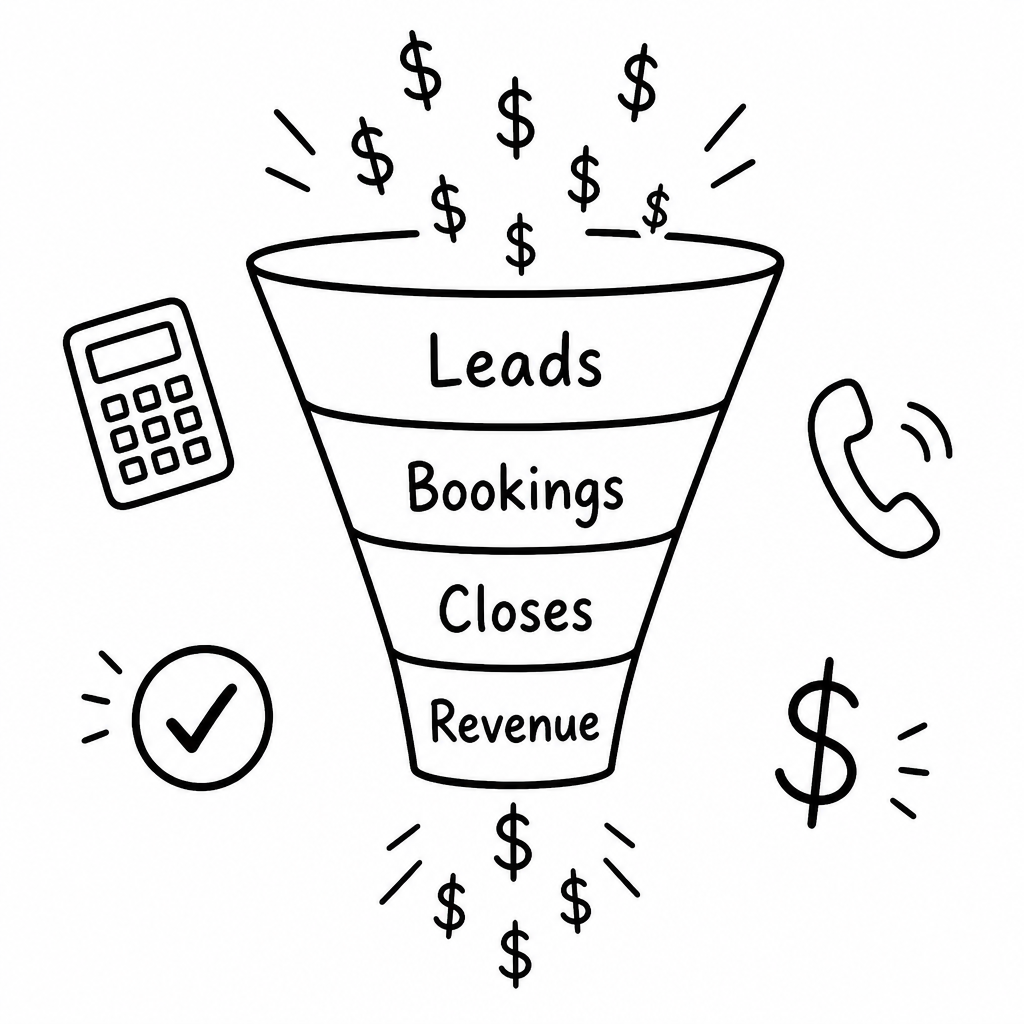
Most contractors track "leads per month" and call it marketing measurement. That's the wrong metric. The math that actually determines whether your business grows is monthly leads × lead-to-book rate × book-to-close rate × average job value. Two contractors with the same monthly lead count can have an 8x difference in revenue depending on the rest of the equation. This post explains the contractor funnel math, gives you industry benchmarks at every stage, and includes a free calculator that diagnoses your biggest revenue leak in 60 seconds.
Free Interactive Tool
Skip the reading and run your own numbers
Enter your 4 metrics and get a personalized diagnosis of your biggest revenue leak in 60 seconds. No email required.
Why "leads per month" is the wrong metric to optimize
Most contractor marketing conversations sound like this: "We got 80 leads last month, up from 65 the month before." That's a fine number to know. But it doesn't tell you whether your business is healthy. It doesn't tell you what to fix. And it doesn't tell you what 80 leads is actually worth.
Two contractors with the same 80 monthly leads can have wildly different outcomes:
- Contractor A: 80 leads × 50% book rate × 30% close rate × $400 AOV = $4,800/mo revenue from leads
- Contractor B: 80 leads × 80% book rate × 60% close rate × $700 AOV = $26,880/mo revenue from leads
Same lead volume. 5.6x revenue difference. And it's not the marketing. It's the entire revenue math from lead to paying customer.
The 4 metrics that actually determine your revenue
1. Monthly leads
The first stage of the funnel. How many people contact you in a given month.
Industry benchmarks for residential home services:
- 1-truck operator: 15 to 40 qualified leads/mo
- 5-truck operator: 80 to 150 qualified leads/mo
- 10-truck operator: 150 to 300 qualified leads/mo
- Enterprise (20+ trucks): 300 to 800+ qualified leads/mo
2. Lead-to-book rate
What percentage of inbound leads turn into a confirmed appointment.
Industry benchmarks: 50 to 70% average, 75 to 85% top quartile.
Leaks at this stage: slow response time (responding within 1 minute lifts conversion by 391%), after-hours leads going to voicemail, dispatcher not knowing pricing, "we'll get back to you within 24 hours" responses, no AI chatbot or AI receptionist for overflow capacity.
3. Book-to-close rate
What percentage of booked appointments turn into paying customers.
Industry benchmarks: 40 to 60% average, 65 to 80% top quartile.
Leaks at this stage: tech doesn't present the work well, no good-better-best pricing menu, high diagnostic fee competing with the job cost, no financing options for high-AOV installs, no follow-up if customer doesn't book on the spot.
4. Average Job Value (AOV)
What the average paying customer spends per job.
Industry benchmarks (residential service): General service call $250 to $600. HVAC service $300 to $800. HVAC install $5,000 to $15,000. Plumbing service $300 to $800. Plumbing install $1,500 to $8,000. Electrical service $200 to $600. EV charger install $800 to $2,500. Panel upgrade $2,500 to $5,000. Roofing reroof $8,000 to $25,000. Lawn care recurring contract $1,500 to $5,000 annual.
Leaks at this stage: no upsell motion, missing high-AOV install categories, no maintenance membership program, inadequate financing options blocking $5K+ install closes.
The compounding math (why every stage matters)
Each stage multiplies through the funnel. A 10% improvement at every stage compounds into a 33% revenue lift. A 20% improvement at every stage compounds into a 73% revenue lift.
Starting point: 100 leads × 60% book × 50% close × $400 AOV = $12,000/mo
Improve each stage by 10%: 100 leads × 66% book × 55% close × $440 AOV = $15,972/mo
Improve each stage by 20%: 100 leads × 72% book × 60% close × $480 AOV = $20,736/mo
This is why funnel-stage improvements compound and why "optimize one stage at a time" is the highest-leverage marketing strategy for contractors.
Use the calculator to diagnose your funnel
Contractor Funnel Calculator. Free. No email required to see results.
You enter your 4 numbers, the calculator outputs your current monthly revenue, your stage-by-stage benchmark comparison, your biggest revenue leak, and specific fixes for that stage with estimated revenue lift.
What this looks like in practice
A typical pattern: contractor thinks they need "more leads." Calculator shows their actual leak is in book-to-close (40% close rate vs 60 to 70% top quartile). The fix is tech sales training and good-better-best pricing, not paid ads. The contractor avoids spending $5K/mo on Google Ads they didn't need and instead invests $1,500 in a one-time sales training that adds $8,000/mo to revenue. That's the value of doing the math.
What to do this week
- Pull your last 90 days of data. Total leads, total bookings, total signed customers, total revenue.
- Calculate your 4 metrics.
- Run them through the calculator.
- Identify your biggest leak. It's usually not the one you assumed.
- Pick ONE fix to focus on this quarter. Most contractors should fix book-to-close before optimizing for more leads.
- Read our Lead Generation for Plumbers guide for deeper system framework (applies across trades).
- Or book a free 30 minute strategy call via our contact page.
The top of the funnel is only worth feeding if the bottom pays back. The customer lifetime value calculator turns your job value, repeat rate and margin into the most you can spend per lead.
FAQ
What's the most common biggest-leak stage?
For most home service contractors, it's book-to-close. Contractors invest heavily in marketing to drive lead volume but lose 40 to 60% of booked leads because tech sales isn't dialed in. Fixing this is usually the cheapest, highest-ROI single change.
What's a "good" monthly revenue per truck?
Healthy residential service contractors typically generate $40,000 to $80,000 per truck per month. Top-quartile operations hit $100,000+ per truck per month.
How often should I recalculate?
Monthly is ideal. Quarterly at minimum.
Do I need a CRM to track these numbers?
Yes. Housecall Pro, ServiceTitan, Jobber, FieldEdge. Without lead source, booking status, and job revenue tracking, you can't measure your funnel accurately.
What if my AOV is much higher than the benchmarks?
The calculator still works. Enter your actual AOV. The diagnostic identifies leaks based on stage conversion rates vs benchmarks, not AOV alone.
What if I'm a 1-truck operator just starting?
The funnel math still applies. Your benchmarks are at the lower end of the ranges, but the same diagnostic logic works.
Should I optimize for more leads or better close rates first?
Almost always close rates first. Improving close rate is cheaper, faster, and compounds with everything else.
Can I share the calculator with my team?
Yes. Free to use.
Do you offer help implementing the fixes?
Yes. SkillMammoth deploys the full stack: AI receptionist, speed-to-lead, instant estimate tools, maintenance membership funnels. See our pricing page or book a call via our contact page.
Want to implement these strategies?
Book a free strategy call and learn how we can help grow your contractor business.
Book a Free Strategy Call