TL;DR
Most plumbing contractors are losing money on at least 2 of the 9 lead channels they're paying for. The four channels that consistently win in 2026 are: Google Business Profile, local SEO on your own site, Google Local Service Ads (LSAs), and review-driven referrals. The four that consistently lose money for plumbers: HomeAdvisor / Networx / Angi shared leads (emergency callers don't shop, they call the first plumber who answers), broad Facebook prospecting, untargeted direct mail, and untargeted Yelp ads. Below: cost-per-lead benchmarks, the rank-order, and the starter stack for a 5-truck plumbing operator today.
If you want a fast diagnostic of where your plumbing leads are leaking, grab a free website audit, we'll send back a 10-minute Loom + report within 48 hours.
Before you add a channel, fix the leak
Adding lead channels to a website that doesn't convert is like running a faucet over a clogged sink, it just floods. If your homepage doesn't have a tap-to-call phone above the fold, an emergency-vs-scheduled dual CTA, real photos, pricing transparency, and embedded reviews, fix that first, then come back to this post.
We covered exactly what makes plumber homepages convert in the Plumber Website Design anchor. The TL;DR: the elements that matter aren't visual, they're trust, speed, and obvious next steps. A great plumber site at a 5% conversion rate makes lead generation 2.5× cheaper than a mediocre site at a 2% rate. Math wins.
OK. Bucket fixed. Let's add water (the right kind).
The 9 channels, ranked by ROI for plumbers in 2026
ROI varies enormously by market, but these rankings hold up across the dozens of plumbing clients we've worked with at SkillMammoth's Plumbing & Mechanical practice. Cost-per-lead figures are 2026 US benchmarks for residential plumbing. Commercial benchmarks run 30–50% higher.
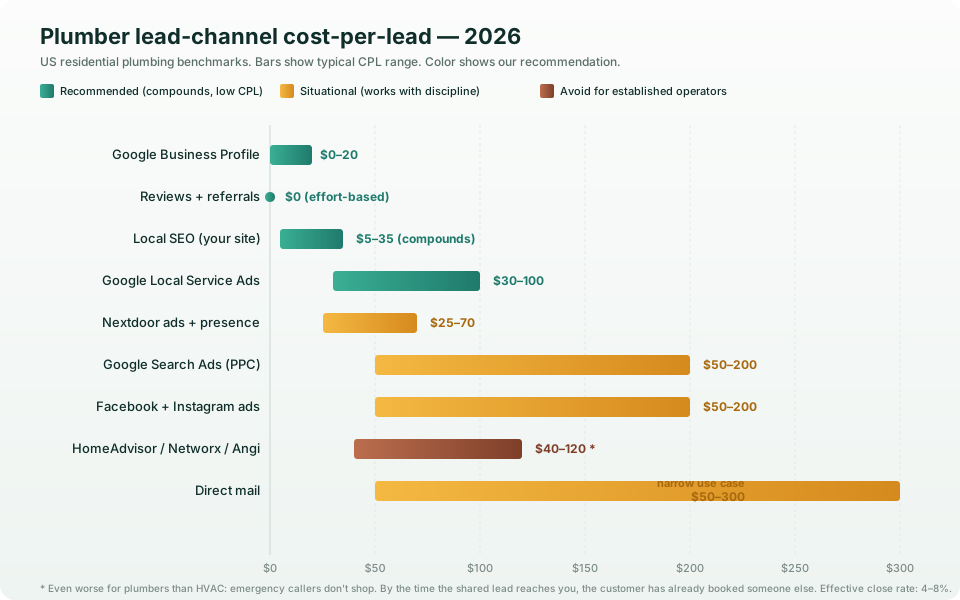 Caption: How plumbing lead channels actually compare on cost-per-lead. Color-coded green (compounds), yellow (situational), red (most operators waste budget here).
1. Google Business Profile (GBP), CPL: $0–20
Single most under-optimized asset for most plumbing contractors. It's free, ranks above your website in 60%+ of local searches, and ~32% of all "plumber near me" searches result in a phone call. (Higher than HVAC.)
What moves the needle:
- Categories: Plumber (primary) + drain cleaning service, water heater installation, emergency plumber, septic system service as secondaries
- Service area: every city you service, listed individually
- Photos: 50+ minimum, refreshed weekly (jobs, before/after, trucks, team)
- Posts: 1–2/week (jobs, before/afters, seasonal tips, holiday hours, water-heater specials)
- Reviews: 1+/week from real jobs, respond to every one
- Q&A: pre-seed 10 common questions ("What's the cost of a water heater install?"), answer them yourself
Median time-to-first-lead from a freshly optimized plumber GBP: under 10 days. Most operators see lead volume 2–3x within 60 days.
2. Google Local Service Ads (LSAs), CPL: $30–100
Pay-per-lead format above traditional ads. Includes the Google Verified badge. Pay only when someone calls or messages you.
For plumbers specifically, LSA pricing skews higher than HVAC because emergency-plumbing keywords ("emergency plumber near me", "burst pipe repair") have intense bidding competition. A $60–100 CPL is normal in metro markets.
Why it wins:
- Highest-intent traffic in Google's ecosystem
- Bid pricing capped, no surprise overspend
- Disputes for spam/wrong-area calls usually credited
- You can pause when at capacity (good for commercial-heavy plumbers with seasonal demand)
Common mistakes: not optimizing the LSA profile, not disputing bad leads, running LSAs without GBP being optimized first. Pair LSAs with a strong GBP and your CPL drops 30–40%.
3. Local SEO on your own website, CPL: $5–35 (after content investment)
The compounding asset. One well-built service-area page that ranks for "plumber in [city]" can produce leads for 3+ years for the cost of writing it.
What works in 2026:
- One page per city you serve. Not one "Service Area" page listing 30 cities, 30 pages, one per city. Single biggest local SEO lever for plumbers.
- One page per service. Emergency plumbing, drain cleaning, water heater repair, water heater install, repipe, sewer line, slab leak, gas line.
- NAP consistency + LocalBusiness + ServiceArea schema across the site
- Embedded reviews with city tags + schema markup (lifts CTR by 10–25%)
Architecture details in the Plumber Website Design anchor, but the short version: 9 pages minimum, 30+ city pages on top of that for SEO.
4. Reviews + referrals, CPL: $0 (but takes effort)
Highest-converting source of leads, period. Customers from reviews/referrals close at 45–65%. Customers from cold ads close at 8–15%.
The system that works long-term:
- Ask every happy customer for a Google review at the moment of payment, on their phone
- Use a tool (NiceJob, Birdeye, Podium) to text the review link 30 minutes after the job
- Hand out 2 business cards with every install ("if you know anyone")
- Member program incentivizes referrals (1 free drain inspection for every referral that becomes a customer)
Boring. Works. Compounds.
One multiplier sits on top of every channel above: answer speed. A plumbing lead reached within five minutes books at several times the rate of one reached an hour later, because the homeowner with a burst pipe calls down the list until someone picks up. Missed-call text-back and instant follow-up are built into every smart website we ship, and they raise the return on every lead you generate or buy.
5. Google Search Ads (traditional PPC), CPL: $50–200
Useful in markets where LSAs are saturated or you need volume fast. Aggressive learning curve.
What works:
- Tight keyword targeting ("emergency plumber [city]", "burst pipe repair [city]")
- Negative keywords list updated weekly (filter "diy plumbing", "plumbing supply", "plumbing schools")
- Landing pages, not your homepage (one for emergency, one for scheduled)
- Call-only campaigns for emergency intent
What doesn't:
- Broad match keywords (Google will burn your budget on irrelevant traffic)
- Sending all traffic to your homepage
- Setting it up and walking away
If you're going to do PPC, hire someone who's run plumber accounts specifically. The category has too many emergency-vs-scheduled keyword traps for a generalist.
6. Facebook + Instagram ads, CPL: $50–200 for service calls, $100–400 for installs
Lower intent than search ads (people on Facebook aren't actively searching for a plumber), but excellent for promotional offers and remarketing. Don't use it for "we're a great plumber" awareness, that's how you set $5K on fire.
What works in 2026:
- Promotional: "Water heater special: $200 off install", "$89 drain inspection", "Annual maintenance plan: $189/yr", clear offer, clear deadline
- Remarketing: pixel your website visitors, retarget them with a maintenance offer
- Lookalike audiences built from your top 100 customer phone numbers
- Flood/freeze season: ramp budget hard during local weather events (people pre-empt issues)
What doesn't:
- "Trust us, we're great" awareness ads with no offer
- Targeting by interest only (too broad for local plumbing)
- Boost-the-post (Facebook's worst-converting placement)
7. Nextdoor ads + neighborhood presence, CPL: $25–70
Underrated for residential plumbing. Nextdoor users skew homeowner, suburban, higher-income, exactly your install + maintenance buyer.
What works:
- Claim your business profile (free)
- Respond to "anyone know a good plumber?" posts within hours (don't be spammy, be a neighbor)
- Run ads with neighborhood-specific targeting and a real offer
- Show up to community events; sponsor youth sports, Nextdoor rewards locally-recognizable brands
8. HVAC/plumbing-specific lead-gen platforms (Networx / HomeAdvisor / Angi shared leads), CPL: $40–120, but quality is brutally worse for plumbers than for HVAC
Burning money territory for most plumbing operators. The model:
- Shared leads, same lead sold to 3–5 plumbers simultaneously
- "Credit" for failed leads only sometimes
- Conversion rates from these leads typically 4–8% vs 30–45% from organic
- Your CPL looks "low" until you account for the close rate
Plumber-specific reason these are worse than for HVAC: emergency callers don't shop. When a pipe is bursting, the homeowner calls the FIRST plumber who answers. By the time the shared-lead system distributes the lead to you, the customer has already booked someone else. You pay $50 for a lead that's already cold.
When it can work: brand new operators with zero pipeline who need ANY leads to start building reviews. Treat as training wheels, get off as soon as your GBP + LSAs + SEO start producing.
When to absolutely avoid: established 5+ truck operations. The economics don't work and the leads damage tech morale. The full fee mechanics, credit-request fights included, are in our HomeAdvisor for contractors breakdown.
9. Direct mail, CPL: $50–300
Not dead, but very specific use case. Works for:
- Annual maintenance plan renewals (mailed 60 days before due date)
- Targeted neighborhood mailings around big install jobs ("we just installed a new water heater at 123 Oak Street, your neighbor, here's $200 off if you book this month")
- Older demographic (60+) maintenance program enrollment
Doesn't work for:
- Cold acquisition in 2026
- Replacing digital channels, pair it, don't substitute
Where to buy plumbing leads, and what they actually cost
If you search "plumbing leads" the results are mostly companies selling them, so here is the honest version of that page. Published or advertised prices as of September 2026; the real number is the cost per booked job, which depends on exclusivity and on how fast you answer.
| Source | Model | Advertised price | Exclusive? | What to watch |
|---|---|---|---|---|
| Google Local Service Ads | Pay per lead, Google Verified badge | $30 to $100 per lead for plumbing; higher for emergency terms in metros | Yes, to you | Dispute bad leads within the window; pause at capacity |
| 99 Calls | Lead generation plus an SEO site | Plumbing leads advertised at $54.99 each in its search listing; sites from $99 a month | Advertised as exclusive | Confirm the per-lead rate and the definition of a lead before signing |
| Service Direct | Pay per call | Roughly $50 to $300 per booked call for plumbing | Shared or exclusive by tier | Set the call-duration threshold so 20-second hangups are not billed |
| 33 Mile Radius | Exclusive pay per call | Not published | Yes | Ask for the per-call rate by city and the refund terms |
| Networx, HomeAdvisor, Angi | Shared leads | $40 to $120 per lead | No, typically 3 to 5 buyers | Credit-request fights; see HomeAdvisor for contractors |
| Salesgenie and list vendors | Data lists, not inbound leads | From about $149 a month | Not applicable | Outbound only; a list is not a lead |
The arithmetic that decides whether any of these work is the same one we use for HVAC: exclusivity and answer speed set the real price.
| Scenario | Lead cost | Real cost per booked job |
|---|---|---|
| Shared lead, 4 buyers, slow callback | $40 | $400 or more (win about 1 in 10) |
| Shared lead, 4 buyers, first to call | $40 | About $135 (win about 3 in 10) |
| Exclusive live call | About $100 | About $200 (win about 1 in 2) |
| Google LSA lead | $30 to $100 | $60 to $200 typical |
The cheapest shared lead answered an hour later is the most expensive lead a plumber can buy. Whatever you buy, put an answering layer in front of it, because a bought lead that rings out is a lead you paid for and gave to the next company; the options and their 2026 prices are in answering service for contractors.
The starter stack for a 5-truck plumbing operator
If you're going to spend $3K–$5K/month on lead gen, here's how we'd allocate it for plumbing specifically (slightly higher LSA budget than the HVAC starter stack because of higher LSA CPLs in plumbing):
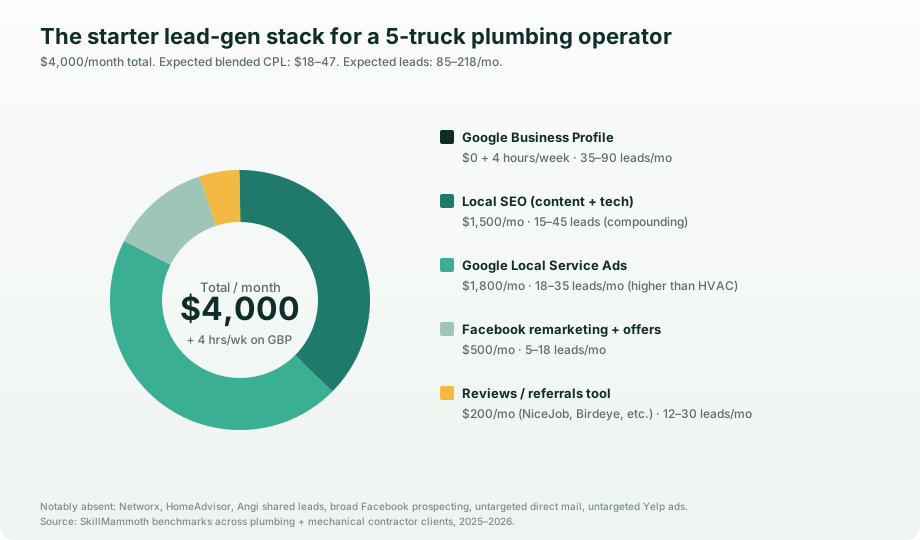 Caption: Where the $4,000/mo plumber starter stack goes. LSAs get a bigger slice than in the HVAC equivalent because plumber LSA pricing skews higher.
| Channel | Monthly spend | Expected leads/mo |
|---|---|---|
| GBP optimization (one-time + maintenance) | $0 + 4 hrs/week | 35–90 leads |
| Local SEO (content + tech) | $1,500/mo | 15–45 leads (compounding) |
| Google Local Service Ads | $1,800/mo | 18–35 leads |
| Reviews / referrals system | $200/mo (NiceJob/Birdeye) | 12–30 leads |
| Facebook remarketing + water-heater offer | $500/mo | 5–18 leads |
| Total | ~$4,000/mo | 85–218 leads/mo |
That math gets you to a blended CPL of $18–47, against an average plumbing ticket of $300–800 for service calls or $1,800–12,000 for installs/repipes. Even at the high end of CPL and the low end of ticket value, the unit economics work.
Notably absent from this stack: Networx, HomeAdvisor, Angi shared leads, broad Facebook prospecting, untargeted direct mail, untargeted Yelp ads. These are the channels we've seen burn the most plumbing marketing budgets.
What to do this week
- Audit your Google Business Profile against the checklist in section 1 above. Most plumbers find 5+ things to fix in 30 minutes.
- Make sure your website has at least one city page per service area. If you don't know whether you do, grab the free new website checklist, covers the audit.
- Set up Google LSAs if you haven't. ~2-hour setup. Optimize the profile fully, the difference between a lazy LSA setup and a tight one is 30–40% on CPL.
- Start a "review at point of payment" SOP for techs.
- Cancel any Networx / HomeAdvisor subscriptions you're paying for unless you can prove a 30%+ close rate from them. (Most plumbers can't.)
If your website is the bottleneck (it usually is), see the Plumber Website Design anchor for what to fix, or look at how we did it for Brico Mechanical (3.2× lift in form-fill leads, 41% drop in bounce rate in 90 days).
Or if you want to skip the DIY and have us run the lead-gen stack for your plumbing business, book a 30-min strategy call, we'll quote your project on the call.
FAQ
What's a normal cost-per-lead for plumbers?
Blended CPL across a healthy mix of channels: $15–55 for service calls, $50–150 for install leads. If your overall CPL is over $80, you're either in an expensive market or your channel mix is broken.
How long until SEO actually produces plumbing leads?
For a brand-new plumber site: 3–6 months for the first organic leads from city pages, 6–12 months before SEO becomes a top-3 channel. GBP can produce leads in under 2 weeks. PPC and LSAs can produce leads in 24 hours. SEO is the long compounding play, start day 1, but pair with paid for the first 6 months.
Are HomeAdvisor / Angi worth it for plumbers?
For most established operators: no. Especially bad for plumbers because emergency callers don't shop, by the time a shared lead reaches you, the customer has already booked someone else. Conversion rates are 4–8% vs 30–45% from organic. The "low CPL" headline number is misleading once you do the math.
Exception: brand new plumbers with zero pipeline who need ANY leads to start building review velocity.
Should I do Google Ads or Local Service Ads first?
LSAs first. Higher intent, capped pricing, sit above traditional ads in the SERP. Once LSAs are saturated in your market, layer on Google search ads for additional volume.
How do I sell maintenance plans?
Plumbing maintenance plans are harder to sell than HVAC plans (people don't think about plumbing until something breaks). The plays that work:
- Bundle with install jobs ("$30/mo maintenance club waived for the first year if you book the water heater install")
- Email sequences to past customers offering annual drain inspection at a discount
- Membership perks the customer can't get otherwise (priority dispatch, no service-call fee, 10% off repairs)
Expect 8–15% take-rate on install jobs, lower on cold outreach.
What about water-damage / insurance-claim leads?
Real opportunity. Build a relationship with 2–3 water mitigation companies in your area. They get the call when water damage happens; they refer the plumbing repair to you in exchange for the same when they need it. Insurance jobs pay full retail, no negotiation. Worth the relationship investment.
What about TikTok or YouTube for plumbers?
Tiny niche of plumbers crushing it on TikTok / YouTube (think: dramatic before/after, "this is what a clogged sewer line looks like" content). For most operators it's a distraction from the boring channels that actually work. If you have a tech who's a natural on camera and wants to do it, sure. Otherwise skip.
When should I hire an agency vs do this myself?
DIY works for the first $5K/month of lead-gen spend. Above that, the opportunity cost of your time + the technical depth required (LSA bid management, SEO content velocity, GBP optimization at scale) usually means an agency or in-house specialist pays back. We'd argue the first agency hire should be for SEO + website + GBP, the compounding work that's hardest to undo if done badly.
How do plumbers compete with the big franchises (Roto-Rooter, Mr. Rooter, etc.)?
Local SEO and local trust signals. The franchises spend big on national branding but their local sites are usually mediocre, they treat each metro as a generic template. A well-built independent plumber site with deep service-area pages and 200+ Google reviews regularly out-ranks franchise sites in the local pack. The franchises have brand recognition; you have local ownership and faster response time. Lean into both.
What's the biggest mistake plumbing contractors make with lead gen?
Buying leads from shared-lead platforms before optimizing GBP and building a real website. The free + compounding channels (GBP, SEO, reviews) outperform the paid + diminishing channels (Networx, HomeAdvisor) by 5–10× over 24 months. Do those first.
Last updated: August 2026. Author: Alex Storey, Co-Founder at SkillMammoth. SkillMammoth builds custom websites, local SEO systems, and lead-generation automations for plumbing and mechanical contractors. See our Plumbing & mechanical practice, or grab a free website audit.
Where LSAs fit
Emergency plumbing intent is the ideal fit for LSA management for plumbers. The Google Verified badge shortcuts the trust decision at the exact moment a homeowner is calling multiple plumbers in a row, and pay-per-lead pricing keeps you out of click-bidding wars with the big brands.
Related reading: our plumber SEO playbook is the ranking strategy behind these lead tactics. If you are pricing against shared lead resellers, see SkillMammoth vs Angi Leads.
Want to implement these strategies?
Book a free strategy call and learn how we can help grow your contractor business.
Book a Free Strategy Call