
TL;DR
Plumber SEO is the combination of local pack dominance, organic service-line rankings, and AI search visibility, wrapped around one dynamic that no other trade shares at the same intensity: emergency intent. The most valuable plumbing queries are urgent, answered-first-wins searches where the person on the other end of the phone will book whoever picks up in the next three minutes. That makes local pack position the business, not a nice-to-have.
What matters most in 2026: a Google Business Profile that reads as an actual 24/7 emergency operation, 100+ reviews with fresh weekly velocity, a service-line page architecture that maps to real intent (emergency vs planned, low-AOV vs high-AOV), click-to-call above the fold on every page, an after-hours capture layer so ranking traffic does not evaporate into voicemail, and answer-first content that gets cited by ChatGPT, Perplexity, and Google AI Overviews.
Honest timeline: small metros (under 250k population) can reach the top three of the local pack in 3 to 6 months. Mid metros take 6 to 9 months. Major metros like Houston, Phoenix, Dallas, Atlanta, and Chicago take 9 to 15 months of disciplined execution. Anyone quoting you two weeks is quoting you paid ads and calling them SEO.
If you want this run for you, our Local SEO service and AI Search Optimization ship the whole plumbing stack together. Start with the $1,000 AI Visibility Audit (credited toward your first month) or book a strategy call. If you are more of a self-serve reader, the sibling pieces in this cluster are our HVAC, roofing, electrician, and landscaping SEO playbooks, all sitting under the broader contractor SEO guide hub.
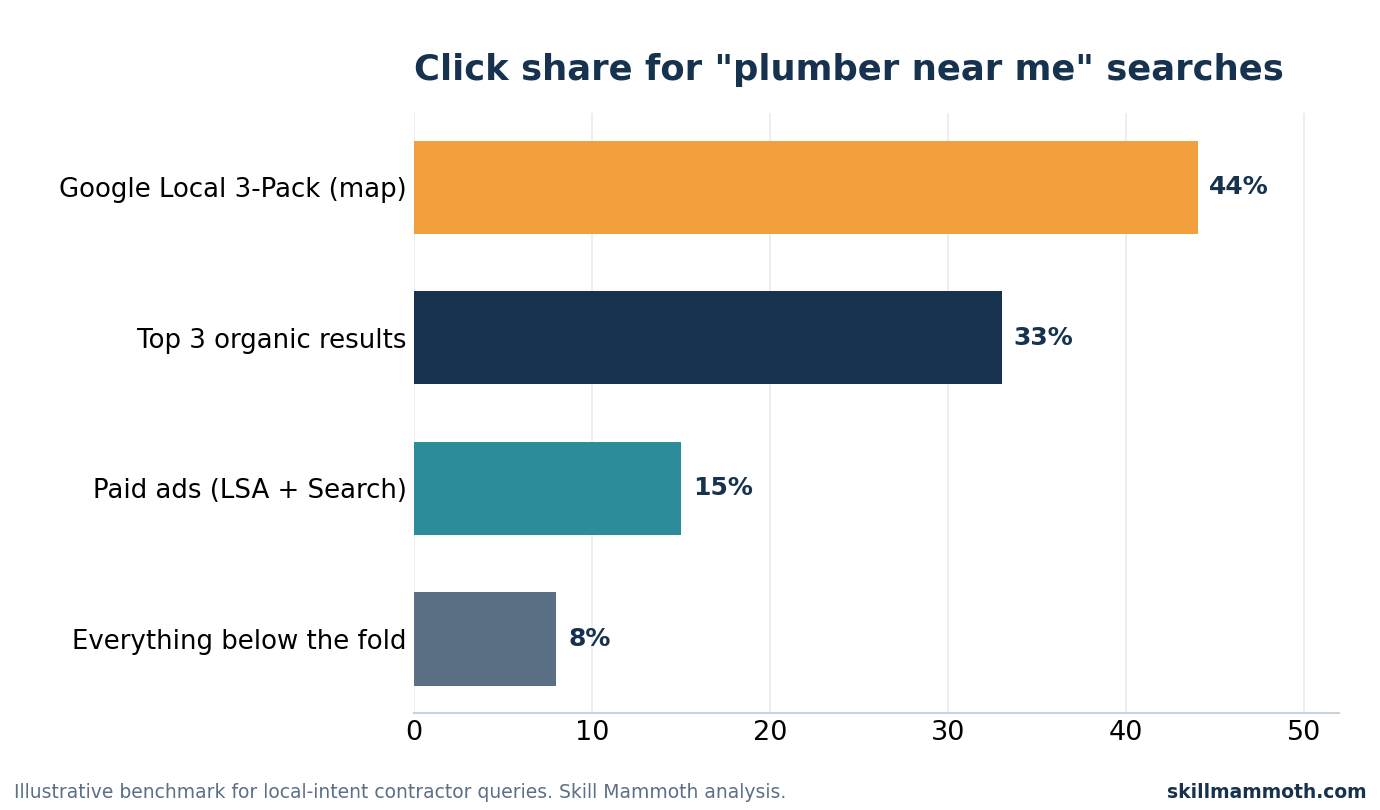
Here is how the search results actually break down for a local plumbing query, and why the map pack matters so much.
Why plumber SEO is different from generic SEO
Plumbing search behavior does not look like other trades. Three dynamics change how you should invest time, content, and budget.
Emergency-intent dominance. A homeowner typing "burst pipe repair" or "plumber near me" at 11pm is not researching. They are already dialing. The top three results in the Google local pack collectively capture the vast majority of those clicks, and the person who answers the phone within one ring converts at 65 to 85 percent. This is a rate that no other paid or organic channel comes close to matching. It also means rank position four is functionally invisible for emergency queries, because the caller has already booked someone by the time they scroll. Local pack position, for plumbers, IS the business.
Service-line economics vary by an order of magnitude. A drain cleaning ranking is worth roughly $175 to $450 per job. A water heater repair ranking is worth $350 to $900. A tankless conversion ranking is worth $4,500 to $8,000. A full repipe ranking is worth $6,000 to $15,000. A sewer line replacement ranking is worth $4,000 to $20,000. Same trade, same domain, ten to fifty times the revenue per lead across service lines. That makes keyword prioritization a profit strategy, not just a traffic exercise, and it means the highest-value pages on your site are often the ones with the lowest search volume.
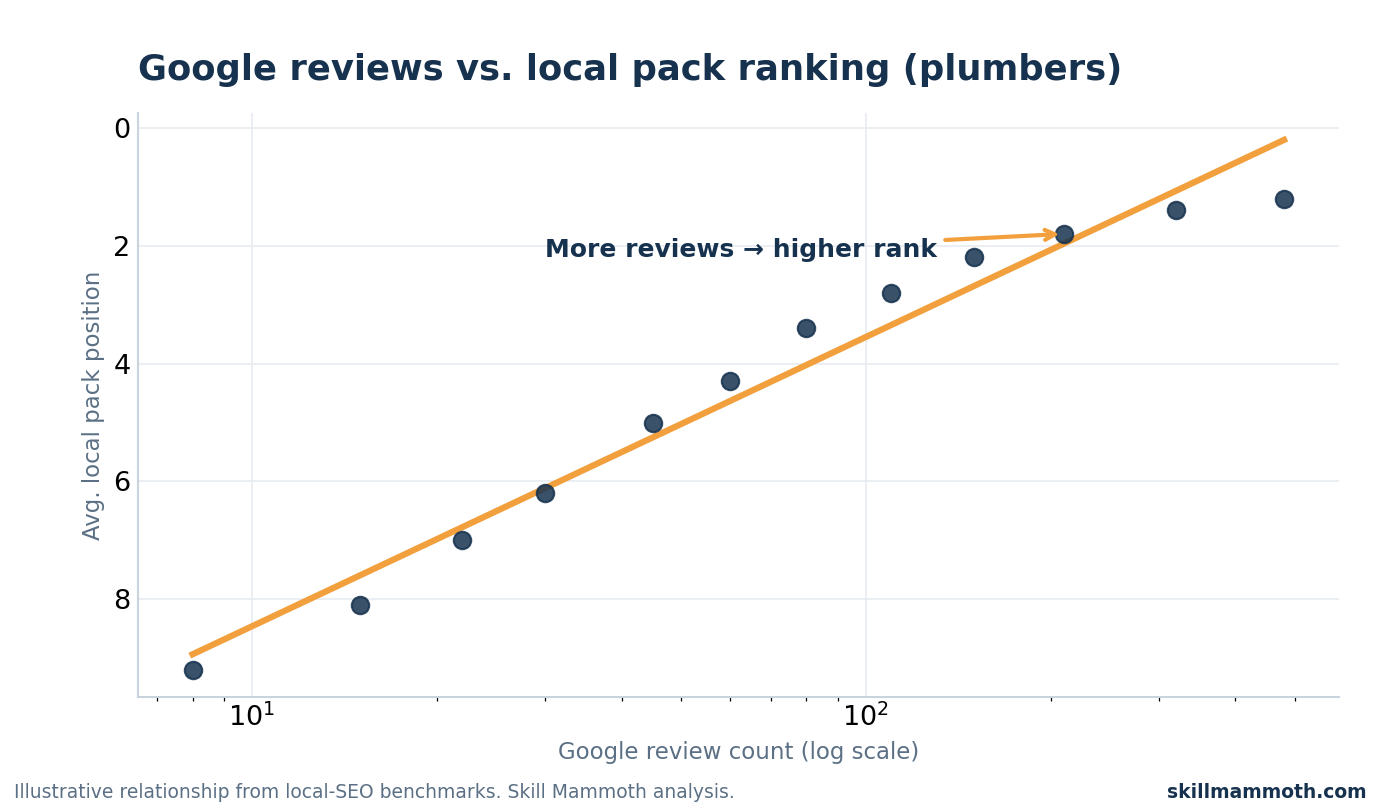
Trust burden is heavier than most trades. Plumbing is licensed, insured, in-home, and priced by the emergency. Homeowners have been burned before and they know it. Every ranking you earn gets filtered through review count, star rating, license badge, and photo evidence before the click converts. Plumbers with 15 reviews get out-clicked by plumbers with 150, even when the 15-review plumber ranks higher, because the pack listing itself sells the click. See how this connects to broader lead flow in our piece on lead generation for plumbers.
None of this shows up in a generic SEO checklist. The rest of this playbook is written for the plumbing-specific version of the game.
The 6 pillars of plumber SEO in 2026
The plumbing SEO stack is six systems working as one. Miss any pillar and the others carry a compounding penalty. Get all six right and rankings become an asset that keeps producing at a falling cost per lead year over year.
1. Google Business Profile
The most important single asset for a plumber. Not the website, not the blog. The GBP. Complete every field, verify service area coverage for every zip you actually serve, and select every relevant service category as a separate service (Drain Cleaning, Water Heater Repair, Water Heater Installation, Sewer Repair, Leak Detection, Emergency Plumbing, Faucet Installation, Toilet Repair, Repiping, Sump Pump Repair, Gas Line Repair, and so on). Each category is a separate ranking surface. Turn on the emergency service attribute and make sure your 24/7 hours are set accurately, because Google filters emergency queries against operating hours in real time.
Upload at least 40 photos with a heavy weight toward before-and-after shots of real jobs: unclogged mainlines, replaced water heaters, repiped basements, and installed fixtures. Post a new GBP update at least weekly. Seed the Q&A section yourself with 15 real emergency questions ("Do you handle burst pipes at 2am?", "How fast can you get to a flooded basement?", "Do you charge for after-hours calls?") so you control the answers instead of leaving that surface to competitors and random users.
2. Review velocity
The moat. Under 25 Google reviews and you are invisible in a competitive metro. 50 to 100 puts you in the conversation. 150+ signals market leader and unlocks the top of the local pack. But the number is only half the game. Freshness matters more than most plumbers realize. Ten reviews in the last 30 days will outrank 200 stale reviews from three years ago in most ranking scenarios.
Emergency plumbing is the single best trade for review velocity because emergency customers are grateful customers. Someone whose flooded basement you saved at 1am wants to leave a five-star review. Send the ask by text within two hours of job completion and follow up at day three. Full system in our guide to 100 Google reviews for contractors.
3. Website architecture
Every service line gets its own dedicated page. Not a bullet on a services page. Not a paragraph. A full 800 to 1,500 word page with its own H1, its own schema, and its own click-to-call CTA. Emergency Plumbing, Drain Cleaning, Water Heater Repair, Water Heater Installation, Sewer Line Repair, Sewer Camera Inspection, Repiping, Leak Detection, Sump Pumps, Gas Line, Fixture Installation. Split water heater repair and water heater installation into separate pages because they are two different search intents (a repair search converts in hours, an installation search converts in weeks with cost-comparison behavior). Same for drain cleaning versus sewer line replacement.
City pages with real local content (neighborhood names, city-specific climate notes like freeze risk or hard water, local building code quirks, local testimonials) still rank strongly. Duplicated template city pages with the city name swapped in get treated as doorway pages and either fail to rank or get de-indexed entirely. Click-to-call above the fold on every page, always. See the full conversion architecture in our plumber website design guide, or work with our team through the plumbing marketing consultant engagement.
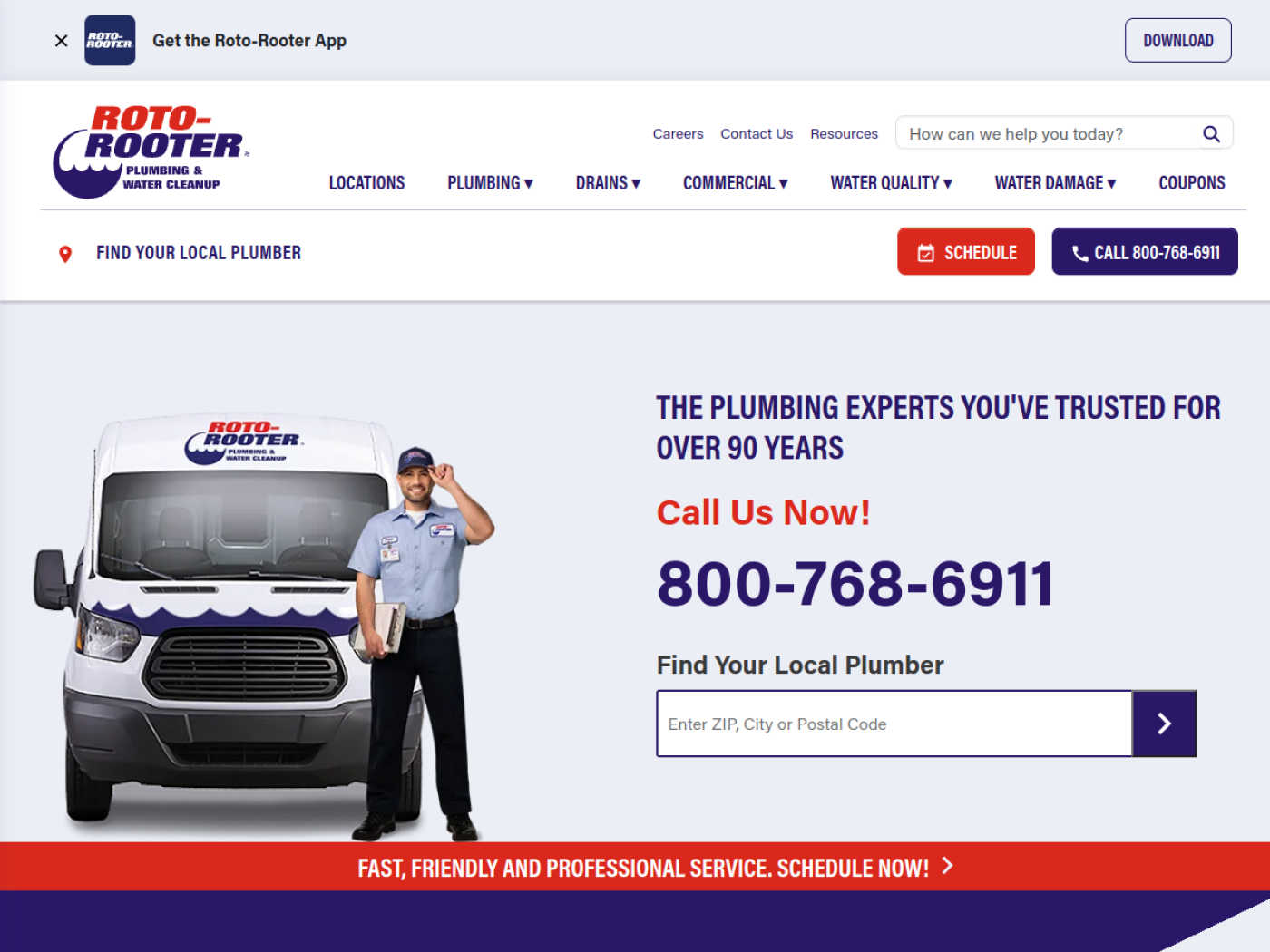
Here is what a strong, focused plumbing homepage looks like. Notice how fast it makes the "call now" and "schedule" actions, and how clearly it states the service and area.
4. Emergency-query SEO (the plumbing pillar)
This is what makes plumber SEO different from every other trade. Ranking for "emergency plumber [city]", "burst pipe repair [city]", "24 hour plumber [city]", and "flooded basement [city]" is not a nice bonus. It is the entire game for a huge chunk of your revenue. These queries convert at 65 to 85 percent when you actually pick up. They convert at zero when you don't.
Everything on-page has to signal that you are a real 24/7 operation, not a plumber with a website that pretends to be one. That means a visible phone number in the header on every device, "Call now" as the primary CTA (not "Get a quote"), an emergency service badge, response-time proof ("Average arrival time 47 minutes"), and dedicated emergency landing pages that skip the marketing fluff and get straight to the phone number.
The infrastructure behind the ranking matters as much as the ranking. If you rank for "emergency plumber Denver" and your ring goes to voicemail after hours, you have paid the ranking cost and captured zero of the revenue. Deploy an AI receptionist for after-hours triage so no ranked call ever hits voicemail. Details in our AI automation consulting service. This is the single highest-ROI infrastructure investment a plumber can pair with SEO.
5. High-AOV service-line strategy
The unglamorous secret of plumber SEO: the biggest wins are hiding in the low-volume, high-AOV keywords that most plumbers ignore because the search volume looks unimpressive. "Sewer camera inspection [city]" might get 60 searches a month. Two closed jobs from that ranking is $12,000 to $18,000 in revenue. "Tankless water heater installation cost" might get 90 searches a month locally and one signed install is $4,500. "Whole house repipe cost" is the same story at a bigger number.
Content lanes that pay: a sewer camera inspection guide with clear pricing and what the video actually shows, a tankless conversion guide comparing traditional versus tankless total cost of ownership, a repipe cost guide broken out by home size and material (PEX vs copper vs CPVC), and a water heater sizing guide with a decision tree. Each of these ranks with lower competition than head terms and captures buyers who are already deep in the funnel. Detailed lead economics in our getting more plumbing leads piece.
6. AI search visibility
Half of a plumber's future ranking work is winning citations in ChatGPT, Perplexity, Claude, and Google AI Overviews. Homeowners increasingly ask "who is the best plumber in [city]" and "should I repair or replace my water heater" to an LLM before they ever open Google. AI systems synthesize an answer from a small set of cited sources. Being one of those sources is the new page-one ranking.
The tactics: answer-first structure at the top of every service-line page (the direct answer in the first 40 words, then the supporting detail), Schema.org markup for LocalBusiness, Service, and FAQPage on every page, clear pricing ranges instead of "call for quote", and content that names its sources, competitors, and trade-offs honestly (LLMs cite sources that read like sources, not sources that read like ad copy). Full framework in our getting ChatGPT to recommend your business guide, or ship it done-for-you with our AI Search Optimization service.
Plumbers usually start by buying leads from Angi or HomeAdvisor, or running Local Service Ads. Those have their place for filling gaps, but the economics get worse the more you rely on them, because you pay again for every single lead and you share them with competitors.
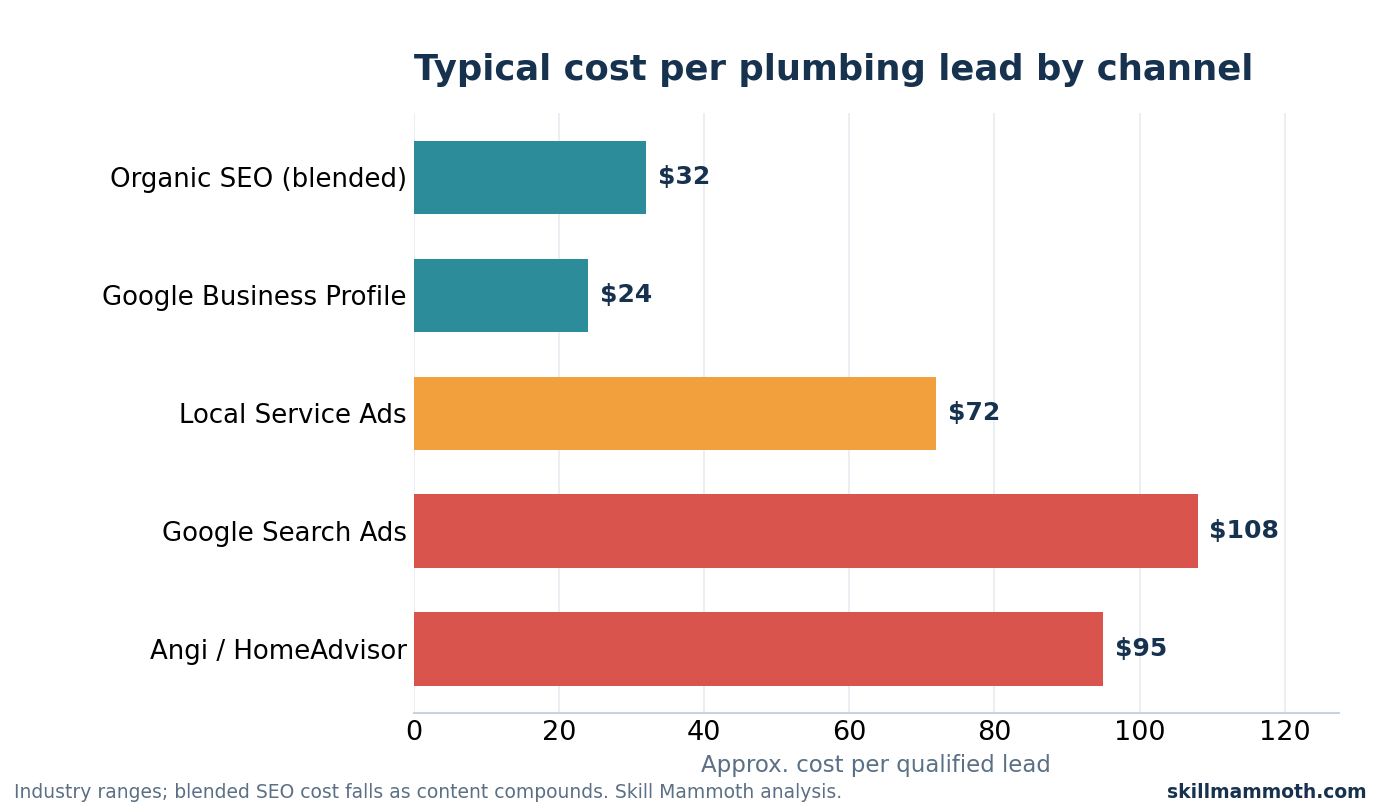
Organic search and your Google Business Profile carry the lowest cost per lead, and that cost keeps falling as your content and reviews compound. Shared-lead platforms and paid search sit at the high end, and they reset to zero the day you stop paying. The smart play is to use paid channels to stay busy now while you build the SEO engine that lowers your cost per job for years. For the tactical list that sits alongside this strategy, see 18 plumber marketing ideas.
Plumber SEO benchmarks
How to tell where your program actually is. These are the numbers we see across the plumbing accounts we audit and manage.
| Metric | Struggling | Average | Winning |
|---|---|---|---|
| Google reviews (count) | Under 20 | Around 50 | 150+ |
| Review velocity (per month) | 0 to 2 | 4 to 8 | 12+ |
| Local pack position (core terms) | Unranked | Positions 4 to 10 | Top 3 |
| Indexed ranking pages | Under 10 | Around 30 | 100+ |
| Monthly organic leads | Under 5 | 15 to 25 | 60+ |
| Emergency queries in top 3 | 0 | 1 to 2 | 5+ |
| AI Overview citations | None | Occasional | Consistent for brand + service queries |
If you are struggling on three or more rows, the sequencing in the next section is what closes the gap.
The 90-day plumber SEO sprint
What we deploy in the first quarter of a plumbing engagement, in order. This is not the full multi-year build. It is the foundation that makes everything after it work.
Days 1 to 14: Audit and foundation
Run a technical audit: indexation, redirects, broken links, schema markup, Core Web Vitals. Run a full GBP audit and overhaul: fill every field, add every relevant plumbing service as a distinct category, upload 40+ before-and-after photos, seed 15 Q&A pairs, respond to every past review (positive and negative). Set the 24/7 emergency service attribute correctly. Deploy LocalBusiness, Service, and FAQPage schema across the site. Fix the top five Core Web Vitals wins. Install click-to-call in the site header. Run a free SEO audit to get an outside baseline.
Days 15 to 45: Service-line pages and review engine
Build dedicated pages for emergency plumbing, drain cleaning, water heater repair, water heater installation, sewer line repair, sewer camera inspection, leak detection, repiping, and gas line service. Each page 800 to 1,500 words with schema, click-to-call, and clear pricing ranges. Launch the review acquisition system: text review request within two hours of job completion, email follow-up at day three, second follow-up at day seven. Publish the first three high-AOV content pieces (a sewer camera inspection guide, a tankless conversion cost guide, a repipe cost breakdown). If you serve commercial accounts, build a dedicated commercial plumbing page (different intent, different sales cycle).
Days 46 to 90: City pages, high-AOV lanes, citations, AI visibility
Build city pages for the top 5 to 10 markets with real local content (neighborhood names, freeze risk notes, hard-water notes, local testimonials). Run a full citation NAP cleanup across Google, Bing, Apple Maps, Yelp, Angi, BBB, Nextdoor, Facebook, and plumbing-specific directories (HomeAdvisor, Thumbtack, and plumbing supply house locators). Publish four more content pieces targeting high-AOV keywords. Deploy answer-first structure across every service-line page. Start monthly AI visibility monitoring in ChatGPT, Perplexity, and Google AI Overviews. If it is a market with freeze risk, publish a burst-pipe prevention and response library so it is indexed before the first cold snap hits.
DIY vs hiring it out
Honest split. What a plumber can genuinely DIY: GBP optimization, weekly GBP posts, review requests, basic citation cleanup, and neighbor-canvass review asks after big jobs. What most plumbers stall on: the service-line page content set (nine to twelve pages of 1,000+ words each is a real content project), technical SEO, schema deployment, high-AOV content lanes, off-page work, and AI visibility monitoring. If you have a spare 10 hours a week and you actually enjoy this, DIY the first three months of the pillar list above and see how far you get.
If you would rather ship it done-for-you, our SEO + AI Search plans are Local $750/mo, Authority $1,500/mo, and Pro $3,000/mo. A one-time $1,000 AI Visibility Audit credits toward your first month. Optional add-ons AI Reporting (+$500/mo) and Off-Page AI Optimization (+$1,000/mo) require an active plan. Full breakdown on our pricing page or the plumbing marketing consultant service. Worth naming: plumbing is our strongest existing content vertical, so we run this playbook on our own domain and on the majority of the plumbing accounts we manage. You are hiring the team that eats its own cooking.
FAQ
What is plumber SEO?
Plumber SEO is the practice of ranking a plumbing company's Google Business Profile, service-line pages, and city pages for the search queries homeowners actually type when they need a plumber. In 2026 it also includes AI search visibility (GEO) because homeowners now ask ChatGPT, Perplexity, and Google AI Overviews for plumber recommendations before they ever open a search engine. What makes it different from generic SEO is the emergency-intent dynamic: the highest-value plumbing queries are urgent, answered-first-wins searches where the local pack position is the business.
How long does plumber SEO take?
Small metros (under 250k population) can hit top three in the local pack in 3 to 6 months. Mid metros take 6 to 9 months. Major metros like Houston, Phoenix, Dallas, Atlanta, and Chicago take 9 to 15 months of disciplined work. High-AOV queries like "sewer line replacement [city]" or "repipe [city]" often rank faster than the head terms because the competition is thinner. Anyone quoting you two weeks is quoting you paid ads and calling them SEO.
How much does plumber SEO cost?
Integrated SEO + AI Search plans run $750/mo (Local), $1,500/mo (Authority), and $3,000/mo (Pro). A one-time $1,000 AI Visibility Audit credits toward your first month. Optional add-ons AI Reporting (+$500/mo) and Off-Page AI Optimization (+$1,000/mo) require an active plan. DIY costs mostly time (10 to 15 hours per week for the first quarter) and tooling (a rank tracker plus citation service runs $50 to $200 per month).
What is emergency plumbing SEO?
Ranking specifically for urgent, high-intent queries like "emergency plumber [city]", "burst pipe repair", "24 hour plumber", "flooded basement", and "water heater leaking". These queries convert at 65 to 85 percent when you actually answer the phone, which is roughly ten times the conversion rate of most organic traffic. Winning them requires local pack top three, a phone number in the header on every device, real 24/7 operations messaging, and an after-hours capture layer (AI receptionist or answering service) so the ranked call does not evaporate into voicemail.
Which plumbing keywords are most profitable?
The counterintuitive answer: low-volume high-AOV keywords beat head terms on revenue. "Sewer camera inspection [city]" at 60 searches per month with two closed jobs is $12,000 to $18,000. "Tankless water heater installation cost" at 90 searches locally with one signed install is $4,500. "Whole house repipe cost" and "sewer line replacement cost" pay similarly. Head terms like "plumber [city]" have huge volume but the competition is fierce and the closed job might be a $200 drain cleaning. Prioritize by profit per ranking, not by search volume.
Do city pages still work for plumbers?
Yes, when built right. Real local content (neighborhood names, city-specific climate notes like freeze risk or hard water, local building code quirks, local testimonials, and photos from actual jobs in that city) still ranks strongly. Duplicated template pages with just the city name swapped in get treated as doorway pages and either fail to rank or get de-indexed entirely. Rule of thumb: if a page could be about any city just by find-and-replace, it will not rank.
How do reviews affect plumber rankings?
Heavily. Under 25 reviews is invisible in a competitive metro. 50 to 100 is competitive. 150+ signals market leader. Freshness matters more than most plumbers realize: ten reviews in the last 30 days will out-perform 200 stale reviews from three years ago in many ranking scenarios. Emergency plumbing has the best review-velocity dynamic of any home service trade because emergency customers are grateful customers. Full system in our 100 Google reviews guide.
Plumber SEO vs LSAs vs Angi Leads: which first?
LSAs first, because they produce leads within days and the Google Verified badge lifts close rates by 20 to 40 percent. SEO in parallel because it takes months to move but produces leads at a falling cost per lead over years. Angi Leads should generally not be the primary channel because you compete against three to five other plumbers on every lead you buy. Full LSA math in our Local Service Ads cost guide and our Skill Mammoth vs Angi Leads comparison. Google Verified background is in Google Verified for contractors.
Can I DIY plumber SEO?
Yes for GBP optimization, review velocity, weekly GBP posts, basic citation cleanup, and neighbor-canvass review asks. Most operators stall on the service-line page content set, high-AOV content lanes, technical SEO, off-page work, and AI visibility. A pragmatic split: DIY the GBP and review engine yourself (they are the highest-leverage parts anyway), and hire out the content and technical layers where you would otherwise plateau.
How do I pick a plumber SEO company?
Look for plumbing-specific case studies with real numbers (not vanity metrics), transparent pricing published on the site (not "contact us for a quote"), no long-term lock-ins, and an owner or senior consultant you actually talk to instead of a rotating account manager pool. Ask them how they handle emergency-query pages, high-AOV content lanes, and AI Overview visibility specifically. If they answer with generic SEO talking points, they do not understand plumbing. Full breakdown in our best plumber marketing agencies guide, and the SEO-specialist shortlist with pricing is in best plumbing SEO companies.
Where to go next
If you want us to ship this stack for your plumbing company, start with the free SEO audit or book a strategy call. For related reading, see our Local SEO service, AI Search Optimization, Local Service Ads management, web design, plumber website design, how to get more plumbing leads, lead generation for plumbers, the LSA cost calculator, and the SEO ROI Calculator. The other spokes of this cluster are the HVAC SEO playbook and the roofing SEO playbook. If you serve the plumbing trade at scale, see the plumbing industry page.
Want to implement these strategies?
Book a free strategy call and learn how we can help grow your contractor business.
Book a Free Strategy Call