TL;DR
SEO for contractors in 2026 is not a single tactic and it is not a checklist you finish. It is the combination of local pack dominance, organic service and city page rankings, and AI search visibility, run as one system across your Google Business Profile, your website, and your review engine. The six universal pillars are the same for every trade: GBP optimization, review velocity, website architecture, service and city pages, schema and technical health, and AI visibility. What changes by trade is the execution: plumbers live and die on emergency intent, roofers ride storm events, HVAC breathes with seasonality, electricians own the EV charger lane, and lawn care operates on a spring buying window. This guide is the hub. It covers the universal contractor SEO system, then hands you off to the trade-specific playbooks that go deep on each one. If you build rather than service, skip ahead to construction SEO for general contractors, where the buyer and the sales cycle are different enough to change the plan.
If you want the whole stack run for you, our Local SEO service and AI Search Optimization ship together as one engagement. Start with the $1,000 AI Visibility Audit, credited toward your first month, or book a strategy call. If you want to size the ROI first, run your numbers through the SEO ROI calculator or the contractor funnel calculator. Two trades with no Local Services Ads category lean hardest on this plan: the concrete leads guide and the asphalt paving marketing guide apply it job by job.
What is SEO for contractors?
SEO for contractors is the work of making a contracting business the answer when a homeowner searches for the trade: ranking in the local map pack, ranking service and city pages organically, and being cited when AI tools like ChatGPT and Google's AI Overviews recommend companies. It differs from generic SEO because the buyer is local, the intent is often urgent, and the map pack takes most of the clicks, so proximity signals, review velocity and Google Business Profile work matter as much as the website itself.
Why SEO is the highest-ROI channel for contractors
Every home service owner eventually asks the same question: where should the next marketing dollar go? Google Ads, Local Service Ads, Angi, Facebook, SEO, direct mail, door hangers, referral programs. The honest answer is that they all work in a specific situation, but only one of them compounds. Every other channel is rent. The day you stop paying, the leads stop the next day. SEO is the only channel where the asset you built last quarter is still producing leads next year and the year after that.
That is the core argument for contractor SEO. It is not that SEO is cheaper per lead in month one, because it usually is not. It is that the cost per lead falls every month while the asset appreciates. A city page that ranked at position eight in month four is at position two by month twelve and still ranking at position two three years later, at zero incremental cost. Compare that to Angi Leads, where the same three-star review can raise your cost per lead 40 percent overnight and every lead is shared with three or four other contractors. See our full breakdown in marketing attribution for home service contractors.
The second reason contractor SEO wins is that the search results page has changed in a way that favors trade-specific operators over generalists. For a query like "AC repair near me" or "emergency plumber" or "roofer for hail damage", Google now shows the Local Services Ads block first, then the Google Business Profile local three-pack, then classic organic. Between LSAs and the pack, more than 60 percent of clicks are gone before the first blue link appears above the fold on mobile. That block belongs to whoever earned it, and it cannot be bought without both a Google Verified badge and enough reviews to keep the LSA bidding engine happy. In practice, this means the local pack plus the LSA block are the game, and both are earned through the same underlying signals: reviews, proximity, relevance, and trust. See the Google Verified guide for how the badge fits in.
Third and most under-discussed: SEO is the only channel where the customer is already sold on hiring. A person searching "water heater replacement near me" is not comparing you to a Facebook ad for solar panels. They are choosing between three contractors on the local pack. Close rates on inbound SEO leads run 30 to 55 percent for most home service trades, compared to 8 to 18 percent for cold outbound and 12 to 22 percent for paid social. That is why the CPAC (cost per acquired customer) math on SEO looks so different from the CPL comparison, and why a $150 SEO lead often beats a $60 Facebook lead on booked revenue.
Now the honest part. SEO is slow. In a small metro you can see meaningful traction in 90 days, but real local pack dominance in a competitive market takes 9 to 15 months of disciplined execution. Anyone promising two weeks is selling you paid ads and calling them SEO. Anyone selling backlink packages by the hundred is running a 2014 playbook that has been penalized since 2019. Real contractor SEO in 2026 is boring and repeatable: GBP hygiene, weekly reviews, service pages, city pages, schema, answer-first content, and monitoring what ChatGPT and Perplexity say about you when someone asks for a contractor in your city.
Why one reported ranking tells you almost nothing
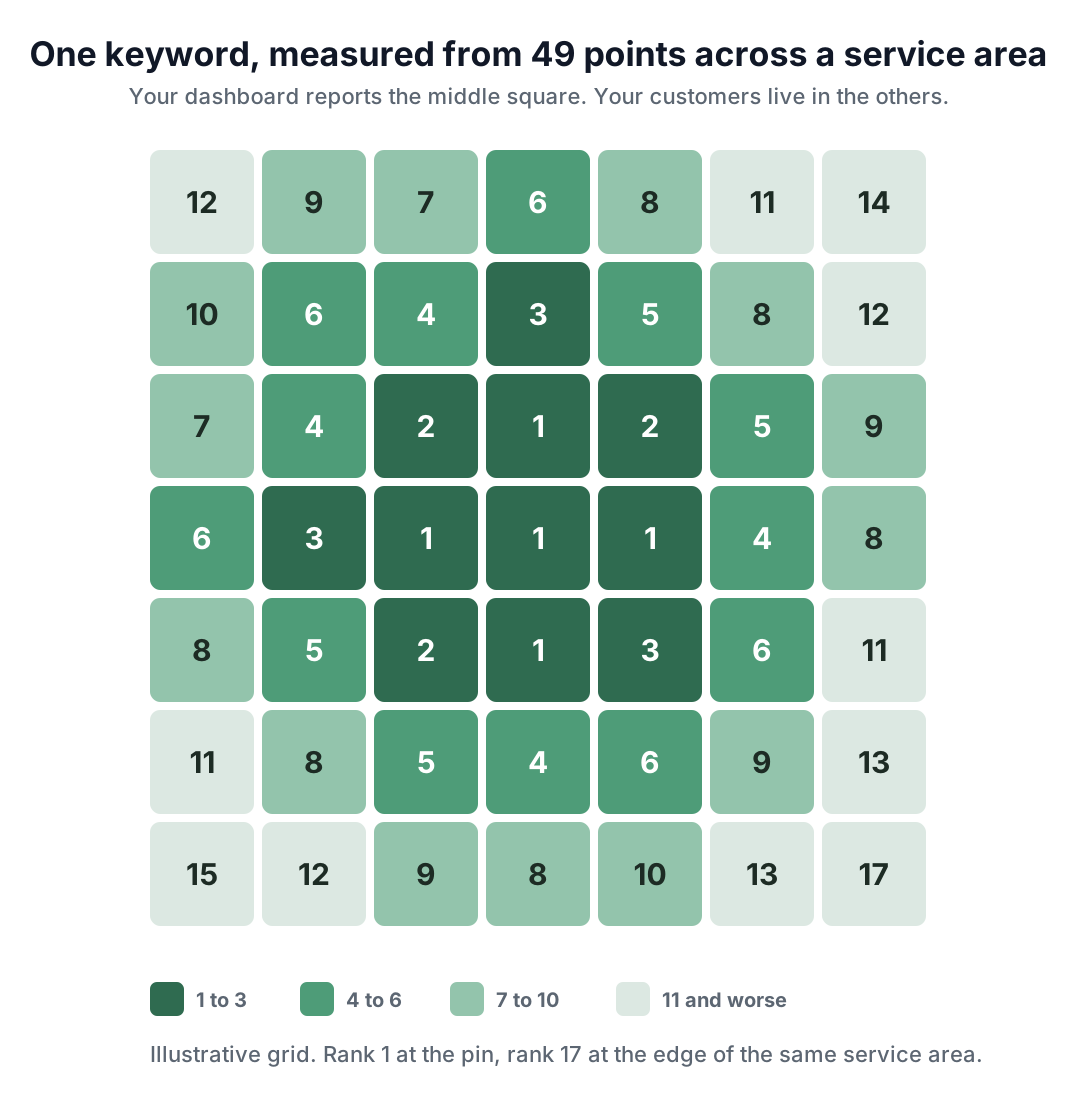
Before the pillars, the measurement problem. Ranking is not one number. It varies across your service area, and the position most dashboards report is measured at your own address, which is the most flattering point on the map.
Local SEO for contractors: the service-area version
Most contractor SEO advice is written for a business with a storefront. A contractor is a service-area business: the crew drives to the customer, the address is often a home or a yard, and Google treats that differently. Local SEO for contractors is the map-pack half of the discipline, and it runs on four inputs that a storefront business barely thinks about.
Proximity to the searcher, not to your address
A service-area business can hide its address and set a service area, and Google still ranks it by distance from where the searcher is standing. That is why a plumber who ranks first at the shop ranks seventeenth twelve miles away, and why the grid in the previous section is the only honest measurement. The fix is city pages with real local content, reviews that name the suburb, plus photos with location context, so Google has evidence you work where you say you do.
The primary category and the service list
"Plumber" as a primary category with "Water heater repair service" and "Drainage service" as secondaries outranks a profile filed under "Contractor" with nothing else, for every query in the trade. Most profiles we audit have the wrong primary or are missing four to six secondaries that exist as Google categories.
Review count, rating, and recency together
The competitive floor in a typical metro is 50 reviews at 4.7 stars, and the winning tier is 150 to 300 with weekly velocity. Ten reviews in the last 30 days often beat 200 reviews from three years ago. For a contractor this is a post-job text, sent within two hours, with a follow-up on day three and day seven.
Citation consistency
Name, address and phone must match across Google, Bing, Apple Maps, Yelp, Angi, BBB, Nextdoor, Facebook and the trade directories. A suite number on one listing and not another, or an old tracking number on Yelp, is enough to suppress a profile that is otherwise strong. This is boring work and it is the first thing we fix on a new engagement.
Two things make the local layer more urgent in 2026 than it was two years ago. Local Service Ads sit above the map pack and draw from the same review and trust signals, so the work compounds across both. And when a homeowner asks ChatGPT or Google's AI Overview for a contractor in their suburb, the answer is assembled largely from the same profile, review and citation data. Local SEO for contractors is now the input to three surfaces at once. If you want it run for you, that is the home services SEO service, and the measurement layer is described in map grid ranking.
The 6 universal pillars of SEO for contractors
Every trade shares the same six pillars. What changes by trade is which pillar carries more weight and how the content has to be written. Below is the universal version. The spoke playbooks in the next section go deep on the trade-specific angles.
1. Google Business Profile optimization
GBP is the single highest-leverage asset a contractor can own. It is free, it is the first thing a searcher sees, and it decides local pack ranking. A fully optimized GBP has every field completed, every relevant service listed as a distinct sub-category, 40 or more photos including real job site work and team shots, weekly Google Posts, seeded Q and A pairs, correct service area, correct hours including a 24/7 attribute if you take emergency calls, a phone number that rings a human, and a review acquisition system running underneath it. Most contractors get about 60 percent of this right and leave the other 40 percent as free ranking they never claim. See our step by step in how to optimize your Google Business Profile.
2. Review velocity and rating
Reviews are the closest thing to a universal ranking factor in local SEO. Volume matters, rating matters, and freshness matters more than most contractors realize. Ten reviews in the last 30 days will often out-rank 200 reviews from three years ago. The competitive floor in a typical metro is 50 reviews at 4.7 stars. The winning tier is 150 to 300 reviews with weekly velocity. If you are below 25, the local pack treats you as invisible regardless of proximity. Full playbook in how to get 100 Google reviews for contractors.
3. Website architecture
Contractor websites fail SEO for two reasons: they are built as a single homepage plus a contact form, or they are built on a platform that cannot handle the schema and Core Web Vitals modern search demands. The right architecture has a service page for every distinct service line, a city or service area page for every core market, a location page for every physical office, and a blog or resource layer that covers the long-tail informational queries feeding those money pages. Every page needs click to call in the header, schema, fast load, and a clear conversion path. See how much a contractor website should cost and our full web design service.
4. Service and city page strategy
This is where most contractor SEO efforts either compound or stall. Service pages need to map to real intent buckets, not to your internal org chart. A homeowner searching "sewer line replacement cost" is at a completely different stage than one searching "emergency plumber near me" and both are different from "annual plumbing maintenance plan." Each intent needs its own page with its own CTA, its own trust signals, and its own answer structure. City pages are the multiplier on top: same service page structure, localized with neighborhood names, local pricing notes, and real testimonials from that market. Duplicated template city pages with just the city name swapped in get treated as doorway pages and either fail to rank or get de-indexed.
5. Schema and technical
Schema markup tells Google what your content is, not just what words it contains. Every service page needs LocalBusiness plus Service schema. Every FAQ block needs FAQPage schema so it can win rich results. Every review widget should push AggregateRating. Technical SEO covers the boring but non-negotiable: mobile Core Web Vitals in the green, no crawl errors, correct canonical tags, sitemap submitted, robots.txt clean, HTTPS everywhere. This is not glamorous work but it is the difference between a site that ranks and a site that indexes.
6. AI search visibility
The fastest-growing channel in contractor search is not Google, it is ChatGPT, Perplexity, Google AI Overviews, and Gemini. When a homeowner asks ChatGPT "who is the best HVAC company in Austin", the answer comes from a different index than the classic Google SERP. Winning here requires answer-first content structure, factual claims that can be cited, schema that machines can parse, and a monitoring layer that tells you which prompts return your brand and which do not. Strategic overview: GEO vs SEO. Tactical playbook: how to get ChatGPT to recommend your business. Done-for-you: AI Search Optimization service.
Want to know which pillar is holding you back?
The free SEO audit checks your Google Business Profile, review velocity, page structure and schema, then tells you which one to fix first.
Trade-specific playbooks (the spokes)
The six pillars above are universal. The execution changes by trade because search behavior changes by trade. Below is the map to each spoke playbook with a short note on what makes that trade different.
HVAC SEO
HVAC has the sharpest seasonal curve of any home service. Searches for "AC repair" can 5x during a heat wave and vanish two weeks later. Furnace queries spike overnight the first time a cold front rolls through. Content has to be published and aged before the demand spike, not during it. Read the full spoke: HVAC SEO playbook. Industry hub: HVAC marketing. Consultant page: HVAC marketing consultant.
Roofing SEO
Roofing SEO lives on two dynamics no other trade shares at the same intensity: storm events and the insurance vs retail split. A single hail event can 10x local search demand for 30 to 60 days. Roofers who publish storm-event landing pages within 48 hours of a weather event and pair them with insurance-claim content own that surge. Read the full spoke: roofing SEO playbook. Industry hub: roofing and siding marketing.
Plumber SEO
Plumbing search is dominated by emergency intent. The most valuable queries are urgent, answered-first-wins searches where local pack position is the business. High-AOV service lines like repipe, tankless conversion, and sewer replacement are worth 10 to 50x more per lead than a drain cleaning ranking, which changes keyword prioritization entirely. Read the full spoke: plumber SEO playbook. Industry hub: plumbing marketing.
Electrician SEO
Electrician SEO has one of the strongest emerging keyword lanes in home services: EV chargers. Search demand for "EV charger installation [city]" is growing 40 to 60 percent year over year and remains under-competed in most metros. Trust and license signals also carry heavier weight because homeowners are more risk-averse about electrical work than most trades. Read the full spoke: electrician SEO playbook. Industry hub: electrician marketing. Consultant page: electrician marketing consultant. Deeper pieces: electrician marketing ideas and how to get more electrician leads.
Lawn care and landscaping SEO
Lawn care and landscaping has a shorter buying window than any other home service: most annual contracts are won or lost in a six to eight week window in early spring, which compresses the entire SEO calendar. Content that needs to rank in April has to be published and indexed by December or January. Route-density suburb targeting matters more than whole-metro coverage, and image and portfolio SEO carry weight they carry nowhere else. Read the full spoke: landscaping SEO playbook. Industry hub: lawn care and landscaping marketing. Consultant page: lawn care marketing consultant.
Home remodeling SEO
Home remodeling is the outlier in the trade playbook set. Sales cycles are 3 to 12 weeks (not 1 to 3 days), project values run $15,000 to $200,000-plus (so acceptable cost per lead is 5 to 20x higher than emergency-service trades), and buyers are visual: they scroll before-and-after galleries for 20 minutes before ever picking up the phone. That reshapes every pillar. Website architecture leads with the portfolio, not the service list. Reviews carry design and craftsmanship keywords, not "fast response". City page strategy targets "kitchen remodel [city]" and "bathroom renovation [city]" queries where competition is 30 to 50 percent lighter than plumbing or HVAC. Industry hub: home remodeling marketing.
Tree service SEO
Tree care splits into two buyers who need opposite pages: planned removals researched over a week, and storm damage calls that spike for 48 hours and go to whoever already ranks. The service radius is bounded by equipment access rather than drive time, which changes how many town pages are worth building. Full playbook: tree service SEO.
Adjacent trades
The same six-pillar system applies to pest control, restoration, and other home service verticals. The differences are in seasonality, emergency intent, and average job value, but the pillars do not change.
Construction SEO: where general contractors differ
Everything above assumes a homeowner with an urgent problem. Construction SEO is the same discipline pointed at a different buyer, and four things change enough to matter.
The map pack stops being the whole game. A homeowner searching "emergency plumber" picks from the local three-pack in under a minute. A property manager sourcing a commercial GC for a tenant fit-out opens six tabs, reads project galleries, checks bonding and licensing, and shortlists over a week. Proximity still helps, but organic depth and proof carry more weight than they do in home services. If you are a general contractor, your website is doing more of the selling than your Google Business Profile is.
The sales cycle runs 3 to 18 months, not 3 days. That breaks the usual measurement habit. A construction SEO program judged on 90-day lead counts will look like a failure while it is working, because the enquiries it generated in month two close in month eleven. Track qualified enquiries and pipeline value from organic, not closed revenue inside the quarter, or you will kill the channel right before it pays.
Project type beats city as the page unit. Home service SEO builds "[service] [city]" pages because that is how homeowners search. Commercial and residential construction buyers search by project: "tenant improvement contractor", "design build contractor", "metal building contractor", "historic renovation contractor". Build the page set around what you construct first and layer geography second. A page on "design build vs bid build" will out-earn five thin city pages, because it catches buyers while they are still deciding how to procure the job.
Your portfolio is a ranking asset, not a gallery. Most construction sites bury completed projects in a lightbox with no crawlable text. Each significant project deserves its own indexable page with the scope, square footage, timeline, materials, challenges solved, and named location. Those pages rank for long-tail procurement queries no competitor is targeting, and they are the pages that convince a buyer you have done their job before.
The rest of the system carries over unchanged. You still need the reviews, the schema, the technical health and the AI visibility work described in the six pillars above. If your work splits between residential service and commercial construction, run both page sets and keep them in separate site sections so Google does not have to guess which buyer a page is for.
Contractor SEO benchmarks
Vague ranges make it hard to know where you stand. Here is the honest picture across our client base and the broader industry, by tier.
| Metric | Struggling | Average | Winning |
|---|---|---|---|
| Google reviews | under 25 | 50 to 100 | 150 to 300+ |
| Star rating | under 4.3 | 4.5 to 4.7 | 4.8 to 4.9 |
| Review velocity | under 2 per month | 5 to 10 per month | 15 to 30 per month |
| Local pack position (core query) | not in top 20 | 4 to 10 | 1 to 3 |
| Ranking pages (top 10) | under 10 | 30 to 80 | 150+ |
| Monthly organic leads | under 5 | 15 to 40 | 80 to 250+ |
| Cost per acquired customer | unknown | $120 to $300 | $50 to $150 |
The 90-day contractor SEO sprint
The universal 90-day plan below runs across every trade. The trade-specific playbooks layer their own priorities on top.
Days 1 to 14: Foundation
Run a full technical audit covering indexation, redirects, broken links, schema coverage, and Core Web Vitals. Run a full GBP audit and overhaul: complete every field, add every relevant service as a distinct sub-category, upload 40 or more real job site photos, seed 15 Q and A pairs, respond to every past review going back a year. Set correct hours and emergency attributes. Deploy LocalBusiness, Service, and FAQPage schema on the homepage and top service pages. Install click to call in the header. Fix the top five Core Web Vitals wins. Get on the free SEO audit to surface the specific gaps.
Days 15 to 45: Content and reviews
Build or rebuild dedicated pages for every core service, 800 to 1,500 words each with schema, click to call, and clear pricing ranges. Launch review acquisition: text within two hours of job completion, follow up at day three and day seven. Aim for 15 to 25 new reviews in the first 30 days. Publish the first three high-intent content pieces, prioritized by profit per ranking rather than raw search volume. Respond to every new review within 24 hours.
Days 46 to 90: City pages, citations, AI visibility
Build city pages for the top 5 to 10 markets in your service area with real local content, not template swaps. Run a full citation NAP cleanup across Google, Bing, Apple Maps, Yelp, Angi, BBB, Nextdoor, Facebook, and trade-specific directories. Publish four more content pieces on high-value keyword lanes. Deploy answer-first content structure on every service page so AI engines can extract clean citations. Start monthly AI visibility monitoring in ChatGPT, Perplexity, and Google AI Overviews. By day 90, you should have measurable local pack movement, weekly review velocity, and the beginnings of AI citations on brand and category queries.
What contractor SEO costs (honest numbers)
Contractor SEO breaks into three price paths, and choosing the wrong one wastes years.
DIY. Realistic tooling budget is $100 to $300 per month for a keyword tracker, a GBP posting scheduler, and a citation cleanup service. Time cost is the harder number: 15 to 30 hours per month if you already know what you are doing, more if you are learning. DIY works for owner-operators in low-competition markets, and it fails almost universally in mid or large metros because the local pack is a full-time job to defend.
Agency. The industry range is $500 to $5,000 per month. Below $700 per month you are almost always getting an offshore templated content mill, sometimes with backlink packages you do not want and cannot audit. Above $3,500 per month you should expect senior strategy, real content sample review, transparent reporting on CPAC (not just rankings), and clear asset ownership. The middle band is where most SMB contractors live.
Our published pricing. We publish everything on the pricing page so no discovery call is a mystery box. Plans with SEO and AI search: Growth $750 per month, Authority $1,500 per month. A one-time $1,000 AI Visibility Audit credits toward your first month. Optional add-ons: AI Search Report ($500 per month) and Get Cited by AI ($1,000 per month) are available on Growth and up. No lock-in, no hidden fees, no backlink-count sales pitch.
How to vet any provider. Ask for CPAC attribution across at least three current clients, not just ranking screenshots. Ask for content samples so you know whether a human or a model wrote them. Ask who owns the site, the content, and the GBP at end of contract. Ask what happens to your rankings the month after you pause. Any provider who cannot answer those four questions cleanly should be a no. If you want named, screenshot-verified shortlists to vet against, we keep them for the two most crowded trades: the best HVAC SEO companies and the best roofing SEO companies.
If the question is what all of this should cost, how much does SEO cost lays out the market rates by price band and the fees that hide the real number.
The version of this playbook for a six-month research cycle is in remodeling SEO.
Want the whole system run for you?
Plans with SEO and AI search are published at $750 (Growth) and $1,500 (Authority) a month, each on a Smart Website we build. A 30-minute call tells you which tier fits your market, or whether you should fix the website first.
Frequently asked questions
What is local SEO for contractors?
Local SEO for contractors is the map-pack half of contractor SEO: ranking a service-area business in Google's local three-pack for "[trade] near me" and "[trade] [city]" searches. It runs on proximity to the searcher, the Google Business Profile's primary category and service list, review count and recency, citation consistency, plus city pages with real local content. The same signals now feed Local Service Ads and AI answers.
What is contractor SEO?
Contractor SEO is the practice of ranking a home service company's Google Business Profile, service pages, and city pages for the search queries homeowners actually type when they need a contractor. In 2026 it also includes AI search visibility, sometimes called GEO, which is the discipline of getting cited by ChatGPT, Perplexity, and Google AI Overviews. It runs across six universal pillars: GBP, reviews, website architecture, service and city pages, schema, and AI visibility.
How long does contractor SEO take?
Small metros can hit local pack top three in 3 to 6 months. Mid metros take 6 to 9. Major metros like Houston, Phoenix, Dallas, Atlanta, and Chicago take 9 to 15 months of disciplined execution. High-AOV service line rankings often show up faster than head terms because competition is thinner on the specific pages.
How much does contractor SEO cost?
Plans with SEO and AI search run $750 per month (Growth) and $1,500 per month (Authority). A one-time $1,000 AI Visibility Audit credits toward your first month. Add-ons AI Search Report ($500 per month) and Get Cited by AI ($1,000 per month) are available on Growth and up. Full details on the pricing page.
SEO vs LSAs vs Angi Leads: which first?
LSAs first if you need leads within days, because the Google Verified badge lifts close rates 20 to 40 percent. See local service ads cost for the math. SEO in parallel because it takes months to move but produces leads at a falling cost per lead for years. Angi and other shared-lead marketplaces should generally not be your primary channel because you compete against three to five other contractors on every lead.
Do city pages actually work for contractors?
Yes, when they are written with real local content: neighborhood names, local codes, local pricing notes, and real testimonials from that market. Duplicated templates with the city name swapped in get treated as doorway pages by Google and either fail to rank or get de-indexed. Ten strong city pages beat 50 template swaps every time.
What about Google AI Overviews and ChatGPT?
These are the fastest growing search surfaces for contractor queries. Winning here requires answer-first content structure, factual claims that can be cited, and monitoring which prompts return your brand. See how to get ChatGPT to recommend your business and the AI Search Optimization service for the full workflow.
What separates a good contractor SEO company from a bad one?
Transparent pricing published on the site, real trade-specific case studies with CPAC numbers (not just ranking screenshots), no long-term lock-ins, senior consultant access instead of a rotating account manager pool, and clear asset ownership at end of contract. Any provider who leads with backlink counts is running a decade-old playbook.
Can I DIY contractor SEO?
You can DIY the GBP, the review engine, and weekly Google Posts. Most owners stall on the service-page content set, the technical schema layer, off-page work, and AI visibility monitoring. A pragmatic split: DIY the GBP and reviews, hire out content and technical.
How much do reviews really affect rankings?
A lot. Under 25 reviews is functionally invisible in a competitive metro. 50 to 100 at 4.7 stars is competitive. 150+ with weekly velocity signals market leader. Freshness beats total count more than most contractors realize. Run the 100 reviews playbook.
Which trade playbook should I read first?
Start with the one that matches your primary trade: HVAC, roofing, plumbing, electrician, or landscaping and lawn care. If you run multiple trades, read this hub and the one your highest-margin service line falls under.
Where to go next
If you want the whole stack run for you: book a strategy call or start with the $1,000 AI Visibility Audit, credited toward your first month. If you want to size the ROI first, run your numbers through the SEO ROI calculator or the contractor funnel calculator. Free SEO audit and website audit tools are also available. Related deep-dives: marketing attribution for contractors, how much a contractor website should cost, and Google Verified for contractors.