TL;DR
Plumbers have a unique problem: when a customer needs you, water is actively damaging their house and they have minutes , not hours , to decide who to call. Most plumber websites are built like they're selling pottery. This post breaks down the 7 elements that actually convert panic-Googling homeowners, walks through 12 real plumber websites (the good, the bland, the wrecks), and gives you honest 2026 pricing across every build path , DIY through custom.
If you'd rather just see what we'd do for your specific plumbing business, grab a free website audit and we'll send a 10-minute Loom + written report within 48 hours.
What plumbing website design actually means
Plumbing website design is not general web design applied to a plumbing company. It is a narrow discipline built around one fact: most of your traffic arrives mid-emergency, on a phone, with water running. Every decision below follows from that.
In practice, good plumber web design means four things a generic agency template will not give you. A tap-to-call button that is reachable with a thumb on the first screen, before any scrolling. Emergency and scheduled work split into separate paths, because those two visitors want opposite things. Service area stated as named towns rather than a vague radius, so both the customer and Google know where you work. And pricing context on the page, even as a range, because the alternative is a form the panicked homeowner will not fill in.
That is the whole brief. The rest of this post is the detail: the seven elements that convert, twelve real sites judged against them, and honest 2026 costs for every build path.
Why plumber websites are different from "regular" websites
When a homeowner lands on your plumber website, one of three things is happening:
- A pipe just burst in their basement. Water is hitting drywall, electronics, the dog. They have 5 minutes to find someone before the damage compounds.
- They're getting quotes for a planned job. Water heater replacement, repipe, slab leak, sewer line. Three plumbers are getting calls today.
- They're shopping for a maintenance plan or non-emergency repair. Slower pace, comparing reviews, photos, and pricing transparency.
The acuity is higher than almost any other home-service category. HVAC is bad at 95°. Plumbing is bad at "the kitchen ceiling is dripping." Your website has to serve all three intents immediately , phone number, service area, trust signals, "Book Now" , above the fold, on mobile, in under 2 seconds.
Most plumber sites fail this test before a visitor finishes their first scroll. That's the whole game we're trying to fix.
The 7 elements that actually convert plumber visitors in 2026
We've audited hundreds of plumber sites at SkillMammoth's Plumbing & Mechanical practice, and the high-converters share these 7 patterns. Most of them are missing from sites built by template-based agencies (you know the ones).
1. The phone number is the hero, full stop
The phone number should be the largest tappable element above the fold on mobile. Bigger than the logo. Bigger than the "Schedule" button. A 24-pt tap-to-call CTA outconverts a 14-pt one by ~2x in our testing, and on a plumber site that gap is even bigger because the visitor's intent-to-call is so much higher than on most service sites.
If your phone number is in a tiny header bar, you are losing leads every single hour your competitors are ranking above you.
2. Emergency vs non-emergency, called out clearly
This is plumbing-specific and most sites get it wrong: a homeowner with a flooding bathroom needs a different CTA than someone shopping for a tankless install. Your above-the-fold should have two clear paths:
- Emergency Plumbing , Call Now: red or high-contrast button, large phone number, "live tech 24/7"
- Non-Emergency / Book Online: secondary button, calendar widget, "book a service window"
If both buyers see the same "Get a Quote" form, the emergency caller leaves in 8 seconds and the non-emergency buyer feels weirdly hurried.
3. Service area, on the page, in plain text
"We serve the Phoenix area" doesn't cut it for SEO or for the homeowner. Your homepage needs the actual cities you serve, listed in plain text , not buried in a footer.
Lists like "Phoenix, Glendale, Scottsdale, Tempe, Mesa, Chandler, Gilbert, Peoria, Surprise" are ugly on a moodboard and they win.
4. Pricing transparency (or directional pricing)
You don't have to publish exact pricing for every job. But you have to publish something. The plumber sites that convert at the highest rate have one or more of these:
- "Service calls starting at $89"
- "Drain cleaning from $179"
- "Water heater installation: $1,800-$4,500 depending on type"
- "Diagnostic fee waived if you book a repair"
Hiding all pricing behind a "Call for a Quote" form costs you 30-50% of your inbound traffic. Plumbing is one of the most-quoted home-service categories (insurance jobs, multiple bids, etc.) , pricing-shy sites lose to transparent ones.
5. Real photos. Of your real techs. In real homes.
Real photos outconvert stock by ~3x because they prove you exist and you're not a fly-by-night operator. Plumbing especially benefits from before/after photos , a clean repipe job, a freshly installed water heater, a successfully cleared main line. Have your techs upload one photo per job to a shared drive automatically; your weekly site refresh comes from that.
Don't use AI-generated photos of "your team" or stock photos of generic-looking plumbers. Customers can tell. It hurts trust.
6. Reviews, embedded, with schema
Linking to Google reviews is fine. Embedding reviews with the reviewer's name + date + the city they're in is better. Schema-marked reviews can also pull star ratings into your Google snippet, lifting CTR by an extra 10-25%.
For plumbing specifically, city-tagged reviews are gold. "Sarah K. , Glendale , 5★" tells Google + the visitor that you actually work in Glendale, not just claim to.
7. Financing copy on water heater + repipe + sewer pages
Big-ticket plumbing jobs ($2K-$15K) usually surprise homeowners. Financing copy above the fold on those service pages turns a $9,000 quote from "I'll think about it" into "let's schedule the install."
If you're not currently offering financing, that's a 2-week phone call with Synchrony, GoodLeap, or Wells Fargo Home Improvement. Worth it. We see 20-30% more closed install jobs when financing is visible at the quote stage.
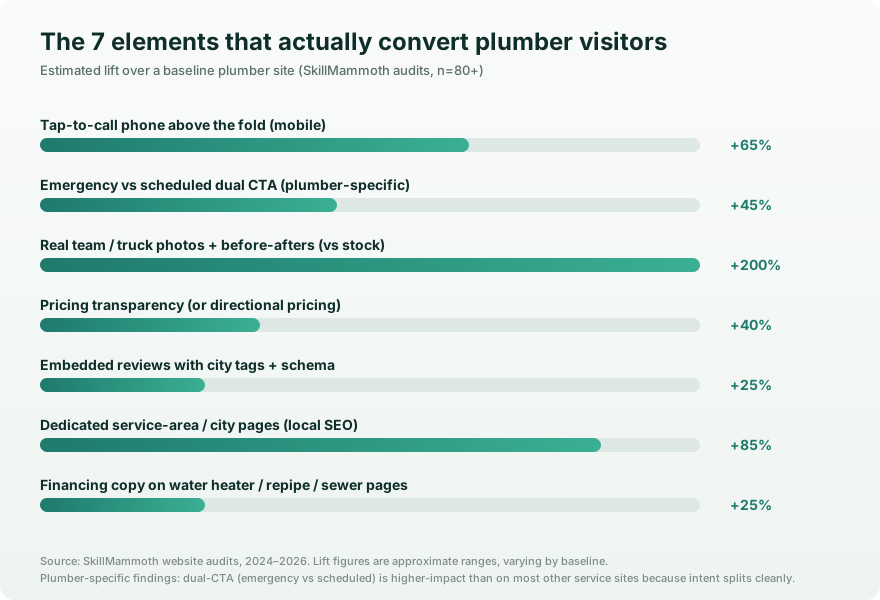 Caption: How each conversion element lifts a baseline plumber site, based on SkillMammoth audits 2024-2026. Real photos and service-area pages are the two biggest individual levers.
See it in action: Our Brico Mechanical case study walks through how we redesigned a plumbing + HVAC site around these 7 principles. The result was a 3.2× lift in form-fill leads and a 41% drop in bounce rate within the first 90 days.
Seven real plumber websites, reviewed
These are live sites, captured in September 2026 at desktop width, found in real search results for "plumber" in Minneapolis, Austin, and Denver rather than pulled from a design gallery. Every company is linked. None of them are clients of ours. The anonymous archetypes in the next section are still useful for pricing tiers; these are what a homeowner actually sees.
1. Abacus Plumbing, Air & Electric, Austin

What it gets right: the most commercial homepage in the set. A 4.7 rating from 11,167 reviews sits in the header beside "We have financing" and a 24/7 phone number, and the hero is a priced offer: a gas or electric water heater at $2,299 installed, with the parts and labor warranty stated and "zero-down financing, as low as $36.33 a month" underneath. Schedule Online is a yellow button in the top corner. This is element four (pricing transparency) and element seven (financing copy) done at the same time, above the fold.
What we would change: the cookie consent panel covers the trust paragraph on first load, and the offer-led hero means a burst-pipe caller has to find the phone number in a busy header rather than a red emergency button. A big operation can carry the density; a three-truck shop should copy the priced offer and not the clutter.
2. Brothers Plumbing, Heating & Electric, Denver

What it gets right: the review count, 9,095, is the first number on the page, the phone number is large and red beside a Schedule an Appointment button, "Same Day Service Available" sits above it, and the hero photo is the company's own van with two real staff members in front of the Denver skyline. A $50-off offer with Call Now and Schedule buttons repeats directly under the hero. Real people plus a real truck is element five, and it is rarer than it should be.
What we would change: the service list in the hero (plumbing, heating and air, electrical, drain cleaning, water heaters) is a checklist rather than a fork, so an emergency caller and a maintenance-plan shopper get the same path. A red "Emergency? Call now" and a quieter "Book a service window" would split them.
3. Gray Duck Plumbing, St. Paul

What it gets right: a memorable brand, which matters when the homeowner is comparing three tabs. Call Now with the number and a Schedule Service button are both in the first screen, Financing has its own menu item, and "Virtual Plumber" in the navigation is a genuinely different offer. The trust bar under the hero (woman-owned, experienced plumbers since 1999) is plain and specific.
What we would change: no review count or rating above the fold, and no service area in text; "the Twin Cities" is a region, not a list of towns. Adding the Google rating beside the phone number and a line of suburbs under the headline would cost nothing.
4. Soderlin Plumbing, Heating & Air Conditioning, Minneapolis

What it gets right: the header carries a 4.7 rating from 559 reviews, a "100 years" badge, the phone number, and a Request Service button, and the hero repeats the number beside "Serving you since 1914." A sticky side rail keeps call, reviews, and booking available while scrolling.
What we would change: the hero form asks for five fields plus a captcha. On a phone, mid-emergency, that is three fields too many. The stock-looking family photo also does less work than one photo of a Soderlin tech would. Shorten the form to name, phone, and what is wrong, and put a tech in the picture.
5. Reliant Plumbing, Austin

What it gets right: the headline is the promise the emergency caller wants ("Your Trusted 24-Hour Plumbing Experts"), the two buttons are exactly the fork this post recommends (Call Now and Book Online), and the photo is a real tech at a real fixture. Four trust icons under the hero (licensed and insured, financing, residential and commercial, satisfaction guaranteed) answer the risk questions in one glance.
What we would change: the phone number in the header is small and set in the same grey as the navigation, and the site ranks for Austin while the number shown is a Dallas area code. A multi-market plumber should show the local number on the page the local searcher lands on.
6. Christopher's Plumbing, Denver

What it gets right: "Trusted Denver Plumbers Since 1959" is a headline that carries its own proof, and the photography is beautiful. Schedule Now is the single clear action, and Reviews has its own place in the navigation.
What we would change: this is a remodeling-grade homepage on a plumbing company. The phone number is small text in the navigation, there is no emergency path, no rating above the fold, and the bathroom photo tells the burst-pipe caller nothing about response time. The site would convert planned-project buyers well and lose the 11pm caller. For a plumber, the 11pm caller is most of the revenue.
7. Erik Nelson Plumbing, Minneapolis

What it gets right: the copy is the most honest on this page. An eleven-person shop, sixteen years in business, South Minneapolis, a focus on older homes, and a real photo of two of their plumbers at a water heater. A named customer testimonial sits beside it. Homeowners trust this kind of plain writing more than agencies expect.
What we would change: the layout is from another era: a fixed-width box, a phone number in small text at the top, no button of any kind, no rating, and nothing that works with a thumb. This is the clearest case on the page of a good company whose site is costing it calls. A Core rebuild that kept every word of that copy and added the phone, the fork, and the reviews would likely double its inbound leads inside a quarter.
Across the seven, the pattern matches what we see in audits. The sites with the review count and the phone number in the first screen (Abacus, Brothers, Soderlin) are the ones that make the comparison easy; the sites with the best photography (Christopher's) are not the ones that convert the emergency caller. The build we ship for the trade is described on the web design for contractors page.
12 plumber website examples (with honest reactions)
Sorted from "actually good" to "expensive train wreck."
The "actually good" tier (4 examples)
1. Mid-sized regional plumber, custom-built site (~$15K range) Phone number is huge above the fold. Booking widget embedded inline. Service area page lists 40+ city-specific URLs that all rank locally. Reviews pull live from Google. Loads in 1.4 seconds on 4G. Emergency vs scheduled clearly forked. This is the top of the market.
2. Family-owned plumber, Webflow build (~$8K range) Tells a multi-generational story above the fold ("Three generations serving the East Bay since 1981") with two photos of grandfather + son in a service truck. Pricing transparent on most services. Maintenance club clearly explained. Doesn't look enterprise , it looks like them. Sweet spot for most independents.
3. Commercial-only plumber, lead-gen optimized (~$12K range) No homeowner CTAs at all , just commercial property managers, facilities directors, GCs. Case studies tied to specific property types (restaurants, schools, multi-family). One conversion path: book a 15-min discovery call. Brutally focused.
4. Small two-truck plumber, GoHighLevel quick-build (~$2K range) Not pretty but converts. Top of page: "Call us. (555) 555-1234." Booking widget. List of services with prices. 5 Google reviews. Map showing service area. Done. The minimum viable plumber site.
The "bland but functional" tier (4 examples)
5. Generic Wix template plumber site Looks like 10,000 other plumber sites. Stock photos of pipes that are clearly not theirs. Phone number in tiny font in the top-right. Conversion rate is probably 1-2%. Could be lifted to 3-4% with one weekend of work.
6. Squarespace plumber site with great photography Beautiful. Owners invested in a real photo shoot. But the booking flow takes 3 clicks to get to a phone number. They're losing the impatient buyer (which is most of their buyers). Photo investment was worth it; checkout flow needs surgery.
7. WordPress plumber site by a local agency Built in 2019. 8 plugins. Loads in 4.5 seconds. Phone number works. Service pages are thin. Schema is missing. Google shows them on page 2. Site needs a refresh, not a rebuild.
8. ServiceTitan-bundled website Comes "free" with the FSM software. Looks like every other ServiceTitan-bundled plumber site (because it is). Booking integration is excellent. Customization is limited. SEO is mediocre. Good if you're already a ServiceTitan power user; mediocre if you want to differentiate.
The "expensive train wreck" tier (4 examples)
9. The $40K agency site that nobody can edit Built on a custom CMS only the agency understands. To change the phone number you have to file a ticket and wait 5 business days. Owner is furious. Site looks impressive but conversion is terrible because they can't iterate.
10. The "we built it ourselves with AI" site Three pages, beautiful AI-generated copy that doesn't match the actual business. Hallucinated certifications. No phone number above the fold. Every CTA leads to a contact form. Bounce rate is brutal.
11. The Scorpion / Hibu / Townsquare "managed" site Looks fine. Locked into a 24-month contract. Owner doesn't own the domain or the content. When the contract ends, they have to start from scratch. Costs $1,200-$2,500 per month. Many alternatives exist that are 1/3 the cost and you actually own.
12. The "let's add live chat to fix conversion" site Bad site + AI chatbot ≠ good site. Chat tools are a multiplier on a foundation that converts. They are not a fix for a foundation that doesn't.
The SkillMammoth plumber website framework
When we build a plumber website at SkillMammoth, we use a 9-page architecture optimized for both Google and the homeowner standing in two inches of bathroom water.
Page 1: Homepage
- Above the fold: company name, phone number (huge), emergency vs non-emergency dual CTA, photo of real team or trucks, financing badge
- Below the fold: services grid (8-10 services with icons), service area list, reviews carousel, recent jobs, certifications
- Bottom: emergency CTA reinforced, secondary phone number, business hours
Page 2: Service area (the SEO workhorse)
- One parent page + child pages for each city you serve (10-50+ child pages)
- Each city page: same structure (intro, what we do here, local landmarks, customer reviews from that city, phone number, service map)
- This is what beats Scorpion at local SEO. They cookie-cutter; you go deep.
Page 3-7: Service pages (one per major service)
- Emergency plumbing, drain cleaning, water heater installation, repipe, sewer line repair, slab leak, gas line, fixture installation
- Each page: problem → cost → process → financing → CTA
- Real photos of that service, not stock
- Schema markup for the service
Page 8: About / team
- Team photos, certifications, ownership story, why-we-do-this
- This is the page that converts the "is this a real local business?" check
Page 9: Contact / book
- Phone number, embedded booking widget, service area map, hours, multiple contact methods
- This is the page Google sends "[your company] phone number" searches to , make it count
9 pages, deep SEO from the city subpages, fast load, mobile-first, financing visible. We can spin this up in 4-6 weeks for most plumbing contractors.
Mobile vs desktop: it's mobile, it's all mobile
For plumber sites we audit, 82-90% of traffic comes from mobile. The "pipe just burst" use case is almost entirely a phone-in-hand situation. The number is even higher than HVAC , plumbing emergencies happen at midnight more often than HVAC emergencies do.
What this means in practice:
- Design mobile-first, then scale up
- Tap-to-call should be a one-tap action, never two
- Forms should be 3 fields max on mobile (name, phone, what's broken)
- Page speed on 4G should be under 3 seconds, ideally under 2
- Sticky bottom bar with "Call Now" + "Book Now" buttons on every page
Almost every plumber site we audit fails at least 3 of these. The fixes are usually under $500 in dev work and they pay back in the first week.
Local SEO essentials for plumber websites in 2026
Ranking your plumber site is 60% your Google Business Profile, 30% your website's local SEO, 10% backlinks. Most agencies obsess over the 10%. Get the 60+30 right and the leads come.
Google Business Profile checklist:
- Categories: Plumber (primary), then drain cleaning service, water heater installation, emergency plumber as secondaries
- Service area: every city you actually serve, listed
- Photos: 50+ photos minimum, refreshed weekly (jobs, before/after, trucks, team)
- Posts: 1-2 per week (jobs, before/afters, seasonal tips, holiday hours)
- Reviews: 1 per week minimum, respond to every one
- Q&A: pre-seed 10 of the most common questions, answer them yourself
On-site local SEO checklist:
- City pages for every service area (not 1 page listing 30 cities , 30 pages, one per city)
- NAP (name/address/phone) consistent everywhere , schema marked
- Local schema (LocalBusiness, ServiceArea)
- Embedded Google Map with your actual service zone
- Customer testimonials with the city the customer is in
- Backlinks from local chamber, BBB, supply houses, PHCC chapter
Technical SEO checklist:
- Core Web Vitals all green (Lighthouse 90+)
- HTTPS everywhere, no mixed content
- Sitemap + robots.txt clean
- Schema for: LocalBusiness, Service, Review, FAQ
- Image alt text on every image
- One H1 per page
If this list looks long, our free new website checklist covers it in a printable format you can hand to whoever builds your site.
How much does a plumber website cost in 2026?
Honest 2026 pricing across every realistic option, based on what we see in the wild and what we charge ourselves.
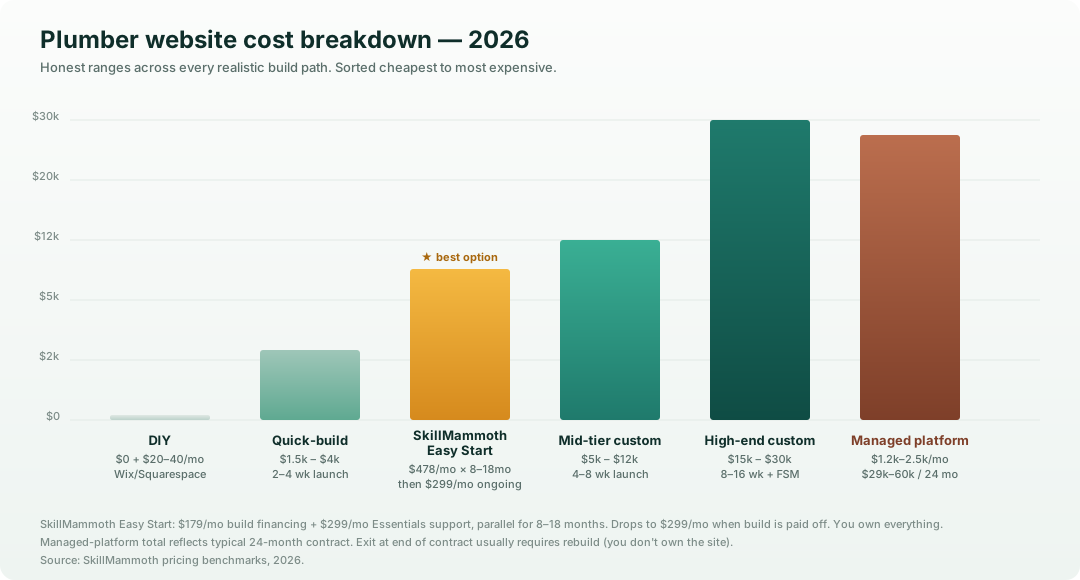 Caption: 2026 cost ranges across every realistic build path. The SkillMammoth Easy Start model lands between Mid-tier custom and High-end on total spend, but with monthly financing built in.
DIY ($0 setup + $20-$40/mo software)
- Tools: Wix, Squarespace, GoDaddy Website Builder
- Time investment: 20-40 hours for a working site, 60+ for a good one
- Conversion potential: 1-2% of visits become leads
- Best for: Brand new plumbers with zero budget who need something online this week
- Honest take: Almost always ends in regret. Get to $2K and skip this tier.
Quick-build agency or freelancer ($1,500 - $4,000)
- Tools: Webflow, GoHighLevel, WordPress with a starter theme
- Time to launch: 2-4 weeks
- Conversion potential: 2-4% if done well
- Best for: 1-3 truck operations
- Honest take: Big leap from DIY. Picks up most of the conversion gains.
Mid-tier custom build ($5,000 - $12,000)
- Tools: Webflow, Framer, WordPress with custom theme, or a focused agency
- Time to launch: 4-8 weeks
- Conversion potential: 4-7% with proper local SEO
- Best for: 4-15 truck operations, multi-location plumbing, anyone serious about lead gen
- Honest take: This is where most plumbing companies should land. Strong ROI, you own everything, you can iterate.
High-end custom build ($15,000 - $30,000)
- Tools: Custom code, headless CMS, integrations to ServiceTitan / FieldEdge / Housecall Pro
- Time to launch: 8-16 weeks
- Conversion potential: 5-10% with high-volume traffic
- Best for: 20+ truck operations, regional/multi-state plumbing, M&A roll-ups
- Honest take: Worth it when your monthly traffic is high enough that 2 percentage points of conversion lift pays back in a quarter.
SkillMammoth subscription , Easy Start at $500/mo, then $350/mo
(Yes, this is us. We're putting it in the breakdown because pretending we don't have skin in this game would be silly, and because the model is genuinely different from anything else on this list.)
- What it is: A custom-built plumber website (same conversion-quality as our mid-tier Core package) financed at $150/mo for 24 months, paired in parallel with your $350/mo Essentials support plan. Total monthly during build payoff: $500/mo for 24 months, then $350/mo ongoing. A Lite tier exists at $450/mo for 12 months for smaller projects.
- Time to launch: 4-6 weeks
- Conversion potential: 4-7% , same as a mid-tier custom build, because it is a mid-tier custom build
- What's included: Custom design + build, hosting + maintenance + security, monthly performance reporting, 2 edit requests per month, quarterly strategy session. Growth and Authority support tiers add GBP management, weekly blog, off-page SEO.
- The ownership model: You can buy out the remaining balance at any time and walk with everything , domain, design, content, code. No lockout. No "start over" pain at the end of a contract. The opposite of the managed-platform model below.
- Best for: 3-15 truck plumbing operators who want a mid-tier-custom site without writing a $5K-$12K check up front, who want monthly edits handled, and who refuse to rent their website forever
- Honest take: We built this model because we got tired of watching plumbing contractors face a bad choice , drop $10K upfront for a great site you babysit yourself, or rent forever from a managed platform that owns the asset. Subscription that converts to ownership is the third option, and at $500/mo it's roughly 1/3 the cost of Scorpion or Hibu over the same period.
Managed marketing platform ($1,200 - $2,500/mo, often 24-month contract)
- Tools: Scorpion, Hibu, Townsquare Interactive, Blue Corona
- Time to launch: 4-6 weeks
- Conversion potential: Variable , usually decent, occasionally great
- Best for: Operators who don't want to think about marketing at all
- Honest take: Predictable monthly cost, but you don't own the asset and exit is painful. Multi-year math usually favors a one-time custom build + a contractor for ongoing SEO, or our Easy Start model.
Where most plumber websites fail (and what to do about it)
| Failure mode | What's actually happening | Fix |
|---|---|---|
| Phone number not above the fold on mobile | Visitor leaves before scrolling | Move it. 30 minutes of dev work. |
| Emergency vs scheduled not differentiated | Panic-caller and price-shopper both get the same generic form | Two clear paths above the fold. |
| No service-area pages | Losing local SEO to competitors who have them | Build city pages, 400-800 words each. |
| Stock photos of pipes | Trust killer | Have techs upload 1 photo per job to a shared drive. Refresh weekly. |
| No financing copy on install pages | Losing $5K+ jobs at the quote stage | Add Synchrony / Wells Fargo financing copy. |
| Slow on mobile | 30%+ of mobile visitors leave at 3+ seconds | Compress images, lazy-load, kill unused plugins. |
| No reviews on-site | Trust signal missing | Embed Google reviews via NiceJob, Birdeye, or similar. |
| Generic "service area" | Vague signals to Google + visitors | List actual cities in plain text. |
| No before/after photos | Plumbing-specific trust gap | Specifically capture before/afters on every install + drain job. |
A halfway-competent free website audit (yes, ours, but also any other good one) will surface these in 30 minutes.
Build vs buy vs DIY: which path is right for you
| Your situation | What we'd recommend |
|---|---|
| Brand new, $0 budget, need something by next week | DIY on Wix / Squarespace, plan to upgrade in 6-12 months |
| 1-3 trucks, want results without ongoing fees | Quick-build agency, $1.5K-$4K |
| 4-15 trucks, ready to scale, can fund $5K-$12K up front | Mid-tier custom build , this is most operators |
| 4-15 trucks, want the same quality without upfront hit | SkillMammoth Easy Start , $500/mo × 24 mo → $350/mo |
| 15+ trucks or multi-location | High-end custom build with FSM integration, $15K-$30K |
| Want to outsource thinking entirely, willing to pay $30K+ over 24 months | Scorpion / Hibu / Blue Corona, eyes open |
The middle of that table is where SkillMammoth lives. We've seen the platform-locked alternatives and we've seen the DIY traps, and the honest math for most plumbing operators puts the sweet spot at either a one-time mid-tier custom build (if you have the cash) or our Easy Start subscription model (if you'd rather spread the cost and have edits handled). Both convert. The other tiers convert less, cost more, or both.
Run the website cost calculator to see your specific number in 30 seconds.
Your next step
Three free things you can grab right now:
- Free website audit , we'll send back a 10-minute Loom + a written report within 48 hours
- Free new website checklist , printable PDF covering the 47 things every plumber website needs before launch
- Free website cost calculator , 30-second personalized estimate
Or if you've already decided you want a redesign and want to talk specifics, see web design for contractors for the packages, then book a 30-minute strategy call , we'll quote your project on the call, no follow-up sales sequence.
FAQ
How long does it take to build a plumber website?
For a custom-built mid-tier site: 4-8 weeks from kickoff to launch. The variables are how fast we can get content + photos from your team and how many revision cycles we go through. Quick-build sites can launch in 2-3 weeks. Enterprise builds with FSM integration take 8-16 weeks.
Should plumbing contractors use Wix or WordPress or Webflow?
Honest answer: Webflow for most plumbing operators in 2026. WordPress is fine if you have a developer relationship; Wix is fine if you're literally just starting. Webflow's combination of visual editor + clean code + native CMS + speed is hard to beat for service businesses.
Do I need separate pages for each plumbing service?
Yes. Every service you sell , emergency plumbing, drain cleaning, water heater repair, water heater install, repipe, sewer line, slab leak, gas line, fixture installation, maintenance plans , needs its own page. Google ranks pages, not websites. One "Services" page that lists everything will not rank for any of the individual services.
How many city pages do I need for local SEO?
One per city you actually service. If you serve 8 cities, build 8 city pages. If you serve 47, build 47. Each one needs unique content (not duplicated) , even if it's just the city name + local landmarks + customer testimonials from that city. This is the single biggest local SEO lever for plumbers.
What is the best website builder for plumbers?
For a DIY build, Wix and Squarespace are the fastest routes and WordPress with a trade theme is the most flexible, all in the $20 to $40 a month range. They work for a basic online presence. The ceiling is conversion tooling: instant estimates, missed-call text back and call tracking are not built into any of them, which is why plumbing companies past roughly $500K in revenue usually outgrow builders and move to a custom build they own.
What's the ROI on a new plumber website?
For a $5K-$12K custom build (or our $500/mo Easy Start) with proper local SEO, most plumbing operators we work with see payback in 3-6 months from a combination of higher organic traffic, higher conversion rate, and reduced ad spend. Beyond that the asset compounds , every month of organic traffic is essentially free leads.
Can I just use AI to build my plumber website in 2026?
You can, and the result will be better than anything from 2023, but it still doesn't replace someone who understands plumbing marketing. AI is great for first drafts of copy, alt text, and meta descriptions. It's not yet great at choosing which 6 services to lead with, where to put the financing CTA, or how to structure a 30-page service area silo. Use AI to accelerate, not to replace. (We wrote a whole post on this , see AI for plumbers when it goes live.)
How often should I update my plumber website?
Content refreshes monthly minimum (new reviews, new photos, new blog posts), structural updates every 12-18 months, full redesign every 4-5 years. Sites that go more than 5 years without a refresh almost always need a full rebuild because the underlying tech is too far behind.
What about an AI chatbot or live chat?
Useful as a layer on top of an already-converting site. Not a fix for a site that's not converting. Start with the foundation. Add chat in v2.
Do plumber websites really need before-and-after photos?
Yes, more than most service businesses. Plumbing work is invisible by definition (it's behind walls, under sinks, in basements). Visual proof that the work happened and looks clean drives trust harder than testimonials alone. Capture before/afters on every install and post-repair job.
Should the website handle financing applications directly, or just link out?
Link out to your financing partner's portal. Embedding the application directly into your site creates compliance complexity that's not worth it. Use the website to qualify the customer on financing availability , direct them to the partner site to actually apply.
Last updated: September 2026. Author: Alex Storey, Co-Founder at SkillMammoth. SkillMammoth builds custom websites, local SEO systems, and lead-generation automations for plumbing and mechanical contractors. See our Plumbing & mechanical practice for more, or if you run an adjacent trade see our electrician website design deep dive, or grab a free website audit.
Related reading: pair a fast site with our plumber SEO playbook so emergency searchers actually find it.
Want to implement these strategies?
Book a free strategy call and learn how we can help grow your contractor business.
Book a Free Strategy Call