
TL;DR
Roofers have a problem most home-service businesses don't: two completely different buyers landing on the same site. There's the storm-restoration buyer (insurance-driven, urgent, often after a hailstorm), and the reroof buyer (planned, multi-bid, financing-aware). Most roofer websites optimize for one and lose the other. This post breaks down the 7 elements that convert both, walks through 12 real roofer websites, and gives you honest 2026 pricing across every build path , DIY through custom.
If you'd rather just see what we'd do for your roofing business, grab a free website audit , we'll send a 10-minute Loom + report within 48 hours.
Why roofing websites are different from "regular" websites
When a homeowner lands on your roofing site, one of three things is happening:
- A storm just hit. They have shingles in their yard, water in their attic, and an insurance adjuster they need to talk to in 48 hours. They're calling 3 roofers in the next hour.
- They're getting bids on a planned reroof. No emergency , just researching. They'll get 3 quotes over 2 weeks, decide based on certifications, financing, warranty, and price.
- They're shopping for a repair, gutter work, or maintenance. Lower urgency, smaller ticket, often comparing reviews more than price.
The buying-mode gap between buyer 1 and buyer 2 is enormous. Storm buyers convert in hours; reroof buyers convert in weeks. Generic roofing sites lose both because they don't speak to either clearly.
The high-converting roofer sites have a clear emergency-vs-planned fork above the fold and route each buyer down a separate path. That's not a design preference , it's the single biggest conversion lift available to a roofer in 2026.
The 7 elements that actually convert roofer visitors in 2026
We've audited dozens of roofer sites at SkillMammoth's Roofing & Mechanical practice and the high-converters share these 7 patterns. Most are missing from sites built by the big "roofing marketing" agencies (you know the ones).
1. Phone number + dual CTA above the fold
Phone number should be the largest tappable element on mobile. Bigger than the logo. Plus two clear CTAs:
- Storm Damage / Insurance Claim , Call Now (red or high-contrast button, "free roof inspection")
- Get a Reroof Quote , Book Online (secondary, calendar widget, "no pressure")
The dual-CTA forking is even more important for roofers than for plumbers because the buying patterns are so different. Roofer sites with a single generic "Get a Quote" form lose the storm caller (too slow) AND the reroof shopper (too pushy).
2. Insurance-claim navigation help
Storm buyers are flying blind. They've never filed a roof insurance claim before. They don't know what an adjuster does, what's covered, what isn't, what to say or not say.
The roofer sites that win storm-restoration jobs have a dedicated "How insurance claims work" page (or section on the homepage) covering:
- What to do in the first 48 hours after a storm
- What to say (and not say) to the insurance adjuster
- The roofer's role vs the adjuster's role
- Common claim mistakes that hurt your settlement
- Free roof inspection offer
This page does double duty: it educates the panicked homeowner AND positions you as the expert who knows the system. Conversion rate on this page typically runs 8–15% (vs 3–5% on a generic services page).
3. Drone aerial photos. Of the actual roof you'll work on.
Real photos outconvert stock by ~3× in any home-service category. For roofing specifically, drone aerial photography is a legit competitive moat in 2026. Most roofers still use ground-level shots. The roofer who sends a drone up and shows the customer their actual roof from above , annotated with damage areas , closes 30–50% more bids.
Capture this on every estimate visit. Use it on the website as proof-of-process. ($800 drone + 1-day FAA Part 107 study guide. Pays back in the first quote.)
4. Manufacturer certifications, prominent
For reroof buyers, this matters. The certifications worth showing on the homepage:
- GAF Master Elite (top 2% of US roofers , this one moves the needle)
- Owens Corning Platinum Preferred (similar tier)
- CertainTeed SELECT ShingleMaster
- IKO ShieldPro or ROOFCONNECT
- Manufacturer warranties (50-year non-prorated is the peak)
Don't list them in a footer. Put the logos above the fold next to your team photos. The reroof buyer is shopping warranties as much as price.
5. Financing copy on every reroof page
Reroof jobs are $8K–$30K. Most homeowners don't have that sitting in cash. Financing copy above the fold on reroof and full-replacement pages turns "I'll think about it" into "let's schedule the install."
The financing partners that matter for roofers in 2026:
- GreenSky / Synchrony Home (the most flexible)
- Service Finance Company
- GoodLeap (good for solar + reroof bundles)
- Some manufacturers (GAF, Owens Corning) have their own financing
If you're not currently offering financing, that's a 2-week phone call. We see 25–40% more closed reroof jobs once financing is visible at quote stage.
6. Real reviews + storm-event tagging
City-tagged reviews are gold for any service business. For roofers, storm-event-tagged reviews are even better:
"Robert and the team replaced our roof after the April 2025 hailstorm. They handled the insurance claim end-to-end and the work was finished in one day." , Sarah K., Frisco, TX
This signals: (a) you handle insurance, (b) you've done storm work before, (c) you're local to a specific event. All three are conversion levers.
Capture review prompts that ask about the event if applicable. NiceJob, Birdeye, and Podium all let you customize prompts.
7. Speed + clarity on after-storm timelines
After a major storm, the question every homeowner asks is: "How long until you can come out?" The roofer sites that win post-storm have this front and center:
- "Within 48 hours of a major storm event"
- "Free emergency tarp service if your roof is open"
- "Live dispatcher available now"
If your timeline is "we'll get back to you within 3-5 business days," you'll lose every storm lead to a competitor with faster commitment. If you can't do 48 hours, partner with a storm-restoration network that can.
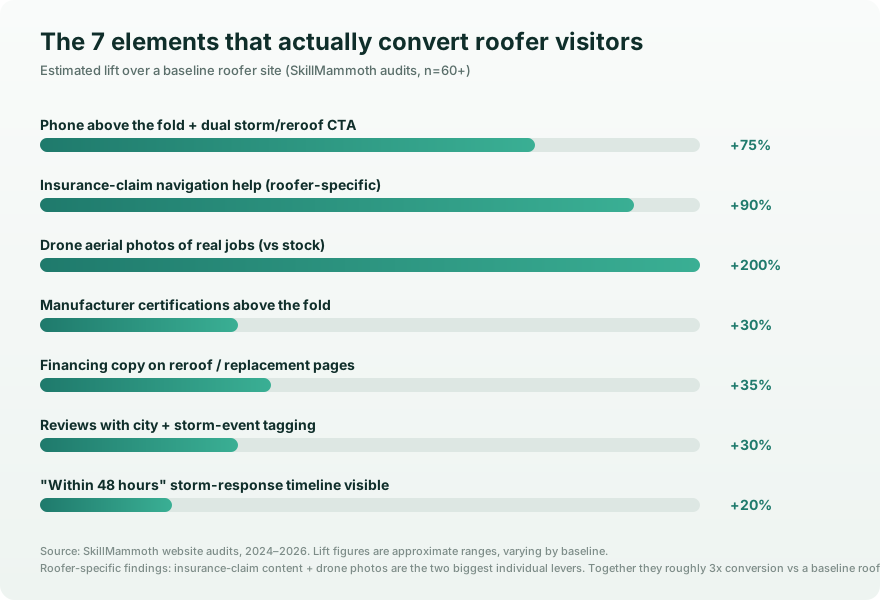 Caption: How each conversion element lifts a baseline roofer site (SkillMammoth audits, 2024–2026). Insurance navigation + drone photos are the two biggest individual levers , both roofer-specific.
See it in action: Our Brico Mechanical case study walks through a similar trade-services rebuild around these principles. The result was a 3.2× lift in form-fill leads and a 41% drop in bounce rate within 90 days.
Eight real roofing websites, reviewed
These are live sites, captured in September 2026 at desktop width, found in real search results for "roofing company" in Minneapolis, Austin, and Denver rather than pulled from a design gallery. Every company is linked. None of them are clients of ours. Judge each one against the seven elements above, and notice that the storm-versus-reroof fork is the thing almost every site skips.
1. Cenco Roofing, Denver
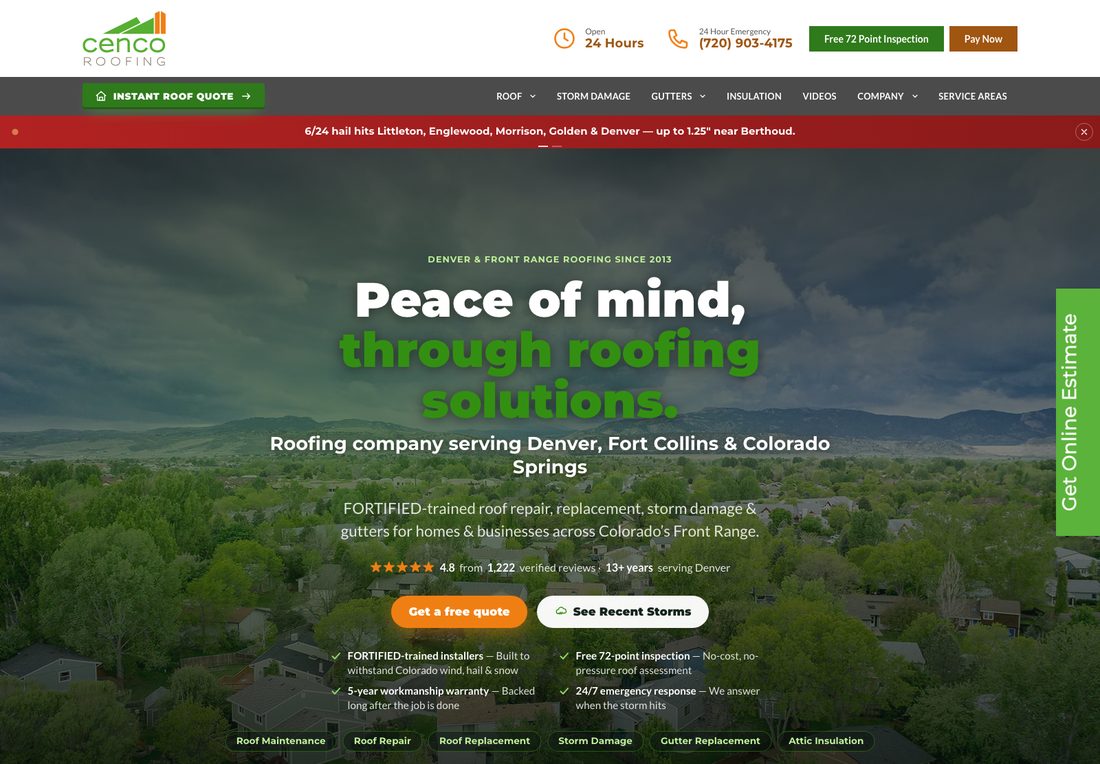
What it gets right: the best storm site in the set, and it is not close. A red banner across the top names the most recent hail event by date and by town ("6/24 hail hits Littleton, Englewood, Morrison, Golden and Denver, up to 1.25 inch"), which is element seven, speed and clarity after a storm, executed better than we usually describe it. Under the headline: 4.8 stars from 1,222 verified reviews, FORTIFIED-trained installer, free 72-point inspection, a 24-hour emergency number, "Get a free quote" beside "See recent storms," and an Instant Roof Quote button in the header. That is the storm fork, the proof, and the emergency path in one screen.
What we would change: almost nothing above the fold. The hero image is a mountain landscape rather than a roof or a crew, which is a small missed chance to show the work.
2. MN Roofing Co., Minneapolis
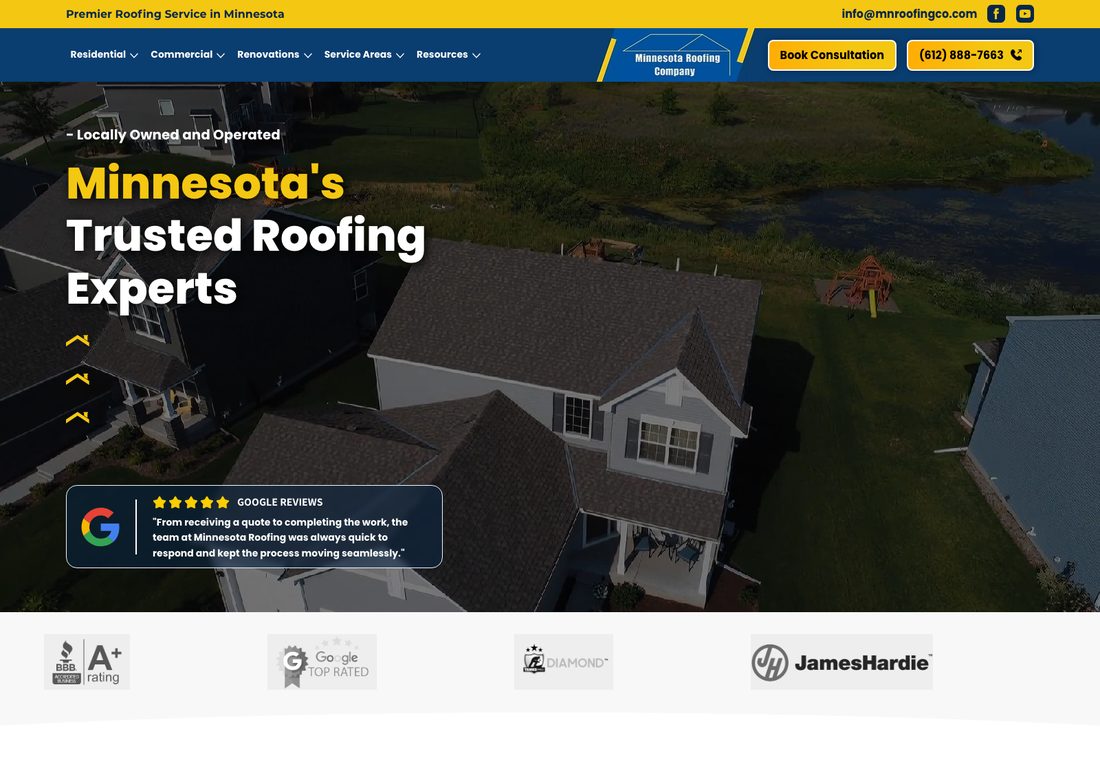
What it gets right: a drone photograph of an actual roof is the hero, which is element three. Book Consultation and the phone number sit together in the header, a Google review is quoted in the hero, and the badge row (BBB A+, Google Top Rated, a manufacturer Diamond tier, James Hardie) answers the reroof buyer's certification question without a scroll.
What we would change: no storm path. A Minnesota roofer takes hail calls every summer, and the site gives that caller the same Book Consultation button as a siding shopper. A second, louder button for storm damage would cost an hour.
3. Sela Roofing & Remodeling, Minneapolis
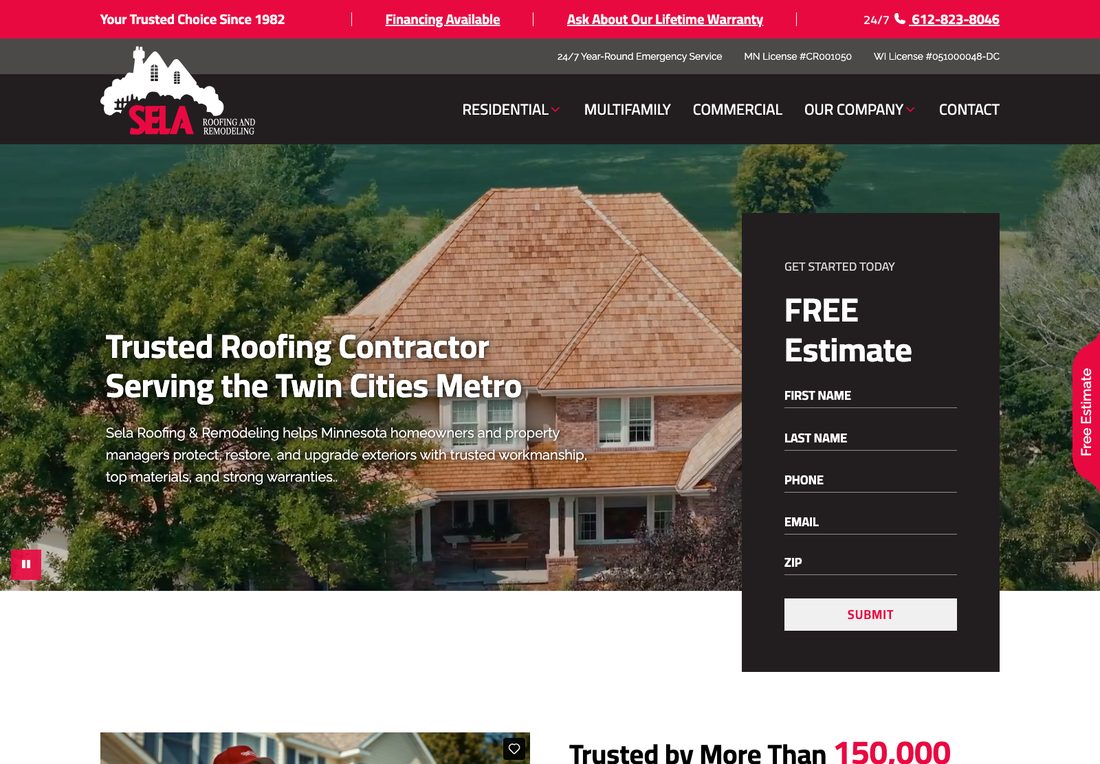
What it gets right: the top bar is a checklist of what a reroof buyer wants: financing available, a lifetime warranty, a 24/7 number, and the Minnesota and Wisconsin license numbers printed. The hero is a finished roof rather than stock, and the estimate form is in the first screen.
What we would change: the form asks for first name, last name, phone, email, and zip. On a phone after a storm that is two fields too many, and there is no separate emergency button. Trim the form to name, phone, and what happened, and give storm damage its own path.
4. Elite Roofing & Solar, Denver

What it gets right: the header has the two buttons a roofer needs, Call Now and a Free 2nd Opinion, and the second is a smart offer for a market where homeowners collect three bids. Book Your Roof Inspection Online is a single clear action, and a side tab repeats it while scrolling.
What we would change: the hero photo is a family on a porch, which reads as stock and shows no roof, no crew, and no truck. There is no rating, no certification, and no storm reference above the fold, in a hail market. Swap the photo for a drone shot of a completed job and add the review count next to the buttons.
5. Longhorn Roofing, Austin
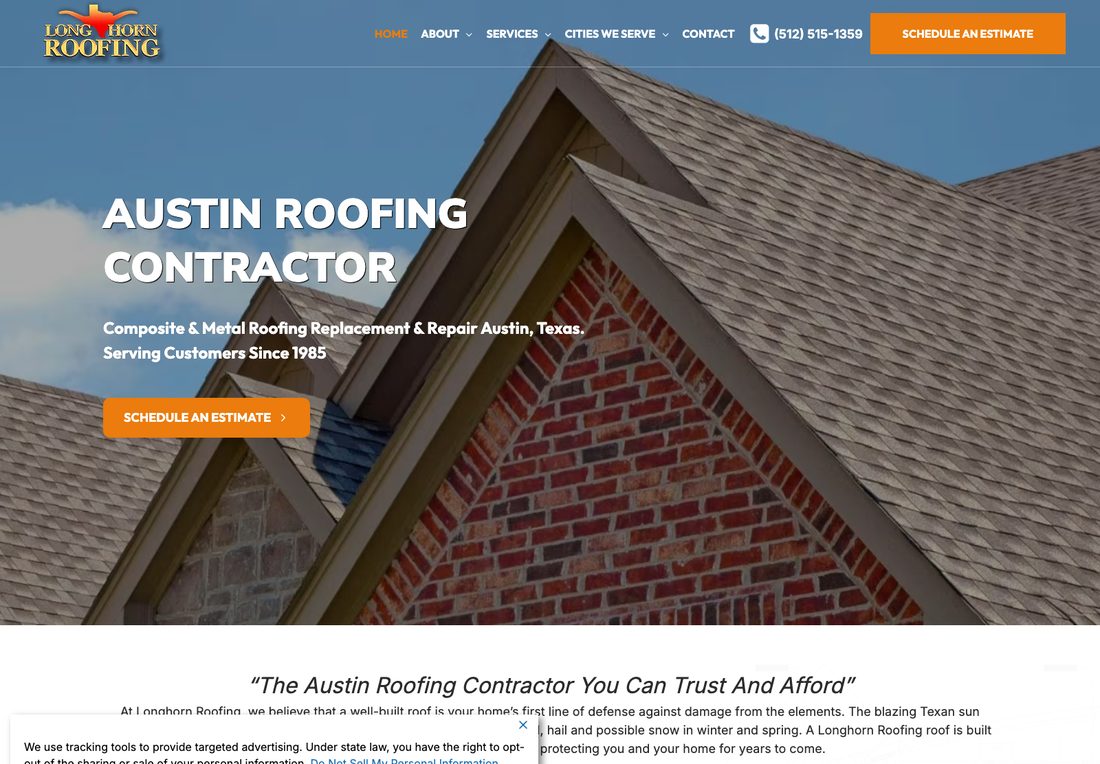
What it gets right: "Austin Roofing Contractor, serving customers since 1985" is a headline that does the SEO work and the trust work at once. The phone number and Schedule an Estimate are both in the header, and Cities We Serve has its own menu item, which is element three of the SEO checklist further down this post.
What we would change: the cookie notice covers the trust copy on first load, and the page is one path for every buyer. A hail-belt roofer with forty years of history should be naming the last storm the way Cenco does.
6. Wilson Roofing, Austin
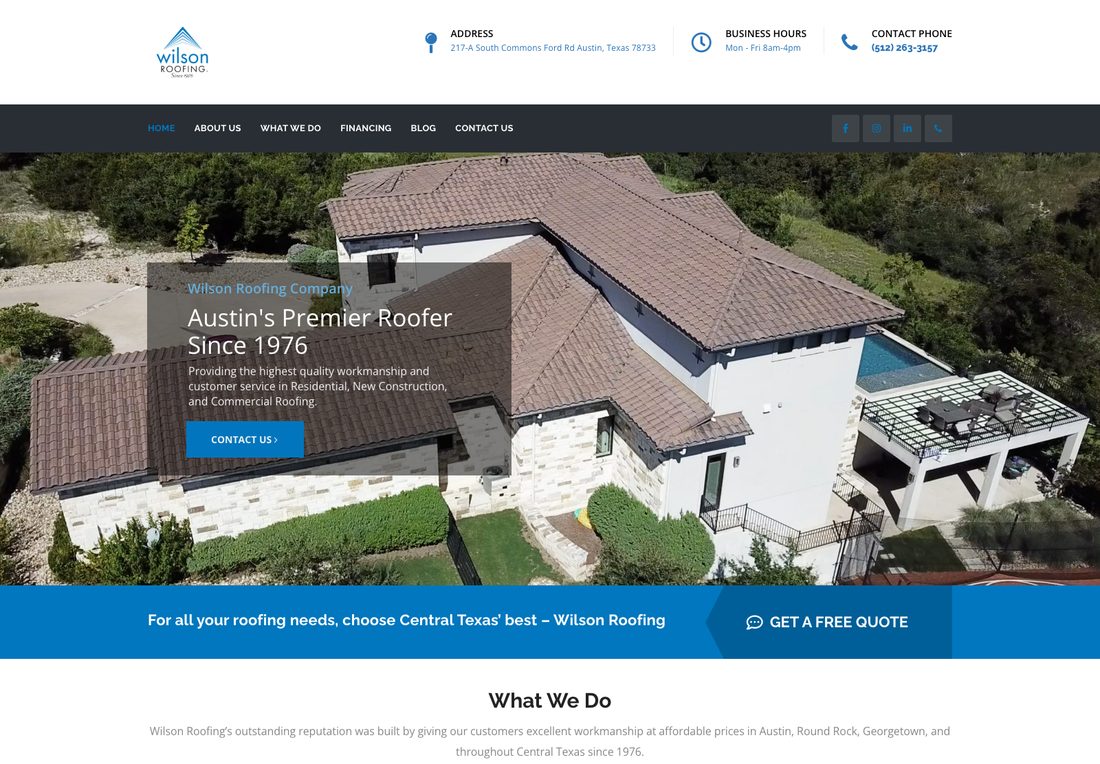
What it gets right: fifty years in business and "trusted by more than 150,000" are the kind of numbers that end a comparison, and the aerial photo is a real Austin roof. Address, hours, and phone are in the header where a homeowner checking whether you are local will look.
What we would change: the single call to action is "Contact Us" in a small button inside the hero. No online booking, no free-inspection offer, no emergency path, and the phone number is one of three small header items. A company with this much proof should be making the ask larger than the proof.
7. Walker Roofing, St. Paul
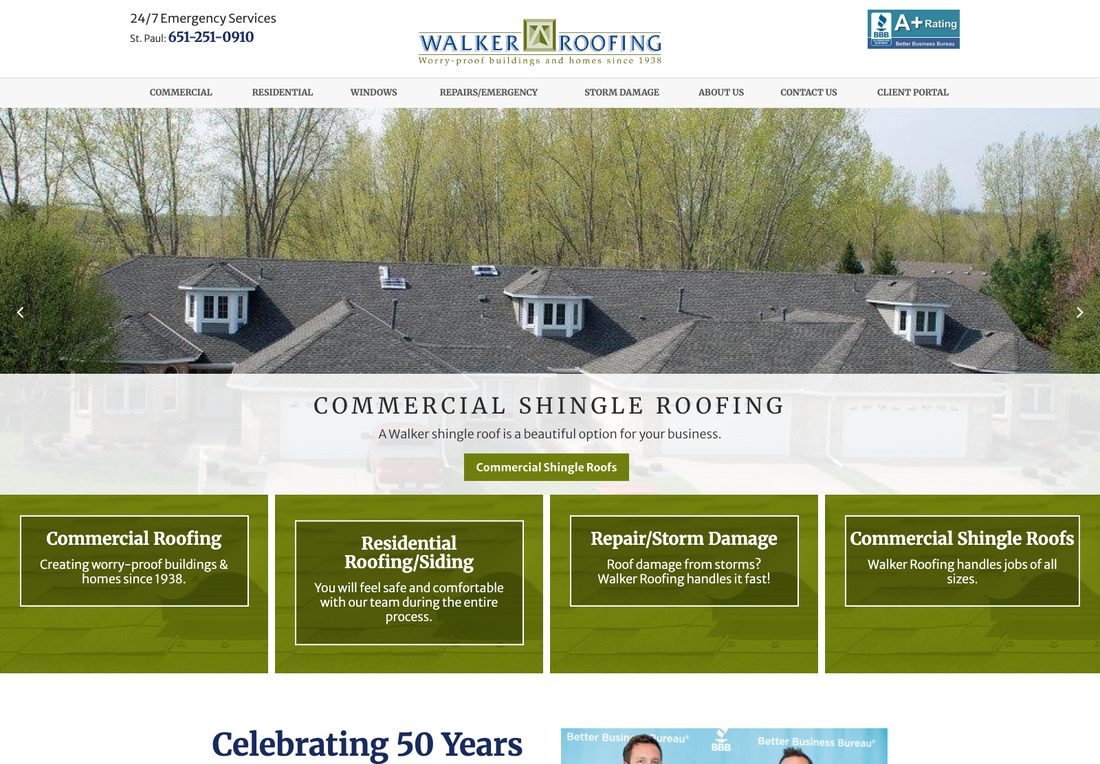
What it gets right: the four tiles under the hero are the fork this post argues for, with Repair and Storm Damage as its own door, and "Celebrating 50 Years" sits directly beneath. A commercial-first roofer showing commercial work first is the correct choice for its buyer.
What we would change: the phone number is tiny in the top corner and there is no button in the hero at all; the slider caption is the only call to action. The storm tile should be red and the phone number should be the largest thing on the page.
8. Acura Roofing, Austin
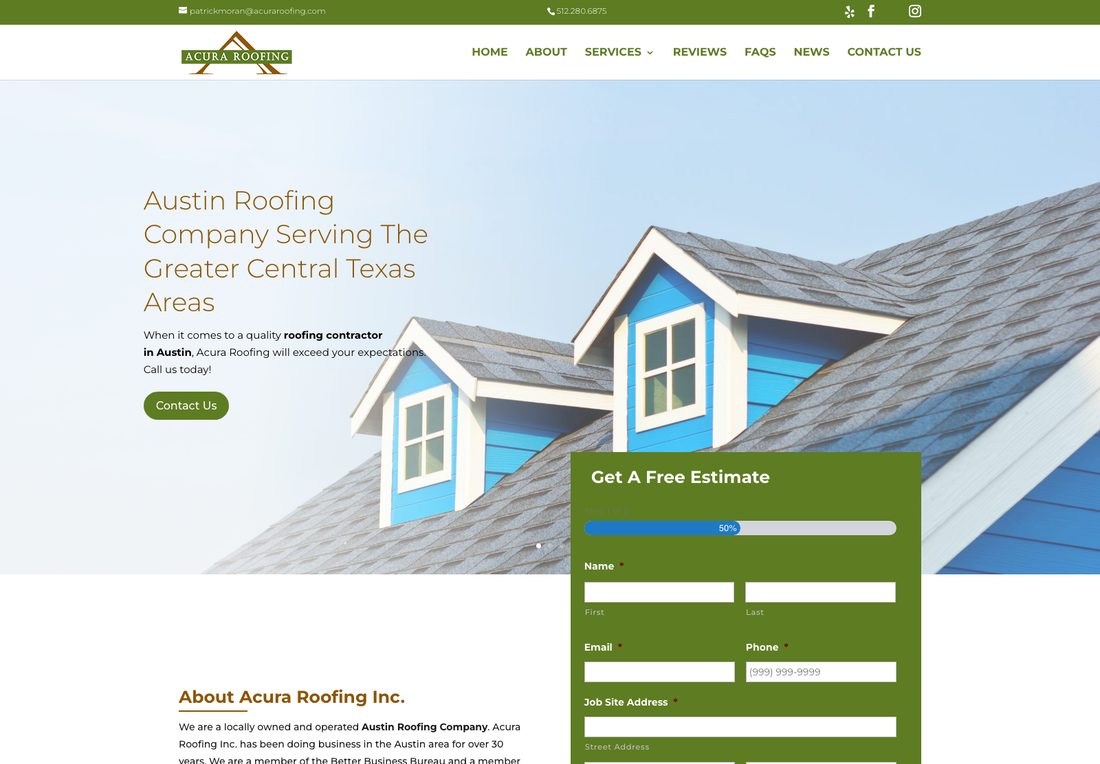
What it gets right: thirty years in the Austin area, Better Business Bureau membership, and a free estimate form in the first screen. The company reads as established and local.
What we would change: the form asks for name, email, phone, and the job site address before anything else, which is the highest-friction first ask on this page, and the phone number is small text at the very top. The headline is set in a light weight that disappears against the sky. This is a solid company on a site built for a desktop visitor in 2015; a Core rebuild with the phone as the hero and a three-field form would likely double its inbound leads.
The pattern across the eight: the one site that names the last storm and puts the review count under the headline (Cenco) is doing what the rest of this post recommends, and the sites with the longest histories (Wilson, Walker, Acura) are the ones asking the least of the visitor. The build we ship for the trade is on the web design for roofers page.
12 roofing website examples (with honest reactions)
Sorted from "actually good" to "expensive train wreck."
The "actually good" tier (4 examples)
1. Mid-sized regional roofer, custom-built site (~$15K range) Phone number huge above the fold. Storm vs reroof clearly forked. Service area page lists 35+ city-specific URLs ranking locally. Drone gallery. GAF Master Elite badge. Live insurance-claim help section. Loads in 1.4 seconds. Top of the market.
2. Family-owned roofer, Webflow build (~$8K range) "Three generations protecting Texas homes since 1981" headline with photo of the founder + son in matching company shirts. Drone photos. Financing badge. CertainTeed Select ShingleMaster certification. Tells a real story. Sweet spot for most independents.
3. Storm-restoration specialist, lead-gen optimized (~$12K range) Single-purpose site. NO reroof CTAs. 100% storm-claim focus. "Hail or wind damage? Free 24-hour inspection." Insurance-claim education content. Owner has 15 years public-adjuster experience and shows it. One conversion path: book a free inspection.
4. Small two-truck residential roofer, GoHighLevel quick-build (~$2K range) Not pretty but converts. Phone huge. Booking widget. List of services with a "from" price on each. 5 Google reviews. Service-area map. Done. The minimum viable roofer site.
The "bland but functional" tier (4 examples)
5. Generic Wix template roofer site Looks like 10,000 other roofer sites. Stock photos of houses that aren't theirs. Phone number tiny in top-right. Conversion rate ~1–2%. Could be lifted to 4% in a weekend.
6. Squarespace roofer site with great photography Beautiful drone shots from a real photographer. Lovely typography. But the booking flow takes 3 clicks to a phone number. Loses impatient buyers (which is most storm buyers). Photo investment was worth it; UX needs surgery.
7. WordPress roofer site by a local agency, built in 2019 8 plugins. Loads in 4.5 seconds. Phone number works. Service pages thin. No storm-claim content. Schema missing. Page 2 in Google. Needs refresh, not a rebuild.
8. ServiceTitan-bundled roofer website Comes "free" with the FSM software. Looks like every other ST-bundled roofer site. Booking integration excellent. Customization limited. SEO mediocre. Fine if you're already on ServiceTitan; mediocre if you want to differentiate.
The "expensive train wreck" tier (4 examples)
9. The $40K+ agency site that nobody can edit Built on a custom CMS only the agency understands. Owner files a ticket and waits 5 business days to change a phone number. Site looks impressive but conversion is brutal because they can't iterate.
10. The "we built it ourselves with AI" site 3 pages, AI-generated copy that hallucinates GAF Master Elite when they're not actually certified (legal risk). No phone above fold. Every CTA leads to a contact form.
11. The Scorpion / Hibu / Townsquare "managed" site Locked into a 24-month contract. Owner doesn't own the domain or content. $1,200–$2,500/mo. When the contract ends, they restart from scratch. The roofing version of this category is especially common because storm-chaser franchises push these platforms.
12. The "let's bolt on AI chat to fix conversion" site Bad site + AI chatbot ≠ good site. The chat tool is a multiplier on a foundation that converts. It's not a fix for a foundation that doesn't.
The SkillMammoth roofer website framework
When we build a roofer website at SkillMammoth, we use a 9-page architecture optimized for both Google and the panicked-after-the-storm homeowner.
Page 1: Homepage
- Above the fold: company name, phone number (huge), dual storm/reroof CTA, photo of real team or trucks, financing badge, certification badges
- Below the fold: services grid (8 services with icons), service area list, drone job-photo carousel, recent insurance claims handled, certifications, reviews
- Bottom: emergency CTA reinforced, secondary phone number, business hours, NRCA + manufacturer cert logos
Page 2: Service area (the SEO workhorse)
- One parent + child pages for each city served (15–50 cities)
- Each city page: intro, what we do here, local landmarks, customer reviews from that city, phone, service map, recent storm events in that area
- This is what beats Scorpion at local SEO. They cookie-cutter; you go deep.
Page 3–7: Service pages (one per major service)
- Storm damage repair, full reroof, repair / leak fix, gutter installation, attic insulation, commercial roofing, metal roofing, solar-ready installation
- Each page: problem → cost → process → financing → CTA
- Drone photos of that service
- Schema markup for the service
Page 8: Insurance claims help
- The page that wins storm work
- "How a roof insurance claim actually works" walkthrough
- "What to say (and not say) to your adjuster"
- Free 24-hour inspection offer
- Links to specific insurance company guides (State Farm, Allstate, Farmers, USAA , top 5 in your area)
Page 9: About / team / certifications
- Team photos in branded shirts (helps the reroof buyer who's evaluating multiple bids)
- Manufacturer certifications with explanation of what each means
- Years in business, # of roofs done, BBB accreditation, NRCA membership
Bonus: /work or /portfolio
- Drone photos of completed jobs, organized by neighborhood
- Customer testimonials with the specific job described
- Useful for both Google Business Profile cross-linking and shopping reroof buyers
That's it. 9–10 pages, deep SEO from the city subpages, fast load, mobile-first, financing visible. We can spin this up in 5–7 weeks for most roofers.
Mobile vs desktop: it's mobile, it's all mobile (during storms)
For roofer sites we audit, 70–85% of traffic comes from mobile , and during major storm events, that spikes to 90%+ in the first 72 hours. Mobile-first design isn't optional.
What this means in practice:
- Tap-to-call should be a one-tap action, never two
- Forms 3 fields max on mobile (name, phone, "what happened")
- Page speed on 4G under 3 seconds, ideally under 2
- Sticky bottom bar with "Call Now" + "Free Inspection" buttons on every page
- Drone photos optimized for mobile (no 5MB hero images)
Almost every roofer site we audit fails at least 3 of these.
Local SEO essentials for roofer websites in 2026
Ranking your roofer site is 60% Google Business Profile, 30% your website's local SEO, 10% backlinks. Get the 60+30 right and the leads come.
Google Business Profile checklist:
- Categories: Roofing contractor (primary), then commercial roofer, gutter cleaning service, siding contractor as secondaries
- Service area: every city you actually serve, listed
- Photos: 50+ minimum, refreshed weekly (drone shots, jobs, before/after, trucks, team)
- Posts: 1–2/week (jobs, storm-event content, certifications, holiday hours)
- Reviews: 1+/week from real jobs, respond to every one
- Q&A: pre-seed 10 common questions ("Do you handle insurance claims?", "How long does a roof replacement take?")
On-site local SEO checklist:
- City pages for every service area (not 1 page listing 30 cities , 30 pages)
- Storm-event pages for any major event in your area ("April 2025 Frisco hailstorm , what to know") , these rank fast and convert hot
- NAP consistent everywhere with schema
- LocalBusiness + ServiceArea schema
- Embedded Google Map showing service zone
- Customer testimonials with city + storm event tagged
Technical SEO checklist:
- Core Web Vitals all green (Lighthouse 90+)
- HTTPS, no mixed content
- Sitemap + robots.txt clean
- Schema for: LocalBusiness, Service, Review, FAQ, Article (for storm-event content)
- Image alt text on every drone photo
- One H1 per page
The free new website checklist covers it printable-format you can hand to whoever builds your site.
How much does a roofer website cost in 2026?
Honest 2026 pricing across every realistic option.
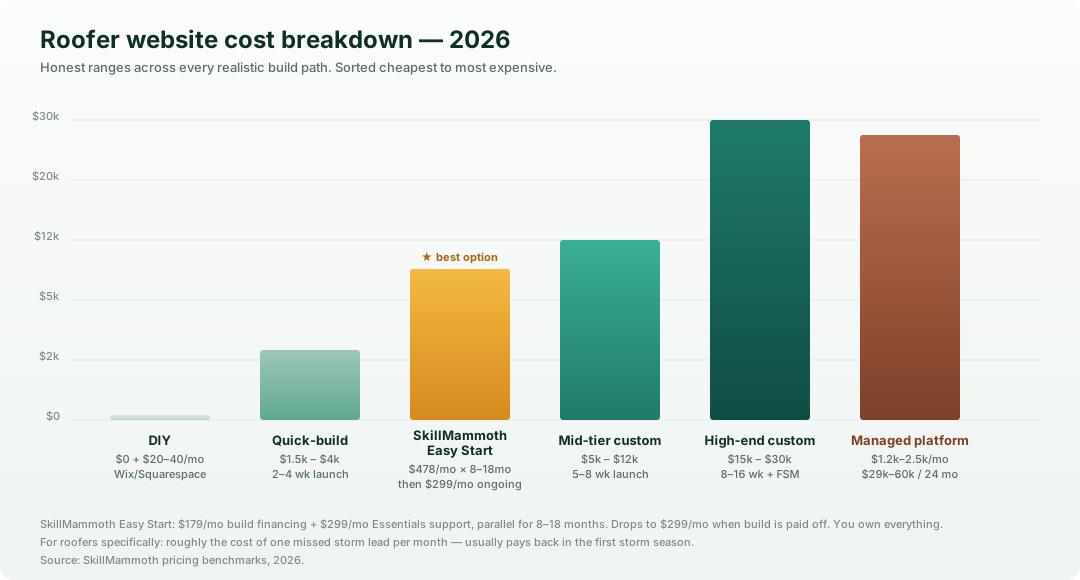 Caption: 2026 cost ranges across every realistic build path. SkillMammoth Easy Start lands between Mid-tier custom and High-end on total spend, with monthly financing built in.
DIY ($0 setup + $20–$40/mo software)
- Tools: Wix, Squarespace, GoDaddy
- Time investment: 20–40 hours for a working site, 60+ for a good one
- Conversion potential: 1–2% of visits become leads
- Best for: Brand new roofers with zero budget who need something online this week
- Honest take: Almost always ends in regret. The financing math on a single $20K reroof you missed because the site didn't convert is roughly 100× the cost of skipping DIY.
Quick-build agency or freelancer ($1,500 – $4,000)
- Tools: Webflow, GoHighLevel, WordPress with starter theme
- Time to launch: 2–4 weeks
- Conversion potential: 2–4% if done well
- Best for: 1–3 truck operations
- Honest take: Big leap from DIY. Picks up most of the conversion gains.
Mid-tier custom build ($5,000 – $12,000)
- Tools: Webflow, Framer, WordPress with custom theme, or a focused agency
- Time to launch: 5–8 weeks
- Conversion potential: 4–7% with proper local SEO + storm content
- Best for: 4–15 crew operations, multi-location roofers, anyone serious about post-storm capture
- Honest take: This is where most roofing companies should land. ROI is fast because reroof AOV is high , one extra closed deal pays for the build.
High-end custom build ($15,000 – $30,000)
- Tools: Custom code, headless CMS, integrations to ServiceTitan / FieldEdge / AccuLynx
- Time to launch: 8–16 weeks
- Conversion potential: 5–10% with high-volume traffic
- Best for: 20+ crew operations, regional/multi-state roofers, storm-restoration networks
- Honest take: Worth it when monthly traffic is high enough that 2-point conversion lift pays back in a single major storm event.
SkillMammoth subscription , Easy Start at $500/mo, then $350/mo
(Yes, this is us. We're including it because pretending we don't have skin in this game would be silly, and because the model is genuinely different from anything else on this list.)
- What it is: A custom-built roofer website (same conversion-quality as our mid-tier Core package) financed at $150/mo for 24 months, paired in parallel with your $350/mo Essentials support plan. Total monthly during build payoff: $500/mo for 24 months, then $350/mo ongoing.
- Time to launch: 5–7 weeks
- Conversion potential: 4–7% , same as mid-tier custom build
- What's included: Custom design + build, hosting + maintenance + security, monthly performance reporting, 2 edit requests per month, quarterly strategy session. Growth and Authority support tiers add GBP management, weekly blog, off-page SEO.
- The ownership model: You can buy out the remaining balance at any time and walk with everything , domain, design, content, code. No lockout. The opposite of the managed-platform model below.
- Best for: 3–15 crew roofers who want a custom site without the $5K–$12K upfront hit, who want monthly edits handled, and who refuse to rent their website forever
- Honest take: Roofer customers especially benefit because the $500/mo is roughly the cost of one missed storm lead. If the site captures even one extra reroof per quarter, it pays for itself many times over.
Managed marketing platform ($1,200 – $2,500/mo, often 24-month contract)
- Tools: Scorpion, Hibu, Townsquare Interactive, Blue Corona
- Time to launch: 4–6 weeks
- Conversion potential: Variable
- Best for: Operators who don't want to think about marketing at all
- Honest take: Predictable monthly cost, but you don't own the asset, and exit is painful. Multi-year math usually favors a one-time custom build OR our Easy Start model. Roofers especially get burned because storm seasons compound revenue , being locked out of the asset during a peak season costs real money.
Where most roofer websites fail (and what to do about it)
| Failure mode | What's actually happening | Fix |
|---|---|---|
| Phone number not above fold on mobile | Storm caller leaves before scrolling | Move it. 30 minutes of dev work. |
| No emergency / reroof differentiation | Both buyer types get a generic form, both leave | Two clear paths above the fold |
| No insurance-claim content | Storm buyer doesn't know if you handle their adjuster | Build a dedicated insurance-claims page |
| Stock photos of houses | Trust killer | Capture drone photos on every estimate visit |
| No financing copy on reroof pages | Losing $15K+ jobs at quote stage | Add Synchrony / GoodLeap financing copy |
| Slow on mobile | 30%+ of mobile visitors leave at 3+ seconds | Compress images, lazy-load, kill plugins |
| No reviews on-site | Trust signal missing | Embed Google reviews with city + event tagging |
| No certifications visible | Reroof shopper picks the bid that LOOKS most legit | Put GAF / Owens Corning logos above the fold |
| Generic "service area" | Vague signals | List actual cities + storm-event pages |
A halfway-competent free website audit (yes, ours, but also any other good one) will surface these in 30 minutes.
Build vs buy vs DIY: which path is right for you
| Your situation | What we'd recommend |
|---|---|
| Brand new, $0 budget, need something by next week | DIY on Wix / Squarespace, plan to upgrade in 6 months |
| 1–3 crews, want results without ongoing fees | Quick-build agency, $1.5K–$4K |
| 4–15 crews, ready to scale, can fund $5K–$12K up front | Mid-tier custom build , most operators land here |
| 4–15 crews, want the same quality without upfront hit | SkillMammoth Easy Start , $500/mo × 24 mo → $350/mo |
| 15+ crews or multi-state | High-end custom with FSM integration, $15K–$30K |
| Want to outsource thinking, willing to pay $30K+ over 24 months | Scorpion / Hibu / Blue Corona, eyes open |
The middle of that table is where SkillMammoth lives. We've seen the platform-locked alternatives and the DIY traps, and the honest math for most roofers puts the sweet spot at either one-time mid-tier custom (if you have the cash) or our Easy Start subscription (if you'd rather spread the cost and have edits handled).
Run the website cost calculator to see your specific number in 30 seconds.
Your next step
Three free things to grab right now:
- Free website audit , 10-minute Loom + written report within 48 hours
- Free new website checklist , printable PDF covering 47 things every roofer website needs before launch
- Free website cost calculator , 30-second personalized estimate
Or see web design for contractors for the packages, then book a 30-minute strategy call , we'll quote your project on the call, no follow-up sales sequence.
FAQ
How long does it take to build a roofer website?
For custom mid-tier: 5–8 weeks from kickoff to launch. Variables: how fast we get content + drone photos from your team, how many revision cycles. Quick-build sites can launch in 2–3 weeks. Enterprise builds with FSM integration take 8–16 weeks.
Should roofers use Wix or WordPress or Webflow?
Webflow for most roofers in 2026. WordPress is fine with a developer relationship; Wix is fine if you're literally just starting. Webflow's combo of visual editor + clean code + native CMS + speed is hard to beat for service businesses.
Do I need separate pages for each roofing service?
Yes. Storm damage, reroof, repair, gutters, attic insulation, commercial , every service needs its own page. Google ranks pages, not websites.
How many city pages do I need for local SEO?
One per city you actually service. Plus storm-event pages (one per major event in your area in the past 24 months). The storm-event pages rank fast and convert hot.
What's the ROI on a new roofer website?
For a $5K–$12K custom build (or our $500/mo Easy Start) with proper local SEO + insurance-claim content, most roofers see payback inside 60 days during a storm season. Outside storm seasons, payback runs 4–6 months.
Should I include a customer portal for tracking job progress?
Nice-to-have, not essential for v1. The conversion gains from a clean homepage + storm content + drone photos are 5–10× what you get from a portal. Build the portal in v2 once the foundation works.
How important are certifications?
Critical for reroof buyers, less so for storm buyers. GAF Master Elite + Owens Corning Platinum Preferred + CertainTeed Select are the trio that matter most in 2026. Display them above the fold next to your team photo.
What about Roofr / AccuLynx integrations?
If you use Roofr or AccuLynx for measurements + estimates, your website should integrate so visitors can request a satellite-based estimate without a site visit. This is a real conversion lever for reroof buyers , they get a number in 24 hours instead of waiting for you to come measure.
Do I need a Spanish-language version of the site?
Depends on your market. In TX, FL, AZ, CA , yes, increasingly. A Spanish toggle that translates the homepage + insurance-claims page is enough for v1. Doesn't need full multilingual until you're at scale.
How often should I update the website?
Content refreshes monthly minimum (new reviews, drone job photos, blog posts, storm-event pages after major events). Structural updates every 12–18 months. Full redesign every 4–5 years.
What about a roof repair price calculator?
Effective lead magnet. Customer enters their roof size, pitch, material → gets a price range estimate. Most roofers don't have this; the ones that do see 2–3× higher form-fill rates. Let us know if you want one , we build them as part of our Pro package.
Do roofer websites really need before-and-after photos?
Yes, more than most service businesses. Roofing is invisible from the ground (a new roof and a 15-year-old roof look similar from the curb). Drone before/after shots are the single most persuasive trust signal you can put on the site.
Last updated: September 2026. Author: Alex Storey, Co-Founder at SkillMammoth. SkillMammoth builds custom websites, local SEO systems, and lead-generation automations for roofing and mechanical contractors. See our Roofing & mechanical practice, or grab a free website audit.
Related reading: pair a fast site with our roofing SEO playbook to actually rank in the storm markets that matter.
Want to implement these strategies?
Book a free strategy call and learn how we can help grow your contractor business.
Book a Free Strategy Call