TL;DR
Getting to 100 Google reviews for your contracting business is one of the highest-ROI marketing moves you can make. Reviews power local search ranking, LSA badge eligibility, and homeowner trust. Contractors with 100+ reviews at 4.7+ stars close 30 to 50% more leads than contractors with under 20 reviews.
This playbook walks through the 6-step review acquisition system, real templates, response frameworks, and the 90-day roadmap to 100 reviews. Plus how SkillMammoth runs review campaigns for clients so they hit 100+ reviews without lifting a finger.
Skip the DIY: SkillMammoth includes review acquisition automation in every Local SEO engagement. See Local SEO service or book a strategy call.
Why Google reviews matter more for contractors than most businesses
Google reviews power three things that directly drive contractor revenue:
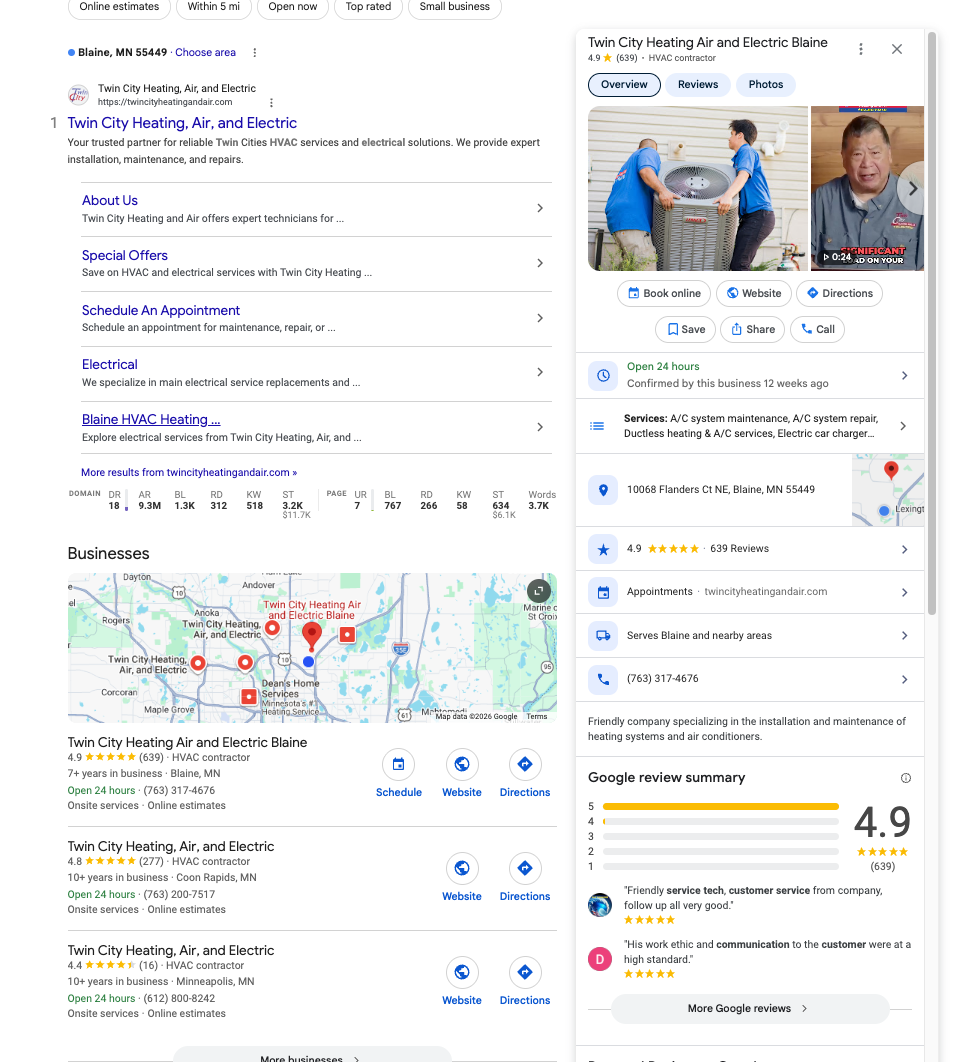
1. Local Pack ranking. Google's Local 3-Pack (the top 3 map results) rewards businesses with more reviews at higher star ratings. Moving from 20 reviews to 100 reviews typically lifts contractors 2 to 4 positions in local pack rankings. That's the difference between showing up on page 1 and getting buried.
2. LSA Google Guaranteed eligibility. Google Local Service Ads use review count and rating as ranking signals. Contractors with 50+ reviews at 4.5+ stars rank higher in LSA impressions and see 20 to 40% higher click-through rates than lower-review competitors. See Google Guaranteed for Contractors for detail.
3. Homeowner trust and close rate. Studies show 89% of consumers read reviews before hiring a contractor. Contractors with 100+ reviews at 4.7+ stars close 30 to 50% more leads than under-reviewed competitors. Same website, same crew, same pricing. Higher reviews equal higher close rate. Reviews also feed AI recommendations: AI assistants weigh reviews when recommending businesses, so review mass now drives both classic search and ChatGPT visibility.
The math of getting to 100 reviews
Simple math:
- Your goal: 100 Google reviews
- Your reality: happy customers only leave reviews when asked, and even then not always
Typical response rates when asked properly:
- Text-based ask within 2 hours of job completion: 30 to 45% response rate
- Email-based ask within 24 hours: 8 to 15% response rate
- No structured ask, hoping for organic reviews: 3 to 5% response rate
If you complete 40 jobs per month and use a text-based ask within 2 hours, you'll capture 12 to 18 reviews per month. Hit 100 total in 6 to 9 months.
If you complete 80 jobs per month with the same system, you'll capture 24 to 36 reviews per month. Hit 100 in 3 to 4 months.
Speed of ask matters more than any other single variable.
The 6-step review acquisition system
Step 1: Time the ask right
The single most important variable in review acquisition is timing. Response rates drop off a cliff after the first 2 hours:
Send the review request within 2 hours of job completion for 7x better response rate.
Every contractor CRM (Jobber, ServiceTitan, Housecall Pro, AccuLynx, Workiz) has a "job completed" trigger. Wire an automated review request to fire within 2 hours of that trigger. This is non-negotiable.
Step 2: Multi-channel ask
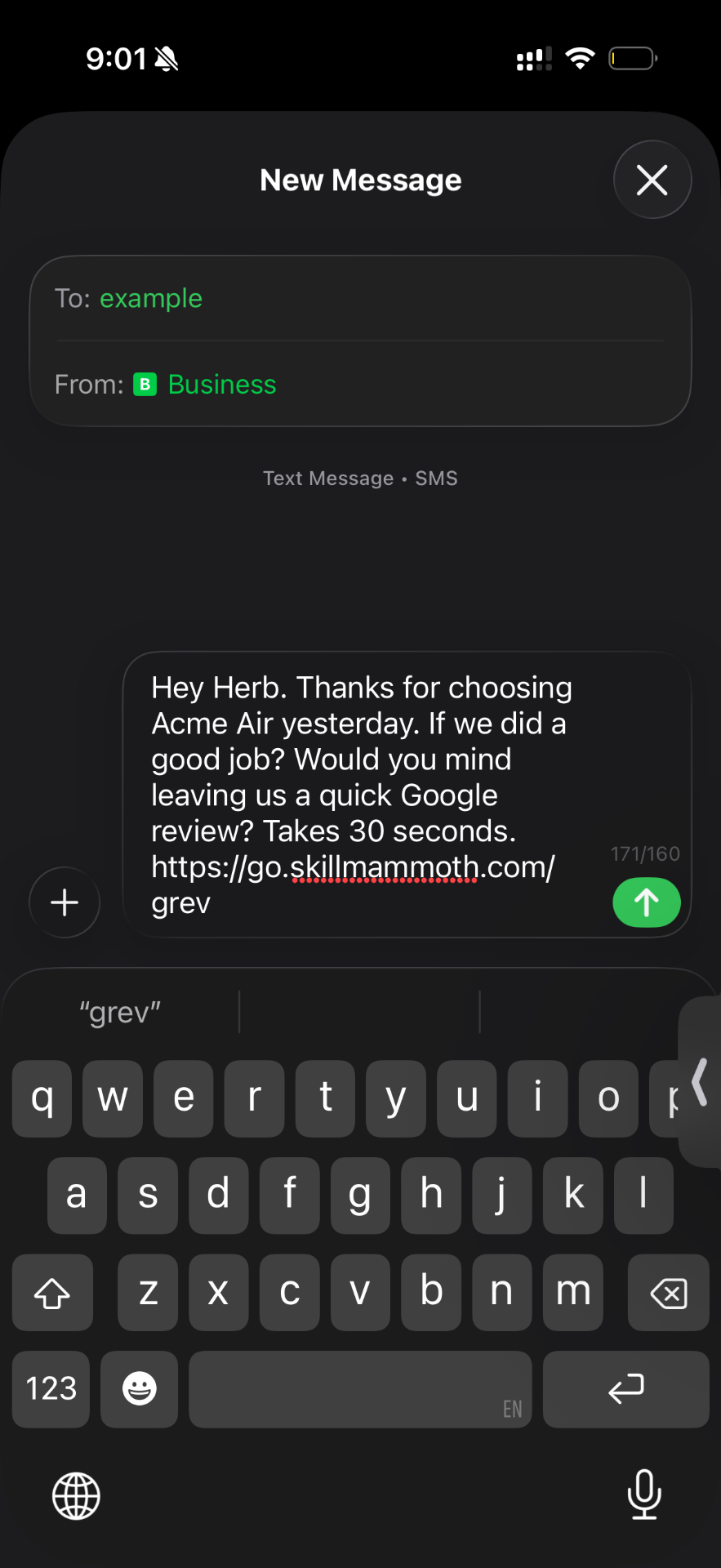
Text has 3x higher response rate than email. But not everyone answers texts. Use both.
Text template (send 90 minutes after job completion):
"Hey [First Name], thanks for choosing [Business Name] today. If you're happy with the work, could you leave us a quick Google review? Takes 30 seconds: [review link]. Thanks!"
Email template (send 24 hours after job completion, only if no review yet):
Hi [First Name],
Thanks for choosing [Business Name] yesterday. If we did a good job, would you mind leaving us a Google review? It really helps other homeowners find us.
Quick link: [review link]
Thanks so much,
[Owner name]
Step 3: Frictionless flow
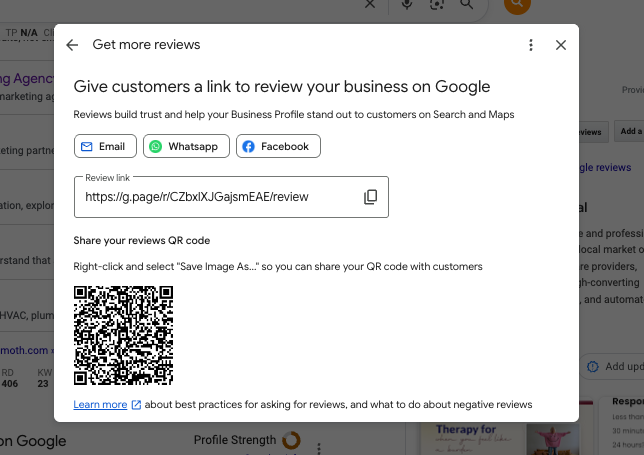
Every review request should link DIRECTLY to your review write page, not your GBP profile. Use the format: https://g.page/r/[your-review-code]/review
This deep link opens the "leave a review" screen with 5 stars pre-selected. Homeowners can write and submit in 30 seconds.
Never make homeowners search for your business. Never make them navigate. One click.
Step 4: Every service counts (this is huge)
Most contractors only ask for reviews after paid jobs. That leaves 40 to 60% of review opportunity on the table.
Ask for reviews on EVERY interaction where a homeowner had a positive experience:
- Free tune-ups and maintenance checks
- Free estimates and consultations
- Warranty visits
- Second opinions and inspection reports
- Emergency call-outs (even if the fix was minor)
- Membership plan renewals
- Post-install follow-up visits
If a homeowner spent 30 minutes with you and left happy, that's a review-eligible touchpoint. Free doesn't mean unreviewable. If anything, homeowners are MORE likely to leave a positive review after a free service because they feel they got something valuable without paying.
The contractors who scale past 100 reviews faster than everyone else are the ones who track review-eligible touchpoints across ALL service types, not just paid jobs.
Step 5: Follow up once, softly
If a homeowner doesn't leave a review within 3 days of the first ask, send ONE follow-up. Not more.
Follow-up text template:
"Hey [First Name], quick reminder that if you had a moment to leave [Business Name] a Google review, it'd really help our small business. Here's the link: [review link]. Thanks!"
Never send more than one follow-up. Multiple follow-ups feel spammy and hurt your brand.
Step 6: Respond to every review
Every review deserves a response. Not just 5-star reviews. Especially critical reviews.
Response framework for positive reviews (30 to 60 seconds each):
- Thank them by first name
- Reference the specific service or job
- Reinforce your commitment to future service
- Invite them to reach out anytime
Example: "Thanks so much for the review, [Name]! We're glad we could help with the [service type] this week. If anything comes up down the road, don't hesitate to reach out. Really appreciate the trust."
Response framework for critical reviews (5-star or lower):
- Acknowledge the specific concern
- Take responsibility if warranted
- Offer to make it right
- Invite offline conversation
- Never argue
Example: "Hi [Name], thanks for the feedback and I'm sorry we fell short on the [issue]. That's not the experience we aim for. Please give me a call directly at [phone] so we can make this right. [Owner name]"
Never argue with a reviewer publicly. Every reader watching your response makes hiring decisions based on how you handle criticism.
What to do about negative reviews
Some negative reviews are fair. Some are unfair. Some are fake.
Fair negative reviews (something did go wrong): Respond publicly with acknowledgment and offer to fix. Then actually fix. If you make it right offline, ask the customer if they'd consider updating the review. Many do. This is how contractors turn 1-star reviews into 5-star reviews over time.
Unfair negative reviews (customer misunderstanding, unreasonable expectation): Respond publicly with the facts (professionally, not defensively). Do not argue. Do not attack. Let the response speak to future readers.
Fake reviews (competitor sabotage, obvious spam): Report to Google via the "Flag as inappropriate" link on the review. Google removes fake reviews when reported with evidence. Response time: 3 to 14 days typically.
Do NOT try to bribe or coerce a customer into removing a legitimate negative review. Google can penalize businesses for this behavior.
How SkillMammoth runs review campaigns for clients
When SkillMammoth builds a Local SEO engagement for a contractor, review acquisition is one of the first automations we deploy. Here's the actual system:
Setup phase (Week 1 to 2):
- Audit current review count and star rating
- Verify GBP review link and generate the shareable deep link
- Configure text and email automation via CRM triggers (Jobber, ServiceTitan, Housecall Pro, etc.)
- Set up review response templates for positive and negative reviews
- Configure automated aggregation dashboard so you see all reviews in one place
Automation phase (Week 2 onward):
- Text review request fires 90 minutes after job completion (auto)
- Email review request fires 24 hours after job completion if no review yet (auto)
- Follow-up text fires 3 days after job completion if still no review (auto, once)
- We monitor the review inbox and alert you to critical reviews within 4 hours
- We draft response text for you to approve for critical reviews (never auto-respond to negatives)
Optimization phase (Month 2 onward):
- Weekly review velocity report (how many new reviews per week, by service type)
- Adjust triggers based on close rate (some job types produce higher response rates)
- Expand to review-eligible touchpoints beyond paid jobs (free tune-ups, warranty visits, quotes, consultations)
- Coordinate with LSA management to maximize the Google Guaranteed badge benefit
Most SkillMammoth clients see review acquisition go from 1 to 3 reviews per month (organic) to 8 to 15+ reviews per month (automated) within 60 days. The math compounds from there.
See our Local SEO service for detail, or book a strategy call.
Tools stack for DIY review acquisition
If you're setting this up yourself instead of hiring SkillMammoth:
Text/email automation via CRM:
- Jobber: built-in review request automation ($55 to $349/mo). SkillMammoth readers get 20% off for 6 months (or 20% off annual) through our partner link. See the full Jobber pricing breakdown.
- ServiceTitan: built-in via Marketing Pro add-on ($400 to $1,500+/mo)
- Housecall Pro: built-in Marketing Center ($59 to $329/mo)
- AccuLynx: built-in ($299 to $500/mo)
- Workiz: built-in ($65 to $199/mo)
Dedicated review platforms:
- NiceJob: $75 to $175/mo (review acquisition + aggregation)
- Podium: $399 to $599+/mo (review + messaging + payments)
- Birdeye: $299 to $499+/mo (review + reputation management)
- Grade.us: $110 to $550/mo (review acquisition only)
Free/low-cost:
- Direct GBP link + manual text send from your phone: $0
- Google Business Profile app on your phone for on-the-spot asks: $0
For most contractors under $2M revenue, the built-in CRM review automation is sufficient. Dedicated platforms make sense at $2M+ revenue when you need enterprise features. Compare service pricing on our pricing page.
The 90-day 100-review roadmap
Assumes you complete 2 to 3 jobs per day (60 to 90 jobs/month) and hit a 30 to 40% review capture rate.
Days 1 to 7 (foundation):
- Get GBP review deep link
- Configure CRM to send review request text 90 min after job completion
- Set up automated follow-up 3 days later
- Ask your last 20 happy customers manually (backlog capture)
Days 8 to 30 (acceleration):
- New job equals automatic review request within 2 hours
- Aim for 15 to 25 new reviews in the first 30 days
- Respond to every review within 24 hours
Days 31 to 60 (expansion):
- Expand review asks to ALL service types (free tune-ups, quotes, warranty visits)
- Add print card in truck for on-site ask
- Aim for 20 to 30 new reviews in month 2
Days 61 to 90 (dominance):
- Weekly review velocity report
- Address any negative reviews with pro-tier response
- Aim for 25 to 35 new reviews in month 3
- Break through the 100 review mark by day 90
Assumes 2 to 3 completed jobs per day and 30 to 40% review capture rate.
Realistic: 100 reviews by day 75 to 90.
Aggressive: 100 reviews by day 45 to 60 (if you have 100+ jobs/month).
Common mistakes to avoid
- Only asking after paid jobs. You're missing 40 to 60% of review opportunity from free tune-ups, quotes, and consultations.
- Sending the ask 24+ hours late. Response rate drops 7x. Same day only.
- Sending a generic thank-you email without a direct review link. Homeowners won't hunt for your GBP.
- Never responding to reviews. Signals to Google (and readers) that you don't engage.
- Arguing with negative reviewers publicly. Kills your close rate on every future prospect who reads the exchange.
- Buying fake reviews. Google penalties are severe. Not worth the risk.
- Asking every customer twice a year. Once per completed service is the ceiling.
- Not tracking review velocity. If you can't see the trend, you can't fix it.
Related reading and tools
Pair this playbook with our other contractor growth resources:
- Google Guaranteed for Contractors
- Marketing Attribution for Home Service Contractors
- Lead Generation for HVAC
- Lead Generation for Plumbers
- Lead Generation for Roofers
- Lead Generation for Electricians
- Lead Generation for Lawn Care
Industry pages: HVAC, Plumbing, Roofing, Electricians, Lawn Care. Services: Local SEO, LSA management, Web Design. Free tools: Free SEO audit, Contractor Funnel Calculator, Free Website Audit, New Website Checklist, AI Stack Picker.
FAQ
Q: How long does it realistically take to get 100 Google reviews?
A: 3 to 9 months depending on job volume. At 60 to 90 jobs per month with 30 to 40% capture rate, plan on 4 to 6 months. At 100+ jobs per month, you can hit 100 in 3 to 4 months.
Q: Should I ask for reviews after free services (tune-ups, quotes, consultations)?
A: Absolutely yes. Free services often produce higher response rates because homeowners feel positively surprised. If someone spent 30 minutes with you and left happy, that's a review-eligible touchpoint whether they paid or not.
Q: What's the best time of day to send a review request text?
A: Send within 90 minutes to 2 hours of job completion. Response rate is highest when the positive experience is still fresh.
Q: How do I respond to a fake negative review?
A: Flag it as inappropriate through Google's review flagging system with specific evidence (customer never used your service, review contains factually incorrect claims, etc.). Google removes flagged fake reviews in 3 to 14 days typically. In the meantime, respond professionally to the public review noting you cannot find them in your customer records.
Q: Does SkillMammoth help with review acquisition?
A: Yes. Review acquisition automation is included in every Local SEO engagement. We set up the CRM triggers, response templates, and monitoring. Most clients see review velocity go from 1 to 3/month to 8 to 15+/month within 60 days.
Q: What review platform should I use if I want dedicated tooling?
A: For most contractors under $2M revenue, the built-in review automation in your CRM (Jobber, HCP, ServiceTitan) is sufficient. If you need dedicated tooling: NiceJob ($75 to $175/mo) is affordable, Podium ($399 to $599/mo) is fuller-featured but expensive, Birdeye ($299 to $499/mo) is mid-range.
Q: How do I get the direct review link for my Google Business Profile?
A: Log into GBP, click "Reviews" then "Get more reviews" then "Share review form". Google generates a short URL in the format g.page/r/[code]/review. Copy that. That's your review deep link.
Q: What's an acceptable star rating for LSA and local pack?
A: 4.5+ stars is the minimum threshold. 4.7+ stars is competitive. Below 4.5 stars, you'll get out-ranked by competitors regardless of review count.
Q: Should I offer discounts or freebies in exchange for reviews?
A: No. Google's policy prohibits incentivized reviews and can result in your GBP being suspended. Ask for honest reviews only.
Q: What if I already have 20 to 30 reviews and want to get to 100?
A: Same system, faster runway. If you already have a review acquisition automation in place, scaling from 30 to 100 typically takes 60 to 90 days. If you're starting from scratch, 90 days is realistic.
Q: How do I handle a review from someone who wasn't actually my customer?
A: Flag it as fake in Google's review system with a note explaining you have no record of them as a customer. Google typically removes these within 2 weeks. In the meantime, respond publicly noting you cannot find them in your customer records and invite them to reach out privately to discuss.
Q: Do Google reviews help my SEO for keywords other than "near me"?
A: Yes. Google uses review volume and rating as ranking signals for local search generally, not just proximity queries. High-review contractors rank better for "[service] [city]" keywords too.
Q: How does review acquisition connect to LSA performance?
A: Directly. Google Local Service Ads use review count and rating as primary ranking signals. Contractors with 50+ reviews at 4.5+ stars rank higher in LSA impressions and get 20 to 40% better click-through rates than lower-review competitors. See Google Guaranteed for Contractors.
Ready to hit 100 reviews without lifting a finger?
Review acquisition automation is included in every SkillMammoth Local SEO engagement. We configure your CRM triggers, review response templates, aggregation dashboard, and weekly velocity reporting. Most clients hit 100 reviews within 90 to 120 days.
Book a free strategy call to see how we'd build your review campaign.
Disclosure: SkillMammoth is a Jobber Partner and may earn a commission from signups through our link.
Related reading: if you are comparing review-request stacks head to head, see SkillMammoth vs Podium.
Want to implement these strategies?
Book a free strategy call and learn how we can help grow your contractor business.
Book Your Free Call