TL;DR
Roofers have more legitimate AI opportunities than almost any other home-service category in 2026 because the job involves three things AI is genuinely good at: visual damage assessment (drone + computer vision), document-heavy insurance work, and storm-season call overflow that humans can't physically handle. The four highest-ROI uses: AI drone / aerial damage assessment (Hover, EagleView AI, CompanyCam AI), AI receptionist for storm overflow, AI insurance claim documentation, and AI-drafted storm-event SEO pages. Three to avoid entirely , including one with serious legal liability: never use AI-generated photos to fake damage.
If you want a quick map of where AI would actually pay back in your specific roofing business, book a free strategy call , we'll diagnose your stack on the call, no follow-up sales sequence.
Why AI matters more for roofers than for most trades
Two reasons.
One: storm seasons create capacity walls. A normal HVAC company never gets 10× call volume on a Tuesday afternoon. A roofer in a storm-prone metro absolutely does. The difference between roofers who capture storm spikes and roofers who lose 70% of inbound to busy signals is operational scalability , and AI is the cheapest scalability lever available in 2026.
Two: roofing is a heavily visual + document-heavy trade. Damage assessment, insurance documentation, supplemental claims, Xactimate descriptions, instant measurements + estimates , most of the office and pre-sale work is reading photos, computing dimensions, and writing structured documents. That's exactly what AI is best at. AI tooling that would be marginal for a plumber is genuinely transformative for a roofer.
This is also why we built our own roofing AI , RoofMammoth.ai, which lives at #2 on the list below. The off-the-shelf tools (Hover, EagleView, Roofr, CompanyCam) are good but kept hitting the same SMB-roofer workflow gaps for our clients, so we built the version we'd actually use.
The 9 use cases below are roofer-specific (or have roofer-specific applications). They're ranked by what we've actually seen move the needle for roofing clients at SkillMammoth's Roofing & Mechanical practice.
The 9 AI use cases, ranked by ROI for roofers
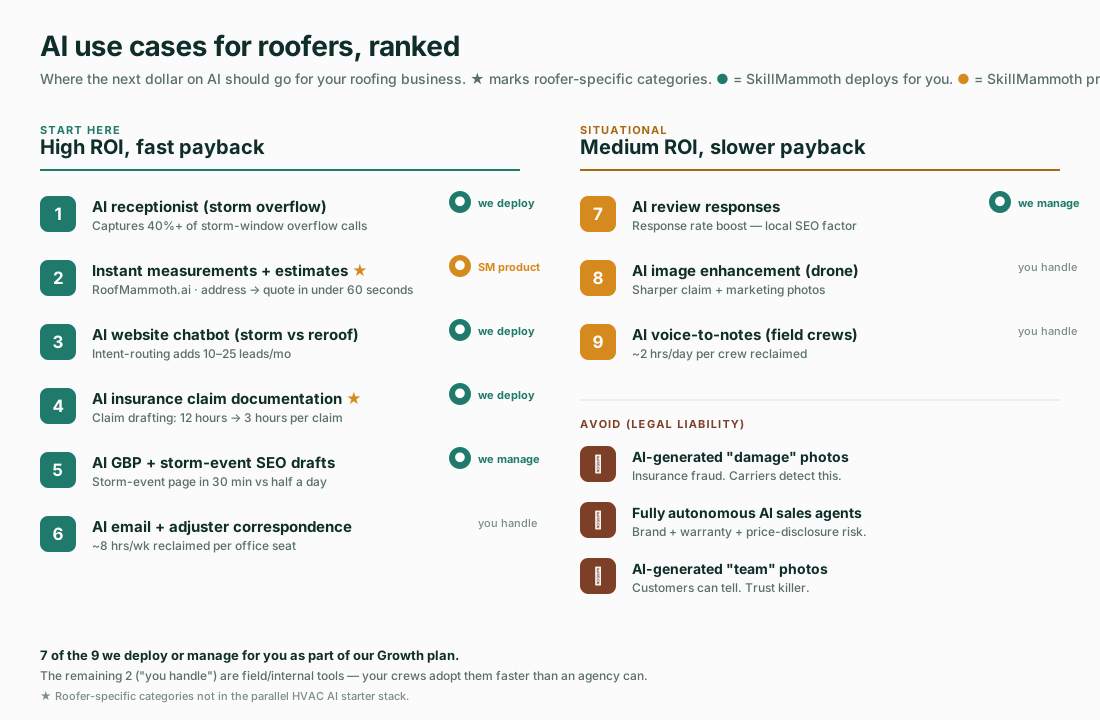 Caption: The 9 AI use cases ranked by ROI. Green "we deploy" badges mark the 7 we handle for you in our Growth plan; the other 2 are field tools your crews adopt directly. ★ flags roofer-specific categories. The 3 red items at the bottom are legal liabilities , avoid even if a vendor offers them.
1. AI receptionist for storm overflow , payback in days
What it does: picks up after-hours and overflow calls during storm events, captures lead details, dispatches emergency inspection requests to your team, schedules non-emergency callbacks. Tools like Goodcall, Phonely, or Vapi.ai handle this well in 2026.
ROI: during a peak storm window, you might miss 60–80% of inbound calls if your dispatchers are overwhelmed. Each missed call is a potential $8K–$25K reroof. An AI receptionist that captures even 40% of those calls is worth $50,000+ in a single storm event for a typical 5-crew operation.
Cost: $80–$300/mo, with surge pricing during storm events.
Time-to-value: 1 week setup. Immediate ROI during the next storm.
Where it fails: AI receptionists trained on generic scripts that hallucinate insurance handling claims or service-area boundaries. Train on YOUR actual intake scripts, not vendor templates.
2. Instant measurements + estimates (RoofMammoth.ai) , payback in 1 month
The roofer-specific killer use case , and the one we built ourselves. RoofMammoth.ai is our proprietary roofing AI: address-to-quote in under 60 seconds, with measurements and a contractor-ready estimate produced from satellite imagery. No site visit required for the first-pass quote.
What it does:
- Instant measurements and estimates using satellite imagery
- Leverages hail and storm data to flag potential hail damage on the property
- Speed-to-lead automations that maximize conversions while the homeowner is still engaged
- Exports leads and quotes straight into your CRM for your team to action
ROI: cuts inspection-to-quote time from 2–4 hours to under 5 minutes. A 5-crew operation typically saves 40+ hours/week and improves close rate dramatically because the homeowner gets a real number while they're still on the call instead of waiting 48 hours for an in-person estimate.
Time-to-value: 2 weeks setup + training, immediate ROI thereafter.
Where it fails: treating the AI estimate as a binding final number. Always have a human reviewer pass before sending high-stakes quotes (large reroofs, insurance scope disputes). The AI is fast and ~90%+ accurate; the 10% edge cases need human judgment.
Third-party alternatives if you want to compare: Hover, EagleView, Roofr, and CompanyCam AI all play in adjacent territory. We built RoofMammoth.ai because none of them were tuned tightly enough to the SMB roofer workflow we kept seeing , too much manual cleanup before the output was actually quote-ready.
3. AI website chatbot for storm-vs-reroof routing , payback in weeks
What it does: captures leads on your website 24/7, routes storm-emergency visitors to a fast call/schedule flow and reroof-shoppers to a financing+estimate flow, books inspections through integrated calendars.
ROI: roofer websites do most of their conversion lift from buyer-intent routing. A chatbot that asks "Are you reaching out about storm damage or planning a reroof?" and then routes accordingly converts 2–3× a generic contact form.
Cost: $50–$200/mo (Tidio, Intercom Lite, or roofer-specialized like the chatbot built into AccuLynx).
Time-to-value: 1 week.
Where it fails: chatbots that don't know your service area, can't book appointments, or feel obviously robotic. The bar in 2026 is high.
4. AI insurance claim documentation , payback in 1 month
Roofer-specific. Tools that draft Xactimate descriptions, supplemental claim narratives, line-item justifications, and adjuster letters from job photos + a few prompts.
ROI: the average roofer office spends 8–15 hours per claim on documentation. AI drafts cut that to 2–4 hours. For a roofer handling 30 claims/month, that's 120–330 hours/month reclaimed , real money even at low office rates.
Cost: ChatGPT Plus or Claude Pro ($20/mo) is enough for basic claim drafting. Roofer-specific tools (RoofClaims AI, Xactware integrations) start at $100–$300/mo.
Time-to-value: 2 weeks to build prompt library, ongoing ROI thereafter.
Where it fails: sending AI-drafted claim documents to adjusters without human review. The legal stakes here are real , never let AI commit to claim language unreviewed.
5. AI-drafted GBP posts + storm-event SEO pages , payback in 1–2 months
What it does: drafts weekly GBP posts, drafts storm-event SEO pages within hours of a major weather event, generates meta descriptions and alt text at scale.
ROI: consistency wins on GBP, and SPEED wins on storm-event SEO. AI cuts the time-to-publish on a storm-event page from a half-day to 30 minutes. That speed matters because the first roofer to publish + rank for "[date] [city] hailstorm" captures meaningful traffic in the days following.
Cost: ChatGPT Plus or Claude Pro ($20/mo).
Time-to-value: immediate, but rankings compound over 60–90 days.
Where it fails: publishing AI output without human review. AI loves to hallucinate certifications and claim coverage details that hurt you legally. Always edit.
6. AI-drafted email replies + adjuster correspondence , payback in 1 month
What it does: drafts replies to common customer emails, summarizes long email threads, drafts adjuster correspondence (request for supplement, scope dispute letters, etc.).
ROI: office time savings. Dispatch handling 50 emails/day at 3 minutes each = 2.5 hours/day. AI drafts cut that to ~45 minutes.
Cost: $20/mo per seat (ChatGPT, Claude, Gemini).
Time-to-value: 1 week to build prompt library, ongoing ROI.
Where it fails: sending AI drafts unedited. Adjuster correspondence especially needs human voice + specificity.
7. AI review responses , payback in 1–2 months
What it does: drafts personalized responses to Google reviews (positive and negative), maintains tone consistency, surfaces common complaint patterns.
ROI: review response rate is a confirmed local SEO factor. Cuts response time from 5 minutes to 30 seconds.
Cost: built into review tools (NiceJob, Birdeye, Podium, $150–$400/mo). Or DIY with ChatGPT for free.
Time-to-value: immediate.
Where it fails: copy-paste robotic responses. Customize the specifics.
8. AI image enhancement for drone/job photos , payback in 1–3 months
What it does: color-corrects, brightens, sharpens drone and ground-level job photos for use on your website, social media, and adjuster reports.
ROI: real drone photos that look professionally edited convert better than raw output. Adjuster reports with sharp, annotated photos get approved faster than reports with murky phone shots.
Cost: $10–$50/mo (Adobe Lightroom AI, Photoroom, Topaz Photo AI).
Time-to-value: immediate.
Where it fails: over-editing that changes the appearance of damage. For adjuster reports specifically, enhancement is OK but alteration is not. Stay on the right side of that line.
9. AI voice-to-notes for field crews , payback in 1–2 months
What it does: crews dictate job notes after each inspection or install; AI transcribes + structures into your CRM/AccuLynx format.
ROI: if crews currently write notes for 5 minutes after each job, AI dictation cuts that to 90 seconds. For a 5-crew operation doing 8 jobs/day per crew, that's ~2.5 hours/day saved.
Cost: $0–$30/mo (iPhone has it built-in; Otter.ai or Workflowy AI are alternatives).
Time-to-value: 1 day.
Where it fails: noisy job sites + low-quality phone mics = bad transcription. Spend $30 on a clip-on Bluetooth mic.
DIY this stack, or have us run it for you
If you're going to deploy this AI stack yourself, the $450/mo tooling number is just the start. The real cost is your time , picking the tools, setting them up, training your team, troubleshooting bad integrations, and waiting 3–6 months for the stack to actually produce results.
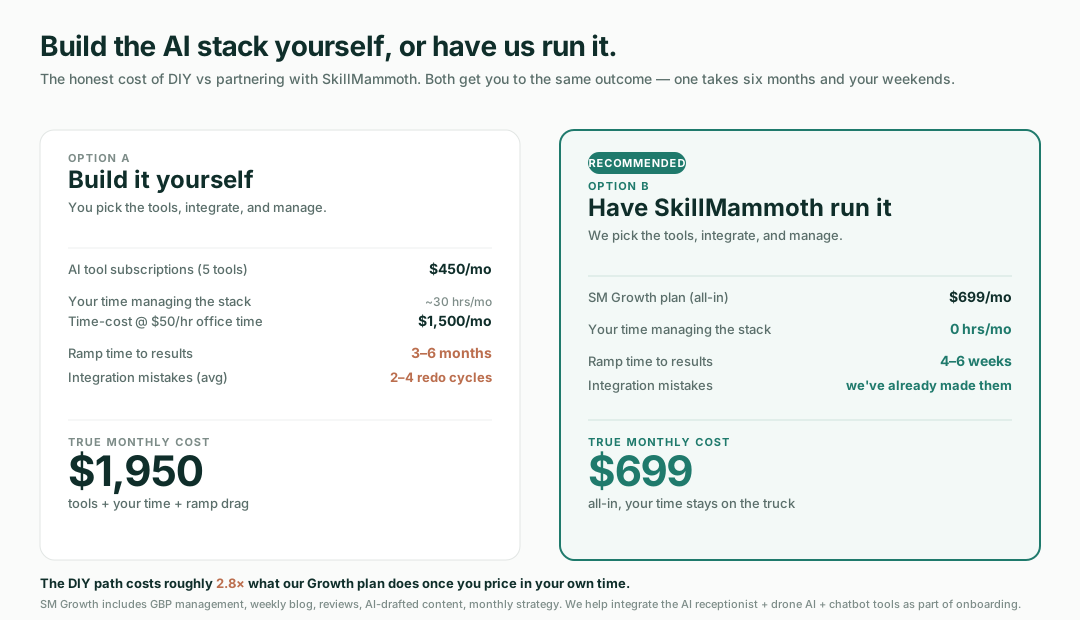 Caption: The DIY path looks cheaper on paper. Once you price your own time at $50/hr (a conservative office-staff rate) and account for ramp delays, our Growth plan is the more honest deal.
Build it yourself ($1,950/mo true cost):
- $450/mo across 5 AI tools you select
- ~30 hours/month of your time managing them = ~$1,500/mo in opportunity cost
- 3–6 months of ramp before the stack starts producing
- 2–4 redo cycles as you learn what doesn't work
SkillMammoth Growth plan ($699/mo all-in):
- We pick the tools, integrate them with your stack, and manage what we can
- 0 hours of your time on tool management
- Deployed in 4–6 weeks instead of 3–6 months
- We've already made the integration mistakes , you skip the ramp
The honest scope: Growth includes GBP management + AI-drafted weekly blog + review responses + monthly strategy. The roofer-specific tools (AI receptionist, drone AI, chatbot, claim docs) we help integrate during onboarding , you own the subscriptions, we make sure they work together. Some tools (voice-to-notes, image enhancement) are field-side and your crew adopts them directly.
That's 7 of the 9 use cases on the ROI matrix above that we deploy or actively manage for you , see the "we deploy" badges on the matrix.
If you want the actual numbers for your business , your monthly missed-call rate, your current inspection-to-quote time, your storm-event capacity , book a 30-min strategy call. We'll quote your stack on the call, no follow-up sales sequence.
For the DIY readers who'd rather build it themselves anyway
Here's the order to roll it out. Same answer either way:
3 things you should never touch (legal liability)
1. AI-generated "before damage" photos
There are tools in 2026 that can generate or modify damage photos for claims. Don't. This is insurance fraud. Carriers are increasingly running submitted photos through their own detection AI; getting caught means a denied claim, a destroyed insurance-partner reputation, and in repeated cases criminal exposure.
Even photo enhancement needs a careful line. Brightening, sharpening, color-correcting = OK. Anything that changes the actual appearance of damage = not OK.
2. Fully autonomous AI sales for reroof jobs
Some platforms in 2026 promise AI agents that qualify, quote, and close reroof jobs without a human. The brand risk is enormous , AI committing to a price or scope you can't actually deliver, hallucinating warranty terms, mis-handling financing disclosures. The labor savings don't justify the liability.
Use AI to book inspections and qualify leads. Have humans sell the reroof.
3. AI-generated team photos / stock people that aren't your team
Same rule as for HVAC and plumbing. Real photos of your real team outperform AI-generated lifestyle images by 3–5× in convert rate. The fact that an AI image is photorealistic doesn't change that , uncanny valley + customer skepticism = trust killer. For roofers specifically, your real team in branded shirts on a real roof = the strongest single trust signal available.
Implementation timeline (90 days)
A realistic order to roll AI tools out without overwhelming your team:
Week 1–2: AI assistant subscription + use it daily for office tasks, claim doc drafts, storm-event SEO. Internal only; no customer impact.
Week 3–4: AI website chatbot. Customer-facing but bounded.
Week 5–8: AI receptionist for after-hours and overflow. Test in non-storm period before storm season hits.
Week 9–12: AI drone + aerial damage assessment. Pilot on the next 10 jobs before scaling.
Week 13+: Layer review management, voice-to-notes, image enhancement as needed.
Before next storm season: Stress-test the AI receptionist + chatbot with a simulated storm-event traffic spike. You want to discover the failure modes BEFORE you actually need the capacity.
What to do this week
- Subscribe to ChatGPT Plus or Claude Pro ($20/mo). Use it daily for 14 days on office tasks. Build AI literacy before deploying customer-facing tools.
- Audit your missed-call rate. Pull 30 days of call logs. If it's over 15%, an AI receptionist is your highest-ROI next move , especially urgent before the next storm event.
- Pilot ONE drone/aerial AI tool. Hover, EagleView, or Roofr. Run it on your next 5 inspections. Compare against current process.
- Cancel any "AI-generated damage photo" or "AI claim filing" tools you're paying for. Legal liability isn't worth it.
If your website's the bottleneck (most are), grab a free website audit before bolting AI on top. We covered why that order matters in the Roofing Website Design anchor.
FAQ
Will customers know they're talking to AI?
Yes, most of the time. Disclose upfront ("Hi, this is our AI scheduling assistant , I can book a free inspection or transfer you to a roofer"). For transactional interactions, customers are usually fine with AI. For emotional ones (just had a storm, worried about the cost), have humans handle as soon as possible.
Is AI drone-roof-inspection accurate enough for insurance claims?
In 2026, the leading tools (Hover, EagleView AI, CompanyCam AI) are ~85–95% accurate at identifying damage types from aerial imagery. That's good enough for a draft assessment but not good enough to submit to an adjuster without human review. Treat AI output as the starting point; the human roofer signs off.
What about predictive storm-damage forecasting?
Promising in theory; not yet ROI-positive for SMB roofers in 2026. The data infrastructure to make it work at the local level requires too much setup for a 5-crew operation. Worth revisiting in 2–3 years.
Can AI help me write supplemental claims?
Yes , this is one of the highest-ROI AI uses for roofers in 2026. AI drafts the supplement narrative based on photos + scope notes; you review + send. Cuts supplement drafting from 1–2 hours to 15 minutes. Use Claude Pro or ChatGPT Plus with a custom prompt library trained on your past successful supplements.
What about ServiceTitan's AI features for roofers?
ServiceTitan's AI features are improving fast. If you're already on ST, turn them on. If you're on AccuLynx, JobNimbus, or Roofr's CRM, the equivalent AI is usually similar or better. Don't switch FSMs just for AI , the migration cost is too high.
How does AI fit into storm-chasing operations?
If you do legitimate storm restoration work, AI is a force multiplier , better intake (AI receptionist), faster inspection (AI drone), faster claim docs (AI claim assistant). If you're a predatory storm chaser cutting corners, AI tools that fake damage or auto-file fraudulent claims are exactly what carriers + state AGs are building detection systems for. Stay on the legitimate side.
Can AI replace my office staff?
No. AI augments office staff , drafts emails, transcribes notes, generates claim docs, handles overflow calls. Real dispatching, customer relationships, escalation handling, and judgment calls still need humans. The right mental model: AI gives a 3-person office the throughput of a 6-person office without the payroll.
How accurate is AI claim documentation?
Roughly 85–92% in 2026 for first-draft Xactimate-style descriptions. Human review catches the gaps. Don't skip review.
What's the single biggest AI mistake roofers make?
Deploying customer-facing AI on top of a website or phone system that doesn't already convert. AI is a multiplier on a foundation that works. If your website converts at 1% and your missed-call rate during storms is 60%, fix those first; then layer AI on top.
Will AI hurt my Google rankings if I use it for content?
If you publish AI content without editing, yes , Google's helpful-content updates penalize generic AI output. If you use AI as a first draft and edit for accuracy + voice, no. The roofers ranking well in 2026 use AI; they just don't ship the raw output.
Related reading: our roofing SEO playbook covers the ranking side that pairs with AI automation.
Also in the AI for trades series: AI for pest control, AI for HVAC, AI for roofers, AI for electricians, and AI for lawn care.
Want to implement these strategies?
Book a free strategy call and learn how we can help grow your contractor business.
Book a Free Strategy Call