TL;DR
Financial advisor SEO is easier than the guides make it sound and harder than the vendors admit. Easier, because the local results are thin: in seven live Minneapolis queries in September 2026, independent RIAs held 34 of 63 page-one organic slots, and the most-reviewed firm in any map pack had 46 reviews. A firm with nine reviews sat in five of six packs. Harder, because every testimonial, rating and review on your site is now an advertisement under the SEC Marketing Rule, the SEC fined nine firms $1.24 million in one September 2024 sweep for getting that wrong, and the template vendors that build most advisor sites do not mention it on their pricing pages. Kitces' 2026 research puts SEO's cost at $0.45 per dollar of new revenue, against $4.88 for social media, and a client at the 1 percent fee on the median $500,000 household is worth $5,000 a year for the decade that 97 percent of RIA clients stay. Seven moves ranked below, what the rule allows, and what the vendors charge.
Most of what ranks for "financial advisor SEO" was written by Schwab, SmartAsset or a national agency, for firms with a marketing department and a compliance officer down the hall. A solo RIA reading it learns to blog weekly and ask for reviews, and never learns that a Google review republished on the homepage without a disclosure is exactly what the SEC's December 2025 Risk Alert describes. This guide is for the independent advisor: which terms are winnable, what the rule permits, and what one ranked page is worth.
It sits alongside our contractor SEO guide for the mechanics of local search that carry over, and the consultants and coaches page, which is where we work with advice businesses.
What the Minneapolis results actually show
Seven queries, Google's live results with the searcher placed in Minneapolis, depth ten, September 24, 2026. Each organic result was classified as an independent RIA, a directory or aggregator, or a large firm.
| Query | US searches per month | Map pack | Independent RIAs in top 9 | Directories | Large firms |
|---|---|---|---|---|---|
| financial planner near me | 14,800 | Yes | 1 | 4 | 4 |
| financial advisor minneapolis | 390 | Yes | 4 | 2 | 3 |
| financial advisor for physicians | 260 | No | 5 | 3 | 1 |
| wealth management minneapolis | 140 | Yes | 5 | 0 | 4 |
| fiduciary financial advisor minneapolis | 50 | Yes | 5 | 3 | 1 |
| fee only financial advisor minneapolis | 30 | Yes | 7 | 2 | 0 |
| retirement planning minneapolis | 30 | Yes | 7 | 1 | 1 |
| Verdict | Independents hold 24 of 36 slots on the modifier queries and 1 of 9 on the generic one. Add a word to the term and the page opens up. | ||||
Three details from the raw results are worth more than the table.
The map pack is nearly empty. Across the six local queries, the most-reviewed firm in any pack is Quarry Hill Advisors with 46 reviews, and every other pack entry has 13 or fewer. Allodium Investment Consultants, at 5.0 stars on nine reviews, appears in five of the six packs. A Portland, Oregon firm whose banner reads "PORTLAND, OREGON + BEYOND" sits in the Minneapolis pack for four queries with nine reviews. In most trades a nine-review profile ranks nowhere. In wealth management it wins the pack, because almost nobody asks.

The modifier is the whole game. "Fee only financial advisor minneapolis" and "retirement planning minneapolis" each returned seven independents in nine slots. "Financial planner near me", at 14,800 US searches a month, returned one independent, a listicle. That listicle, on a content site run by a local RIA, appeared on six of the seven queries. One firm built a second site of "top 14" lists and now ranks for everything.

Five of nineteen page-one independents run on advisor template vendors, three on Twenty Over Ten and two on Advisor Websites. Seven are on WordPress, three on Wix. The templates are not stopping anyone from ranking on the modifier queries, and they are not helping.
The compliance layer
The SEC Marketing Rule took effect for compliance on November 4, 2022. It allows testimonials and endorsements for the first time under conditions, and the conditions are where the fines are.
| You want to | What the rule says | Source |
|---|---|---|
| Put a client quote on the site | Allowed. Disclose within the quote, "clearly and prominently", whether the person is a current client, whether they were compensated in cash or anything else, and any material conflict. A hyperlink to the disclosure fails the standard, and the disclosure "must be at least as prominent as the testimonial". | Rule 206(4)-1(b); adopting release p. 90, quoted in the December 2025 Risk Alert |
| Give a client a gift card for a review | That is compensation and it must be disclosed. The de minimis exemption is $1,000 per promoter in the trailing twelve months, cumulative, and examiners found advisers who paid under $1,000 each time and blew through it. | December 16, 2025 Risk Alert |
| Let clients leave Google reviews | Allowed without turning them into your advertisement, "so long as the adviser does not selectively delete or alter the comments or their presentation". Remove only the negative ones, or prioritise the positive ones, and they become yours. | Adopting release, pp. 23 to 24 |
| Copy Google reviews onto the homepage | Now they are testimonials. Examiners flagged advisers who did this "without clearly and prominently disclosing that those testimonials and endorsements were provided by current or former clients". | December 2025 Risk Alert |
| Show a "Best Advisors" badge | Allowed if you disclose the date, the period it covers, who created it, and whether you paid for it or for the logo. Undated ratings and paid placements without disclosure were in the September 2024 sweep. | Rule 206(4)-1(c); SEC press release 2024-121 |
| Say you are "conflict-free" or act "in the client's best interest" | Examiners cited both: the first as untrue where conflicts existed, the second as misleading without saying every adviser owes that duty. | April 17, 2024 Risk Alert |
| Put the SEC logo on the site | Cited as implying SEC approval. | April 2024 Risk Alert |
| Like or share a client's post about you (broker-dealer reps) | Under FINRA Notice 17-18, "by liking or sharing the favorable comments, the representative has adopted them" and the testimonial rules apply. | FINRA Regulatory Notice 17-18 |
| Verdict | Reviews on Google are fine if you treat every client the same. The moment a quote, rating or badge moves onto your site, the disclosure goes next to it in the same size type. | |
The enforcement record is short and expensive. September 2023: nine firms, $850,000, for hypothetical performance on public websites. April 2024: five firms, $200,000, same issue. September 2024: nine firms, $1,240,000, for untrue claims about ratings and memberships, unsubstantiated "conflict-free" language, testimonials that were not from clients, undisclosed paid endorsements and undated ratings; the penalties ran from $60,000 to $325,000 per firm. In 2025 the SEC issued no sweep and instead published a Risk Alert entirely about testimonials and ratings, which is how a regulator says what it will look for next.
Broker-dealer representatives have a second layer. Under FINRA Rule 2210 a website is a "retail communication", a registered principal must approve it before use, and a new member firm files it ten business days before it goes live. An advisor at a broker-dealer on r/CFP: "I'm at a BD so I'm heavily restricted in terms of compliance. No website access or SEO, seminars must be pre approved, no custom social media content." If that is you, the moves below still apply to the pages your firm lets you control, and your Google Business Profile is usually one of them.
What one client is worth
Kitces Research found 86 percent of firms charge primarily on assets, and 62 percent charge at least 1 percent on a $1 million portfolio. The median household in a newly launched practice holds about $500,000 of investable assets and the median in an established one $1.3 million. Schwab's 2026 benchmarking study, from 1,236 firms, reports that RIAs "have retained 97% of their clients over the past decade".
a year in advisory fees from one household at 1 percent of $500,000 to $1.3 million, for a relationship that lasts a decade 97 percent of the time
An RIA owner who left a wirehouse for his own firm wrote on r/CFP in September 2025 that his site now produces "over 100 organic new potential clients scheduling meetings on our calendar from our website every year", closing above 50 percent, with "average household revenue for new clients in 2025 is $6500-7000 per year". Kitces' 2026 marketing report, from 506 advisors, puts the typical cost of acquiring a client at $2,551 and ranks the channels by dollars spent per dollar of new revenue: online directories $0.28, client referrals $0.34, SEO $0.45, centers of influence $0.72, blogging $1.64, seminars $1.76, newsletters $4.14, social media $4.88. In its 2022 report the same research called SEO "the best-performing tactic under both measures" and noted it was used by 29 percent of practices.
Want to know which of these terms your firm can win?
We will pull the live results for your city, show you who holds the pack and the modifier queries, and send a written plan. Free, and nothing on it needs compliance approval to read.
Seven moves, ranked by clients per dollar
1. A page for each modifier you can honestly claim
Fee-only, fiduciary, retirement planning, wealth management, each plus your city. Independents hold 24 of the 36 page-one slots on those in Minneapolis and the volumes are small enough that nobody big bothers. "Fee-only" is a regulated claim, so the page needs to be true, and the People Also Ask box on four of seven queries is the same question, "Is $500,000 enough to work with a financial advisor?", which means the page that answers it plainly, with your minimum and your fee, earns the box. Laurel Wealth Planning's homepage says the city in the headline and "160+ people currently planning their financial future with us" under the button. That is a client count, which needs no disclosure, doing the work a testimonial would.
2. A niche page with the niche in the URL
"Financial advisor for physicians" gets 260 US searches a month, returns no map pack, and independents hold five of nine slots, including a solo firm's own list of the best advisors for physicians. "Financial advisor for dentists" is 170 searches at a $25.09 click, "for teachers" 110. Kitces' data says the businesses that pay most for advice pay more for a specialist, and the search results say the specialist pages are half empty. Pick the niche you already serve and write the page you would want to send a referral.
3. A Google Business Profile with a written review policy
Category "Financial planner" or "Financial consultant", with "Investment service" as a secondary. Then the review question, which is the one advisors get wrong in both directions. The adopting release is clear that unsolicited reviews you do not curate are not your advertisement. So the policy is: every client gets the same link at the same point in the relationship, nobody gets a gift card, nobody gets asked twice, and nothing gets deleted. Get that policy approved by your compliance reviewer in writing before the first request. Nine reviews put Allodium in five packs. Twenty would put you in every one.
4. The directories that charge a subscription, not a share
Kitces ranks online advisor directories the most efficient channel in the 2026 report at $0.28 per dollar of new revenue, because "the subscription fees are modest relative to the revenue of even a single client" and they take almost no advisor time. In Minneapolis, Fee-Only Network is first organically for both "fee only financial advisor minneapolis" and "financial planner near me", and the FPA's PlannerSearch and NAPFA's finder are on page one for four and one queries respectively. A listing on each is a page-one presence you did not have to build, and the profile links to the modifier page you did.
5. Content you wrote, on a domain you own
Advisors on r/CFP describe the template libraries the same way. On FMG and Snappy Kraken: "It looks just like every other site your prospect will hit." On the pre-approved articles: "Their content is very canned and feels that way." A third asked whether Google "penalizes your site for copying the same content as 100 other sites", and the answer is that it filters it, which for ranking purposes is the same thing. The pages that rank in Minneapolis are the ones with a specific claim in them: a city, a client count, a niche, a fee. Write one page a month that answers a question a prospect actually asked you, run it past compliance, and keep it. A Guardian Wealth Strategies content site built that way now ranks on six of our seven queries.
6. A referral plan that is written down
Schwab's study reports referrals produce 67 percent of new clients and that firms with a client referral plan "generated 1.6x more new client assets than those without", and that only 44 percent of firms over $250 million have one. Firms with a written marketing plan attracted 87 percent more new clients. The SEO work above is what makes a referral convert: the prospect who was told your name searches it, and finds the modifier page, the profile with twenty reviews and the niche page for their profession. Pure Financial's CEO on referral close rates: "if you get a referral from a really good client, your closing ratio is 70% to 80%."
7. Paid leads, last and with your eyes open
SmartAsset's Advisor Marketing Platform is reported at $25,000 a year on six or twelve month commitments, with pricing behind an intro call. Pure Financial paid SmartAsset $10 million over about two years, converted 3.5 percent of the leads and added $1 billion in assets, and its CEO described the experience as "Short term, you're going broke, but long term, you're going to be very profitable." Smaller firms on r/CFP describe the other side: "90% of leads don't respond and those that do weren't interested in speaking with a financial advisor"; "We're just finishing our 3rd month and have ZERO conversions"; "we pay $200 plus per lead". Datalign prices by auction and does not publish a number. Zoe and the referral networks take a share of revenue for the life of the client, which Kitces calls "substantially more costly in dollar terms" than it looks. Paid leads can work for a firm with a nine-person business development team. For a solo advisor the organic work above costs less per client and the client already knows your name.
What to skip
- The generic "near me" blue links. One independent in nine, and it was a listicle. Win the map pack for that query instead, which needs a profile and reviews, not a page.
- Reviews copied to the site without the disclosure. The most common finding in the December 2025 Risk Alert. If you republish one, the current-client and no-compensation disclosure goes inside the quote, in the same size.
- Gift cards for reviews, referral gifts that add up. $1,000 per person per trailing year, cumulative. Track it.
- "Conflict-free", "seen on" and the SEC logo. All three were named in the April 2024 Risk Alert and the first was in the September 2024 fines.
- Hyperlinked disclosures and grey footnotes. Examiners cited disclosures in "a smaller or lighter font" and "at the bottom of the website pages away from the actual ratings".
- Template articles as your content plan. The prospect has seen them on the last three advisor sites they opened, and so has Google.
What the advisor website and SEO vendors charge
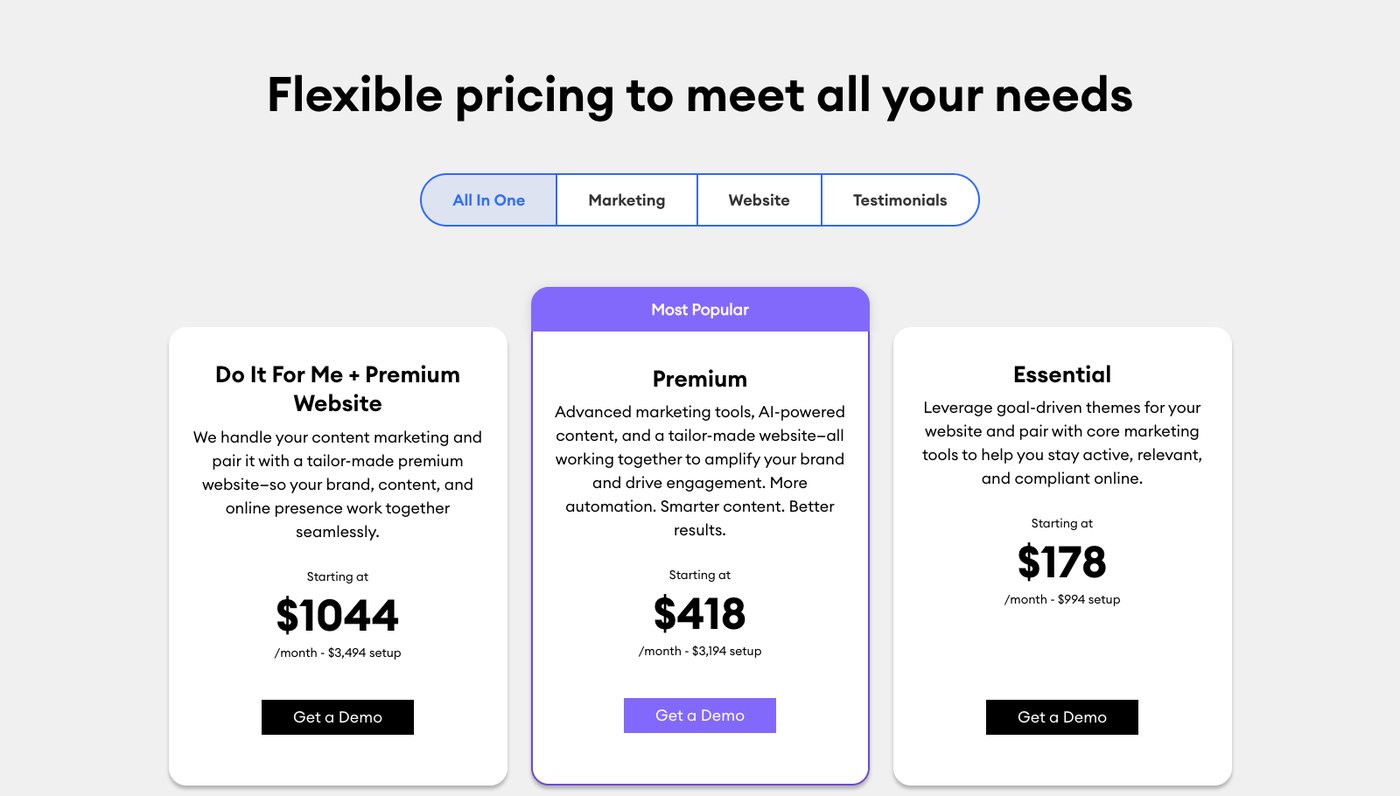
Published prices as of September 24, 2026, quoted exactly. Twenty Over Ten's pricing page now says it is part of FMG; Advisor Websites' pricing page redirects to Snappy Kraken, which acquired it in 2022.
| Vendor | Published price | Notes |
|---|---|---|
| FMG | All-in-one from $178 a month plus $994 setup; website alone from $149 a month plus $2,995 setup; testimonials add-on $99 a month | "One-Click Compliance" is a submission workflow to your own reviewer. Six themes on the entry tier. Archiving not mentioned. An advisor on r/CFP reported being sent to collections after a cancellation dispute. |
| Snappy Kraken | Websites from $99 a month plus $499 setup; with campaigns, bundles from $298 a month plus $698 setup, on an annual term | "Built-In Compliance" and "Broker Dealer Configuration" listed. Archiving not mentioned. |
| Broadridge Advisor Solutions | Websites from $75 a month; bundled with digital marketing from $225 | Compliance workflows only in the Enterprise tier. An advisor at a firm using it: "optimized for compliance" and "a very clunky interface". |
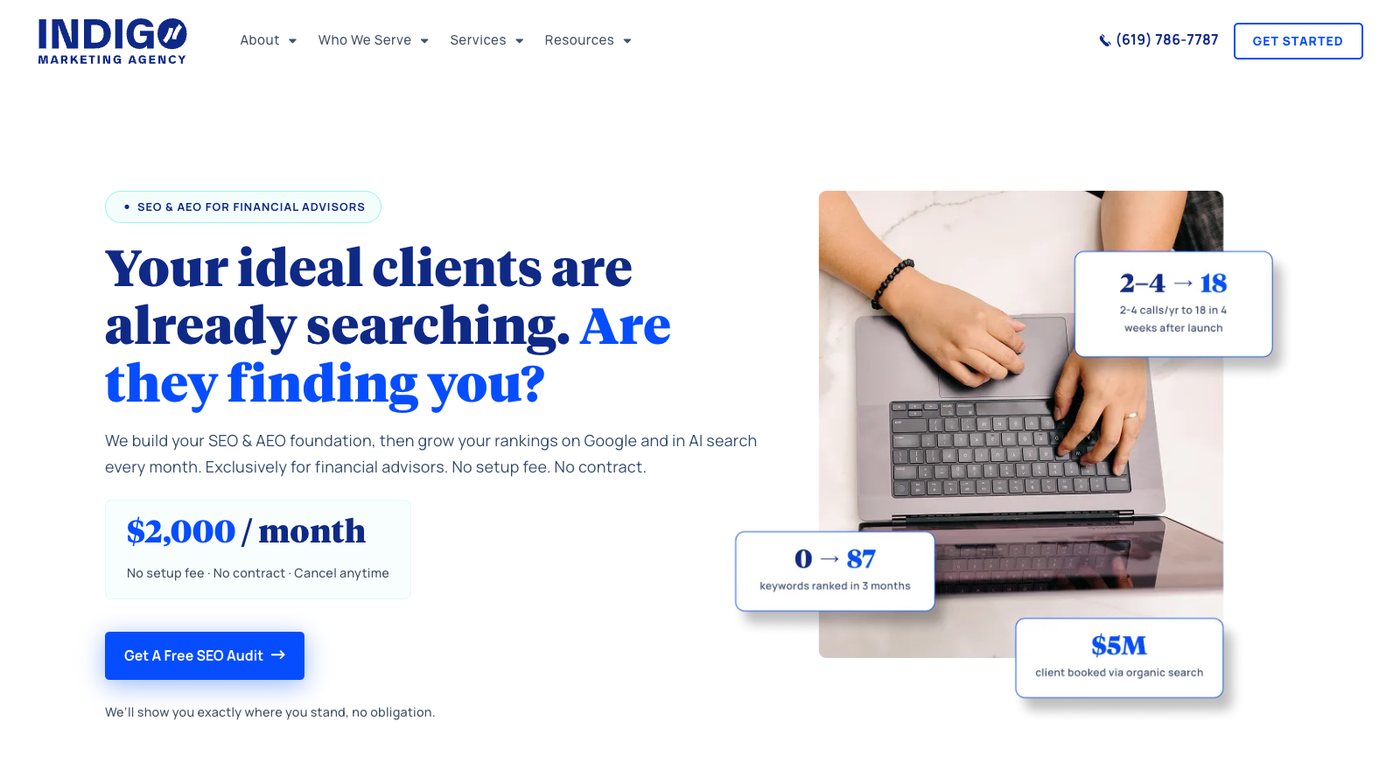
| Indigo Marketing Agency | SEO $2,000 a month, no setup fee, no contract; full marketing $1,450 to $3,000 a month plus $4,000 to $5,000 setup | Advisor-only agency. Compliance review not listed as included. |
| AdvisorSEO Max | $199 a month or $1,990 a year, 14-day trial | Software, not a service: audits, rank tracking and "compliance-aware" copy suggestions. Its own table prices agencies at $2,000 to $5,000 a month. |
| Simple SEO Group, Carson Group | Not published | Both route to a consultation. Simple SEO Group ranks first for "financial advisor seo" and does not say what it charges. |
| Verdict | A template is $75 to $178 a month and looks like the other templates. Advisor-specialist SEO is $2,000 a month. Neither includes the archiving your compliance program requires, so price that separately. | |
The template vendors solve the compliance workflow and leave the ranking to you, which is the wrong way round for a firm that already has a compliance reviewer. Our local SEO service does the modifier pages, the profile and the niche content, and every page goes to your reviewer before it goes live. The free SEO audit will show you which of the seven moves you are missing, and whether anything on the current site would catch an examiner's eye.
Want the modifier pages and the pack handled, with compliance in the loop?
Fee-only, fiduciary and niche pages, a Google Business Profile with a written review policy, and content that goes to your reviewer first. Ten-minute audit, then a plan.
Related reading
- Insurance agency SEO, the same local-versus-national split without the marketing rule.
- Accounting firm website design, for what the template trap looks like in the other advice profession.
- Contractor SEO: the complete 2026 guide, for the mechanics.
- How to optimize your Google Business Profile.
Frequently asked questions
Can a financial advisor ask clients for Google reviews?
Yes, if every client gets the same opportunity and the adviser does not compensate them, curate the results or remove negative ones. The SEC's adopting release says unsolicited third-party commentary is not the adviser's advertisement "so long as the adviser does not selectively delete or alter the comments". Get the policy approved by your compliance reviewer in writing first.
Can a financial advisor put testimonials on a website?
Since the Marketing Rule's November 2022 compliance date, yes, with disclosures inside the testimonial stating whether the person is a current client, whether they were compensated and any material conflict. The disclosure cannot be a hyperlink and must be at least as prominent as the quote. Nine firms paid $1.24 million in September 2024 for getting this wrong.
Which keywords should a financial advisor target?
Modifier terms plus your city: fee-only, fiduciary, retirement planning, wealth management. In Minneapolis, independent RIAs hold 24 of 36 page-one slots on those and 1 of 9 on "financial planner near me". Niche terms such as "financial advisor for physicians" (260 US searches a month) have no map pack and five independents on page one.
How many Google reviews does a financial advisor need to rank in the map pack?
Fewer than in any other local business we have measured. In six Minneapolis queries, the most-reviewed map-pack firm had 46 reviews and a firm with nine reviews at 5.0 appeared in five of six packs. Twenty honest reviews gathered under a written policy would place a firm in nearly every pack in the city.
What is one advisory client worth?
At the 1 percent fee that 62 percent of advisors charge on a $1 million portfolio, a median $500,000 household is $5,000 a year and a $1.3 million household $13,000, for a relationship that Schwab's benchmarking says lasts a decade 97 percent of the time. Kitces puts the 2026 cost of acquiring a client at $2,551 and SEO's cost at $0.45 per dollar of new revenue.
How much do financial advisor website and SEO vendors charge?
FMG's all-in-one starts at $178 a month plus $994 setup, Snappy Kraken websites at $99 a month plus $499 setup, and Broadridge at $75 a month. Indigo Marketing Agency charges $2,000 a month for advisor SEO with no contract, and AdvisorSEO Max is $199 a month for software. Simple SEO Group and Carson do not publish prices, and none of the vendors include compliance archiving.