TL;DR (answer-first)
For most HVAC contractors, Google Local Service Ads win. They charge per lead instead of per click, they sit above every other paid and organic result, and the Google Verified badge lifts close rates. Google Search Ads are the next best paid channel when you need volume beyond what LSAs supply, and Facebook or Instagram ads are useful for seasonal offers and replacement demand, not for someone whose AC just died at 4 p.m.
Rough cost per lead in 2026: LSAs $25 to $80, Google Search Ads $60 to $200, Facebook $40 to $150, display and retargeting cheap per click but low intent. The number that actually matters is cost per acquired customer, and that is where LSAs usually pull ahead.
One disclosure up front: SkillMammoth manages Google Local Service Ads, Google Ads (PPC), and Meta ads, so we have a horse in this race. The guide still covers every channel factually, including the ones where the honest answer is to spend nothing.
The HVAC advertising landscape in 2026
There are four paid channels that matter for HVAC, and they are not interchangeable. They differ on intent, on pricing model, and on how fast the money turns into a booked job.
- Google Local Service Ads. Pay per lead. Top of the page. Requires background check and license verification. Highest intent available.
- Google Search Ads. Pay per click. Below LSAs. High intent, but you pay for clicks that never call.
- Facebook and Instagram ads. Pay per impression or click. No active intent. Good for offers, financing, and replacement season.
- Display and retargeting. Cheapest traffic, lowest intent. Only worth running against people who already visited your site.
HVAC advertising cost per lead by channel
Google Local Service Ads: the top pick for HVAC
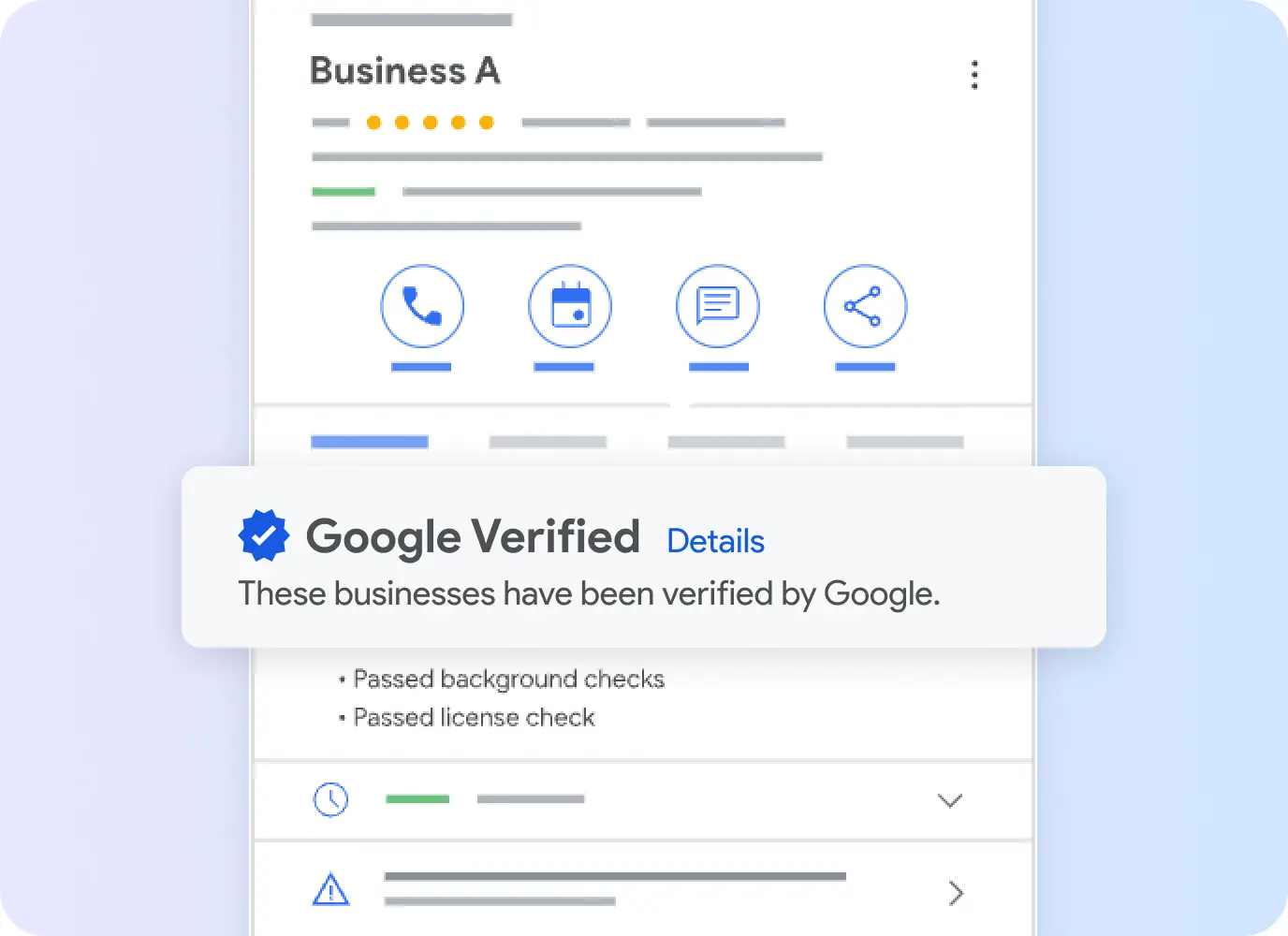
LSAs are the only HVAC advertising channel where you pay for a lead rather than a click. Google verifies your license and insurance, runs a background check, awards the Google Verified badge, and then places you above the search ads and above the map pack. On a phone, that is the entire first screen.
What makes them work for HVAC specifically:
- Emergency intent. "AC not cooling" searches convert on the first call. Being first on the screen is most of the battle.
- Lead-based pricing. A tire-kicker click costs nothing. You pay when someone calls or messages.
- Dispute process. Wrong-number and out-of-area leads can be disputed and credited, which lowers effective cost per lead.
- Trust transfer. The badge does work that your brand cannot do in a two-second scan.
The catch: LSA volume is capped by search demand in your service area, and rankings inside the LSA block are driven by review score, review count, responsiveness, and proximity. It is a channel you can improve, not just buy.
Deeper reading: Google Verified for contractors, Local Service Ads cost, and the free LSA cost calculator. Managed service: Local Service Ads management.
Google Search Ads (PPC)
Search Ads are the pay-per-click ads marked "Sponsored" that sit below the LSA block. They give you control that LSAs do not: keyword targeting, ad copy, landing pages, negative keywords, and dayparting. That control is also the cost, because they demand real management to avoid wasting money.
Where they earn their place: high-ticket replacement and install campaigns, commercial HVAC, and markets where LSA inventory runs out before your capacity does. HVAC click costs commonly run $8 to $30 in competitive metros during peak season, so at a 10 to 15 percent lead rate you land in that $60 to $200 cost-per-lead band.
Where they hurt: broad match keywords, no negative keyword list, sending clicks to a homepage, and running without call tracking. Those four mistakes account for most of the "we tried Google Ads and it did not work" stories in this trade.
Where we sit: we start HVAC budgets on LSAs because the cost-per-acquired-customer math wins, and we run Google Ads (PPC) and Meta for the demand LSAs cannot reach: branded search, research-phase queries, and homeowners who are not searching yet.
Facebook and Instagram ads
Meta ads reach people who are not searching, which makes them the wrong tool for emergency repair and a reasonable tool for planned replacement. Nobody scrolling Instagram is having an HVAC emergency. But a homeowner with a 16-year-old system does respond to a financing offer, a spring tune-up special, or a heat pump rebate explainer.
What tends to work: a clear seasonal offer, real photos or short vertical video of your crew, local geo-targeting tight to your service radius, and a lead form that hands off to a human in minutes. What tends to fail: generic "we do HVAC" brand ads with no offer and no follow-up system behind them.
Also worth knowing: the Meta Ad Library is public. You can search any competitor and see every ad they are currently running, for free. It is the best competitive research tool in advertising and almost nobody in the trades uses it.
As with PPC, this is not a service we offer. We are describing the channel so you can judge it.
Why LSAs win for most HVAC contractors
Compare channels on cost per acquired customer, not cost per lead. That is where the LSA math separates.
Run the arithmetic with round numbers. Say LSAs deliver leads at $55 and you book 35 percent of them: that is roughly $157 per booked job. Say Search Ads deliver leads at $120 and you book 25 percent of them, because a share of those leads are researchers rather than buyers: that is $480 per booked job. Even if your real numbers differ, the shape holds, because the LSA lead arrives having already chosen a verified, badged, top-of-page contractor.
Three structural advantages compound that:
- Position. Above search ads and above the map pack on mobile.
- Verification. The badge answers "are these people legitimate" before the call starts.
- Bad-lead credits. Spam and out-of-area leads can be disputed, which no click-based channel offers.
The honest limit: LSAs cannot scale past local demand. When you have exhausted LSA volume and still have capacity, that is the moment Search Ads earn their budget.
Local and earned tactics that beat paid
The cheapest HVAC advertising is the advertising you do not pay for per lead. The local pack sits immediately alongside the LSA block, and it is earned through the Google Business Profile, reviews, and local SEO rather than bought.
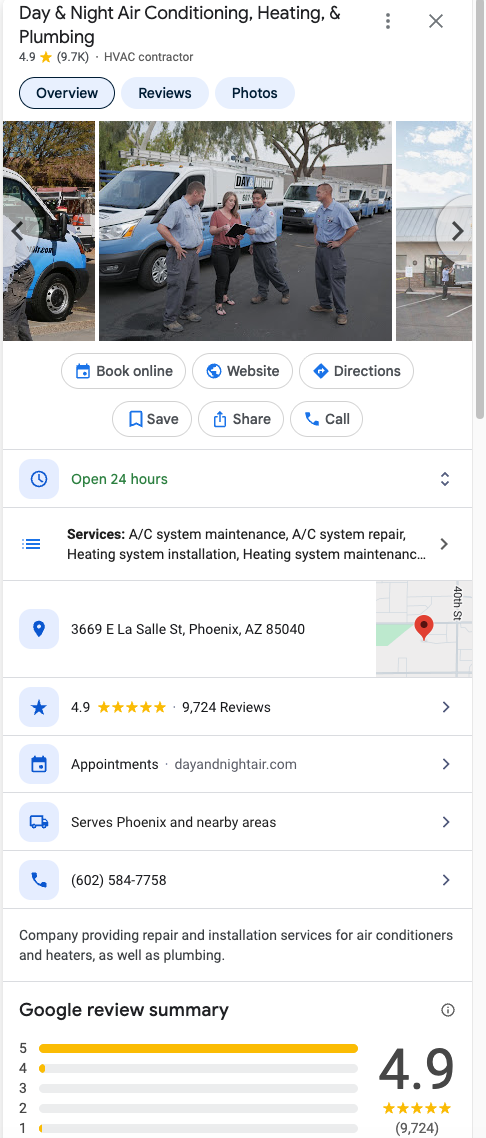
Three earned assets carry disproportionate weight: a complete and actively posted Google Business Profile, a review engine that adds reviews every week, and service and city pages that rank organically. They also feed the paid channels, because LSA ranking uses your review score and count directly.
Playbooks: HVAC SEO and 25 HVAC marketing ideas.
How much should you spend on HVAC advertising
Most healthy HVAC companies spend 5 to 10 percent of revenue on marketing, with paid advertising taking roughly half of that. Newer companies with no organic footprint run higher, established companies with strong review counts and rankings run lower.
Practical starting points by channel:
- Local Service Ads: $1,500 to $5,000 per month in a mid-size metro, scaled by capacity and season. Start at the low end and raise the weekly budget only while cost per booked job holds.
- Google Search Ads: do not start below roughly $2,000 per month plus management. Under that, there is not enough data to optimize and you are paying tuition for nothing.
- Facebook and Instagram: $500 to $1,500 per month against a specific seasonal offer, not an always-on brand campaign.
- Retargeting: $200 to $500 per month, only once you have meaningful site traffic to retarget.
Two rules before you increase any budget. First, fix conversion: buying traffic for a site that converts at 1.5 percent is the most expensive mistake in this list, and a free website audit will tell you where you stand. Second, track cost per booked job by channel, not cost per lead, or you will optimize toward the cheapest leads instead of the most profitable customers.
Season matters too. HVAC demand spikes with the first heat wave and the first cold snap. Front-load budget into those windows and pull back in the shoulder seasons rather than spending evenly across twelve months.
Want help sizing this? See pricing or book a strategy call.
Six HVAC advertising mistakes that waste budget
Most of the money lost in HVAC advertising is lost in the same handful of ways, and none of them are exotic.
- Sending paid traffic to the homepage. Someone who searched "emergency ac repair" should land on a page about emergency AC repair with a phone number at the top, not on a general homepage with a carousel. This one change routinely doubles conversion on the same spend.
- No call tracking. Without a unique number per channel, you cannot tell which channel produced the booked job, so you optimize on lead counts and quietly fund the worst performer.
- Ignoring what happens after the lead arrives. A 30-minute callback on a lead you paid $60 for is the most expensive habit in the trade. Speed-to-lead is an advertising decision, not an office decision.
- Running flat budgets year round. HVAC demand is spiky. Spending the same amount in April and July means underspending during the weeks that would have paid best.
- Neglecting reviews while buying leads. LSA ranking uses review score and count directly, so a weak review profile raises your effective cost per lead on the channel you are paying for.
- Judging a channel in two weeks. Give any channel at least 60 to 90 days and enough volume to produce meaningful data before you decide, especially outside peak season.
Fix these before you add budget. A channel that looks broken is usually a conversion or follow-up problem wearing an advertising costume.
Related reading
- HVAC marketing services
- HVAC marketing consultant
- Lead generation for HVAC
- 25 HVAC marketing ideas that work
The search-campaign structure, keyword tiers, and negative list are worked through in Google Ads for plumbers, and they transfer to HVAC almost line for line.
Meta gets its own treatment in Facebook ads for contractors: $31 leads, which trades they pay for, and the 60-second follow-up rule.
FAQ
How much does HVAC advertising cost?
Cost per lead runs roughly $25 to $80 on Google Local Service Ads, $60 to $200 on Google Search Ads, and $40 to $150 on Facebook and Instagram. Most HVAC companies spend 5 to 10 percent of revenue on total marketing, with about half of that going to paid advertising.
Are Local Service Ads better than Google Ads for HVAC?
For most HVAC contractors, yes. LSAs charge per lead instead of per click, appear above Search Ads, carry the Google Verified badge, and allow you to dispute bad leads. Search Ads make sense when you have exhausted LSA volume, or for install and commercial campaigns that need keyword-level control.
Do Facebook ads work for HVAC companies?
They work for planned purchases, not emergencies. Seasonal tune-up offers, financing promotions, and heat pump rebate campaigns perform reasonably. Someone whose AC just failed is on Google, not Instagram, so Meta is a supporting channel rather than a primary lead source.
What is the cheapest way to advertise an HVAC business?
Earned channels: a fully optimized Google Business Profile, an automated review engine, and local SEO. They cost time rather than cost per lead, they compound, and they also improve your paid performance because LSA ranking depends on your review score and count.
What is the Google Verified badge worth?
It is the trust signal on Local Service Ads, backed by Google's own lead guarantee up to the job amount. Contractors commonly see meaningfully higher call and close rates against unbadged competitors, because it removes the legitimacy question before the phone rings. See Google Verified for contractors.
When should an HVAC company advertise?
Weight budget toward demand spikes: the first sustained heat wave, the first hard cold snap, and the shoulder weeks when homeowners book tune-ups. Prewrite the creative and the budget bump so you can trigger a surge campaign the morning a heat advisory hits rather than building it that week.
How do I know if my HVAC advertising is working?
Track cost per booked job by channel, not cost per lead. That means a unique tracking number per channel, source tags on every form, and a monthly review tying spend to jobs closed. Without it, budget decisions are guesses. See marketing attribution for contractors.
Does SkillMammoth run Google Ads or Facebook ads?
Yes. We manage Google Local Service Ads, Google Ads (PPC), and Meta ads, on flat monthly fees with no contracts. For most HVAC companies we start with LSAs because cost-per-acquired-customer runs 40 to 60% lower, then add PPC and Meta when there is budget for more volume.
Want to implement these strategies?
Book a free strategy call and learn how we can help grow your contractor business.
Book a Free Strategy Call