TL;DR (answer-first)
The HVAC marketing ideas that actually work in 2026 are local and compounding: a fully optimized Google Business Profile, a steady flow of new reviews, a website that converts at 6 to 10 percent, Google Local Service Ads, and being the company AI assistants name when someone asks who to call. Everything else on this list is an accelerator on top of those five.
Below are 25 ideas grouped into five buckets, with real screenshots of what good looks like. If you only have budget and attention for a handful, jump to where to start at the bottom.
Want the whole system built and run for you? See HVAC marketing, check pricing, or book a strategy call.
Foundation ideas: get found
1. Fully optimize your Google Business Profile
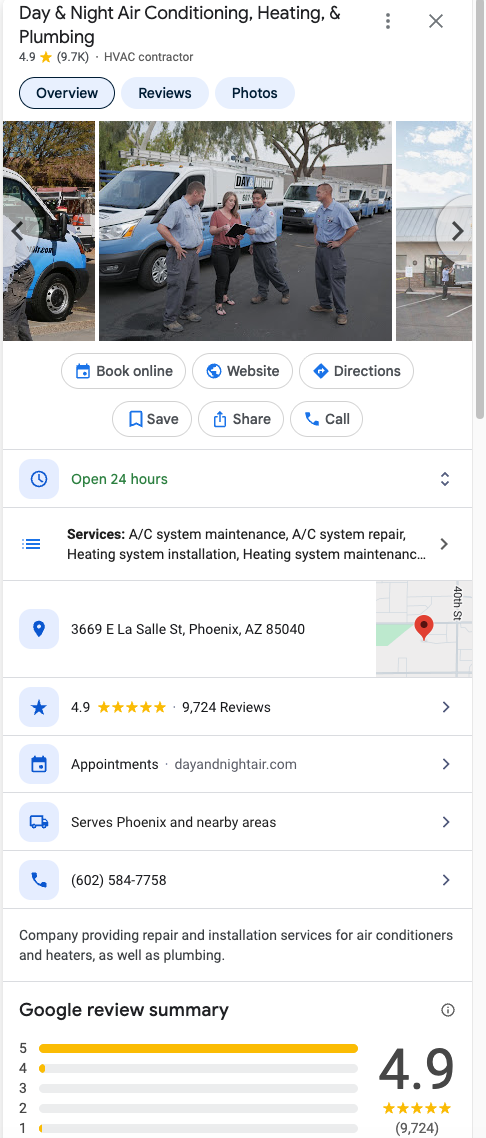
For a local HVAC company, the Google Business Profile is the highest-ROI marketing asset you own, and it costs nothing. Fill in every field: primary category (HVAC contractor), secondary categories, service list, service area, hours, attributes, and a description that names your city and your main services. Then load real photos and keep them coming.
The profile below is what a mature one looks like. Note the review count, the service list, the appointment link, and the photo depth. That is not luck, it is maintenance.
Full walkthrough: how to optimize your Google Business Profile. If you want it managed, that is part of local SEO.
2. Run Google Local Service Ads
Local Service Ads sit above every other result on a phone screen and charge per lead instead of per click. For HVAC, they are the fastest way to buy qualified calls, and the Google Verified badge does real work on close rate. Budget realistically: HVAC LSA leads typically land between $25 and $80 depending on market and season.
More: Local Service Ads management and Google Verified for contractors.
3. Build a website that converts at 6 to 10 percent
Most HVAC sites convert at 1 to 2 percent because they lead with a stock photo and a paragraph about family values. A converting site leads with the job: click-to-call in the thumb zone, a short form, service area proof, financing, and reviews visible without scrolling. Six to ten percent is achievable and it doubles your lead count without buying a single new click.
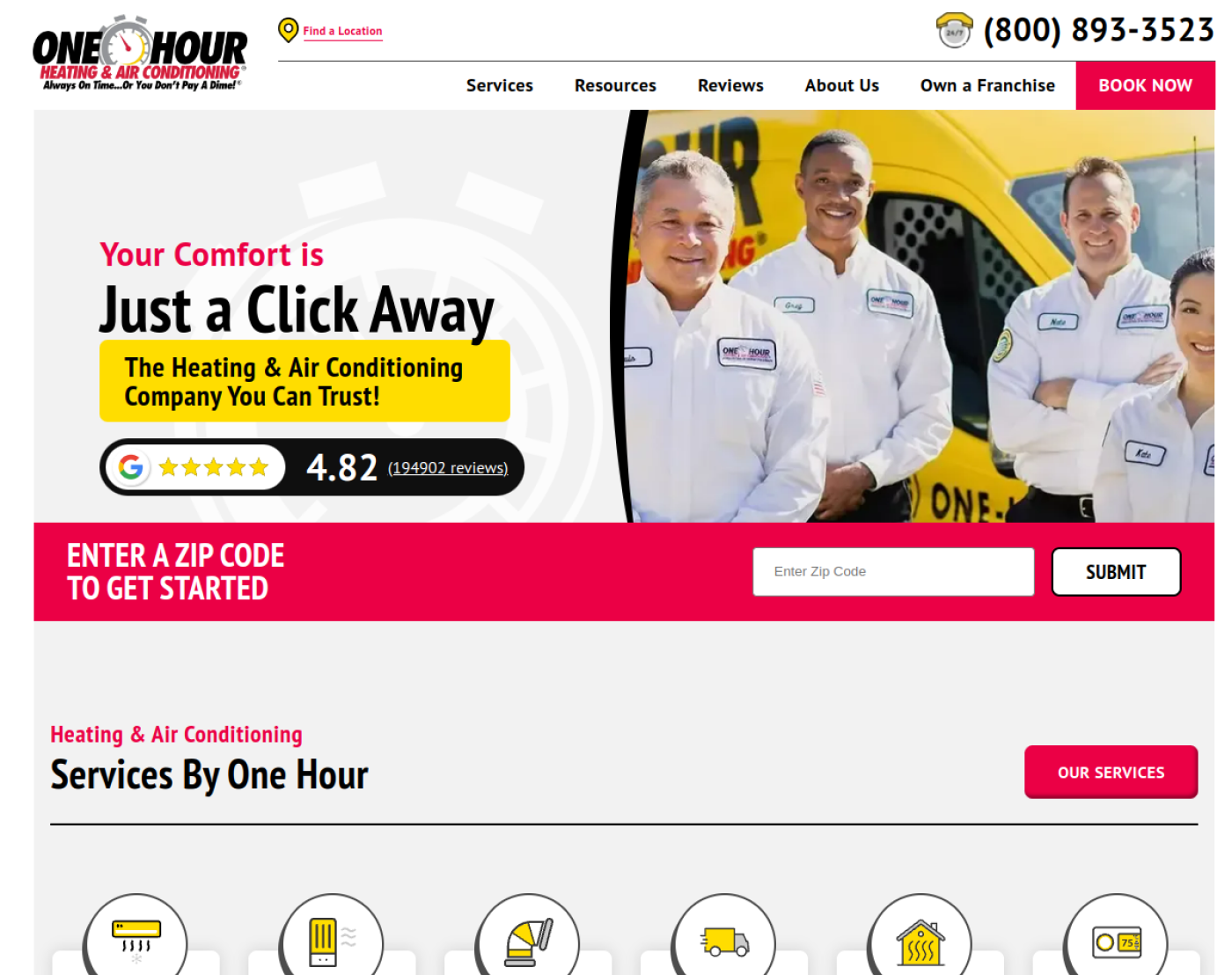
See HVAC website design for the layout patterns, or run a free website audit on your current site.
4. Nail local SEO for your city
Organic local search is the cheapest long-run lead source in the trade because it does not turn off when you stop paying. The work is unglamorous: one strong page per service, one page per city you actually serve, internal links between them, and technical hygiene so Google can crawl it all. Ranking in the map pack for "ac repair near me" in your metro is worth more than any single campaign you will run this year.
Playbook: HVAC SEO.
5. Claim and fix your citations
Your name, address, and phone number should be identical everywhere: Google, Bing Places, Apple Business Connect, Yelp, Angi, BBB, Nextdoor, and the manufacturer dealer locators you qualify for. Inconsistent NAP data is a quiet ranking drag, and it is a one-afternoon fix. Old suite numbers and disconnected tracking numbers are the two most common offenders.
Reputation ideas: build trust
6. Automate review requests after every job
Reviews do not happen because you asked once. They happen because the request fires automatically, within two hours of the tech leaving, by text, with a direct link that opens the review box in one tap. Two hours is the window where the customer still feels relief that the AC is blowing cold.
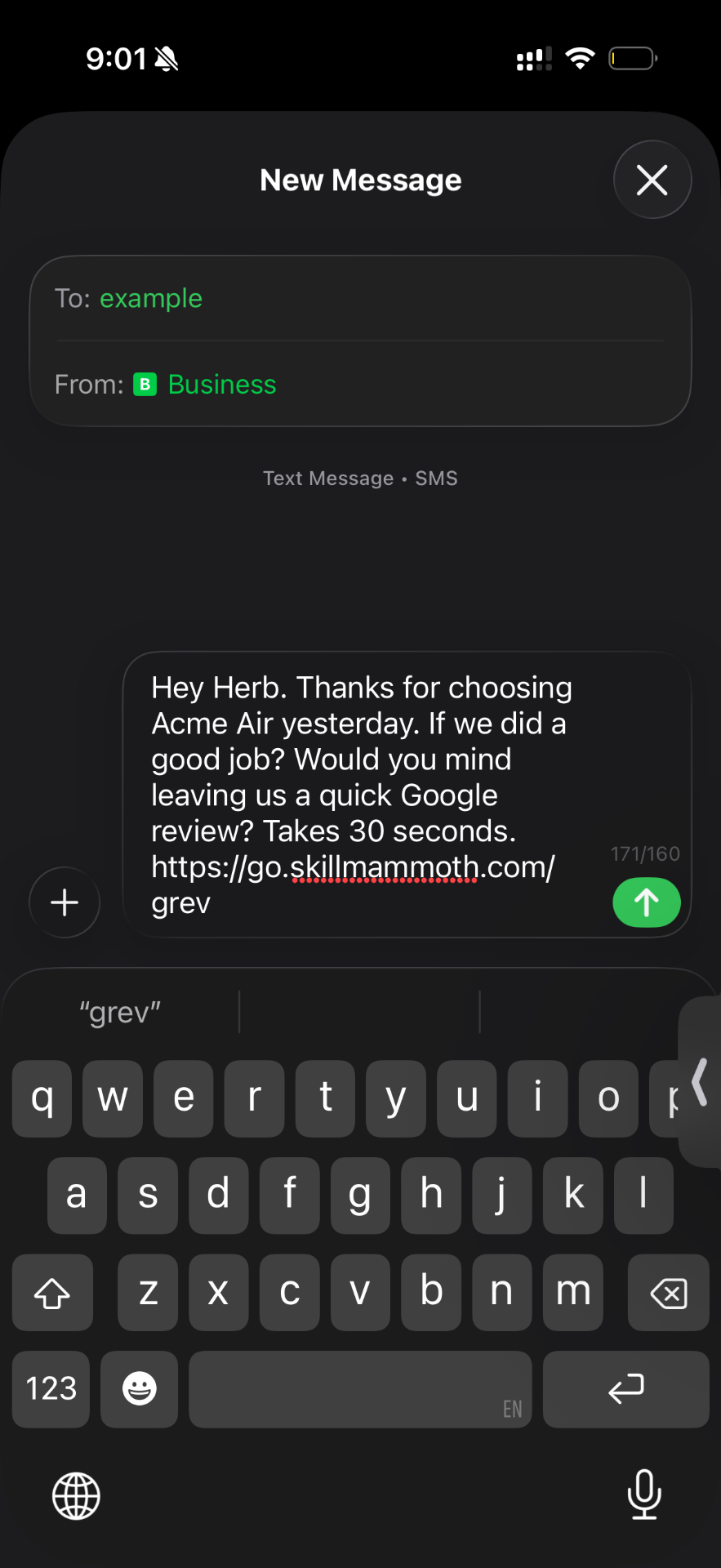
Full system: how to get 100 Google reviews.
7. Get to 100+ Google reviews
One hundred reviews is the threshold where the map pack stops being a coin flip and homeowners stop comparison shopping as hard. If you do 400 jobs a year and 20 percent of automated requests convert, you clear 100 in about 15 months from a standing start. The reviews that help most are the specific ones that name the work.
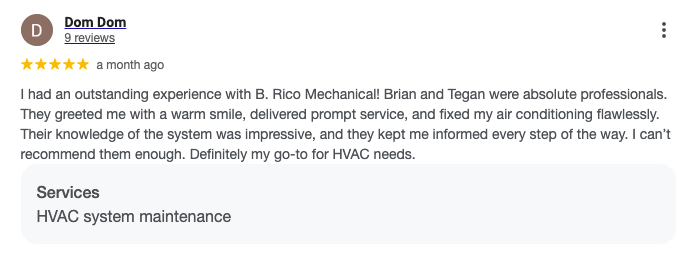
8. Respond to every review
Every one, good and bad, within 24 hours. Responses are indexed, they show prospects how you handle friction, and Google treats an active profile as a live business. For a negative review, acknowledge, state the fix, and move the conversation to a phone number. Never argue about the invoice in public.
9. Show real photos of your crew and trucks
Stock photography of a smiling model in a clean uniform reads as fake to homeowners who have been burned before. Photos of your actual techs, your actual wrapped trucks, and your actual installs are the cheapest trust asset available. Ask every tech for two photos per job and dump them into the GBP and the site gallery weekly.
10. Display manufacturer certifications and financing badges
NATE certification, factory-authorized dealer status, and consumer financing options remove three separate objections at once: competence, legitimacy, and affordability. Put them above the fold and repeat them on the estimate. A $9,000 system replacement decision hinges on payment options more often than on SEER rating.
Content and social ideas: stay visible
11. Post weekly on GBP and social
A Google Business Profile post takes four minutes and keeps the profile active: a seasonal tune-up offer, a completed install, a heat advisory reminder, a new financing option. Reuse the same asset on Facebook and Instagram. Consistency beats production value here every single time.
12. Publish seasonal content before the season
Content ranks on a lag of roughly 60 to 120 days, so the AC content has to be live in March, not July. Build a simple calendar: spring tune-up and AC prep in late winter, emergency AC repair and heat wave content in late spring, furnace and heat pump content in late summer. Publishing in the middle of a heat wave is publishing for next year.
13. Answer common customer questions on your site
Every question your CSRs answer ten times a week is a page or an FAQ block: how long does a system last, what does a new AC cost in this city, why is my unit freezing up, should I repair or replace at 12 years. These pages capture early-stage searches, they feed featured snippets, and they are the source material AI assistants quote from.
14. Get recommended by ChatGPT and AI search
A growing share of homeowners now ask an AI assistant who to hire before they ever open Google. Those answers are assembled from your reviews, your structured data, directory listings, and third-party mentions, not from your ad budget. This is a real channel now and most of your competitors have done nothing about it.
Start here: how to get ChatGPT to recommend your business, then score yourself with the free AI visibility grader.
15. Create before and after and job-site content
A rusted 20-year-old condenser next to the new install is the most persuasive image in HVAC marketing. Short vertical video of a tech explaining what failed and why performs even better. This content does triple duty: social reach, website proof, and sales collateral your comfort advisor can pull up on a tablet.
Lead and conversion ideas
16. Add an instant estimate or quote tool
Homeowners want a number before they want a conversation. A simple guided tool that collects home size, system age, and job type, then returns a realistic range and books the visit, converts browsers who would never fill in a bare contact form. Ranges are fine, precision is not the point, momentum is.
17. Set up 24/7 call capture or an AI receptionist
The AC dies at 9 p.m. in August and the first company that answers wins the job. If calls after 5 p.m. go to voicemail, you are funding your competitor's revenue. An answering service or an AI receptionist that qualifies, books, and texts the summary to dispatch pays for itself in one recovered install.
See AI and automation consulting.
18. Speed-to-lead: respond in under 5 minutes
Form fills and LSA leads decay fast. Responding within five minutes rather than thirty raises contact rates dramatically, and in a trade where three companies get contacted, first contact usually books the appointment. Route every lead to a phone that someone actually carries.
19. Offer maintenance plans for recurring revenue
Maintenance agreements smooth the shoulder seasons, create two legitimate touchpoints a year, and dramatically raise the odds you get the replacement when the system finally dies. Sell them on every service call, price them monthly, and make cancellation easy so the sale is easy.
20. Track every lead source
If you cannot say what a booked job from LSAs costs versus one from organic search, every budget decision you make is a guess. Call tracking numbers per channel, form source tags, and a monthly review of cost per booked job is the difference between marketing and gambling.
How to set it up: marketing attribution for home service contractors.
Growth ideas
21. Referral program with incentives
A $50 gift card or an account credit for a referral that books is cheaper than any paid lead you can buy. The trick is asking at the right moment: right after a successful install, in the same message thread as the review request. Track it so you know what it actually produces.
22. Neighbor canvassing after visible installs
A crane lifting a rooftop unit or a crew in the driveway all day is free attention. A door hanger on the eight closest houses that says you were just working next door converts at rates paid channels cannot touch, because proximity plus proof is the whole pitch.
23. Partner with realtors and property managers
Realtors need fast inspection-repair turnarounds and property managers need reliable volume. Both are relationship sales, not ad buys. One property manager with 200 doors can be worth more than an entire quarter of paid spend, and the work is countercyclical to your retail season.
24. Storm and heat-event surge campaigns
Have the assets prewritten: a GBP post, an email, a social graphic, and an LSA budget bump you can trigger the morning a heat advisory hits. The companies that win surge weeks are the ones that did not have to write anything on the day.
25. Retarget past website visitors
Most visitors leave without calling, and replacement decisions take weeks. Inexpensive retargeting keeps your name in front of the people who already showed intent, which is a far better audience than a cold local interest list. Keep the creative simple: financing offer, review count, phone number.
HVAC marketing plan: where to start
If you only do five things, do these, in this order. This is the shortest credible HVAC marketing plan we can give you.
- Google Business Profile. Free, fastest to move, biggest local impact. Complete every field this week.
- Reviews on autopilot. Automated text request within two hours of every job, plus responses to all of them.
- A website that converts. Fix the homepage and the service pages before you buy more traffic.
- Local Service Ads. Turn on paid demand once the profile and site can convert it.
- AI search visibility. Get named by ChatGPT and AI Overviews before your competitors notice the channel exists.
Sequence matters. Buying leads into a site that converts at 1.5 percent is how contractors conclude that marketing does not work. Fix conversion, then buy volume.
Budget guidance is on the pricing page. If you want the whole thing built and run, book a strategy call, or size the opportunity first with the free SEO ROI calculator.
A 90-day sequence for these ideas
Twenty-five ideas is a menu, not a schedule. Here is how to actually work through them without stalling out in month two.
Days 1 to 30: fix what you already own. Complete every field on the Google Business Profile, add the full service list, upload 30 real photos, and write the description with your city and services in it. Audit your top five citations for NAP consistency. Turn on automated review requests and start responding to every existing review. Nothing here costs money, and all of it feeds the map pack.
Days 31 to 60: fix conversion. Rewrite the homepage and the top three service pages so the phone number, the offer, and the review count are visible without scrolling. Add financing and certification badges. Set up call tracking numbers by channel so that the next 30 days produce real data. Add the FAQ content your CSRs already answer daily. This is the month that determines whether paid spend is profitable later.
Days 61 to 90: buy volume and claim the AI lane. Turn on Local Service Ads with a conservative weekly budget and raise it only while cost per booked job holds. Publish the next season's content now rather than during the season. Run the AI visibility grader, fix the structured data and listing gaps it surfaces, and start collecting the third-party mentions AI assistants read.
After 90 days you have a working baseline: a profile that ranks, a site that converts, paid leads you can measure, and a review engine that runs without anyone remembering to ask. The growth ideas in the last section are what you layer on top once that baseline is stable, not before.
Related reading
- HVAC marketing services
- HVAC marketing consultant
- How to get more HVAC leads
- Lead generation for HVAC
- HVAC advertising: the complete guide
FAQ
What are the best HVAC marketing ideas for 2026?
A fully optimized Google Business Profile, automated review generation, a website that converts at 6 to 10 percent, Google Local Service Ads, and AI search visibility. Those five produce the majority of results for most HVAC contractors. Seasonal content, maintenance plans, and referral programs compound on top of them.
What is the cheapest high-ROI HVAC marketing idea?
Google Business Profile optimization paired with automated review requests. Both are free apart from your time and a review tool, and together they drive map pack ranking, which is where most local HVAC calls originate. Most contractors can move measurably within 60 to 90 days.
How do I make an HVAC marketing plan?
Start with the five foundations in priority order: profile, reviews, website conversion, paid leads, AI visibility. Set one measurable target per quarter, assign an owner, and track cost per booked job by channel. A plan without lead source tracking is a wish list.
Do HVAC marketing ideas work for a brand new company?
Yes, with a different sequence. A new company has no reviews and no domain history, so the first 90 days should focus on the Google Business Profile, aggressive review collection from the first jobs, and Local Service Ads to buy immediate volume while organic rankings build.
How much should an HVAC company spend on marketing?
Most healthy HVAC companies spend 5 to 10 percent of revenue on marketing, with newer companies at the higher end. What matters more than the percentage is cost per booked job by channel, and whether the money is buying compounding assets or only renting attention.
How do I get my HVAC company recommended by ChatGPT?
AI assistants assemble recommendations from reviews, structured data, consistent listings, and third-party mentions. Optimize those inputs and add clear answer-first content to your site. See how to get ChatGPT to recommend your business and grade yourself with the AI visibility grader.
Does SkillMammoth build these systems for HVAC companies?
Yes. We handle websites, local SEO, AI search optimization, Local Service Ads management, and the automation behind reviews and lead follow-up. See HVAC marketing and pricing, or book a strategy call.
Want to implement these strategies?
Book a free strategy call and learn how we can help grow your contractor business.
Book a Free Strategy Call