
Google Ads and Facebook Ads are not two prices for the same thing. Google sells a click from someone who typed the problem into a search box; Facebook sells a click from someone who was looking at their cousin's vacation photos. That difference explains every number below, and it is why the honest answer for a contractor is usually both, in a fixed order, with most of the money on Google.
How each one charges
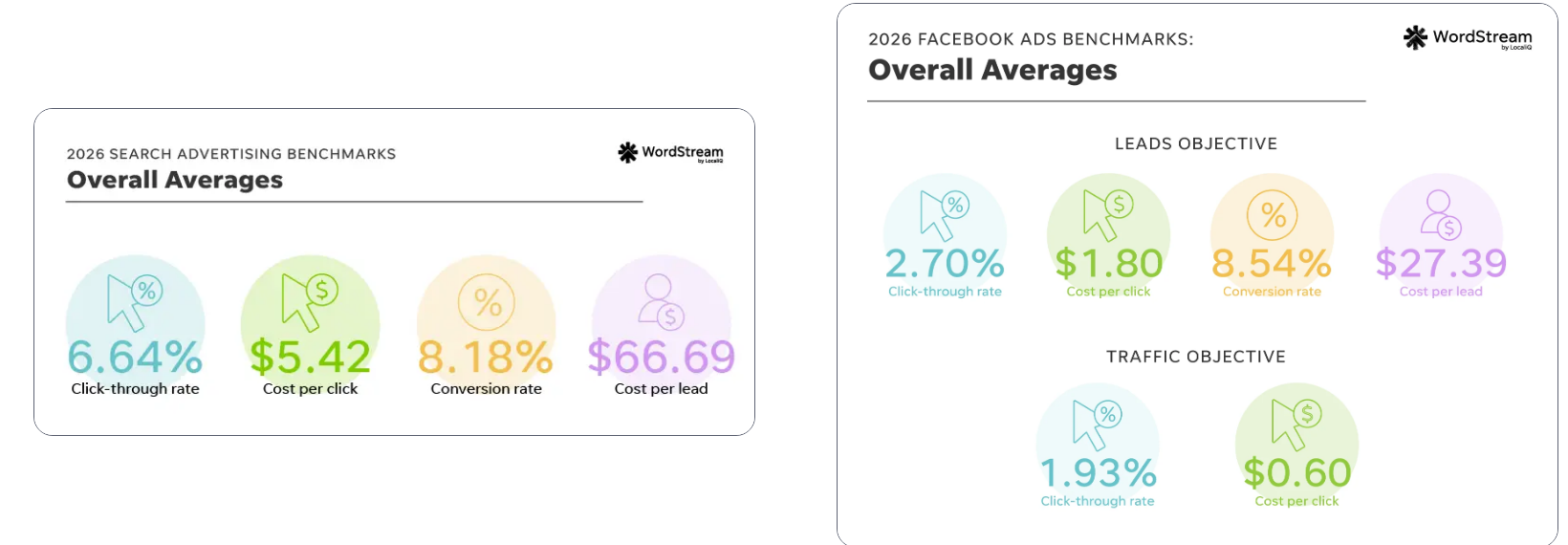
Google Ads charges per click, with the price set by auction on each search. There is no minimum; Google's own page says bidding amounts "are ultimately up to you." The 2026 WordStream benchmarks put the all-industry average at $5.42 a click, 6.64 percent click-through, 8.18 percent conversion and $66.69 a lead, with home and home improvement at $8.33 a click and $90.92 a lead. The searches that book a contractor's job cost far more than the average: Google's planner data on October 6, 2026 prices "plumber near me" at $39.45 a click, "ac repair near me" at $46.82 and "emergency plumber" at $76.38. New advertisers can take a sign-up credit of $500, $1,000 or $1,500 after spending $500, $1,500 or $3,000 in the first 60 days.
Facebook Ads (Meta, which also covers Instagram) charges per impression or per click against a daily or lifetime budget, with the price set by auction for the audience you target. Meta's help center sets no single minimum but requires your daily budget to be at least five times any cost-per-result goal you set, so a $40 lead goal needs $200 a day. The 2026 benchmarks for lead-generation campaigns are $1.80 a click, 2.70 percent click-through, 8.54 percent conversion and $27.39 a lead across industries, and $2.18 a click, 5.32 percent conversion and $42.95 a lead in home and home improvement.
The comparison
| Google Ads (Search) | Facebook Ads (Meta) | |
|---|---|---|
| You pay per | Click | Impression or click |
| Home improvement cost per click, 2026 | $8.33 average; $25 to $80 on emergency searches | $2.18 |
| Home improvement cost per lead, 2026 | $90.92 average; $150 to $400 in emergency trades | $42.95 |
| Who sees it | Someone searching for the service right now | Someone you targeted by location, age, interest and homeownership |
| Lead readiness | High; many book on the first call | Low; most need a text in 60 seconds and three follow-ups |
| Realistic close rate on the lead | 20 to 35 percent | 5 to 15 percent |
| Cost per booked job (home services) | $260 to $450 | $290 to $860 |
| Minimum useful budget | $1,000 a month; $1,500 in emergency trades | $900 to $1,500 a month ($30 to $50 a day) |
| Creative needed | Text ads, a landing page | Photos or video that stop a thumb, plus the landing page |
| Management (Skill Mammoth) | $600 a month or 12% of spend | $1,000 a month or 15% of combined spend with Google |
| Verdict | Facebook's lead is half the price and closes at a third of the rate, so the booked job costs about the same or more. Google wins for anything urgent or searched. Facebook wins for replacement, remodel and seasonal work where the homeowner had no plan until the photo. Run Google first; add Facebook when the follow-up system can handle cold leads. | |
The math the per-lead numbers hide
Cost per lead is where every comparison stops and where the mistake lives. Multiply by the close rate. A $90 Google lead closed at 30 percent is a $300 customer. A $43 Facebook lead closed at 8 percent is a $540 customer. The Facebook lead only catches up when a text goes out inside 60 seconds, a call follows inside five minutes, and the offer is something a homeowner can say yes to without an emergency: financing on a furnace replacement, a storm inspection, a spring lawn sign-up. With that system in place, Facebook close rates reach 12 to 15 percent and the booked job lands near $300, which is competitive. Without it, a Facebook lead form is the most expensive way a contractor can fill a spreadsheet. The system is in contractor lead follow-up system.
There is also a third Google product that beats both for licensed trades: Local Services Ads, which charge per lead ($20 to $80 in most trades), sit above the search ads, and carry the Google Guaranteed badge. For plumbing, HVAC, electrical, roofing and the other LSA categories, that is the first dollar, before either channel on this page. The trade-by-trade cost is in Local Services Ads cost.
When each one makes sense
- Google Ads: emergency and repair trades, installation and replacement searches, any service a homeowner types into a search box, and any business whose website already converts at 8 percent or better. The budgets by trade are in PPC for contractors, and the full price picture is in how much Google Ads costs.
- Facebook Ads: roof replacements after a storm, HVAC replacements with financing, remodels and exteriors with strong before-and-after photos, seasonal lawn, cleaning and pressure washing offers, and retargeting the people who visited the site from Google and did not call. The campaign that works is in Facebook ads for contractors.
- Neither, yet: any business with under 30 Google reviews, no tappable phone number on the landing page, or nobody answering inside five minutes. Both channels amplify what the website already does, and a site that converts at 3 percent turns either budget into expensive clicks.
Frequently asked questions
Which is cheaper, Google Ads or Facebook Ads?
Facebook per click and per lead: $2.18 a click and $42.95 a lead in 2026 home improvement benchmarks, against $8.33 and $90.92 on Google Search. Per booked job the gap closes or reverses, because Google leads close at 20 to 35 percent and Facebook leads at 5 to 15 percent. Compare cost per customer, not cost per lead.
Which is better for contractors, Google Ads or Facebook Ads?
Google for anything urgent or searched (repairs, emergencies, replacements people research), and Local Services Ads before either for licensed trades. Facebook for replacement, remodel and seasonal offers where the homeowner had no plan, and only with a follow-up system that texts inside 60 seconds. Most contractors should run Google first and add Facebook once the budget passes $2,000 a month.
How much should I spend on Google Ads vs Facebook Ads?
Google Search needs $1,000 to $1,500 a month to produce usable data, more in emergency trades where clicks run $40 to $80. Facebook lead campaigns need $30 to $50 a day, and Meta requires the daily budget to be at least five times any cost-per-result goal. A contractor with $2,500 a month should put $1,500 to $2,000 on Google and test Facebook with the rest.
Can I run Google Ads and Facebook Ads together?
Yes, and the best version is sequential: Google Search catches the people searching now, a Facebook retargeting audience built from your site visitors catches the ones who did not call, and a Facebook lead campaign fills the slow season with replacement and seasonal offers. Keep the budgets and the conversion tracking separate so you can see each channel's cost per booked job.
Want the split worked out for your trade and budget?
Fifteen minutes with your service list and your average ticket is enough to say how much goes to Local Services Ads, Google Search and Facebook, and what each should produce.