TL;DR
Connectors let Claude reach into your actual tools (QuickBooks, HubSpot, Google Drive, Slack, hundreds more) to read data and take actions, with your approval and only inside the permissions your login already has. They're powered by the Model Context Protocol, work on every Claude plan including Free, and you add them from a directory in about two clicks. Skills are the other half: reusable instruction sets that teach Claude how your business does a task, so you stop re-explaining your invoice format every Tuesday. Together they're the difference between a chatbot that gives advice and an assistant that does work. This guide covers both in plain English, plus the five setups we'd wire first in a service business.
Every owner who tries Claude hits the same wall in week one: it's smart, but it can't see anything. It doesn't know your pipeline, your books, or what's in that folder called "FINAL final quotes." Connectors and skills are how you knock that wall down, and since they're the machinery behind Claude for Small Business, understanding them is understanding whether any of this is useful to you.
Connectors, in plain English
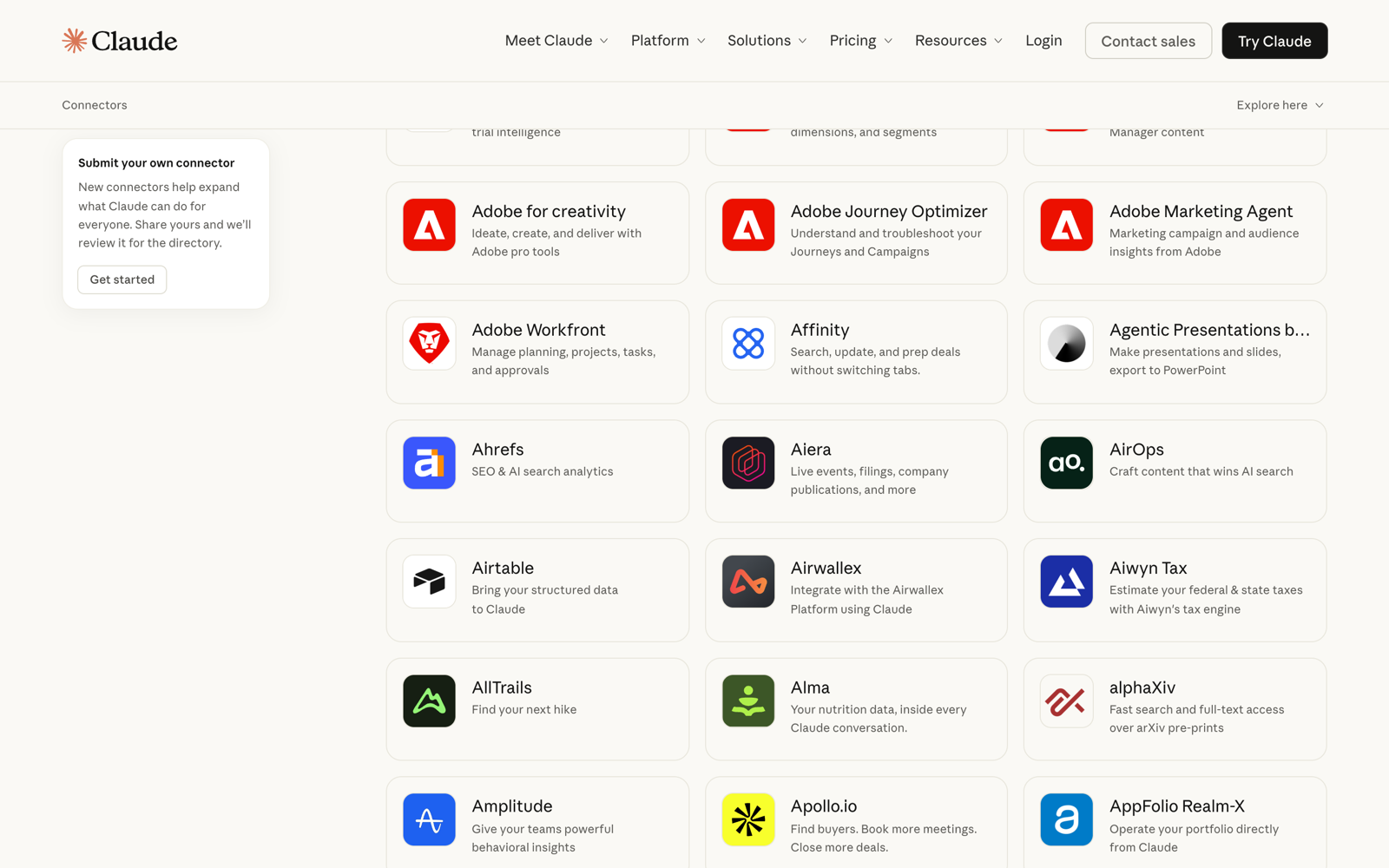
A connector is a bridge between Claude and an app you already use. Once connected, Claude can pull data out (read your QuickBooks invoices, search your Drive) and push actions in (update a HubSpot deal, post to Slack), all inside the permissions your account already has. Anthropic's own framing: connectors "let Claude access your apps and services, retrieve your data, and take actions." The plumbing underneath is the Model Context Protocol, an open standard, which is why the ecosystem grew fast: anyone can build one.
How you add one
Inside Claude, click the + in the chat box, go to Connectors, browse the directory, hit Connect, and sign in to the tool like you would anywhere else. That's the whole install for directory connectors. Three plan notes worth knowing before you start:
- Connectors work on every plan, including Free. The Free plan caps you at one custom connector.
- On Team and Enterprise plans, an owner has to enable a connector before the team can use it. That's a feature: it means your bookkeeper can't wire Claude into something you haven't approved.
- Custom connectors (for tools not in the directory) need a server reachable over the public internet. That's builder territory, and it's how the long tail like ServiceTitan or your niche CRM gets connected.
Skills: the other half nobody explains
Anthropic shipped Agent Skills in October 2025, then made them an open standard with a partner directory that December. A skill is a folder of instructions, examples, and small scripts that Claude loads when a task calls for it. Think of it as an SOP that actually gets followed. Where a connector gives Claude hands, a skill gives it your playbook: your estimate format, your review-response voice, your job-costing rules.
The 15 skills inside Claude for Small Business are pre-built versions of exactly this (invoice chasing, month-end narratives, campaign briefs). The leverage for a real business is writing your own, because that's where "draft me an email" becomes "draft the email the way we always do it, with our terms, our tone, and our numbers."
to connect a directory tool. The gap between businesses using AI and businesses talking about it is mostly this small. The setup stopped being the hard part; deciding what to wire up is.
The five connections we'd make first in a service business
| Connect | Then ask Claude to |
|---|---|
| QuickBooks | Reconcile monthly, rank overdue invoices, draft the chase emails |
| Google Drive / M365 | Search every quote and contract you've ever written, in seconds |
| HubSpot (or your CRM) | Summarize the pipeline, flag stalled deals, draft follow-ups |
| Slack | Deliver a morning brief of cash, pipeline, and calendar |
| Canva | Turn finished jobs into social posts and one-page flyers |
| Verdict | Connect one, run it for a week, verify the output against reality, then add the next. Seven connectors on day one is how owners end up trusting none of them. |
Have a tool Claude can't see?
We build custom connectors and AI workflows for service businesses, including the CRMs and field-service platforms the directory doesn't cover. If it has an API, Claude can work with it.
The security question, answered like an adult
Connectors inherit your permissions: Claude sees what your login sees, nothing more. Transfers are encrypted, org admins can restrict connectors to read-only, and on business plans your content isn't used for model training by default. The real-world risk isn't the pipe, it's the credential hygiene around it: if your whole team shares one QuickBooks login with full admin rights, Claude inherits that mess too. Fix the permissions first; it's the same advice we give before any custom dashboard build.
Skills vs. connectors vs. GPTs vs. plugins: naming the thing
If you're keeping score across platforms: connectors are Claude's version of integrations (ChatGPT calls its equivalents connectors too these days), and skills are closest to custom instructions with an engine behind them. The strategic difference is that Anthropic published both MCP and Agent Skills as open standards, so work you invest in them is less likely to be trapped in one vendor. For a small business betting a workflow on this stuff, portability is not an academic concern.
The tool-picking side of this decision, which assistant and which stack fits your shop, is what our free AI Stack Picker walks you through in about three minutes.
Frequently asked questions
What are Claude connectors?
Bridges that let Claude access your apps and services to retrieve data and take actions, powered by the open Model Context Protocol. You add them from a directory inside Claude, authenticate like a normal login, and Claude works within the permissions your account already has.
Are Claude connectors free?
Connectors work on every Claude plan, including Free, and directory connectors cost nothing to add. The Free plan is limited to one custom connector, and heavier connector use burns through usage limits faster, which is the practical reason most business users end up on Pro at $17 to $20 a month.
What are Claude skills?
Reusable instruction sets, launched by Anthropic in October 2025, that teach Claude how to perform specific tasks your way: folders of instructions, examples, and scripts that load automatically when relevant. They function like SOPs Claude actually follows, and they became an open standard in December 2025.
Can Claude connect to ServiceTitan, Jobber, or Housecall Pro?
Not through the core Claude for Small Business integrations. Coverage changes as the directory grows, and anything with an API can be reached through a custom connector, which requires a publicly reachable MCP server. That's typically a build project rather than a toggle.
Are Claude connectors safe for business data?
Claude only accesses what your connected account has permission to see, data transfers are encrypted, admins can make connectors read-only, and business plans exclude your content from model training by default. The biggest practical risk is sloppy account permissions on your side, so tighten those before connecting anything.
Want your first three connectors wired by Friday?
Book a free strategy call. We'll pick the highest-value connections for your business and set up the skills that make them useful.