TL;DR
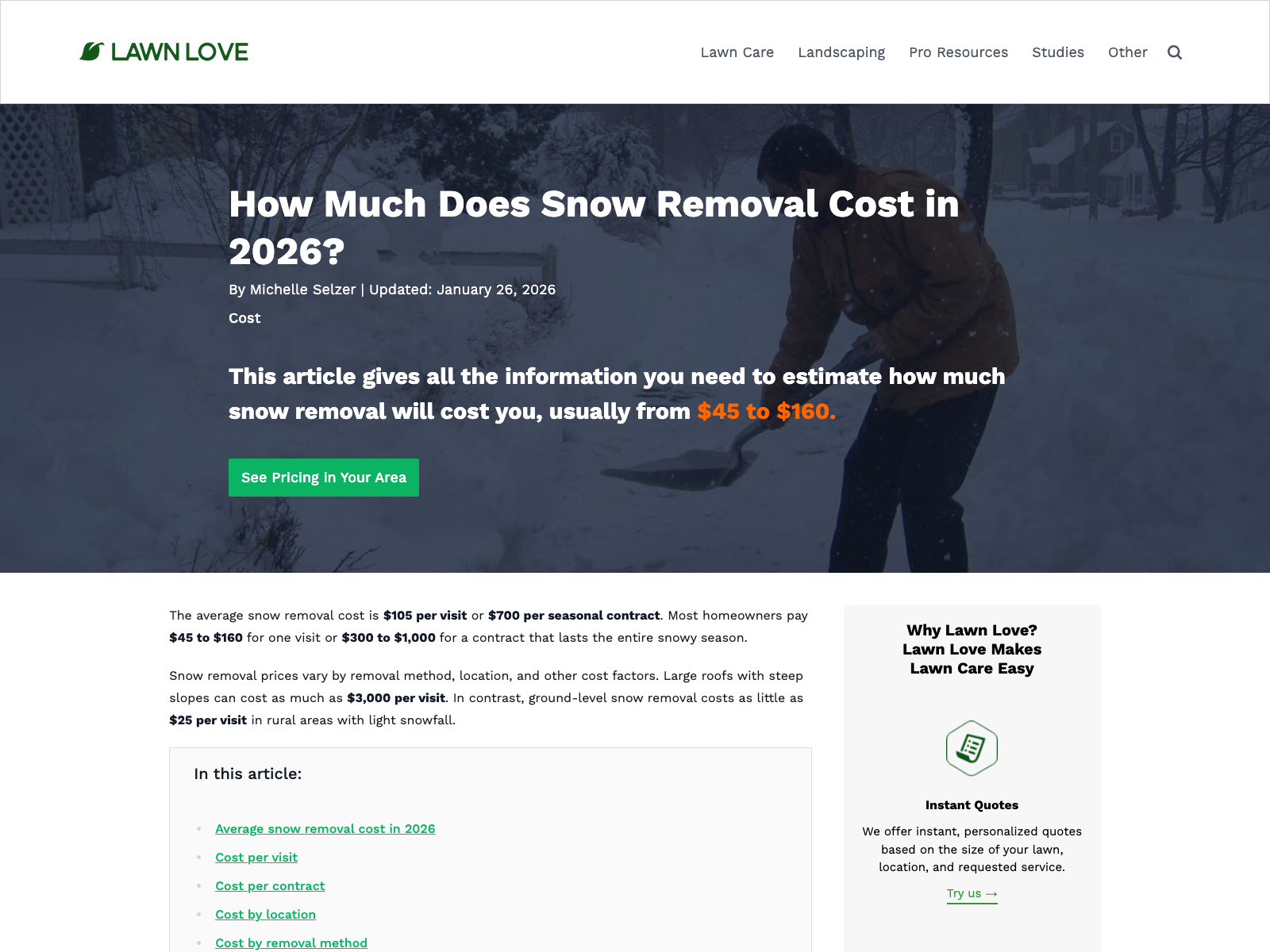
2026 snow removal pricing benchmarks: the national average is $105 per visit and $700 for a seasonal contract, with most residential visits landing between $45 and $160. Driveways run $30 to $70 per push, sidewalk crews $25 to $75 an hour, commercial lots $45 to $155 an hour, and seasonal residential contracts $300 to $1,000. Depth surcharges are standard: $10 to $25 per inch for the first six inches, $4 to $9 for each inch after. The pricing model matters more than the rate: per-push pays you for heavy winters, seasonal contracts pay you for light ones, and the operators who last run a mix of both on routes dense enough that the plow never deadheads. The benchmarks and formulas are below.
This one's written for the operator side: the lawn and landscape companies bolting on winter work, and the plow guys deciding what this season's rates should be. Homeowners are welcome to read along, since knowing how your contractor prices is the best negotiating position there is. The market figures come from Lawn Love's 2026 national cost survey, one of the most-cited datasets on this search, cross-checked against what our upper-Midwest clients actually charge.
The 2026 rate benchmarks
| Service | Typical 2026 range | |
|---|---|---|
| Residential visit (national average $105) | $45 to $160 per visit | |
| Driveway only, per push | $30 to $70 | |
| Sidewalks and shoveling, hourly | $25 to $75/hr | |
| Commercial parking lot, hourly | $45 to $155/hr | |
| Seasonal contract, residential (average $700) | $300 to $1,000 | |
| Seasonal contract, commercial lots | Up to $6,000 | |
| Salt or ice-melt application | $20 to $50 per visit | |
| Roof snow removal | $190 to $735 per visit | |
| Verdict | Anchor on $45 to $160 per residential push and $300 to $1,000 per season, then adjust for your snowfall zone and route density. | |
The three pricing models, and who each one protects
Per-push charges each visit ($30 to $70 for a typical driveway). It protects you in heavy winters and starves you in brown ones, and it attracts the customers who'll call at 6am asking if you're sure it really needs plowing. Seasonal contracts ($300 to $1,000 residential) flip the risk: the customer buys certainty, you eat the blizzard year, and your November cash flow stops depending on the forecast. Per-inch splits the difference with depth tiers: $10 to $25 per inch on the first six inches, $4 to $9 per extra inch, so the 14-inch storm that trashes your equipment and your night actually pays like it should.
The formula that keeps seasonal contracts honest: take your per-push rate, multiply by your area's average plowable events (snowfalls over your trigger depth, usually 2 inches), then add 10 to 20% as your risk premium. A $50 driveway in a 12-event market prices at $600 plus the premium, call it $660 to $720, right in the national band. Cap it in writing: seasonal contracts should include an event limit (say, 20 pushes) with per-push billing beyond it, or one anomaly winter erases three seasons of margin. Those clauses are exactly what our free snow removal contract template is for, trigger depth and liability language included.
Sending quotes from a template is faster than writing them at midnight.
Grab the free snow removal contract template, then let us make sure your town actually finds you before the first storm. Free 10-minute website audit, delivered within 48 hours.
Route density is the real rate
Two operators can charge the same $50 per driveway and run completely different businesses. The one with 30 driveways across four neighborhoods clears $400+ an hour of route time in a storm; the one with 30 driveways scattered across the county spends the night deadheading between jobs at $90 an hour before fuel. Every pricing decision downstream gets easier when the route is tight: you can hold a competitive rate, you can honor your response-time promise, and a blizzard becomes a long night instead of a broken one. Practically, that means pricing your existing customer map first (mowing clients within your plow radius are your cheapest wins), offering neighbor discounts to cluster jobs on one street, and being willing to decline the profitable-looking outlier 20 minutes from everything else. It isn't profitable.
Winter is a bundle, not a service
The same truck and customer list that buy plowing buy the rest of the cold-season menu. Salt applications at $20 to $50 ride along on every push for a few minutes' work. Holiday lighting fills the November gap before plowable snow arrives, at margins that embarrass plowing; the full math is in our Christmas light installation pricing guide. And every seasonal contract you sign is a spring conversation about mowing, cleanups, or a lawn care agreement with someone who already trusts you with their property. Operators who sell the bundle see winter stop being the survival season, and the lead engine is the same one that fills summer: the lawn care leads playbook applies verbatim, with "snow removal near me" as the money keyword and October as the deadline, since rankings won't move the week of the first storm. If your website can't quote or book a plow customer in one visit, start with the SEO for contractors guide before spending a dollar on ads.
Frequently asked questions
How much should I charge for snow removal?
Benchmark $45 to $160 per residential visit (national average $105), $30 to $70 for a standard driveway push, and $25 to $75 an hour for sidewalk and shoveling work. Commercial lots run $45 to $155 an hour. Add depth surcharges of $10 to $25 per inch for the first six inches and $4 to $9 per inch beyond, and hold a per-visit minimum that covers your drive time.
How much is a seasonal snow removal contract?
Residential seasonal contracts run $300 to $1,000 in most markets, averaging around $700, with commercial lots reaching $6,000. Price yours at your per-push rate times your area's average plowable events, plus a 10 to 20% risk premium, and cap the number of included pushes in writing so an anomaly winter can't erase the margin.
Is per-push or seasonal pricing better?
For the operator, a mix. Per-push protects you in heavy winters, seasonal contracts protect your cash flow in light ones, and a book that's roughly half of each is weatherproof. Pure per-push books starve in brown winters; pure seasonal books get crushed by the 20-storm year unless every contract has an event cap.
How much does snow removal cost per inch?
Standard depth pricing runs $10 to $25 per inch for the first six inches, then $4 to $9 for each additional inch. Per-inch structures exist to make big storms pay fairly: a 14-inch event is several times the work and equipment wear of a 3-inch dusting, and flat per-push rates quietly subsidize it.
When should snow removal contracts be signed?
September and October. Operators want routes locked before the first plowable event, and homeowners get better rates before the first-storm panic, when everyone calls at once and the good routes are full. If you're the operator, that means your rankings and your service page need to be ready by early fall, not December.
Want your routes full before the first storm?
We build the local rankings and the website that fill a plow book in October. Flat pricing from $350 a month, no contracts, cancel in spring if you want.