
TL;DR (answer-first)
Your Google map ranking is not one number. It changes street by street, and a map-grid scan shows you exactly where you rank across your whole service area. Contractors who own their market rank in the top three from most points on that grid, not just at their own address.
Most contractors think of their Google ranking as a single number: you are either "on page one" or you are not. But local search does not work that way. Your rank changes depending on where the person searching is standing. You might rank first at your own front door and be invisible three miles away, in a neighborhood full of customers who will never see you. The tool that reveals this is a map-grid scan, and understanding it is the key to actually owning your market.
What a map-grid scan is
A grid scan checks your Google ranking for a keyword from dozens of points spread across your service area, then plots each result on a map. Green points are where you rank in the top three. Yellow is page one but weak. Red is where you are invisible. The result looks like this.
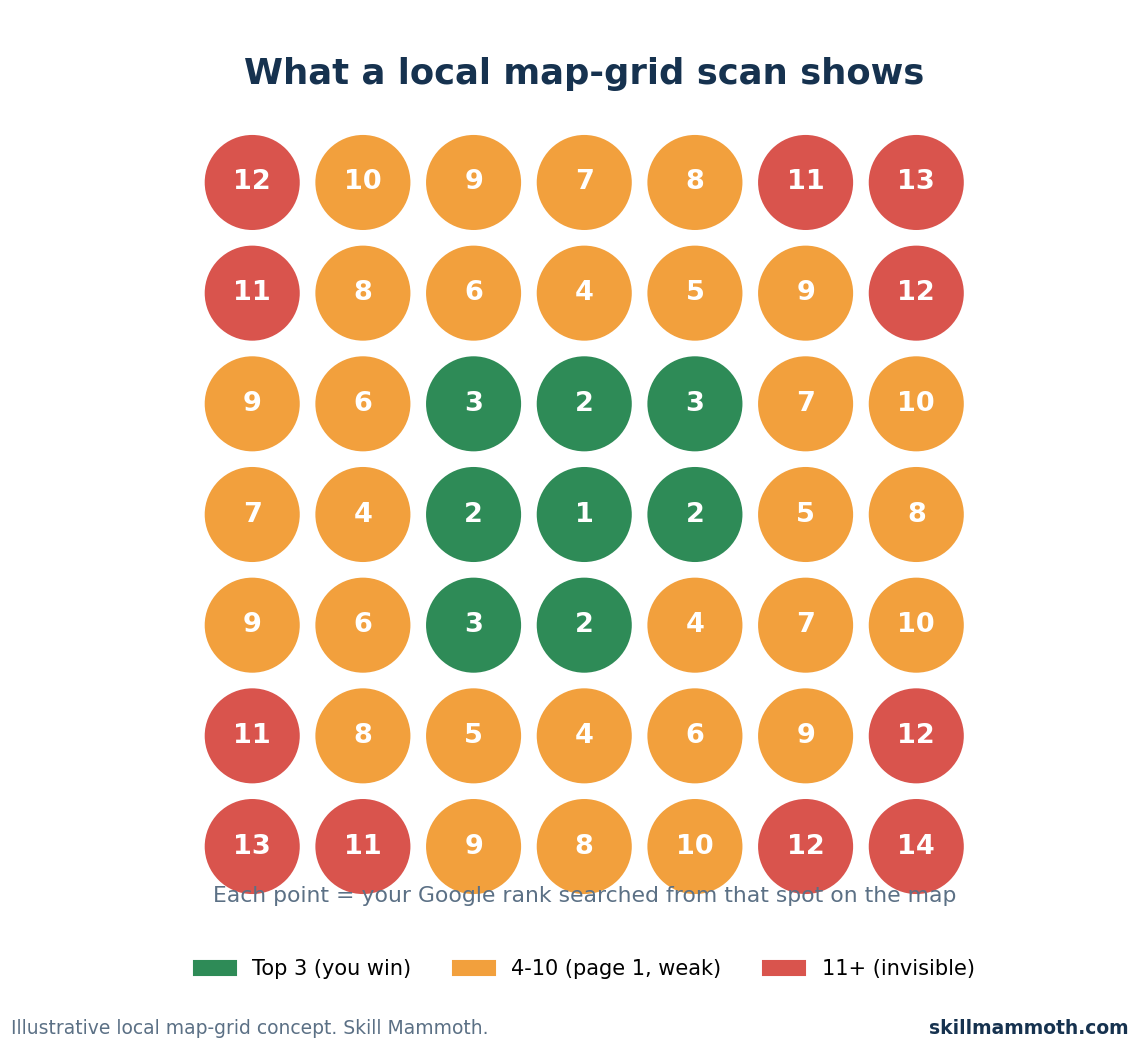
The single average number at the top (your average map rank) tells you how you are doing overall. But the real story is in the pattern. A sea of red with a small patch of green near your office means you are capturing only the customers closest to you and losing everyone else.
Why the grid matters more than a single ranking
The businesses that dominate a local market are not the ones ranking first in one spot. They are the ones ranking in the top three across the whole grid, so that no matter where a homeowner searches from, they show up. That is what "owning the map" means, and it is worth far more than a single top ranking at your address, because it captures the entire service area instead of one corner of it.
This is exactly what happened with Mama's Metal Roofing. They went from an average map rank of 15.3, mostly red across their market, to 1.6, ranking top three almost everywhere. You can see the full before and after in their case study.
What actually moves the grid
Improving your grid is not a trick. It is a handful of fundamentals done consistently.
Your Google Business Profile. This is the foundation of every green point. Complete every field, choose accurate categories, add real photos, and keep it active. Google will not rank a thin or neglected profile across a wide area.
Reviews, in volume and recency. Reviews are the strongest lever on how far your rankings spread across the grid. A business with 150 recent five-star reviews will rank across a much wider area than one with 20. Make asking for a review part of closing every job.
Service-area and city pages on your website. Google needs a reason to rank you in a neighborhood a few miles away. Dedicated pages for each city and suburb you serve give it that reason, and they are the biggest lever most contractors are missing. This is why a 30-plus page site outranks a five-page template. See what you get with a Skill Mammoth website.
Consistent citations. Your name, address, and phone should match everywhere online. Inconsistency tells Google it cannot fully trust your location, and that shrinks your grid.
Proximity is real, but beatable. Google does favor businesses physically close to the searcher, which is why proximity shows up in every grid. You cannot move your office, but strong reviews, a deep website, and an active profile let you overcome proximity and rank in areas where you are not the closest option.
If you are a roofer working through this, pair it with the demand side: how to get roofing leads.
How to track it
You cannot improve what you cannot see. Run a grid scan for your main keywords every month so you can watch the red turn green over time. The average rank number tells you if you are winning overall, and the map shows you exactly which neighborhoods still need work, so you know where to focus.
FAQ
What is a good average map rank?
Lower is better, and it represents your average position across the grid. Anything in the top three (an average near 1 to 3) means you are winning across your market. Averages above 10 mean you are on page two in most of your area and effectively invisible to most searchers.
Why do I rank first at my office but nowhere else?
Proximity. Google favors businesses close to the person searching, so you naturally rank best near your own location. Ranking across your whole service area takes reviews, service-area pages, and a strong profile that let you overcome the proximity disadvantage farther out.
How long does it take to improve your grid?
Google Business Profile and review improvements can shift the grid within weeks. Expanding your top-three coverage across a whole market usually takes a few months of consistent work, as Mama's Metal Roofing's six-month transformation shows.
Do I need a big website to rank across the map?
It helps significantly. Dedicated pages for each city and service you cover give Google a reason to rank you across a wide area, which is why deeper sites consistently out-cover thin template sites on the grid.
Want to see your own map grid?
We will run the scan, show you where you are red, and give you a plan to turn it green.
Or see how Mama's Metal Roofing owned their market and what you get with a Skill Mammoth website.
Want to implement these strategies?
Book a free strategy call and learn how we can help grow your contractor business.
Book a Free Strategy Call