TL;DR
Seven apps cover 90% of what a field contractor needs: a CRM/field-service hub (Jobber for most under 10 techs), photo documentation (CompanyCam, the closest thing to a mandatory app in the trades), estimating (materials takeoffs per trade), accounting (QuickBooks, because your accountant already lives there), communication (a missed-call text-back tool), measurements (a laser app or satellite tool), and reviews (whatever your CRM includes before you buy standalone). The trap is app sprawl: seven apps that don't talk to each other recreate the paper chaos digitally. Pick the hub first and make everything else feed it.
Every contractor's phone has a graveyard: apps downloaded at a trade show, used twice, now sending notifications into the void. This list is the opposite of that. Seven categories, one honest pick each, and the order to adopt them, chosen for crews that fix things for a living rather than admire dashboards.
1. The hub: Jobber (or your CRM of choice)
Everything else on this list feeds the hub, so pick it first. For crews under about 10 techs, Jobber wins on speed-to-useful: quoting, scheduling, invoicing, and payments working within a week. Housecall Pro competes hard in the same bracket, and the full sizing logic across trades lives in our CRM guides (HVAC, plumbing, roofing). If none of the shelf options fit how you run jobs, that's a different conversation: we build custom ones.
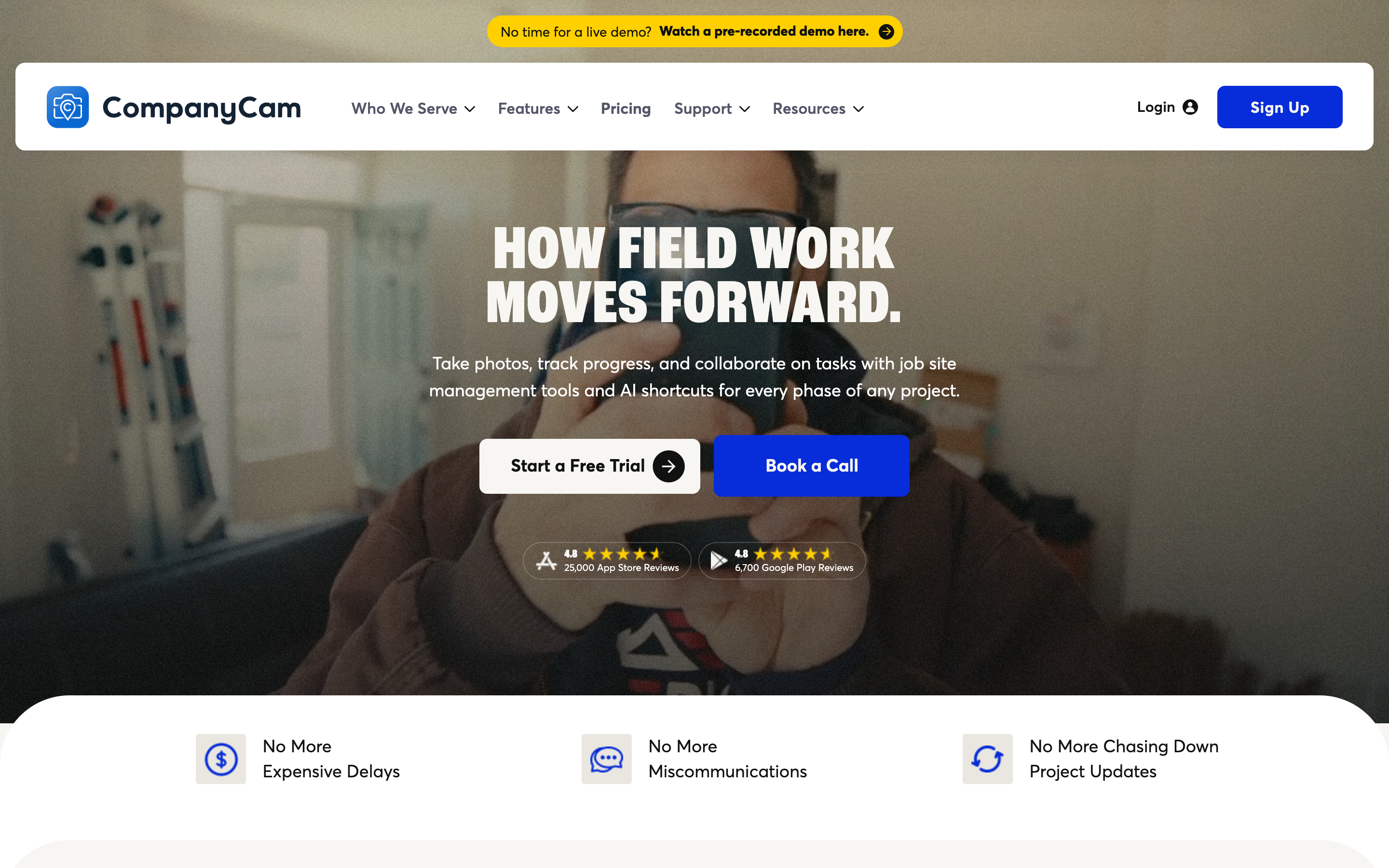
2. Photo documentation: CompanyCam
The app with the highest praise-to-price ratio in the trades. Every photo automatically tagged to the job and the address, visible to the office in real time, organized without anyone organizing it. It ends the "text me the pictures" era, arms your warranty defense, and quietly builds the before-and-after library your marketing runs on. Integrates with essentially every CRM on this list.
3. Estimating: per-trade, not one-size
Generic estimating apps lose to trade-specific ones because the takeoff logic differs. Roofers: satellite measurement tools (our own RoofMammoth plays here, on the homeowner-facing side). Remodelers: Buildertrend or Houzz Pro. Everyone else: your CRM's built-in quoting usually beats a standalone app once your price book is loaded, which is the real work either way.
4. Accounting: QuickBooks Online
Not because it's beloved; because it's the standard your accountant, your lender, and every integration already speak. The winning setup is your CRM syncing invoices and payments into QuickBooks automatically, so nobody types the same number twice. If you're doing double entry today, fixing that sync is worth more than any new app on this list.
5. Communication: missed-call text-back
The highest-ROI app category on the phone, because the math is brutal: a missed call in this industry is often a lost $2,000+ job, and crews miss calls all day by the nature of the work. A tool that instantly texts "on a roof, what do you need?" keeps the lead in play. Many CRMs include it; standalone tools run $30 to $100 a month. The full follow-up stack is in our lead follow-up system.
6. Measurements: the laser in your pocket
Phone LiDAR apps (like the iPhone's native measuring plus apps such as magicplan for floor plans) have gotten genuinely good for interior work, and satellite tools cover roofs without a ladder. A $30 Bluetooth laser plus its companion app remains the accuracy king for interiors. Pick per trade; the point is ending the "I'll come back and measure" second trip.
7. Reviews: use what you have before buying more
Standalone review platforms charge $200+ a month for what Jobber and Housecall Pro now include: the post-job review ask with a direct Google link. Turn on the built-in version first, wire the timing to job completion, and only graduate to standalone tools when volume demands it. What to do with the reviews once they arrive is covered in the 100-reviews playbook.
The stack, in adoption order
| Order | Category | Pick | Rough cost |
|---|---|---|---|
| 1 | Hub / CRM | Jobber (under ~10 techs) | $39-249/mo |
| 2 | Photos | CompanyCam | ~$24/user/mo |
| 3 | Missed-call text back | CRM built-in, else standalone | $0-100/mo |
| 4 | Accounting | QuickBooks Online + CRM sync | $35-100/mo |
| 5 | Estimating | Trade-specific tool | Varies |
| 6 | Measuring | Laser + app, or satellite | $0-50/mo |
| 7 | Reviews | CRM built-in first | $0 to start |
| Verdict: hub first, photos second, and nothing that doesn't integrate with the hub. Every app that can't sync is a second office you now have to manage. | |||
Apps organized, but the phone still quiet?
The stack manages jobs; it doesn't create them. We build the website, local rankings, and review engine that keep the hub fed.
The app-sprawl rule
Before adding anything to this stack, ask one question: does it push data into the hub without a human retyping it? A no means you're not adding an app, you're adding a job. The contractors drowning in software all made the same trade: they solved seven small problems with seven disconnected tools and created an eighth problem bigger than the first seven. The stack above stays at seven because each piece feeds the middle. When the middle itself stops fitting, the answer is rarely an eighth app; it's covered in our custom CRM and dashboard service.
For the solo-operator version of this stack, see handyman software.
Frequently asked questions
What is the best all-around app for contractors?
For crews under about 10 techs, Jobber: quoting, scheduling, invoicing, payments, and a review ask in one app your office and field crew both tolerate. Housecall Pro is the closest competitor. Above 10 to 15 techs with dispatch pain, the ServiceTitan conversation starts, covered in our CRM guides by trade.
What does a full contractor app stack cost?
A realistic solo-to-five-tech stack runs $150 to $400 a month: CRM ($39 to $249), CompanyCam (~$24 per user), QuickBooks ($35+), and a missed-call tool if your CRM lacks one. That's less than one recovered missed call a month, which is roughly the standard the stack should be held to.
Is CompanyCam worth it for a small crew?
Yes, and it's usually the second app worth paying for after the CRM. Automatic job-tagged photos end the group-text archaeology, protect you in warranty disputes, and build the before-and-after library your website and social feeds need. It integrates with every major field CRM.
Do I need a separate app for reviews?
Not at first. Jobber, Housecall Pro, and most field CRMs include a post-job review request with a direct Google link, which is 80% of what standalone review platforms sell. Turn that on, tie it to job completion, and revisit standalone tools only when review volume becomes a workflow of its own.
What about AI apps for contractors?
The useful ones today are embedded, not standalone: AI receptionists answering missed calls, satellite estimating, and AI-drafted follow-ups inside your CRM. Adding a general chatbot app to the stack solves nothing; wiring AI into intake and follow-up solves the expensive problem. That's the layer covered in our AI automation service.
Want a second opinion on your stack?
Send us your website and tell us what's on the phone. The free 10-minute audit covers both the demand side and the leaks, within 48 hours.