TL;DR
We pulled seven live cleaning company websites from Minneapolis, Austin, Denver and Phoenix and looked at what each does to the person who lands on it. Three are residential, four are commercial, and the split matters more than anything else on this page.
A homeowner is deciding whether to give a stranger a key to their house. A facilities manager is deciding whether complaints will land on their desk. Those are different fears, and a website that tries to calm both at once usually calms neither.
The best residential example puts a flat price in the navigation. The best commercial example asks for a company name in the first form field. The weakest one has a leftover blog plugin sentence sitting in the middle of its homepage.
The two heroes are not the same page
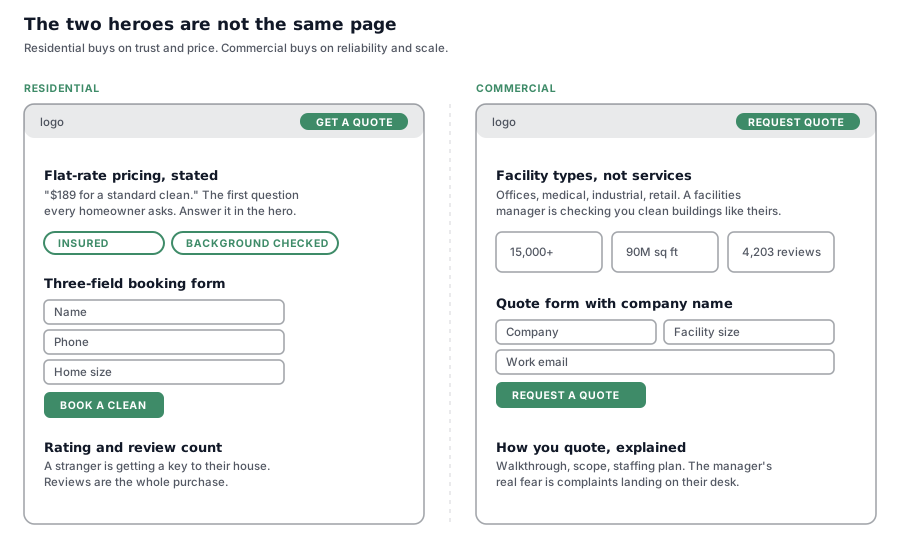
Before the examples, the structural point. Residential cleaning is bought on trust and price: the buyer wants to know what it costs, whether you are insured, and whether your people have been background checked. Commercial cleaning is bought on reliability and scale: the buyer wants to know you already clean buildings like theirs and that you will not become their problem.
If you sell both, and most cleaning companies do, the answer is not a compromise homepage. It is a homepage that picks the larger side of your revenue, with a clearly signposted route to the other. We covered the sales mechanics of that split in how to get cleaning clients.
Residential: three real examples
These are live sites captured in August 2026 at desktop width. We found them in real search results rather than in someone else's gallery. Every company is linked and none are clients of ours.
1. Two Hour Maids, Phoenix
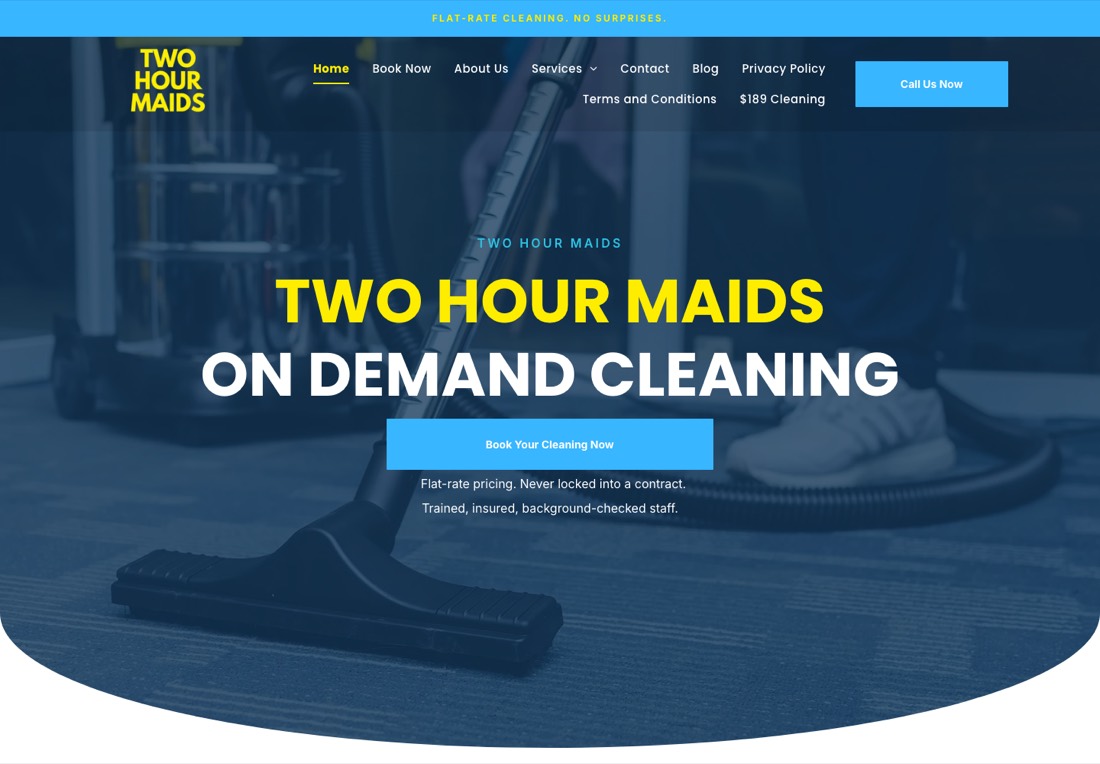
What it gets right: the price is in the navigation. An actual menu item reads "$189 Cleaning," and the bar above it says "Flat-rate cleaning. No surprises." Under the headline sit three lines that answer the whole residential trust question at once: flat-rate pricing, never locked into a contract, trained, insured, background-checked staff.
Why it works: price is the first thing a homeowner wants and the last thing most cleaning sites give them. Putting a real number in the navigation is a filter, not a leak. The people who bounce were never going to book, and everyone who stays has already accepted the price before they read a word of copy.
What we would change: the hero photograph is a vacuum on commercial carpet, dark and slightly grim, and it undercuts a brand promising a two-hour clean of your home. There is also no rating or review count anywhere in the first screen, which is the one thing that would make the promise credible.
2. Two Bettys Green Cleaning, Minneapolis
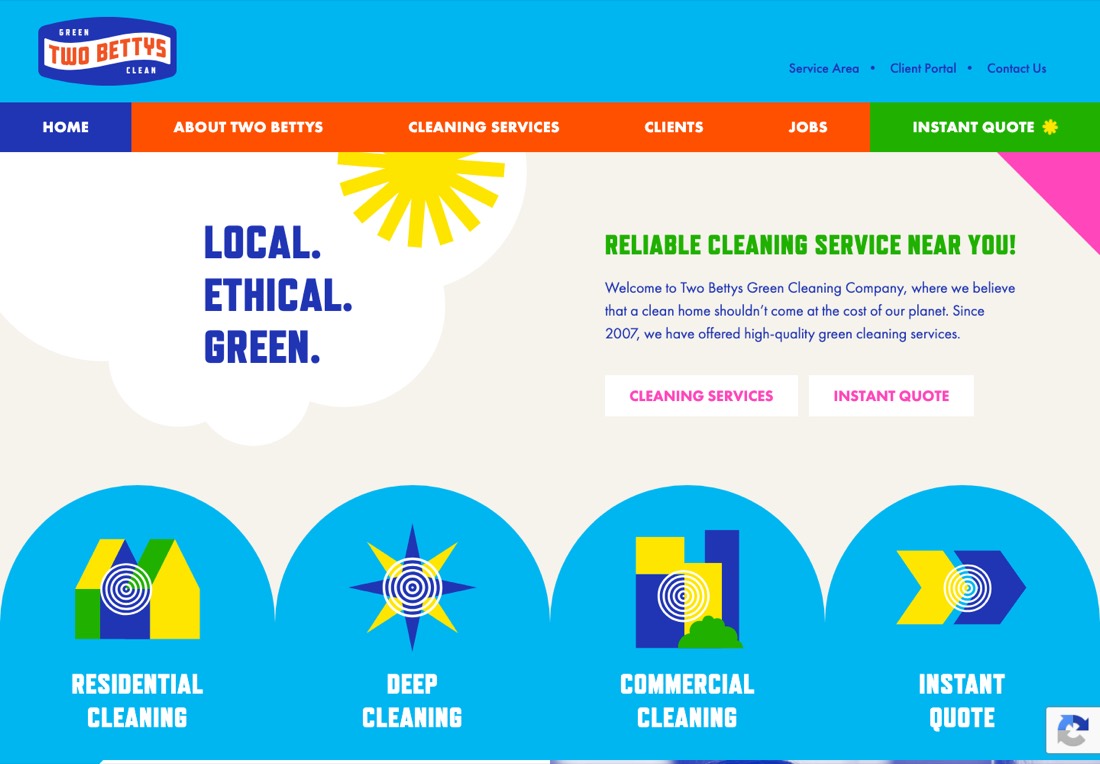
What it gets right: personality, which is rarer than it should be in this trade. "Local. Ethical. Green." set in heavy type against color-blocked shapes, with an Instant Quote button highlighted in a different color from the rest of the nav so it cannot be missed. Four large tiles split residential, deep, commercial and instant quote.
Why it works: most cleaning websites are interchangeable stock photos of a woman in rubber gloves. This one is recognizable, which is worth real money when a homeowner is comparing three tabs. The green positioning is also a real differentiator rather than a slogan, and it justifies a higher price.
What we would change: the opening line of body copy is "Welcome to Two Bettys Green Cleaning Company." That sentence does nothing. It also gives no rating, no review count and no phone number in the header, so the brand is doing all the persuading with no proof behind it.
3. The Maids, Minneapolis
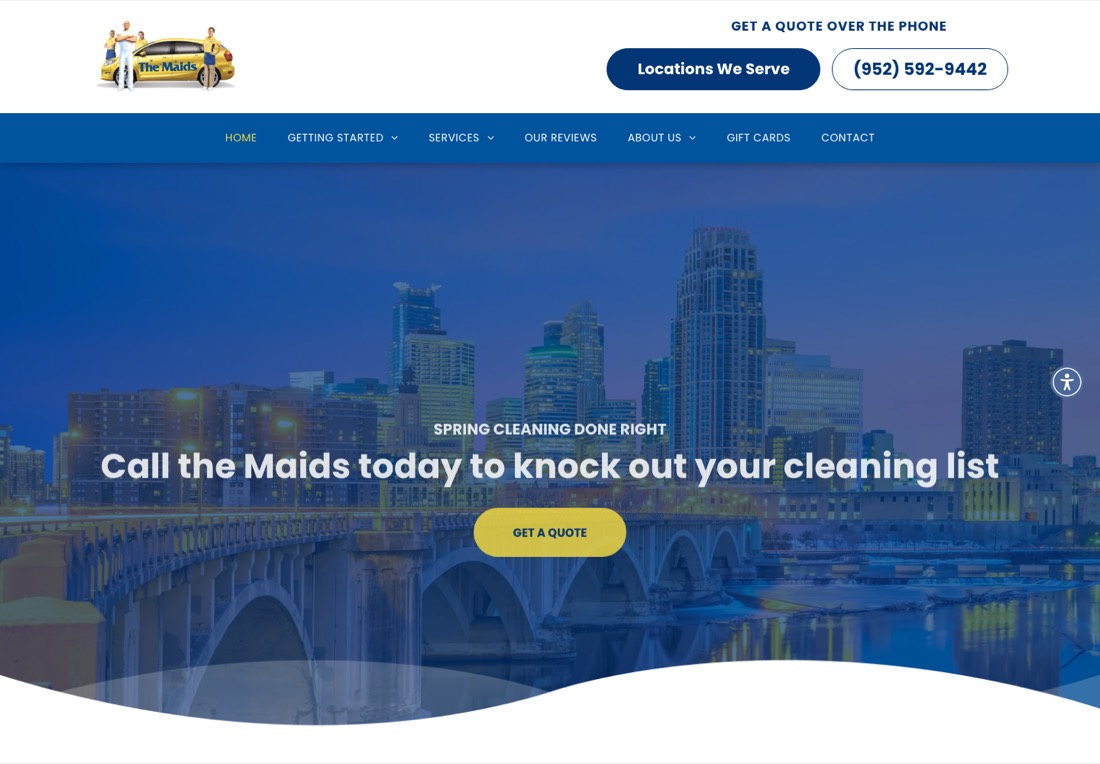
What it gets right: the phone number is large, in the top right, and labelled "Get a quote over the phone," which is a small piece of copy doing real work. It tells a hesitant caller exactly what will happen if they dial. "Our Reviews" is a top-level nav item rather than something buried.
What we would change: two things, and the first is the kind of mistake that costs nothing to avoid. The hero banner reads "Spring Cleaning Done Right." We captured this in the middle of August. A seasonal message left up for two quarters tells a visitor the site is unattended, which is exactly the wrong impression for a business asking to be trusted inside a home.
The second is the photograph. It is the Minneapolis skyline at dusk, which is attractive and has nothing to do with cleaning, and the white headline over the bright parts of it is hard to read.
Commercial: four real examples
4. Stratus Clean
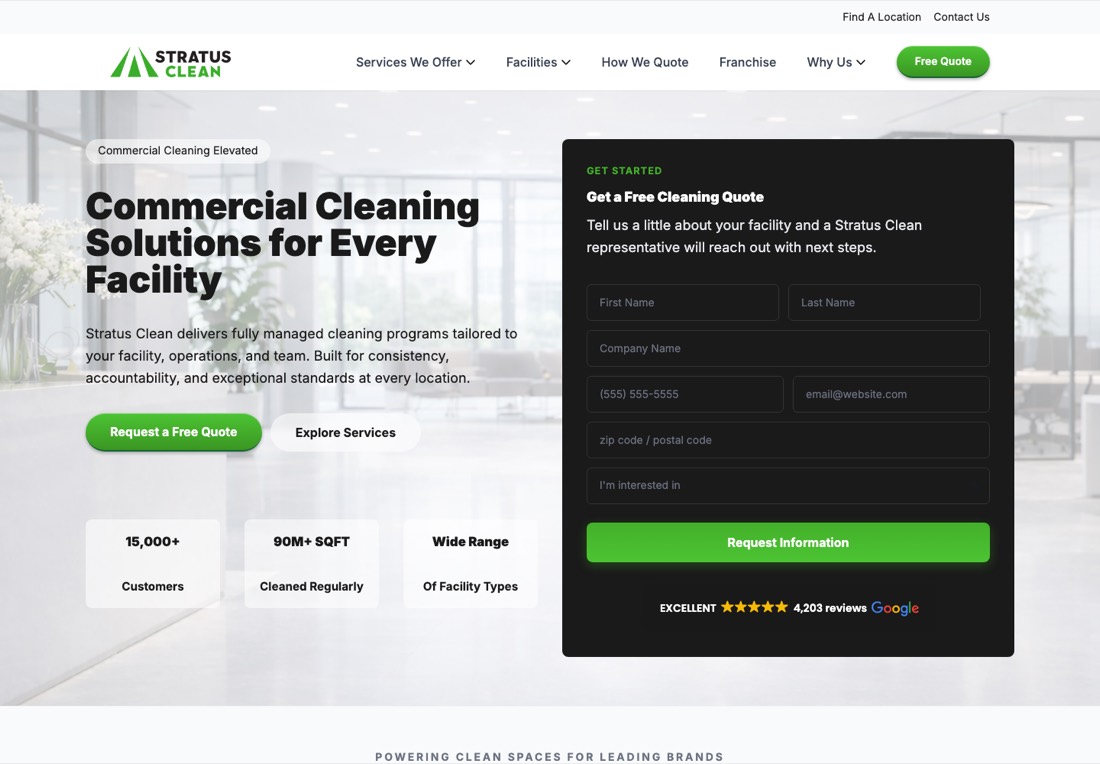
What it gets right: the strongest commercial page in the set, and a useful contrast with the residential ones. The hero form asks for company name, not just a personal name, which signals immediately that this is a B2B conversation. Three stat blocks carry the proof a facilities manager needs: 15,000+ customers, 90M+ square feet cleaned regularly, wide range of facility types. Under the form sits a Google badge showing 4,203 reviews.
Why it works: commercial buyers are assessing risk of failure, not price. Volume statistics answer the only real question, which is whether you can absorb their building without dropping the ones you already have. "How We Quote" as a navigation item is the other smart move here, because opacity about pricing process is what makes facilities managers nervous.
What we would change: six form fields in the hero is one or two more than needed. Company, facility size and work email would carry the same qualification with less friction.
5. KG Facility Solutions, Denver
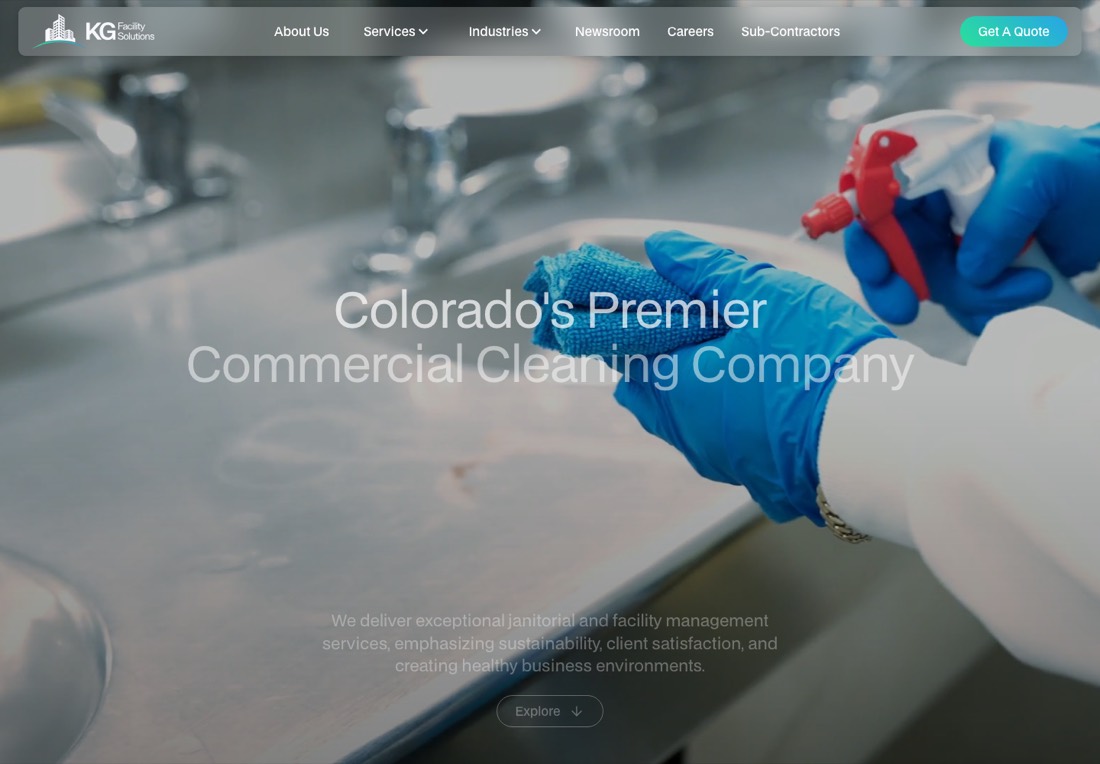
What it gets right: the photography is a cut above, a close shot of gloved hands actually cleaning rather than a stock office. The nav splits Services and Industries, which is the correct structure for commercial because the buyer thinks in building types.
What we would change: the headline is "Colorado's Premier Commercial Cleaning Company," which is a claim anyone can make and nobody can check. Set that beside Stratus stating 90 million square feet. One is an adjective and the other is evidence. The headline is also set in light grey over a busy photograph and is difficult to read, and the only action offered is a button reading "Explore," which asks the visitor to browse rather than to do anything.
6. JK Commercial Cleaning, Austin
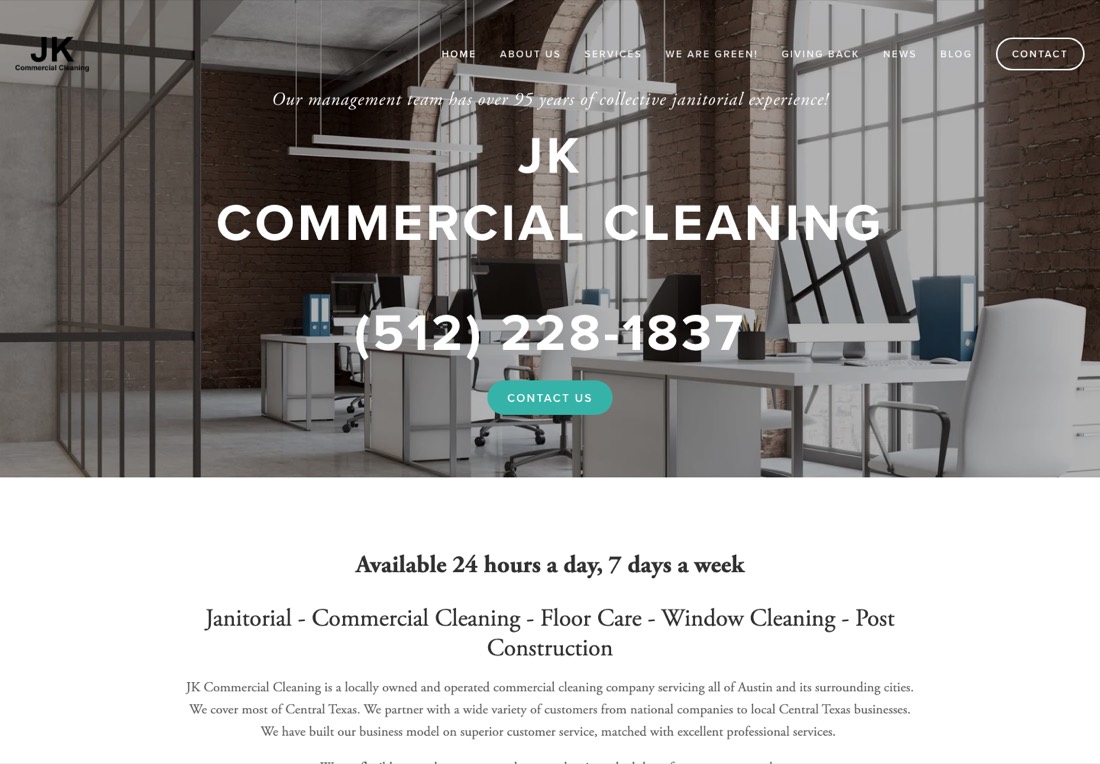
What it gets right: the phone number is enormous and sits in the middle of the hero. For janitorial work, where a facilities manager often wants a quick conversation rather than a form, that is a defensible choice. "Our management team has over 95 years of collective janitorial experience" is a specific number rather than a vague claim, and "Available 24 hours a day, 7 days a week" answers the after-hours question every commercial buyer has.
What we would change: below the hero the page becomes a wall of centred serif paragraphs, and the copy drifts into the generic. "We have built our business model on superior customer service" could belong to any company anywhere. There is no form, no facility-type breakdown and no proof of scale, so a manager comparing this to Stratus has far less to work with.
7. Maintenance Resources, Denver
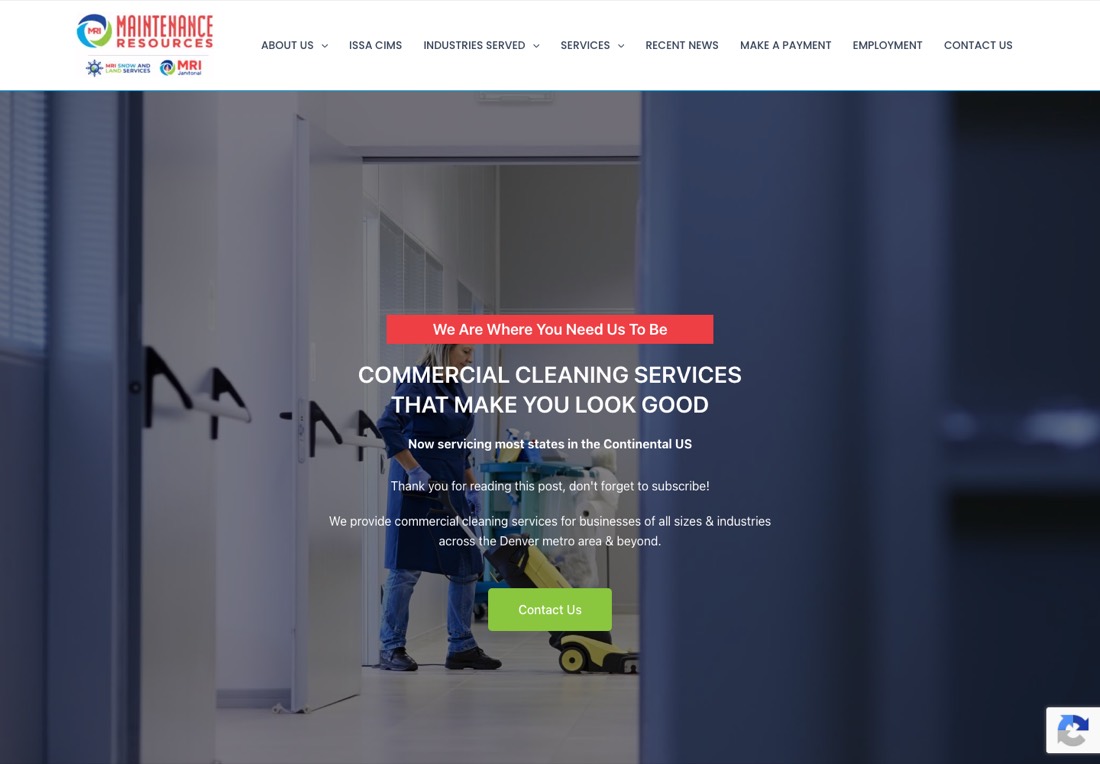
What it gets right: "Commercial cleaning services that make you look good" is the best headline on this page. It speaks directly to the facilities manager's actual motivation, which is not cleanliness but not being blamed. The ISSA CIMS certification in the nav is meaningful to buyers who know what it is.
What we would change: sitting in the middle of the hero, between the headline and the description, is the sentence "Thank you for reading this post, don't forget to subscribe!" It is a leftover from a blog theme or plugin and it has nothing to do with anything. Any visitor who reads carefully now knows the site is not being maintained.
That is the whole lesson of this example. A company can have good positioning, a real certification and a strong headline, and still leak credibility through an artifact nobody on their side has looked at in months. Read your own homepage, slowly, once a quarter.
The patterns worth copying
- Residential: put a number on it. Flat rate, starting price, or an instant quote. The homeowner is going to ask anyway, and answering first removes the main reason people leave.
- Residential: insured and background checked, in the first screen. This is the specific fear. Two Hour Maids says both in one line and it does more work than any amount of design.
- Commercial: lead with facility types, not services. Offices, medical, industrial, retail. The buyer is checking whether you clean buildings like theirs.
- Commercial: prove scale with numbers. Square feet, customer count, years. Adjectives like premier and leading are what everybody without numbers uses.
- Both: reviews near the top. A stranger is entering a private space either way.
- Both: read your own homepage. Two of the seven sites here carry a stale seasonal banner or a plugin artifact in the hero. Neither costs money to fix.
What none of the seven do. Not one gives a residential visitor a real price for their specific home. Two Hour Maids comes closest with a flat rate, and even that is one number for every house. An instant estimate that asks bedrooms, bathrooms and frequency and returns a real range in thirty seconds is still unclaimed in this trade. See what happened when one contractor added one.
What a cleaning company website costs in 2026
Nobody in this search result publishes numbers, so here they are.
- DIY on a builder (Wix, Squarespace, GoDaddy): $0 to $300 up front, $20 to $40 a month.
- Freelancer or template build: $1,500 to $4,000. Usually ships without service area pages or booking automation.
- Mid-tier custom build: $5,000 to $12,000. Where most established cleaning companies should land.
- High-end custom with scheduling integration: $15,000 to $30,000.
- Rented from a marketing platform: $250 to $600 a month, and you do not own it.
Our own builds are $1,000 for Smart Website Lite, $3,000 for Core and $8,000 for Pro, or $100 to $400 a month on Easy Start with no credit check, and the site is yours at the end of the term. Support runs from $350 a month. Full comparison in what a contractor website should cost, and the website cost calculator will price your case.
What to do this week
- Decide which side of the business your homepage is for. If residential is 70% of revenue, the homepage is residential and commercial gets a clearly linked page.
- Put a price, a range, or an instant quote in the first screen.
- Add insured and background checked to the hero if you are residential, and square footage or customer count if you are commercial.
- Read your homepage top to bottom, slowly. Look for stale seasonal banners and plugin leftovers.
- Get your Google rating and review count above the fold.
More on the demand side in cleaning services marketing, or grab a free website audit and we will run the list for you.
The hero line under the headline on each of these sites is a slogan; 150 to choose from are in cleaning business slogans.
Frequently asked questions
What makes a good cleaning company website?
For residential, a price or instant quote in the first screen, the words insured and background checked, a rating with a review count, and a booking form of three fields. For commercial, facility types rather than services, proof of scale in numbers, and a quote form that asks for a company name. Both need reviews near the top, because either way a stranger is entering a private space.
Should a cleaning website show prices?
Residential, yes. A flat rate or a starting range removes the main reason a homeowner leaves a cleaning site, and it filters out people who were never going to book. Commercial is different, because pricing depends on square footage and frequency, so what you publish there is your quoting process rather than a number.
Do residential and commercial cleaning need separate websites?
Separate sites are rarely worth the cost, but separate paths are essential. Pick the side that carries more revenue for the homepage, then give the other its own clearly linked page with its own hero, its own proof and its own form. A homepage that tries to speak to homeowners and facilities managers simultaneously persuades neither.
How much does a cleaning business website cost?
DIY on a builder runs $0 to $300 plus $20 to $40 a month. A freelancer or template build is $1,500 to $4,000. A mid-tier custom build, where most established cleaning companies land, is $5,000 to $12,000. High-end custom with scheduling integration runs $15,000 to $30,000. Renting from a marketing platform costs $250 to $600 a month and you do not own the result.
What is the best website builder for a cleaning business?
Wix and Squarespace are the fastest DIY routes and WordPress with a service theme is the most flexible, all in the $20 to $40 a month range. None include instant quoting, missed-call text back or call tracking, which is usually why cleaning companies past roughly $500K in revenue move to a custom build.
What photos should a cleaning website use?
Your own team, your own vans and your own finished work. Stock photographs of a woman in rubber gloves are invisible because every competitor in your market is using the same library. Two of the sites reviewed above lose ground on exactly this, one using a city skyline and one using a dark shot of commercial carpet.
How many fields should a cleaning quote form have?
Residential, three: name, phone and home size. Commercial can justify four or five because company name and facility size actually qualify the lead, but six or more starts costing completions without adding useful information.
Want to implement these strategies?
Book a free strategy call and learn how we can help grow your contractor business.
Book a Free Strategy Call