TL;DR
Residential and commercial cleaning are two different businesses that happen to share a name. Residential is won on local search, reviews and speed of reply. Commercial is won on relationships with property managers and on being the company that shows up to the walkthrough prepared. Running the same playbook for both is the most common mistake in the trade.
If you want more residential clients, start with a complete Google Business Profile, a review habit that never stops, and a reply time under five minutes. If you want commercial contracts, build a target list of buildings, find who actually signs, and get in front of them before the current contract renews.
Neither of those requires a website rebuild, and neither costs much beyond your time.
Do this arithmetic before you spend anything
Cleaning has an unusual economic shape: individual jobs are small, but a retained client is worth a great deal. That changes what you can afford to pay for one.
Work out your own numbers before reading further:
- Average job value. A residential clean typically runs somewhere between $120 and $250 depending on home size and market; the full 2026 benchmarks by home size are in how much to charge for house cleaning. A commercial contract is usually priced monthly.
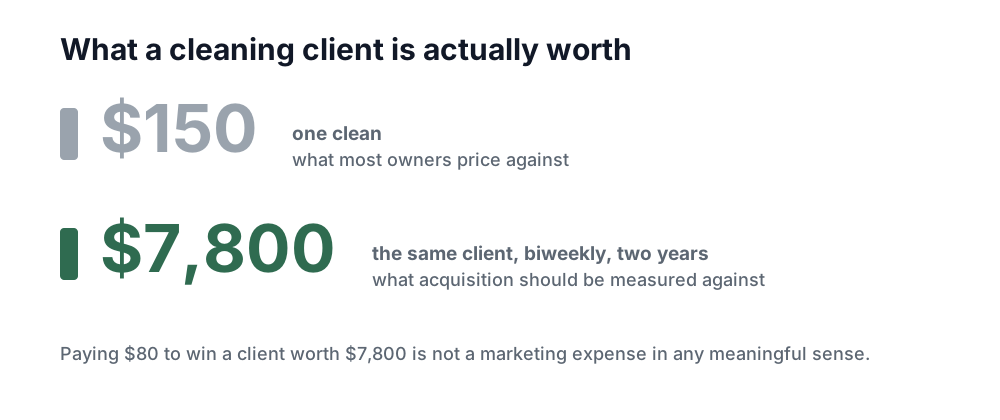
- How long a client stays. This is the number that matters. A biweekly residential client at $150 who stays two years is worth roughly $7,800. That is not a $150 sale.
- Your close rate. Of the last 20 people who asked for a quote, how many booked?
Once you know the retained value, the case for spending on acquisition changes completely. Paying $80 to win a client worth $7,800 is not a marketing expense in any meaningful sense.
The constraint is usually staffing, not leads. Cleaning has high turnover, and plenty of owners chasing more clients are actually capacity-limited. Before you spend on demand, be honest about whether you could service it next week. Selling work you cannot staff is how cleaning companies lose their reputation and their reviews at the same time.
Residential: the five things that work
1. Google Business Profile, completed properly
Homeowners looking for a cleaner search and then call from the map results. A complete profile with real photographs of your own work, correct service areas, listed services and consistent hours will out-perform almost anything else you do, and it costs nothing but an afternoon. If you have duplicate listings from a previous owner or a former name, fix them, because they split your reviews and your ranking. We wrote up the process in how to fix duplicate Google Business Profiles.
2. A review habit, not a review push
Reviews are the single strongest signal in this trade because the buyer is letting a stranger into their home. Trust is the whole purchase. The companies that win are not the ones who ran a review campaign once. They are the ones who ask after every single job, by text, within a couple of hours of finishing while the house still looks immaculate.
Steady beats spiky. Ten reviews a month for a year does more than a hundred reviews in one week, which looks manufactured to both Google and to humans. Our full method is in how to get 100 Google reviews.
3. Answering fast enough to matter
Cleaning quotes are comparison-shopped. The homeowner messages three companies and books whoever replies first with a straight answer. Response time here is the sale itself, not a tactic layered on top of it.
If you are on a job with your hands full, an automatic text back on missed calls keeps the lead alive until someone can respond properly. See the follow-up system for how the pieces fit together.
4. Referrals, made into a system
Every cleaning business gets referrals. Very few ask for them. A standing offer of a free or discounted clean for any client who refers a neighbor costs you one visit and buys a client who was pre-sold by someone they trust. Neighbors are the ideal referral because routing two houses on one street makes your day more profitable.
5. Nextdoor and local groups, used carefully
Neighborhood platforms punish anything that reads as an ad and reward genuine recommendations. The play is to become the company whose name comes up when somebody asks, which loops back to referrals and reviews. Posting promotions achieves the opposite.
Commercial: an entirely different sale
Commercial cleaning is not won through search in any meaningful volume. Nobody procuring janitorial services for an office park types "cleaning company near me". Contracts are won three ways.
Know who actually signs
For offices and retail it is usually a property manager or a facilities manager, not the business occupying the space. For medical it may be a practice manager with compliance requirements attached. Building a list of the actual decision makers in your area is unglamorous work and it is the whole job.
Time it to the renewal
Commercial contracts run annually more often than not. Approaching a building the month after it renewed is wasted effort. Approaching it 60 to 90 days before renewal, when the manager is already thinking about whether the current provider is worth keeping, is a completely different conversation. Track renewal dates as you learn them and build a calendar from them.
Win the walkthrough
Most commercial bids are decided at the walkthrough. Show up with proof of insurance and bonding, your background check policy, a staffing plan that answers who specifically will be in the building, and a scope written from what you saw rather than a template. The competition usually arrives with a price and nothing else. Being the one with a plan is frequently enough.
Do not compete on price alone in commercial. There is always somebody cheaper, and the client who leaves their current provider over $50 a month will leave you over $50 a month too. Compete on reliability, communication and turnover, because the property manager's actual fear is complaints landing on their desk.
What to skip
- Flyers and door hangers at scale. Response rates are low enough that the arithmetic rarely works once you count your time. A targeted drop on a street where you already clean is a different matter, because the neighbor recognizes your van.
- Buying leads shared with four competitors. Marketplaces sell the same inquiry several times, so you end up competing on callback speed against companies who bought the identical lead. Build the callback speed and skip the middleman.
- A social media presence as a lead source. Useful for recruiting, which matters a great deal in this trade, and for staying visible to past clients. It is not where people with a dirty house go looking.
- Discounting the first clean to nothing. Deep discounts attract one-time customers, and this business only works on retention. A first-clean discount tied to booking a recurring schedule is fine. An unconditional one is a leak.
Your first 30 days
In order, and none of it requires a new website.
- Week one. Complete the Google Business Profile. Every service, correct service areas, twenty photographs of your own work, hours that match reality. Fix duplicates.
- Week one. Set up an automatic text back on missed calls, then measure your median response time for a week. Most owners are shocked by the real number.
- Week two. Start the review habit. Text every client within two hours of finishing. Every client, every time, no exceptions.
- Week two. Write down your retained client value. It changes every spending decision that follows.
- Week three. If you want commercial, build a list of 50 buildings, identify the manager for each, and start learning renewal dates.
- Week four. Make the referral offer explicit to every existing client rather than hoping they mention you.
Where a website actually matters
A website is not what generates cleaning inquiries. Search results and reviews do that. What the site does is convert the person who has already found you and is deciding whether to trust you with a key to their home.
Two things move that needle. The first is proof: real photographs of real jobs, your insurance and bonding stated plainly, and your background check policy written where a nervous customer can find it. The second is an instant quote tool, because the alternative is a contact form and a wait, and the homeowner is currently on three other tabs. See how an instant estimate tool changed conversion for what that looks like in practice.
If you are weighing what to spend, what a contractor website should cost covers every build path honestly, including the cheap ones.
Related reading
- Cleaning services marketing, residential and commercial
- Seven cleaning websites reviewed, what converts and what does not
- How to get contractor leads, nine channels ranked
- The follow-up system that converts the leads you already have
- What Local Service Ads actually cost
The commercial side, including which lead vendors are worth paying, is in where to buy commercial cleaning leads.
The slogan that goes in the website hero and the review-request text is picked in cleaning business slogans.
If you would rather have the website, the profile, and the follow-up built for you, that engagement is described on our cleaning business marketing page.
Frequently asked questions
How do I get my first cleaning clients?
Complete your Google Business Profile, tell everyone you know personally, and ask every single early client for a review and a referral. The first ten clients almost always come from people rather than from advertising, and the reviews they leave are what make the advertising work later.
Is residential or commercial cleaning more profitable?
Commercial contracts are larger and more predictable, but they take longer to win, pay on longer terms and are lost to price competition more often. Residential is faster to start, has higher margins per hour and depends on retention. Most established companies run both so that commercial covers fixed costs and residential carries the margin.
How much should I spend on marketing for a cleaning business?
Work backwards from retained client value rather than from a percentage of revenue. If a client is worth several thousand dollars over their lifetime, an acquisition cost of $50 to $150 is comfortable. Under roughly $250K in revenue, spend nothing until the Google Business Profile is complete and you reply inside five minutes, because both are free and both outperform paid channels.
How do I win commercial cleaning contracts?
Identify the property or facilities manager rather than the tenant, learn when the current contract renews, and make contact 60 to 90 days before that date. Then win the walkthrough by arriving with insurance, bonding, a background check policy and a scope written from the actual building rather than a template.
Do cleaning companies need a website?
You will get inquiries without one, because the Google Business Profile does that work. The website is what converts a nervous homeowner into a booking, so it matters most at the point of decision. Proof of insurance, real photographs and an instant quote do more than design does.
How long does it take to get cleaning clients from Google?
Google Business Profile improvements typically show within two to eight weeks. Organic rankings in a competitive metro take considerably longer. Review velocity is the fastest lever most cleaning companies have available, and it compounds.
Should I use lead marketplaces for cleaning?
As a stopgap when the schedule is thin, they work. As a foundation they are weak, because the same inquiry is sold to several companies and you end up competing on who calls back first. That skill is worth building for its own sake, at which point you no longer need the marketplace.
What is the biggest mistake cleaning companies make with marketing?
Chasing more inquiries while the real constraint is staffing. The second biggest is treating residential and commercial as one business, which produces marketing that is slightly wrong for both.
Want to implement these strategies?
Book a free strategy call and learn how we can help grow your contractor business.
Book a Free Strategy Call