TL;DR
Google Ads for dentists cost $8.00 a click and $72.97 a lead in the 2026 WordStream benchmarks, the third-highest click of 23 industries, saved by a 10.67 percent conversion rate that is among the best. The averages hide a split. Google's planner data on October 7, 2026 prices "dentist near me" at $13.92 a click and "dental implants near me" at $39.05, and the implant click is the better buy, because a first visit bills $576 on average and a single implant case runs $3,000 to $6,000. The campaign that works is three separate campaigns (new patient, high-ticket, emergency) inside a five-to-seven-mile radius, a landing page per procedure with a price range and financing, and call tracking that counts booked appointments. Two things most dental ads guides miss: Google Local Services Ads now list Dentist and Orthodontist as eligible categories (pay per lead, no booking leads for healthcare), and Google's personalized advertising policy puts health in its sensitive-interest list, so the retargeting campaign the agency pitched is mostly off the table. Budget $1,500 to $3,000 a month for 90 days, and expect 10 to 14 new patients a month at the benchmark rates.
Disclosure: Skill Mammoth manages Google Ads and Local Services Ads for local businesses, including dental practices, at a flat $600 a month or 12 percent of spend for search and $300 or 15 percent for LSAs. We also tell practices to fix the Google Business Profile and the online booking before spending on ads, because a $14 click that lands on a site with no booking button is a $14 click. Every figure here is from the 2026 WordStream benchmarks, Google's keyword planner data pulled through DataForSEO on October 7, 2026, Google's own policy and LSA pages read the same day, and the ADA Health Policy Institute's practice survey.
What a dental click and a dental patient cost
| Metric | Dentists, 2026 | All industries, 2026 |
|---|---|---|
| Cost per click | $8.00 | $5.42 |
| Click-through rate | 5.66% | 6.64% |
| Conversion rate | 10.67% | 8.18% |
| Cost per lead | $72.97 | $66.69 |
| Verdict | Dentists pay 48 percent more per click than the average advertiser and only 9 percent more per lead, because a dental landing page with online booking converts better than almost anything else on Google. The conversion rate is the lever; protect it before you touch the bids. | |
Then the patient. The ADA's practice survey puts a solo general dentist's gross billings at $576 a visit on average and $481 at the median, with 2025 average gross billings of $965,660 on a net income of $215,320. A single-tooth implant case runs $3,000 to $6,000 all in, and CareCredit's procedural cost study puts All-on-4 at $15,176. A $73 lead that books at 40 percent is a $182 new patient, which a first visit covers twice over before the patient ever comes back. That is why dentistry can afford the third-most expensive click on Google, and why the practices that lose money on it are not losing it on the click.
What the searches that book patients cost
Industry averages blend the whole category. The searches below are the ones that fill a chair, priced from Google's planner data on October 7, 2026 as top-of-page estimates; a campaign with quality score history usually lands 20 to 40 percent lower.
| Search | US searches a month | Cost per click | What it is worth |
|---|---|---|---|
| dentist near me | 1,830,000 | $13.92 | A new patient, $576 first visit, recurring hygiene |
| pediatric dentist near me | 201,000 | $10.93 | A family, often two or three patients |
| dental implants cost | 135,000 | $15.06 | Research stage; a $3,000 to $6,000 case later |
| dental implants near me | 110,000 | $39.05 | Consult stage; the most expensive dental click |
| cosmetic dentist near me | 74,000 | $14.22 | Veneers, whitening, bonding; high ticket, elective |
| dental crown cost | 74,000 | $8.29 | A $1,000 to $2,000 procedure, price-sensitive |
| teeth whitening near me | 60,500 | $10.68 | Low ticket, good first-visit funnel |
| dental cleaning near me | 49,500 | $17.77 | A hygiene patient, the recurring one |
| braces near me | 40,500 | $20.43 | $3,000 to $7,000 orthodontic case |
| dentist that accepts medicaid | 27,100 | $12.81 | Volume, low margin; only if you accept it |
| all on 4 dental implants | 22,200 | $25.19 | A $15,000-plus case |
| sedation dentist near me | 14,800 | $11.74 | Anxious patients with deferred work |
| Verdict | The $39 implant click is the best buy in the table and the $8 crown click is the worst, because the implant searcher is choosing a surgeon and the crown searcher is comparing prices. Split them into separate campaigns so the budget goes where the ticket is. | ||
Want the click prices for your procedures in your city?
We pull the planner data for your metro and your service list in about ten minutes and tell you which three campaigns to build first. No agency deck.
Local Services Ads for dentists, which most guides miss
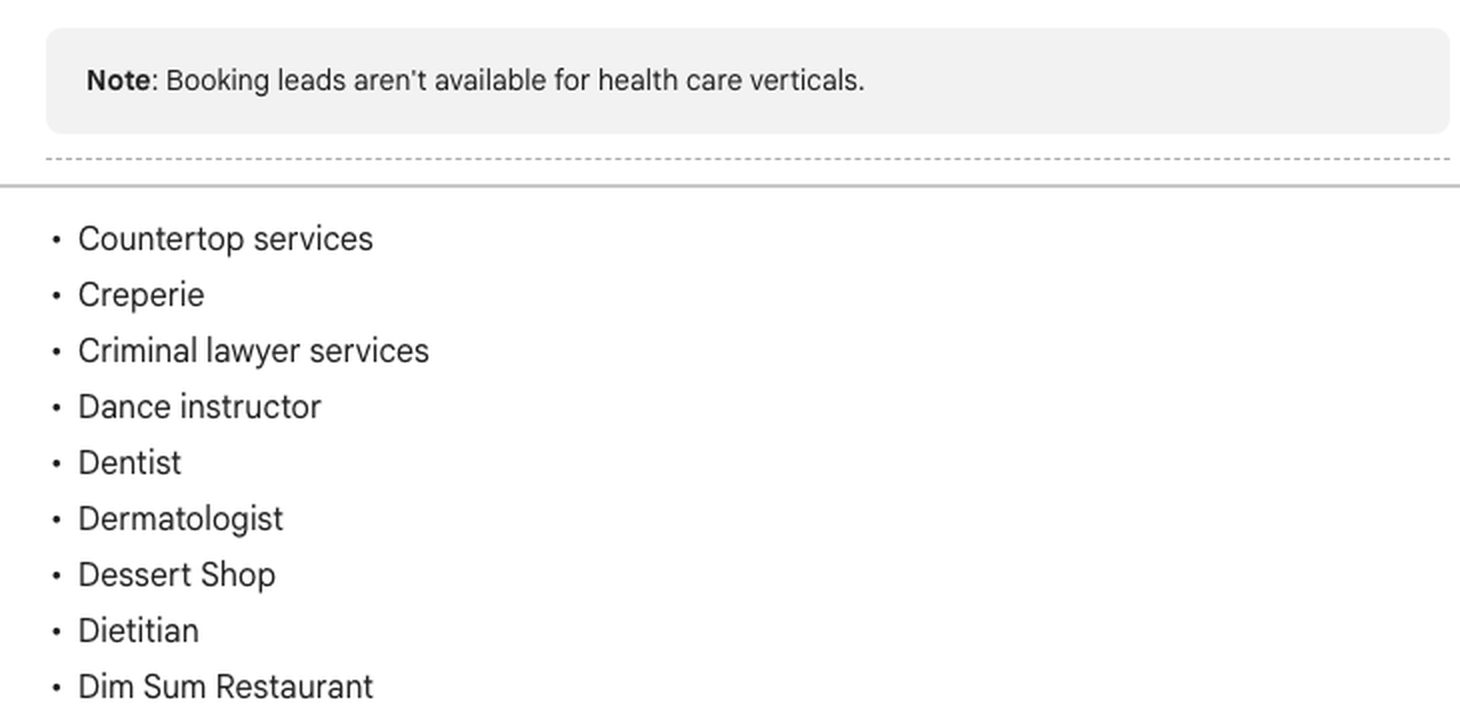
Google's Local Services Ads eligibility list for the United States now includes Dentist and Orthodontist alongside chiropractors, optometrists, physical therapists and primary care, with one healthcare-specific limit: "Booking leads aren't available for health care verticals," so leads arrive as calls and messages rather than scheduled appointments. LSAs charge per lead instead of per click, sit above the search ads with the Google Screened badge, and let you dispute leads that were wrong-number or existing patients. Dentists on Reddit report LSA leads at $100 or more, including charges for existing patients calling to reschedule, which is the dispute discipline problem in a nutshell. At $100 a lead and a 40 percent booking rate, that is a $250 new patient against roughly $182 on search, so LSAs are a supplement for dentists rather than the first dollar they are for plumbers. Run them alongside search if your profile has 50-plus reviews and someone disputes the reschedule calls weekly; the mechanics are in Local Services Ads cost.
Two policies that change the campaign
Healthcare ads are "Eligible (limited)." Google's healthcare and medicines policy restricts some services and requires certification for others; general dentistry is not among the restricted categories, and dental insurance advertising is specifically exempt, but ads and landing pages for sedation, prescription pain management or anything that reads like a drug claim can trip a review. Keep the ad copy about procedures and outcomes, and expect the "Eligible (limited)" label on most of the account.
No health-based remarketing. Google's personalized advertising policy lists health as a sensitive interest category, which rules out building a retargeting audience from the people who visited your implant page and chasing them across YouTube. The agency deck that shows a "retargeting layer" for a dental practice is selling something Google will disapprove. Retarget the whole site's visitors with a general new-patient offer if you must, and put the money into search instead.
Separately, do not pass patient identifiers into conversion tracking. Count a call over 60 seconds or a booking-form submission as the conversion, and keep names, procedures and dates out of the tag.
The three-campaign structure
- New patient, five to seven miles. "dentist near me," "dental cleaning near me," "pediatric dentist near me," "dentist accepting new patients." Phrase and exact match, a 150-term negative list (jobs, school, salary, free, "how to," DIY, every city you do not serve, the insurance plans you do not take), and a landing page with online booking above the fold, the new-patient offer, three named reviews and the insurance list. Budget 40 percent.
- High ticket, ten to fifteen miles. Implants, All-on-4, Invisalign or braces, cosmetic. Separate ad groups per procedure, each to its own page with a price range, financing (CareCredit or your plan), before-and-after photos and a consultation form. People drive farther for a $5,000 case. Budget 45 percent.
- Emergency, call-only, business hours plus whatever after-hours line you actually answer. "emergency dentist," "tooth pain," "broken tooth." Call-only ads, no landing page needed, paused the moment the phone is not covered. Budget 15 percent, and raise it in January and the week after Thanksgiving when the queries spike.
Use Maximize Clicks with a bid cap at 70 percent of the planner estimate for the first 30 conversions, then Maximize Conversions. Decline Performance Max, broad match and auto-applied recommendations, all of which Google turns on by default; the general setup is in Google Ads for small business.
The budget, worked
| Monthly click budget | Clicks at $8 blended | Leads at 10.67% | New patients at 40% booked | Cost per new patient |
|---|---|---|---|---|
| $1,000 | 125 | 13 | 5 | $200 |
| $2,000 | 250 | 27 | 11 | $182 |
| $3,000 | 375 | 40 | 16 | $188 |
| Verdict | At $576 a first visit and a hygiene patient worth several years of recall, $182 to $200 a new patient pencils for any general practice. The implant campaign runs on different arithmetic: $2,400 buys about 60 clicks at $39, a 5 percent consult rate is three consults, and one accepted $4,000 case pays for the month. | |||
Those are benchmark rates, and the number that moves them is the landing page. A practice whose ads land on the homepage with a contact form converts at 3 to 4 percent instead of 10, which doubles every cost in the table. The page checklist is in dental website design, and where paid search sits against the other six channels for a practice is in dental marketing, which found that in eight live Minneapolis dentist searches not one paid ad was running, and 15 of 18 map-pack slots belonged to independents.
Three things to skip
"Cheap dentist" and "affordable dentist" keywords. They are the lowest clicks in the category ($5.54 for "cheap dentist minneapolis" in our September pull) for a reason: the searcher is shopping on price, the conversion rate is poor and the patient does not stay. Add "cheap" to the negative list unless you run a membership plan built for it.
Performance Max for a practice with no conversion history. It will spend the budget across YouTube and Display finding "leads" that are mostly form spam. Search only for 90 days.
Ads before the profile is ready. A paid result next to a competitor with 400 reviews loses the call. Fifty Google reviews and a response to every negative one is the floor; the response patterns are in how to respond to negative reviews.
Want the campaigns built and watched?
Flat $600 a month or 12 percent of spend for search, $300 or 15 percent for Local Services Ads, no contract, with weekly search-term pruning and a monthly cost-per-new-patient report. We also say no when the booking flow is not ready.
Frequently asked questions
How much do Google Ads cost for dentists?
$8.00 a click and $72.97 a lead on average in WordStream's 2026 benchmarks, with a 10.67 percent conversion rate. Specific searches run higher: "dentist near me" is $13.92 a click, "braces near me" $20.43, "all on 4 dental implants" $25.19 and "dental implants near me" $39.05 in Google's planner data as of October 7, 2026. A realistic budget is $1,500 to $3,000 a month, which produces 10 to 16 new patients at benchmark rates.
Are Google Ads worth it for a dental practice?
Yes, at $182 to $200 per new patient against a $576 average first visit and years of hygiene recall, provided the landing page has online booking and converts near the 10 percent benchmark. A practice sending clicks to a homepage with a contact form converts at 3 to 4 percent and pays double, which is where most "Google Ads don't work for dentists" stories come from.
Can dentists use Google Local Services Ads?
Yes. Google's US eligibility list includes Dentist and Orthodontist. Healthcare categories receive call and message leads only, not booking leads. Dentists report LSA leads at around $100 or more, including charges for existing patients calling to reschedule, so dispute those weekly and treat LSAs as a supplement to search rather than the first dollar.
Can a dental practice run remarketing ads on Google?
Not based on health interest. Google's personalized advertising policy lists health as a sensitive category, so audiences built from visits to a treatment page (implants, Invisalign, sedation) cannot be used for retargeting. A general site-wide audience with a new-patient offer is the most you can do, and the budget is better spent on search.
What is a good cost per new patient from Google Ads?
Under $250 for a general practice, under $500 for an implant or orthodontic consult. At the 2026 benchmarks ($8 a click, 10.67 percent conversion, 40 percent of leads booked) a general practice lands near $182 to $200. Above $300 for general dentistry the landing page or the phone handling is the problem, not the bids.
Which dental keywords should I bid on?
Three groups in three campaigns: new patient ("dentist near me," "dental cleaning near me," "pediatric dentist near me"), high ticket ("dental implants near me," "all on 4," "invisalign," "cosmetic dentist") and emergency ("emergency dentist," "tooth pain") as call-only ads. Skip "cheap dentist" and "free" terms, and add every insurance plan you do not accept to the negative list.