TL;DR
We pulled five independent staffing agency websites out of live search results for Minneapolis, Denver and Columbus in September 2026 and looked at what each one does to the two people who land on it: the candidate on a phone, and the hiring manager on a desktop with a req to fill. Four of the five put the candidate button first. Two have no audience split in the hero at all. None of the five renders a single job in crawlable HTML on its own domain, because every one of them hands the job board to the applicant tracking system, and the ATS puts it on the vendor's domain.
The employer path ranges from no form at all to a twenty-field form, and only one agency offers a calendar. The recruiter who wrote the best article on this problem, Jessica Payne at Frontline Source Group, put it in one sentence: "A recruitment agency website serves two audiences with opposite goals at the same time." The sites below mostly serve one, and the job board serves the vendor. We built the alternative for a Minneapolis staffing firm this month and show it at the end.
Five staffing agency websites, reviewed honestly
These are live sites captured on September 24, 2026 at desktop width. We found them in the real results for "staffing agency minneapolis", "staffing agency denver" and "staffing agency columbus ohio", where national chains and aggregators take about half of page one and these are the independents that still rank. Every firm is named and linked. None of them are clients of ours. Speed scores are Lighthouse mobile performance from a local run the same day, which uses the same simulated throttling as Google's PageSpeed tool.
1. Atlas Staffing
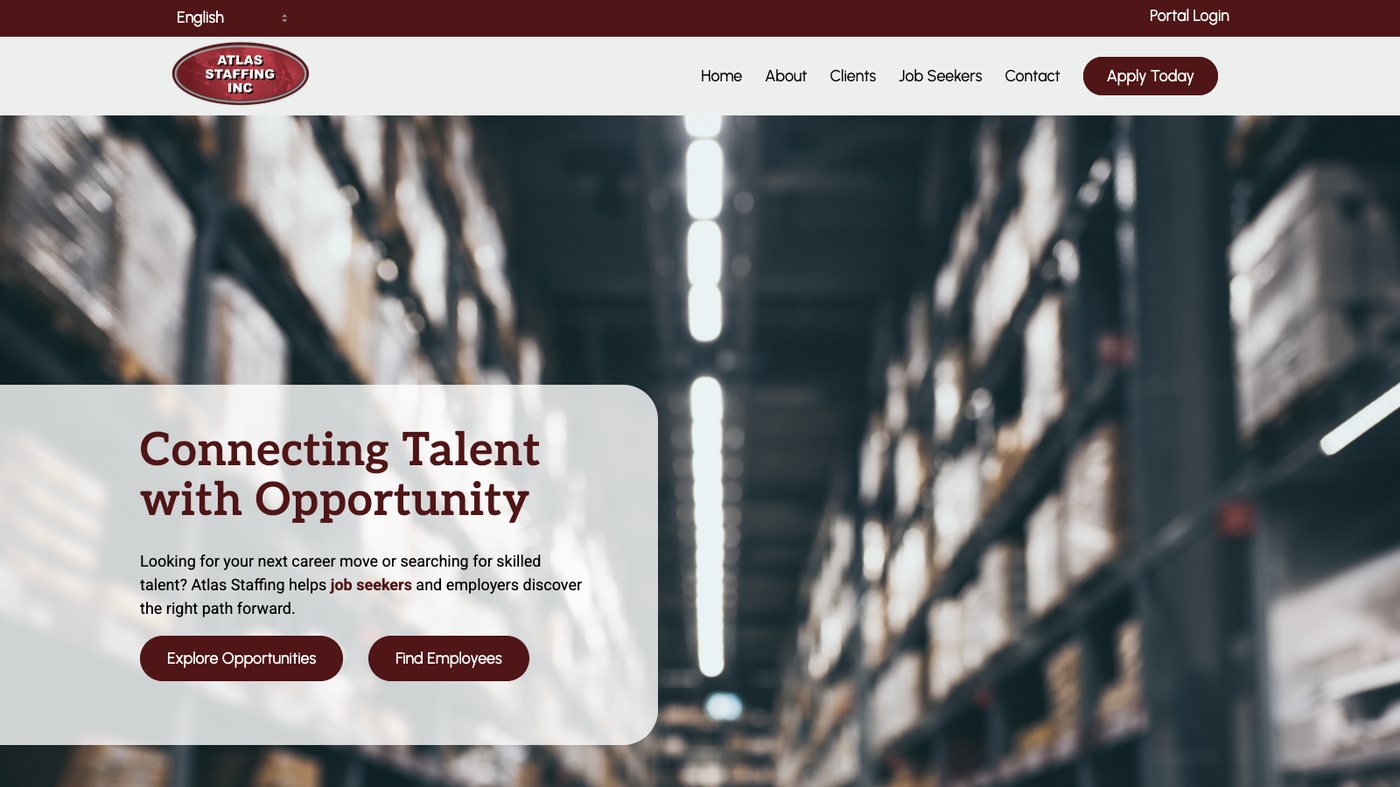
The strongest ranking of the five and a hero that names both audiences in one sentence: "Looking for your next career move or searching for skilled talent?" Two equal buttons under it, "Explore Opportunities" and "Find Employees", an "Apply Today" pill in the nav, and a portal login in the top bar for placed workers. The warehouse photo tells a light industrial candidate they are in the right place before they read a word. Branch pages exist for a dozen Twin Cities suburbs, which is why it ranks.
What we would change: "Explore Opportunities" leaves the site for a TempWorks job board on a vendor domain, and that board sat behind a Cloudflare human-verification wall in every browser we tried, so we could not count the jobs and neither can Google. "Find Employees" goes to a Clients page with another "Find Employees" button and no form. The phone number is plain text with no tap-to-call link. Not a single review is shown on a homepage that has 220 of them. Mobile score 63.
2. The Right Staff
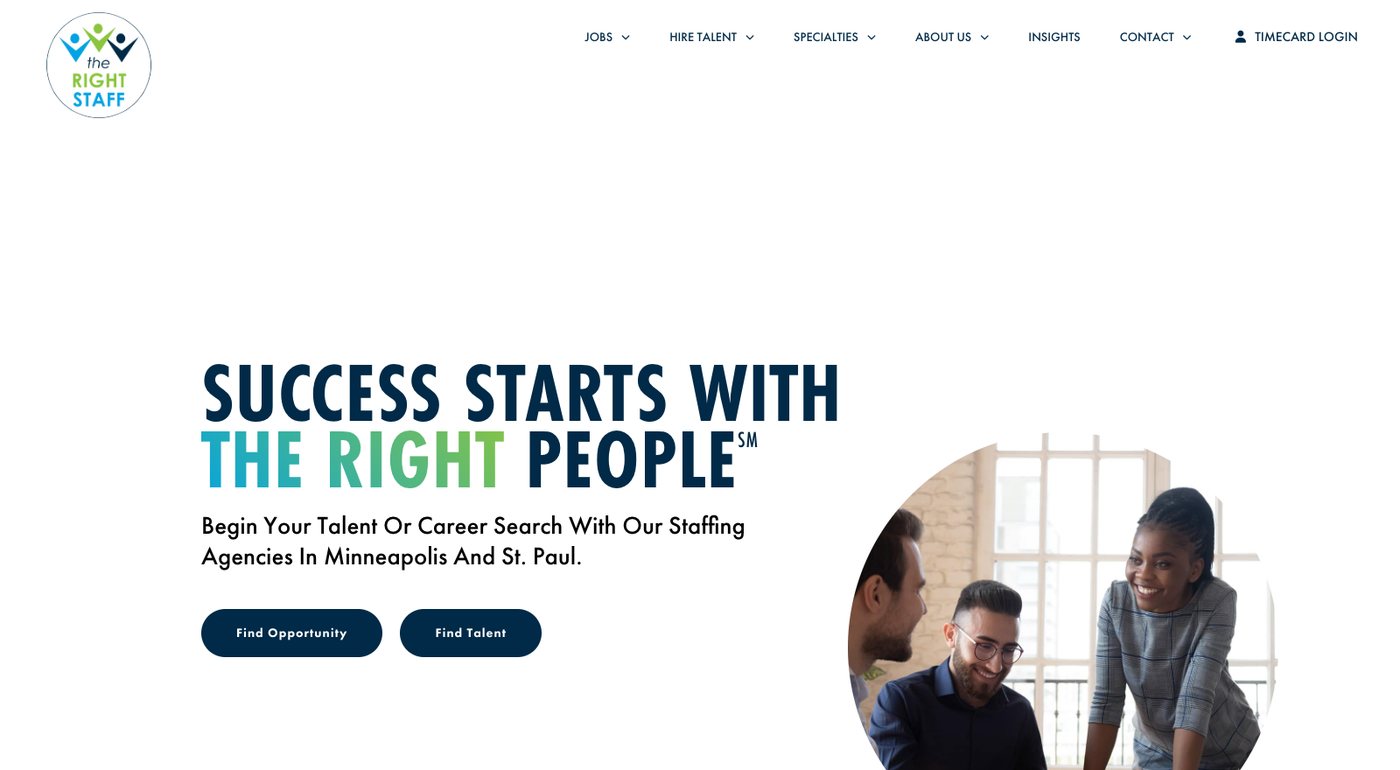
Two clean paths in the hero, "Find Opportunity" and "Find Talent", and a specialty menu that runs from accounting to legal so a hiring manager can find their category in one click. The employer form asks for seven things and nothing more. This is the only site of the five whose job pages carry Google's JobPosting structured data, with a direct-apply flag and an expiry date, which means its 34 jobs can appear in Google's job results.
What we would change: those 34 jobs live on jobs.therightstaff.com, a Haley Marketing portal on a subdomain, and the list itself is rendered by script, so the main site has no job on it. Three things compete with the hero for attention: a slide-in circle about Minnesota PFML coverage, a cookie banner and a chat bubble. On a phone in our test render there was roughly a full screen of white space between the logo and the headline. Mobile score 57.
3. Konik

The only one of the five with a clickable phone number, and the only one that lets an employer book a call: the Request Talent page has a "Message Us" form and a "Schedule a Call" tab wired to Calendly. The niche is clear from the nav, Positions We Fill through engineering and manufacturing, and 157 reviews at 4.9 is the best reputation in this set.
What we would change: the hero says "Welcome to the Konik Network" with one button, "Learn More", and no path for either audience. The next section is the 50th anniversary video. A candidate has to scroll past the founder's retrospective to reach "Find Your Next Job", and then leaves for a Crelate portal on jobs.crelate.com that is styled to look native and holds 105 jobs as a script-rendered shell with no markup. The 4.9 rating is nowhere on the homepage. Mobile score 63.
4. J. Kent Staffing
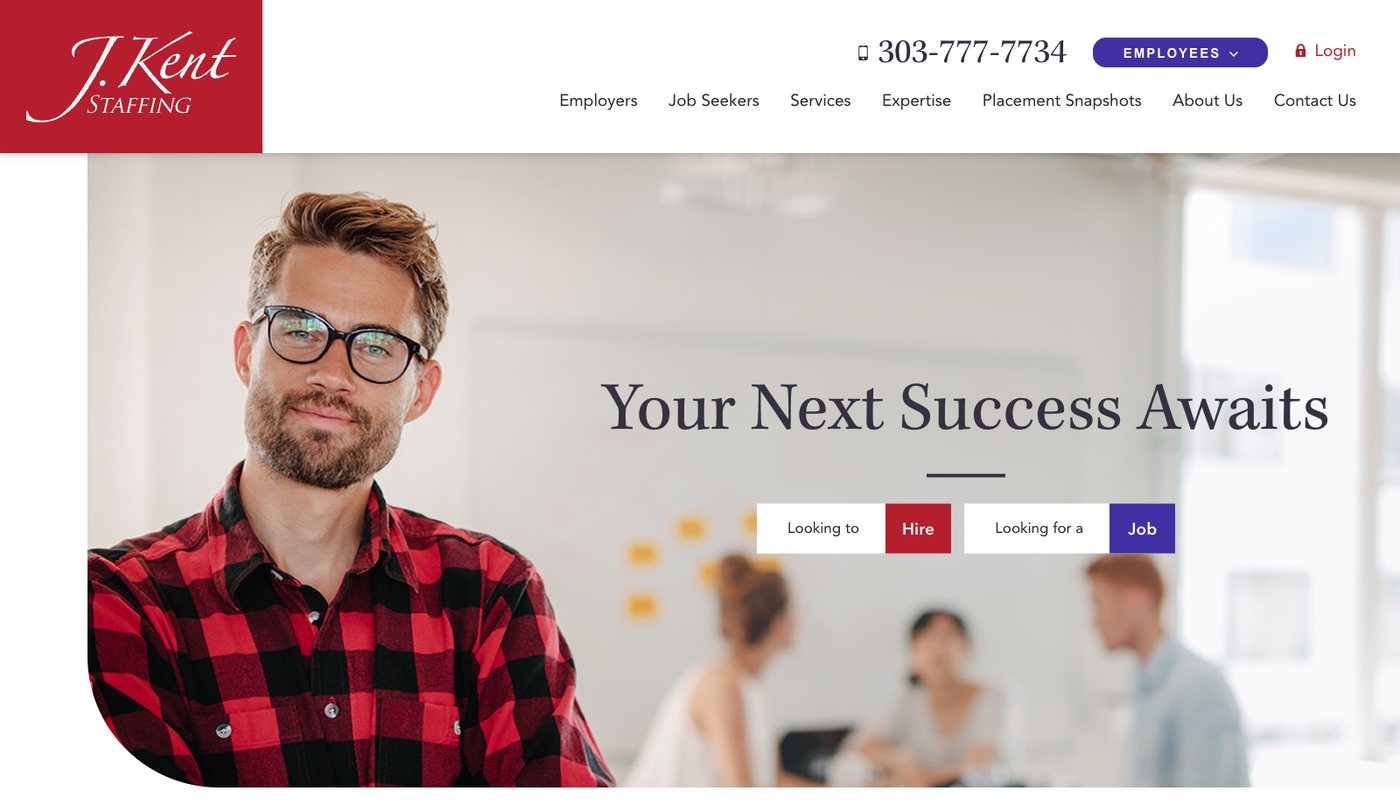
The best two-audience hero of the five: "Looking to | Hire" and "Looking for a | Job" as two segmented buttons, phone number with a tap-to-call link in the header, and the footer splits the blog itself into "View Our Employers Blog" and "View Our Job Seekers Blog". Two ClearlyRated Best of Staffing awards sit in the footer, a candidate testimonial with a name sits on the homepage, and there is a line pointing to Google reviews. Each audience has its own sub-menu with FAQs.
What we would change: the employer form is about twenty fields, including the company's street address, website and two phone numbers, before a recruiter will call. The job board is an Avionte widget on a page whose URL still reads "search-for-jobs-avionte", it lists nine jobs, and every job detail link is a hash URL on hire.myavionte.com. The headline in the hero is an H2; the page's H1 is the eyebrow "Woman-Owned, Founded in 1979". Mobile score 61.
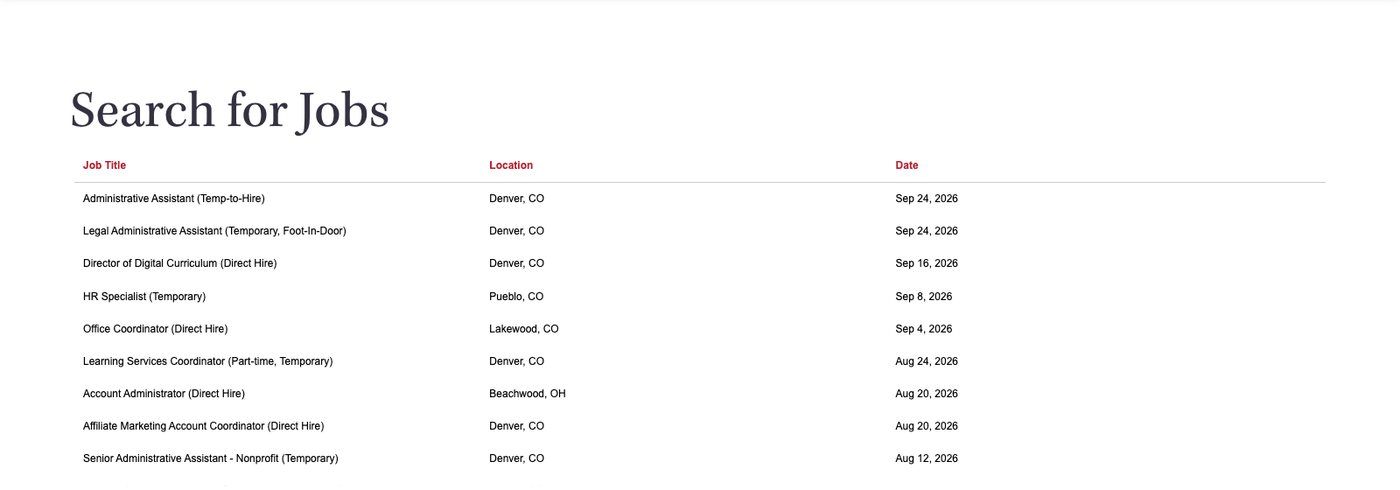
5. Dawson
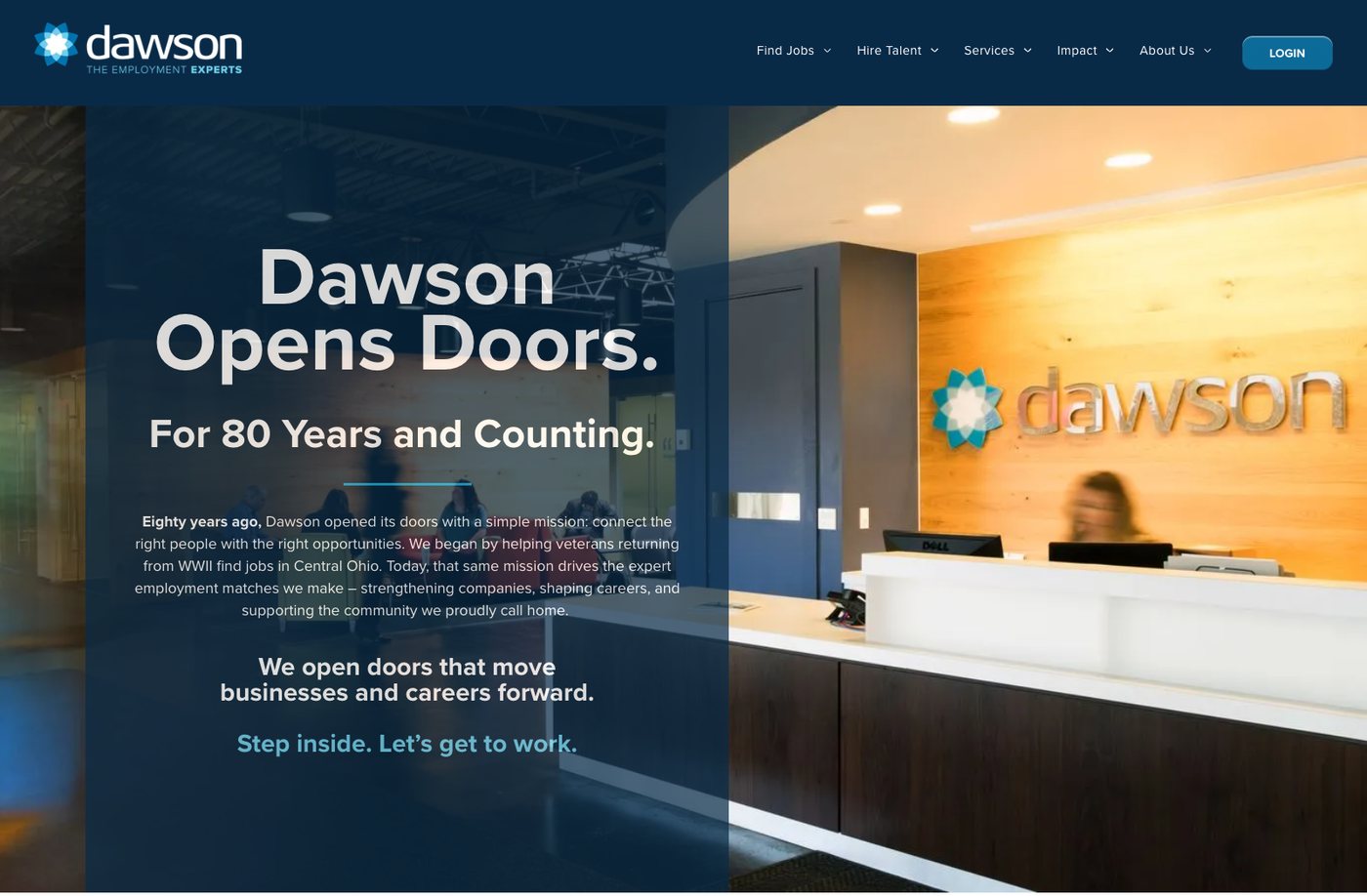
The most jobs of the five, 79 of them, dated within the last four months and filterable by department and distance. The five-star testimonials on the homepage name individual recruiters. The audience split, when it arrives, is well written: "For Job Seekers: Your next opportunity starts here" and "For Employers: Build the team behind your success."
What we would change: the hero has no button. It is the company's eighty-year story, five lines of it, ending in "Step inside. Let's get to work." with nowhere to click. The homepage HTML contains no phone number at all. The employer path is a page of four cards, then a "Let's Talk Talent" modal that pops over it, then a contact page; there is no form on the services page. The 79 jobs are the same Avionte widget as J. Kent's. Mobile score 51, the lowest here, with a large photo filling the first phone screen.
Five sites, five applicant tracking systems, and not one job in crawlable HTML on the agency's own domain. Atlas links out to TempWorks, Konik to Crelate, The Right Staff to a Haley subdomain, and J. Kent and Dawson inject an Avionte widget whose links open on Avionte's domain. Whatever search value those hundreds of job pages earn goes to the vendor.
Two audiences, one homepage
Jessica Payne's article, written from inside a staffing firm, states the problem: "Candidates want to find a role and apply with as little friction as possible. Employers want proof that the firm can deliver before they pick up the phone." Haley Marketing, which has built over 1,500 staffing sites, says the same in its own best-of list: employers want credibility and speed, job seekers want simplicity and trust. The pattern across our five is that the candidate wins the hero and the employer gets a form, or nothing.
| Site | Hero addresses | Employer path | Job board lives on | Jobs | Phone tappable | Reviews on homepage |
|---|---|---|---|---|---|---|
| Atlas Staffing | Both, candidate first | Button, page, button, no form | TempWorks domain, behind a bot wall | Not retrievable | No | None |
| The Right Staff | Both, candidate first | Seven-field form | Haley subdomain | 34 | No | None |
| Konik | Neither | Eleven-field form or a Calendly call | Crelate domain | 105 | Yes | None |
| J. Kent Staffing | Both, hire first | Twenty-field form | Own page, Avionte widget, vendor detail links | 9 | Yes | Testimonial, awards, review link |
| Dawson | Brand story, no button | Cards, popup, contact page | Own page, Avionte widget, vendor detail links | 79 | No | Named testimonials |
| Verdict | Split the hero, give the employer a short form and a calendar, and put the jobs on your own domain. | |||||
The employer is the one who pays. A placement fee or a temp markup is worth thousands of dollars, and the hiring manager who arrives at 10pm with an open req is the most valuable visitor the site will ever have. Making that person fill in a company street address before a recruiter calls, or click through three pages to find a popup, is the same mistake as the auto-opening chat widget we found covering the headline on law firm sites. It is a default nobody tested as a stranger.
Where the job board lives, and why it matters
Every applicant tracking system offers a way to show jobs on your site, and every one of them defaults to a method that keeps the jobs on the vendor's domain. We read the vendor documentation for each.
| ATS | Default method | Route to first-party job pages |
|---|---|---|
| Crelate | Link to jobs.crelate.com, or an iframe with "iframe=true"; a script widget since the v1 portal was retired on December 31, 2025 | RSS feed, which Crelate calls "the most complicated and the most flexible" and "involves writing custom code" |
| Avionte Bold | An iframe, or "a single line of code" that injects the widget; job links are hash URLs on hire.myavionte.com | JSON jobs feed, which "requires more development" |
| Loxo | Redirect your jobs page to the Loxo careers page, or iframe it | Open API, or a third-party plugin |
| JobAdder | A hosted CareersPage on clientapps.jobadder.com, or a JavaScript widget | XML feed or API, for a developer to build pages |
| Recruiterflow | An iframe that "lets them apply right inside the iframe" | API |
| Zoho Recruit | Embed code pasted into the CMS | Not documented |
| Bullhorn | Open Source Career Portal, a free app you host yourself, or iframe it on Wix | The portal itself, on your hosting, with "most customers" needing a developer |
| Verdict | The easy setting sends the jobs to the vendor. The feed or API setting keeps them, and it is a development job. | |
Google's rules make the difference concrete. JobPosting markup "must only be used on pages that contain a single job posting", "must appear on the same page as the job description", and Google does not allow "job postings that don't have a way to apply". Filled jobs must be removed by expiring them, returning a 404, or stripping the markup. In its December 2023 office hours, Google said it attempts to associate iframe content with the parent page but that this is not guaranteed. An iframe or a script-injected widget with hash links meets none of the conditions on your domain. Of our five, The Right Staff's Haley portal is the only one emitting the markup, and it does so on a subdomain.
The worked example
We rebuilt Katapult Network's site, a Minneapolis staffing firm that places early-career professionals, and it went live on September 16, 2026. The old site's job board lived on a Breezy subdomain and its testimonials had been dropped in a previous rebuild. The new site has two paths from the first screen, the employer path in navy and the candidate path in orange, so the two audiences never share a page.
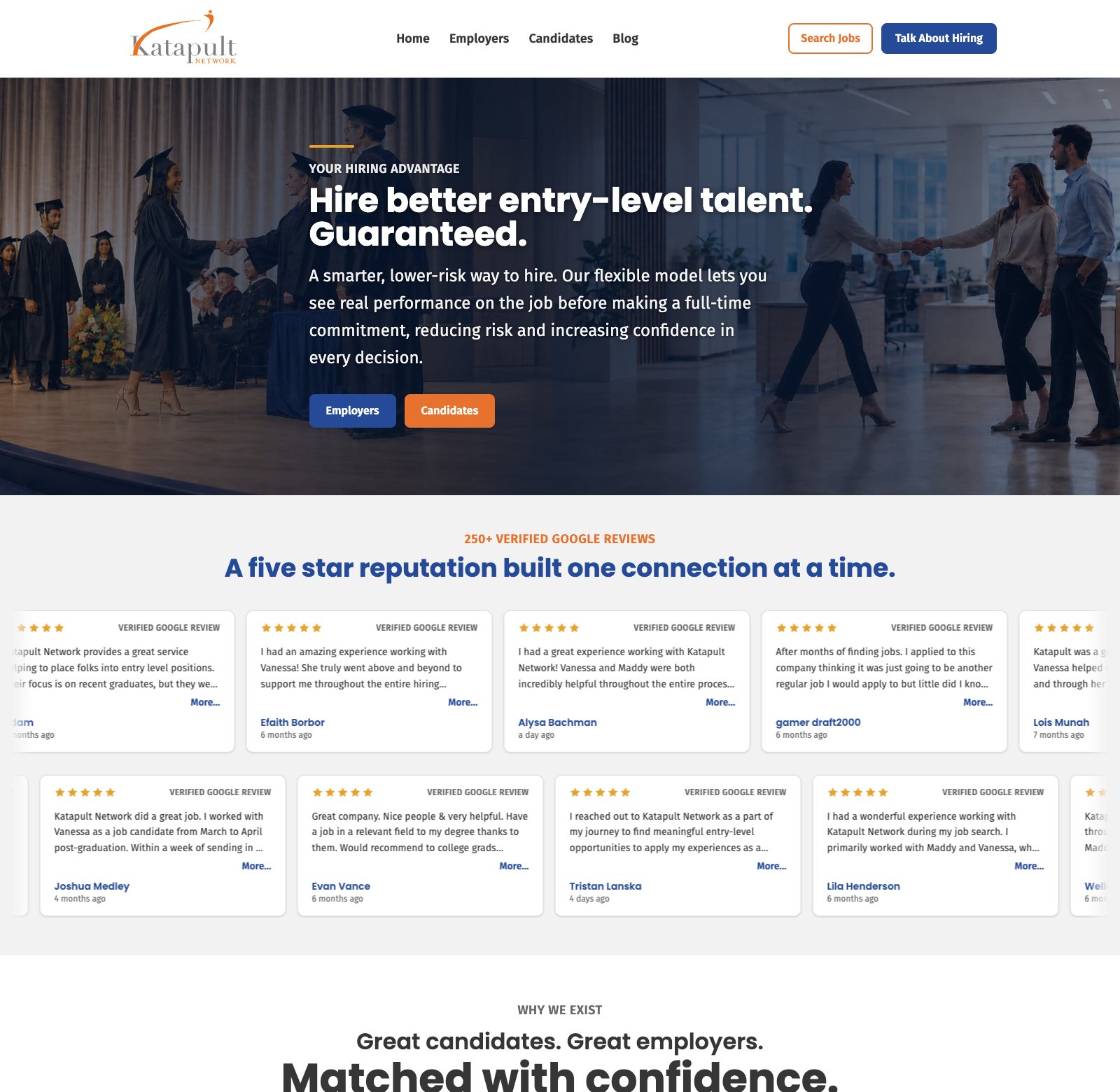
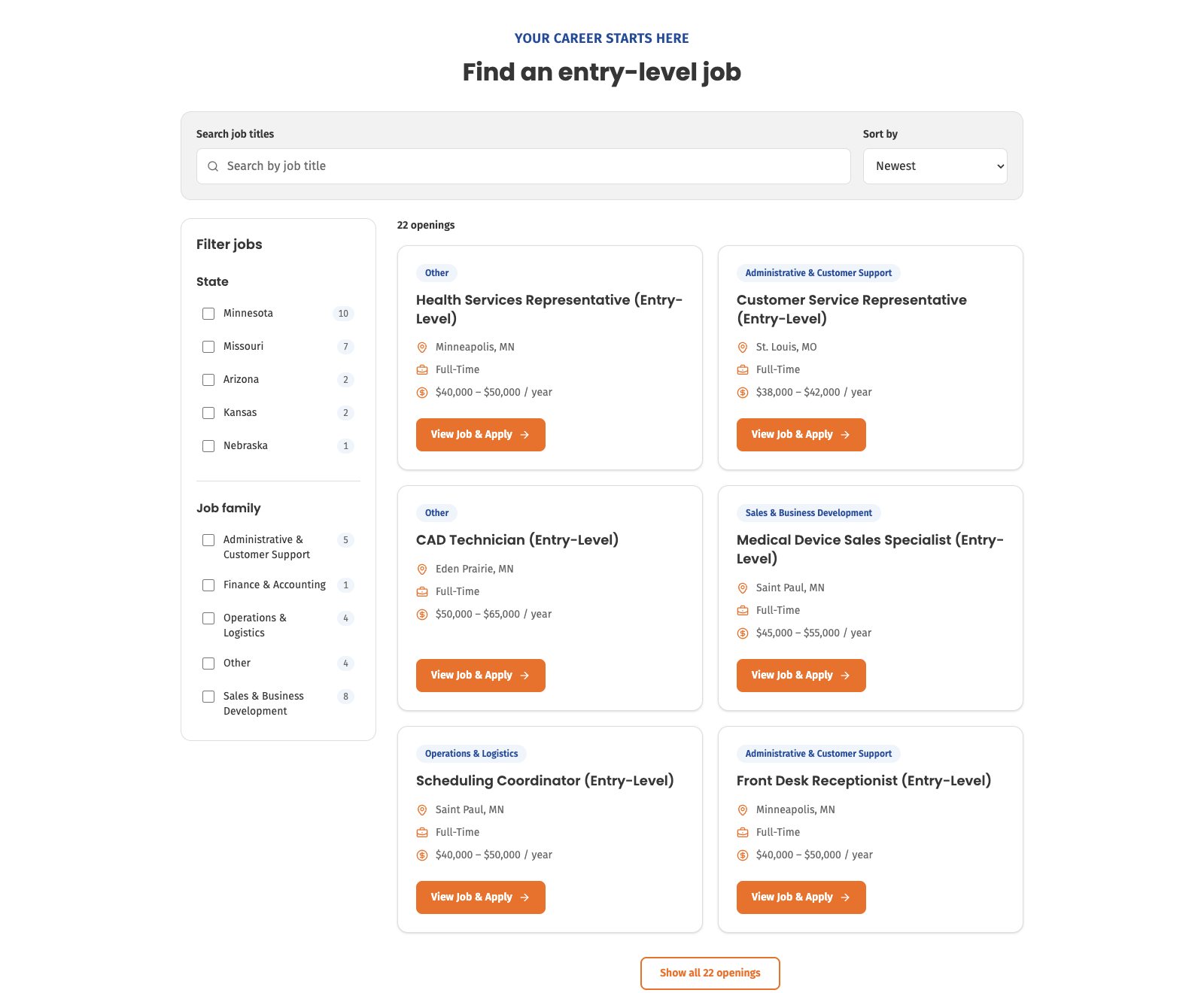
A filterable job board runs on katapultnetwork.com itself, with every opening on its own URL and editable from the client portal, and four role pages that did not exist before give an employer a place to land for each function the firm fills. The 67-post archive kept its URLs and its backlinks through 110 redirect rules. In the first eight days the job board page was second only to the homepage in traffic. The full before-and-after is on the case study page.
Want this done to your agency's site?
We will record a ten-minute walkthrough of your homepage as a hiring manager and as a candidate on a phone, with the fixes ranked, and send it within 48 hours. Free.
What candidates actually do on a phone
- Appcast's 2025 benchmark report, built on 281 million clicks and 25.6 million applications from over 1,300 US employers in 2024, found roughly three quarters of both clicks and applies came from mobile. Its advice is the same every year: "Make the apply process simpler: Forgo the long questions, avoid asking for documents, or more specifically, resumes, that job seekers won't have on their phones." Konik's own-domain apply form requires a resume attachment.
- The overall apply rate in that data was 6.1 percent, so 94 of every 100 candidates who click a job never finish. SmartRecruiters puts the drop-off between "Apply" and a completed application at 92 percent, and cites a client that cut application time from 17 minutes to 3 to 5 minutes for a 60 percent reduction in drop-off.
- CareerBuilder's research, quoted by TempWorks for the staffing industry, found one in five workers spends less than ten minutes, or two to three mobile pages, on an application before dropping it, and 60 percent quit applications because of length or complexity.
- The American Staffing Association's own survey found 77 percent of job seekers "prefer human interaction when searching for a job" and 62 percent think "job websites are too impersonal". The site's job is to get the candidate to a recruiter fast, with a phone number that dials.
- All five homepages showed clipped headline text at 390 pixels wide in our headless test render. That may be a rendering quirk, so check yours on a real phone. Only two of the five would have shown a tappable number when you did.
The patterns worth copying
- Two paths in the first screen, labelled by what the visitor wants. J. Kent's "Looking to Hire" and "Looking for a Job" is the model. Nobody arrives at a staffing site to learn about the network.
- A short employer form and a calendar. The Right Staff's seven fields plus Konik's "Schedule a Call" tab would be the best employer page in the set if they were on the same site. Ask for four things (name, company, role, phone), then let a recruiter get the rest on the call.
- Reviews and awards above the fold. Atlas has 220 reviews and shows none; J. Kent has 393 and shows a testimonial, a review link and two awards. The hiring manager wants proof before the phone call, and the proof exists.
- Jobs on your own domain, one URL each, with the markup Google asks for and an expiry that removes them when filled. Use the ATS feed, not the iframe. It is a development job once and a ranking asset forever.
- A phone number that dials. Two of five had one.
- A niche in the headline and in the photo. Atlas's warehouse and Konik's engineering nav both work; "Connecting Talent with Opportunity" and "Your Next Success Awaits" could be any agency in the country.
What to skip
- The iframe or widget job board, for the reasons above. Frontline's rule: the site "should never send a candidate off-site to a third-party job board to finish the application."
- A twenty-field employer form. The address, website and fax number belong on the contract, not the first contact.
- Anything that pops over the hero. Dawson's "Let's Talk Talent" modal, The Right Staff's PFML slide-in, cookie banners and chat bubbles all landed on the same screen as the headline.
- A hero with no button. Eighty years is a good story for the About page.
- "Welcome to" as a headline. It tells both audiences nothing about which of them you serve.
What a staffing agency website costs in 2026
| Vendor | Published price | Notes |
|---|---|---|
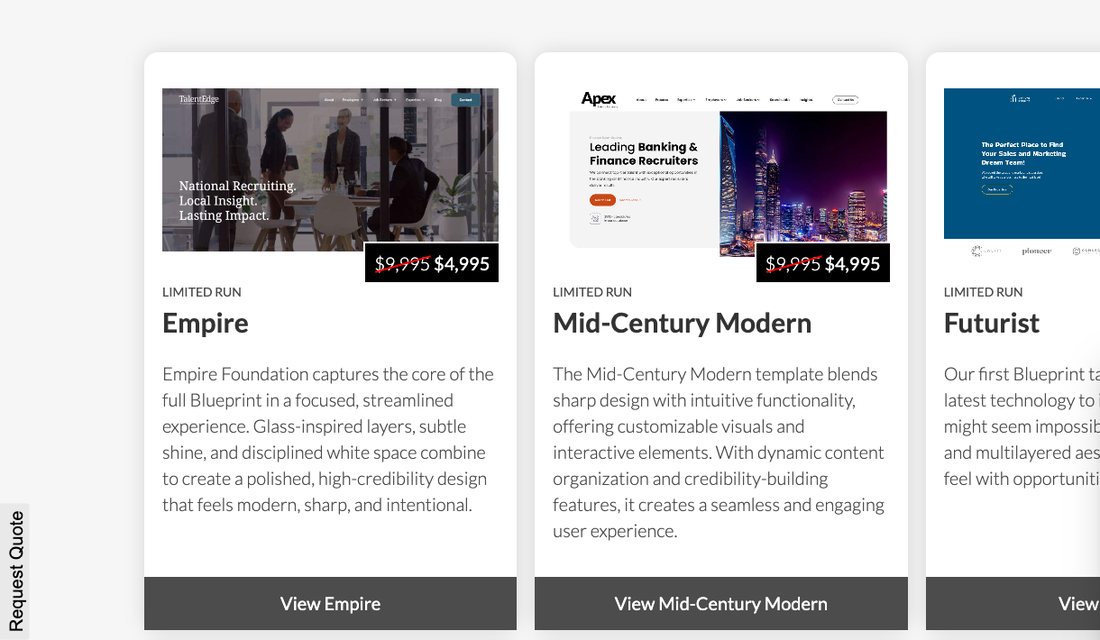
| Recruiters Websites | Blueprint template sites $4,995, shown struck from $9,995 as a "Limited Run" | Up to ten pages, custom copy, and a career portal; automatic ATS posting is a paid upgrade with no price shown. The $995.95 figure quoted elsewhere is their AI blog product. |
| Recsites | $115, $175 or $245 a month plus a $995 setup fee | Integrated job board on all tiers; CRM import of jobs from the middle tier up. No contract. |
| Shazamme | From $195 a month | Career-site platform with its own job pages; tiers run to $785 and up, and the plan table did not render in our capture, so confirm the billing terms on the page. |
| RecruiterWEB | £149 to £599 a month plus VAT | UK platform with first-party job pages built for Google for Jobs. "No stealth or hidden prices." |
| Fast Recruitment Websites | £2,250 or £4,500 plus VAT, then £400 a year hosting | UK. One-off build, no monthly model, ATS integrations listed. |
| Haley Marketing | Not published | Three tiers described, every one ends in "Get An Estimate". The pricing URL is a quote form. Over 1,500 staffing sites built. |
| VisionFriendly (now Blackbird Digital), Orbit Media | Not published | Both rank for the term and both route to a call. |
| Verdict | A template with a hosted board is $115 to $245 a month. A site with the jobs on your own domain is $5,000 to $8,000 once, and it is the part that ranks. | |
Our own pricing sits in that custom range and the staffing and recruiting page shows what we build. If you already have a site and want to know whether the problem is the hero, the board or the phone, the free website audit covers all three.
Want a site both audiences can use?
Two paths from the first screen, a short employer form with a calendar, and a job board on your own domain that Google can index. Ten-minute audit first, then a plan.
Related reading
- Katapult Network: a staffing site built for two audiences, the full case study with before and after.
- Accounting firm website design: five sites reviewed, the same treatment for another professional service.
- Law firm website design: five real examples reviewed.
- What a small business website costs in 2026.
Frequently asked questions
What makes a good staffing agency website?
Two paths in the first screen, one for employers and one for candidates, a short employer form with a way to book a call, a phone number that dials on a phone, reviews and awards above the fold, and a job board on the agency's own domain with one URL per job. Of five ranking sites we reviewed, none had all of those.
Should a staffing agency's job board be on its own domain?
Yes. Every applicant tracking system defaults to an iframe, a widget or a hosted portal on the vendor's domain, which means the job pages earn search value for the vendor. Google's JobPosting rules require the markup on a single-job page with a way to apply, which an iframe on your site does not satisfy. Use the ATS feed or API and build the pages on your domain.
How long should a job application be?
Short enough to finish on a phone in under ten minutes. Appcast's 2024 data shows roughly three quarters of applications come from mobile and an overall apply rate of 6.1 percent, and its advice is to drop long questions and resume uploads. CareerBuilder found one in five candidates abandons after less than ten minutes or two to three mobile pages.
What should the employer page on a staffing site include?
The niches you fill, the services (temp, temp-to-hire, direct hire), proof in the form of reviews, awards and named testimonials, a four-field form (name, company, role, phone) and a calendar link. Of the five sites we reviewed, one had no employer form at all and one asked for twenty fields.
How much does a staffing agency website cost?
Template platforms with a hosted job board run $115 to $245 a month plus a setup fee at Recsites, from $195 a month at Shazamme, and £149 to £599 a month at RecruiterWEB. Recruiters Websites lists template sites at $4,995. Haley Marketing, the largest staffing web vendor, publishes no prices. A custom site with the job board on your own domain runs $5,000 to $8,000 from an agency like ours.
Why do candidates apply on job boards instead of the agency site?
Because the agency site usually sends them to a third-party board to finish, and the application there asks for a resume they do not have on their phone. The largest job board has also retired free organic posting for staffing agency accounts on several ATS platforms, so it is now a paid channel. A first-party job page with a short apply form is the alternative.