TL;DR
Psychology Today's signup page tells therapists that "many members find that they no longer need a website after joining". Our September 2026 pull of eight live Minneapolis searches says otherwise, with a catch. On the generic terms ("therapist minneapolis", "anxiety therapist", "takes blue cross") directories took every practice slot: zero practice websites on page one. On the specialty terms ("couples therapist minneapolis", "emdr", "child", "online therapy minnesota") practice sites held four to eight of nine. The map pack is won by solo clinicians with 2 to 24 reviews. One new client is worth about $1,790 at the Minneapolis average fee and the median course of therapy, and the median therapist spends $500 a year on marketing. The two things every SEO guide gets wrong for this profession: your ethics code bars you from asking for reviews, and Google will not sign a business associate agreement for Analytics. Seven moves ranked below, the HIPAA layer in plain terms, and what the vendors charge.
Most therapist SEO advice is generic local SEO with the word "therapist" swapped in. It tells a solo LICSW to collect Google reviews, install Analytics, and put a contact form on every page. The first is barred by the ACA, APA and NASW codes, the second has no business associate agreement behind it, and the third is the exact example HHS uses for when a tracking vendor becomes a business associate. This guide is for the private practice clinician on a Squarespace site with a Psychology Today profile, and it is built on live results rather than a keyword tool.
It sits alongside our contractor SEO guide for the local search mechanics that carry over, and the medical and healthcare page, which is where we work with practices.
What the Minneapolis results actually show
Eight queries, Google's live results with the searcher placed in Minneapolis, depth ten, September 25, 2026. Each organic result was classified as a directory (Psychology Today, Zencare, TherapyDen, GoodTherapy, Headway, Alma, Zocdoc and their kind), a venture-backed platform (BetterHelp, Talkspace, Thriveworks, LifeStance), a group practice, or a solo practice.
| Query | Map pack | Directories | Group practices | Solo practices | Practice sites on page one |
|---|---|---|---|---|---|
| therapist near me (368,000 US searches a month) | Yes | 4 | 4 | 0 | 5 of 9 |
| therapist minneapolis (1,000) | Yes | 6 | 1 | 1 | 2 of 8 |
| anxiety therapist minneapolis | Yes | 7 | 0 | 0 | 0 of 9 |
| therapist that takes blue cross minneapolis | Yes | 7 | 0 | 0 | 0 of 9 |
| couples therapist minneapolis (320) | Yes | 1 | 4 | 2 | 6 of 9 |
| emdr therapist minneapolis | Yes | 3 | 3 | 1 | 4 of 9 |
| child therapist minneapolis | Yes, plus an AI Overview | 1 | 5 | 1 | 6 of 9 |
| online therapy minnesota | No | 1 | 6 | 2 | 8 of 10 |
| Verdict | Generic and insurance terms belong to the directories. Specialty plus city belongs to practices. Write for the second kind. | ||||
Three details from the raw results matter more than the counts.
The map pack is a solo clinician's best asset. Across the seven packs, solo practices held nine of 21 slots. "Corey Busch, Mental Health Therapist" appears in three packs with 13 reviews. Restoration EMDR Therapy made the EMDR pack with two reviews and a hidden address. Review counts in the packs ran from 2 to 63 with a median around 13, which is what an unsolicited review flow looks like, and it is enough.
Psychology Today is on every page and first on three. Its signup page claims the directory "appears as the top Google search result for therapy-seekers 96.2% of the time". In our eight queries it ranked first organically on three. For "couples therapist minneapolis" a Reddit thread outranked it; for "emdr" the EMDR International Association did; for "online therapy minnesota" it sat ninth behind eight practices with a dedicated page. Three of its six results on "therapist minneapolis" were individual therapist profiles, which is the directory ranking for its members rather than instead of them.
Google publishes no search volume for most of these terms. The Google Ads endpoint returns nothing for "anxiety therapist minneapolis", "emdr therapist minneapolis" and the insurance query, because Google restricts health-condition keyword data. The two that returned, 1,000 and 320 a month, bracket what a city-plus-specialty term is worth. Do not let a keyword tool showing zero talk you out of a page the live results say a practice can win.
Psychology Today: ally, competitor, both

At $29.95 a month with no contract, the listing is the cheapest marketing a therapist can buy, and the profession knows it. Heard's 2026 survey of 1,950 therapists found 82 percent cite online directories as a client source, second only to referrals at 83 percent, with Google and SEO at 31 percent. One therapist on r/therapists: "$30/mo is cheap insurance if it lands you even one long term client every few months, it pays for itself 10x over". Another, historically: "approximately 50-60% of my inquiries come from PsychToday (historically). 90% when I was first starting out".
The same forum in 2026 reads differently. A therapist who charted her contacts from 2024 to 2026: "PT used to be my most steady stream to get clients and now I am getting absolutely nothing." Another: "I have followed all of the guides on the internet about optimizing the profile, and nothing. I have had two calls in 5 months." A third noticed the mechanism: "I updated one line in my bio and got a bunch of contacts for a month, then nothing." Whatever changed on the directory's side, the therapists who are full in 2026 describe a different shape: a website, a niche, and referrals that arrive already knowing the name. Keep the listing. Stop treating it as the plan.
What one client is worth
Psychology Today's own Minneapolis index puts the average session at $179 across more than 2,000 listed therapists. The only long-run private-practice dataset we can find, Clement's 40-year study of 1,969 patients, puts the median course of therapy at 10 sessions and the mean at 17. Heard's 2026 report has the median solo therapist at 18 clients a week, $80,412 in revenue, and $500 a year on marketing.
private-pay value of one new client at the $179 Minneapolis average fee and the ten-session median course, before referrals; about $1,050 at the $105 insurance reimbursement Heard reports
Insurance changes the arithmetic. SimplePractice's 2025 data from 245,000 clinicians puts the average self-pay session at $139.75 and the average insurance reimbursement at $99.75. Heard says a $150 cash session reimburses around $105. A therapist who moves ten new clients a year from panel referrals to private pay has added roughly $7,000 of revenue for the same hours. One clinician on r/therapists ran the numbers on joining Headway and found the fee lift was "Just 4.34%". The website that brings a private-pay client is worth the difference.
Want to know which specialty terms your practice can win?
We will pull the live results for your city and specialties, show you who holds the pack and the blue links, and send a written plan. Free, and nothing in it touches client data.
The HIPAA layer, in plain terms
If you bill insurance electronically you are a covered entity, and the website is inside the rules. HHS's tracking bulletin names "frequency of visits to a therapist" as the kind of information a tracking script can leak. The tools most therapists install were not built for that.
| You want to | What the source says | Where |
|---|---|---|
| Run Google Analytics on the site | "Google makes no representations that Google Analytics satisfies HIPAA requirements and does not offer Business Associate Agreements in connection with this service." Google says not to tag authenticated pages or pages related to providing care. | Google's own help page, "HIPAA and Google Analytics" |
| Use the Squarespace contact form | The form block "can't be used as part of a HIPAA compliant solution". Only Acuity Scheduling on the Powerhouse or Premium plan is covered by Squarespace's BAA. | Squarespace help, "Acuity Scheduling and HIPAA", updated January 20, 2026 |
| Take appointment requests through a form with a tracking script on the page | "if an individual makes an appointment through the website of a covered health clinic ... the tracking technology vendor is a business associate, and a BAA is required." | HHS Office for Civil Rights tracking bulletin |
| Rely on the 2024 court ruling | AHA v. Becerra vacated only the rule that an IP address plus a visit to a public health page is PHI. Footnote 8 leaves the rest of the bulletin standing, and HHS withdrew its appeal on August 29, 2024. | N.D. Texas, No. 4:23-cv-01110-P, June 20, 2024 |
| Get a form and email that sign a BAA | Hushmail healthcare plans from $11 a month, forms from $13.75; Paubox from $32 a month with forms included; Jotform only on the $129 a month Gold plan; Google Workspace signs one in the Admin console. | Vendor pricing pages, September 25, 2026 |
| Verdict | Public pages about your specialties can carry analytics. The page where someone asks for an appointment cannot, and the form on it needs a vendor that signs. | |
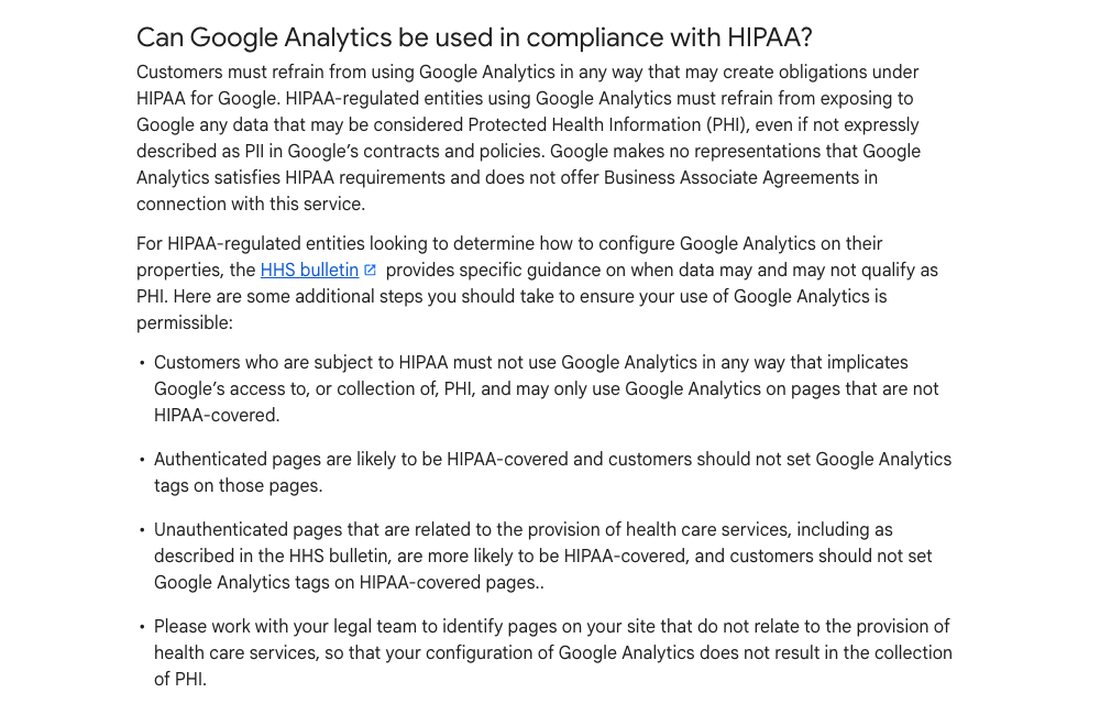
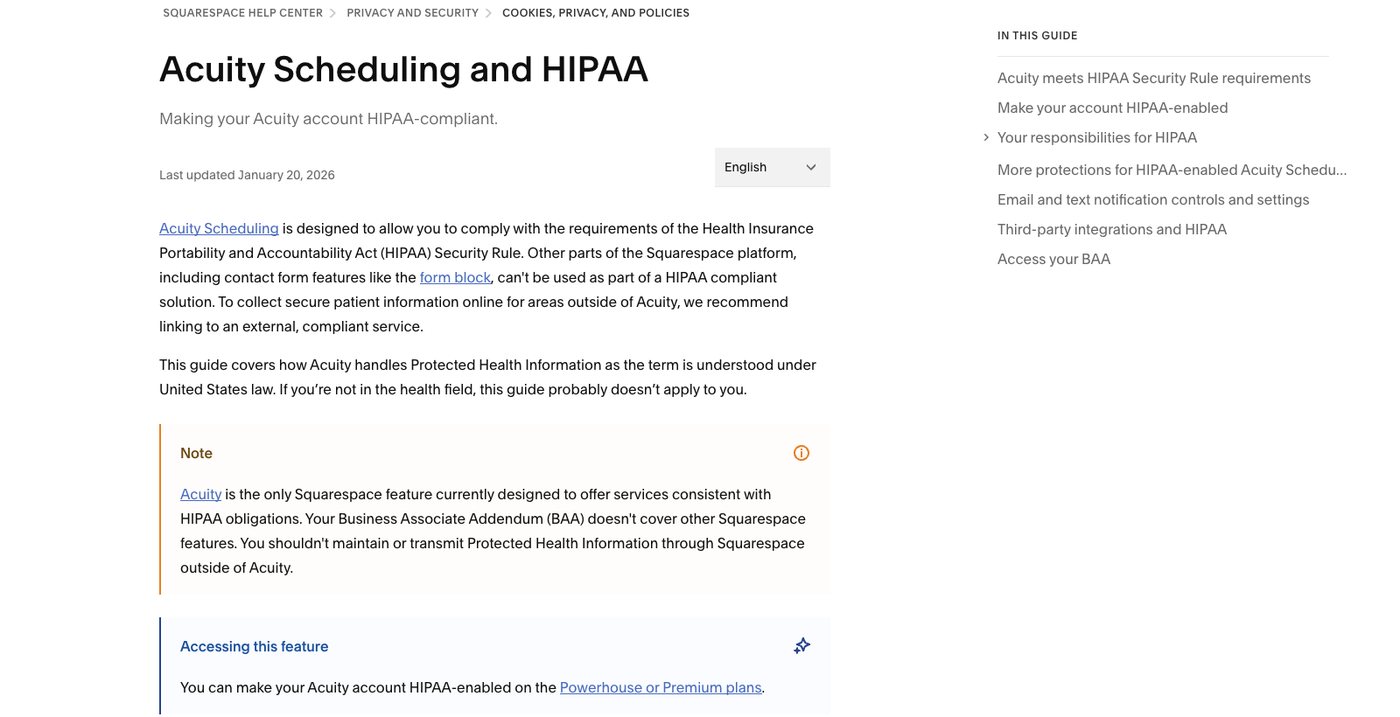
A cash-only practice that never files a claim may not be a covered entity at all, and state privacy law and your licensing board still apply. The practical setup is the same either way: analytics on the specialty pages, no analytics on the booking or contact page, and a form from a vendor that signs. One therapist auditing the therapist-only website vendors on Google's own speed tool found "non-HIPAA contactforms with lame disclaimers", which is the setup to avoid.
Seven moves, ranked by clients per hour of your time
1. A page for each specialty, with the city in it
"Couples therapist minneapolis" returned six practice sites in nine slots. "Child therapist minneapolis" returned six. "Online therapy minnesota" returned eight, and neither BetterHelp nor Talkspace was among them. The page that wins is a real page: who you see, what a first session looks like, your fee, your training, in the words a client would use. A full private-pay therapist on r/therapists: "I niched down so specifically that people think of me specifically when they have my type of client to refer. My practice doesn't cater to 98% of the population but when the 2% are looking, they call me."
2. A Google Business Profile in your own name, address hidden if you work from home
The map pack shows on seven of eight queries and solo clinicians hold nine of 21 slots in it. Google's category list has "Psychotherapist", "Counselor", "Marriage or relationship counselor", "Child psychotherapist" and a dedicated "EMDR psychotherapist". Google's own guideline says a business that does not serve clients at its address should hide it, and two hidden-address profiles sat in the Minneapolis packs. Name the profile the way the ranking ones are named: your name and your credential.
Then the part every generic guide gets wrong. The ACA Code of Ethics, C.3.b: "Counselors who use testimonials do not solicit them from current clients, former clients, or any other persons who may be vulnerable to undue influence." The APA code, 5.05: "Psychologists do not solicit testimonials from current therapy clients/patients". The NASW code, 4.07(b): "Social workers should not engage in solicitation of testimonial endorsements ... from current clients". Google permits asking for reviews; your board does not. A clinician on r/therapists said it for the whole profession: "any advice that tells you to chase reviews wasn't written for therapists." Reviews that arrive unasked are fine. The Minneapolis packs are won at two to 24 of them.
3. The Psychology Today profile, kept and refreshed
Still the highest-yield $29.95 in the profession, and on three of our eight queries it is the first organic result. Refresh it monthly, because the therapists who see contacts describe a profile that goes quiet when it goes stale. Link it to the specialty page, since the profile ranks and the page converts. Zencare ($59 a month plus $80 setup, $69 in New York and California), TherapyDen ($30 for a profile that appears in search) and GoodTherapy ($25.95 for new practices) are the same bet at smaller scale.
4. A FAQ page in your own voice
The People Also Ask box on these queries asks "How much does therapy usually cost?", "Is EMDR usually covered by insurance?", "What is the success rate of couples counseling?" and "When should a child see a therapist?" A page that answers those in plain language, with your fee and your insurance position, earns the box. A therapist who grew a caseload this way: "Add a FAQ page, it helps with how search engines work nowadays with AI integrated. Talk plainly like you're talking to your target client. Don't write in a cold clinical expert voice."
5. A contact path that signs a BAA
Replace the Squarespace form with a Hushmail or Paubox form, or with Acuity on a HIPAA-enabled plan, and keep analytics off that page. It costs $11 to $32 a month and it is the difference between a site you can defend and one you cannot. SimplePractice and TherapyNotes both include a client portal and publish a BAA, so a "request an appointment" link into the portal is the simplest compliant path of all.
6. A page for the clinicians who refer to you
Referrals are the first source for 83 percent of therapists in the Heard survey, and most of those come from physicians, psychiatrists, school counselors and other therapists who need to send someone a name at 4pm. A page written for them, with your specialties, your openings, your insurance panels and a direct line, is the page they forward. It ranks for nothing and it converts better than anything else on the site.
7. Insurance platforms, with the arithmetic done first
Headway is free to join and keeps an undisclosed share of each session; Alma is $50 a month on annual billing after a first-year promotion and takes nothing from cash clients. Both rank on the insurance queries your site cannot. A new clinician on r/therapists in August 2026: "All of my current clients came directly through Headway during the first couple of weeks after I joined. Since then, referrals have slowed". Another left the platforms over "pay rate decreases and a failure on their parts to actually refer new clients". They fill a new caseload fast. They are not a reason to skip the six moves above, which are what fill it with the clients you want.
What to skip
- Asking for reviews. Barred by all three codes. Two to 24 unsolicited reviews win the Minneapolis packs.
- A page targeting "anxiety therapist" or "takes blue cross" plus your city. Zero practice sites on page one for either. The directories and the insurer own those, and the map pack is your only route.
- Google Analytics on the contact or booking page. No BAA exists. Tag the specialty pages, not the appointment path.
- Template vendor SEO promises. A therapist who audited the therapist-only vendors on Google's speed tool found they "perform very poorly on technical SEO etc. despite all the claims". Another on Brighter Vision: "I can tell from the data that most people find me on a phone. And BrighterVision phone sites don't really look all that great."
- Daily social posting as the plan. Twelve percent of therapists cite social media as a client source in Heard's survey. An Illinois LCPC posting daily and optimizing every profile: "I'm still not seeing consistent client inquiries or a reliable stream coming in."
What therapist website and SEO vendors charge
Published prices as of September 25, 2026, quoted exactly.
| Vendor | Published price | Notes |
|---|---|---|
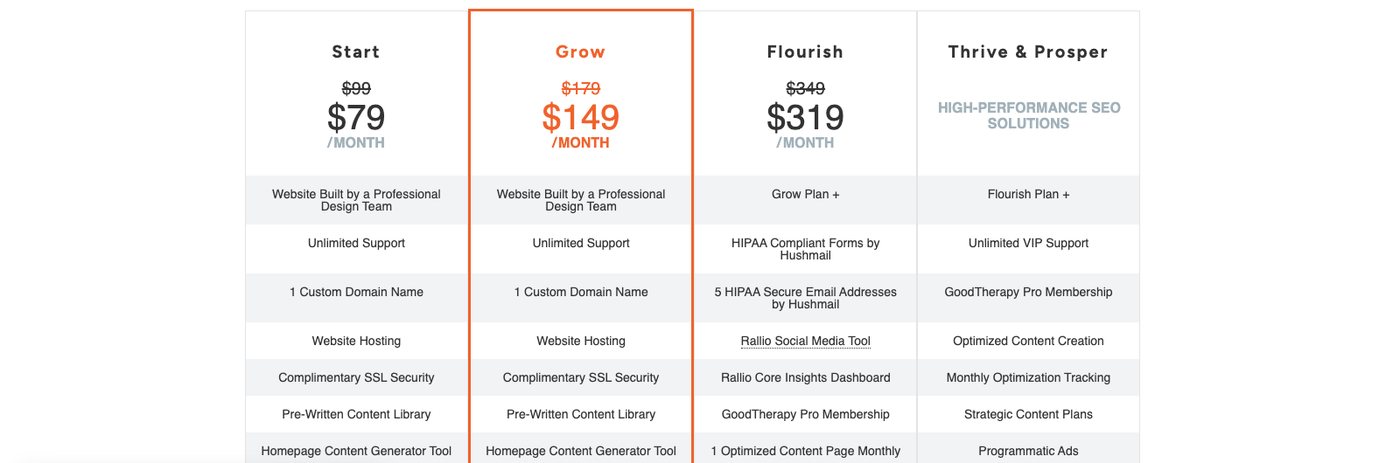
| Brighter Vision | Start $79 a month, Grow $149, Flourish $319; $100 setup on annual plans below Flourish | HIPAA forms by Hushmail and five secure email addresses only at Flourish. A therapist who left: "I'm not getting any traffic with them." |
| TherapySites | Core $69 a month, Advantage $99, Premium $158, up to Elite Plus $336; $199 design fee | Owned by Internet Brands. Secure forms and email from $15 a month extra. A therapist who left Brighter Vision for it: "My site is mine and I own everything with it." |
| Simplified SEO Consulting | Done-for-you SEO $1,050 to $1,350 a month by contract length, $350 onboarding; local SEO $695 a month for six months; DIY courses $97 to $749 | Early termination fee of at least $100 per remaining month. |
| The Passive Practice | SEO retainers $550, $800 or $1,200 a month, three-month minimum; setup $1,200 | Squarespace builds; website prices not published. |
| Private Practice Elevation | Custom site "starts at $6,499"; SEO $797 to $1,497 a month; care plans $127 to $497 a month | WordPress. Client testimonial on the page: "averaging 4 to 6 new leads a month". |
| Strong Roots Web Design | $6,000, $8,000 or $9,500 one-time | Content, brand and logo included; about twelve weeks. |
| YourTherapistX | $7,500 then $1,200 a month, up to $13,500 then $2,000 a month, on 16-month plans | HIPAA forms are a $50 a month add-on. |
| Therapist Marketer | Not published | On page one for "therapist seo" and routes to a consultation. |
| Verdict | A template is $69 to $319 a month and the HIPAA parts are extra. A custom site is $6,000 to $9,500 once. Either way, the specialty pages and the profile are the labour, and that is what the vendors mostly do not include. | |
Squarespace itself is $19 to $49 a month, plus Acuity on a HIPAA plan and a Hushmail form, which is the cheapest defensible setup there is. Our web design and local SEO services cover the specialty pages, the profile and the compliant contact path, and the free SEO audit will tell you which of the seven moves you are missing and whether your current form is one you can defend.
Want the specialty pages and the profile handled, with the compliance done right?
Specialty-plus-city pages, a Google Business Profile in your name, a FAQ in your voice, and a contact path with a BAA behind it. Ten-minute audit first, then a plan.
Related reading
- Financial advisor SEO, the other profession where a rulebook decides what the site can say.
- Chiropractic marketing, for the map-pack economics of another practice-based business.
- Contractor SEO: the complete 2026 guide, for the mechanics.
- How to optimize your Google Business Profile.
Frequently asked questions
Do therapists need a website if they have a Psychology Today profile?
For generic searches the directory ranks and the profile does the work. For specialty searches such as "couples therapist" or "emdr therapist" plus a city, practice websites held four to eight of nine page-one slots in a September 2026 Minneapolis study, and the directory ranked first on only three of eight queries. The profile and a specialty page do different jobs.
Can a therapist ask clients for Google reviews?
No. The ACA code bars soliciting testimonials from current or former clients, the APA code from current clients, and the NASW code from current clients including reuse of a prior statement. Google's policy permits asking, but the ethics codes are the binding constraint. Unsolicited reviews are fine, and Minneapolis map packs are won with 2 to 24 of them.
Is Google Analytics HIPAA compliant for a therapy website?
Google says it "does not offer Business Associate Agreements in connection with this service" and tells HIPAA-regulated customers not to tag authenticated pages or pages related to providing care. Analytics on a public specialty page is defensible. On the contact or booking page it is not.
Which contact forms are HIPAA compliant for therapists?
Squarespace's own help says its form block cannot be part of a HIPAA-compliant solution and that only Acuity Scheduling on the Powerhouse or Premium plan is covered by its BAA. Hushmail (forms from $13.75 a month), Paubox ($32 a month with forms) and Jotform's $129 a month Gold plan sign BAAs, as do SimplePractice and TherapyNotes client portals.
What is one therapy client worth?
Psychology Today lists the average Minneapolis session at $179 and the only long-run private-practice study puts the median course at 10 sessions, so about $1,790 for a private-pay client and about $1,050 at the $105 insurance reimbursement Heard reports. The median solo therapist earns $80,412 a year and spends $500 on marketing.
How much do therapist website and SEO vendors charge?
Template subscriptions run $69 a month at TherapySites and $79 to $319 at Brighter Vision, with HIPAA forms extra or at the top tier. Custom sites run $6,000 to $9,500 at Strong Roots and from $6,499 at Private Practice Elevation. Done-for-you SEO runs $550 to $1,350 a month. Psychology Today is $29.95 a month with no contract.