TL;DR
Almost every generative engine optimization agency on the market is built for B2B software companies with a $10 million run rate, and their minimums say so: $4,000 at Minuttia, $5,000 at Omnius, $10,000 at Onely and Percepto, $50,000 at Victorious. Published industry ranges put a small-business GEO retainer at $1,500 to $5,000 a month and a mid-market one at $2,000 to $8,000. Only a handful of shops publish a price at all: WebFX starts at $3,000 a month, and we start at $750 for one market. Below is the list ranked by who each agency is actually for, with the price where one exists and a plain "not published" where one does not, because for this category that is the most useful thing a list can tell you.
Disclosure first. Skill Mammoth is on this list, so read the ranking with that in mind. Every figure attributed to another agency is quoted from their own page or from a public directory as of September 2026, and the links are there so you can check.
This is the roundup, not the explainer. If you want to know what a generative engine optimization agency does and whether you need one, that is in what an AI SEO agency sells and who it serves, and the difference between GEO and the SEO you already pay for is in GEO vs SEO. This page assumes you have decided to hire and want to know who.
The one question that sorts the whole category
Every agency here does roughly the same work: rewrite pages so an AI assistant can quote them, fix entity and citation consistency, add schema, build authority signals, and monitor a set of prompts monthly to see who gets named. The deliverables are close to interchangeable. What is not interchangeable is the client they were designed around.
Most of the field was built for B2B software. The buyer has a long sales cycle, the prompts are things like "best CRM for mid-market fintech," and the retainer is sized against a pipeline where one deal pays for a year. A home service contractor asking to be named when a homeowner types "who should I call for a furnace repair in Edina" is a different problem with a different budget, and an agency built for the first job will either turn you away or charge you as if you were the second.
The agencies, ranked by who they serve
Ranked with the local and small-business fits first, then mid-market, then enterprise and B2B SaaS. "Minimum" is the minimum project size the agency states on Clutch or on its own site. "Not published" means exactly that.
| Agency | Built for | Published price | Minimum |
|---|---|---|---|
| Skill Mammoth | Home service contractors, one to a few markets | $750, $1,500 or $3,000 a month; $1,000 audit credited to month one | $750 a month |
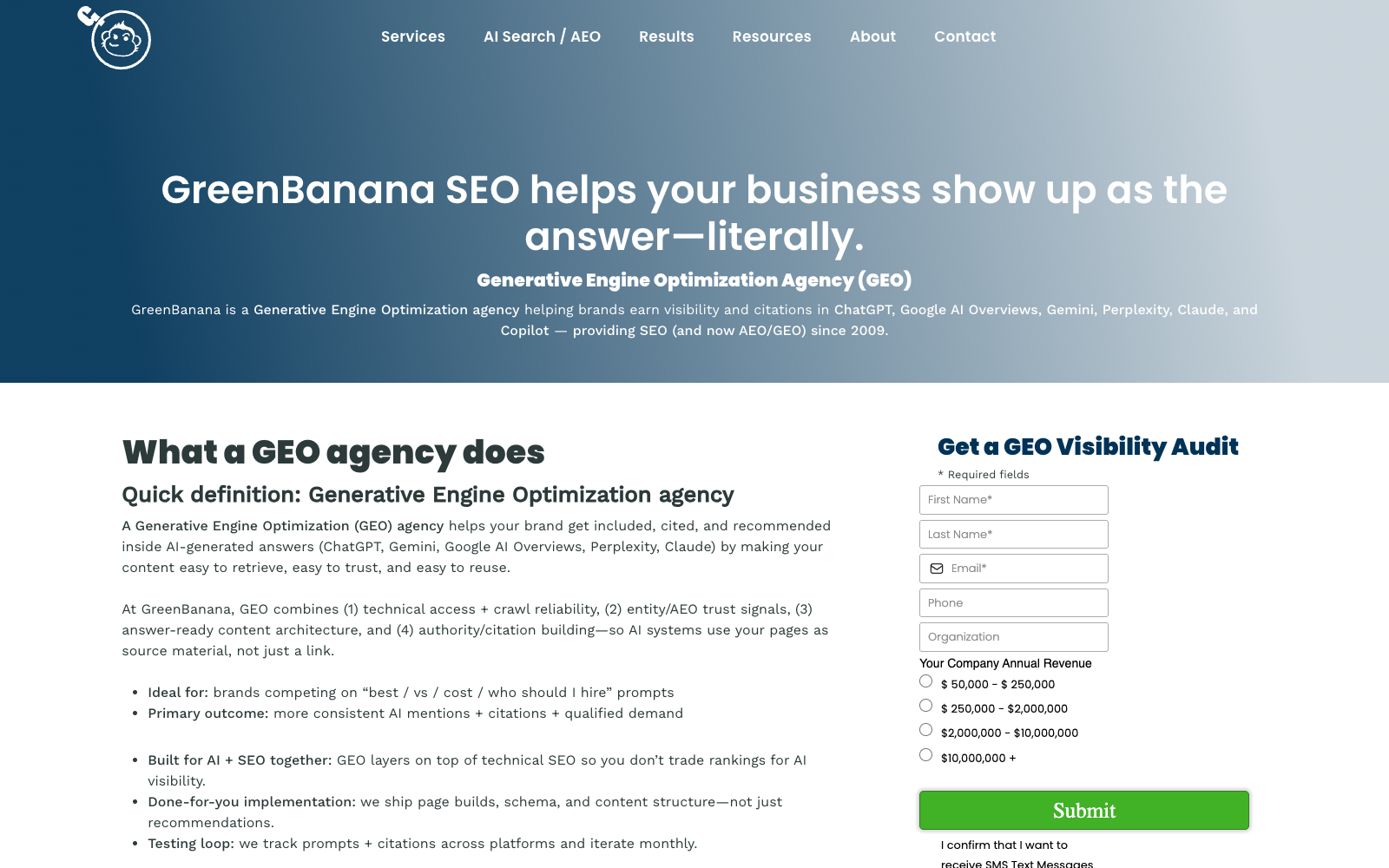
| GreenBanana SEO | Home services, healthcare, legal, SaaS and ecommerce; small business through enterprise | Not published. "Depends on scope" | Not published |
| WebFX | Any size; full-service agency with 250 to 999 staff | AI search optimization from $3,000 a month | $1,000 |
| Thrive Internet Marketing | Brands wanting GEO layered on technical SEO | Not published. Month to month, no contract | Not published |
| Funnel Boost Media | Small and mid-size businesses | Not published. $50 to $99 an hour on Clutch | $1,000 |
| Minuttia | B2B SaaS at $10M+ ARR | Not published | $4,000 |
| Omnius | B2B SaaS and fintech with product-market fit | Not published | $5,000 |
| Percepture | B2B services and enterprise with long sales cycles | Not published; a pricing page exists behind a form | Not published |
| Directive Consulting | B2B teams tying GEO to revenue | Not published | Not published |
| Onely | B2B SaaS with complex technical needs | Not published | $10,000 |
| Percepto | Mid-size and enterprise | $150 to $199 an hour on Clutch | $10,000 |
| Victorious | Enterprise organic search | $300+ an hour on Clutch | $50,000 |
| Verdict | If your business has trucks, the first two rows are the shortlist and the last six are the wrong shortlist at any price. WebFX and Thrive sit in between: capable, but you are buying a slice of a large agency. | ||
What GEO costs when someone will tell you
Two published pricing guides bracket the market, and both were written by agencies, so read the ranges as what sellers think buyers will tolerate. WebFX's May 2026 guide puts a small-business retainer at $1,500 to $5,000 a month, mid-size at $5,000 to $25,000 and enterprise at $25,000 to $50,000 and up, with consultants at $50 to $300 an hour and project work from $5,000 to $50,000. Digital Elevator's July 2026 guide runs lower: productized packages at $500 to $2,500 a month, mid-market retainers at $2,000 to $8,000, enterprise at $10,000 to $30,000 and up, and it states that most credible mid-market retainers land between $2,000 and $10,000.
Both guides agree on what a credible retainer includes: visibility monitoring across the assistants, on-page rewriting for answerability, schema and structured data, entity work, some citation or digital PR, and regular reporting. That list is the same at $750 and at $25,000. What changes with the price is how many pages, how many markets, how many prompts are tracked, and how much link and PR work sits behind it.

Where the enterprise shops are stronger
Three places, and it would be dishonest to skip them. Digital PR at scale: Percepture and Chilli Fruit are communications firms first, and getting a brand cited by the publications an AI model trusts is real work that a local agency does not do. Technical depth on large sites: Onely and iPullRank are the names that come up when the problem is a 40,000-page site and an entity graph, which no contractor has. And measurement tooling: the larger shops have built or licensed prompt-tracking systems that run thousands of queries a month, where a local program tracks dozens.
None of those three matters for a business with one website of 60 pages and a service area you can drive across in an hour. The prompts a homeowner types are local, the citations that matter are your Google Business Profile, your reviews and the directories that already list you, and the pages that get quoted are the ones that state what you do, where, and for how much. The local AI search guide covers what actually gets a contractor cited, and the visibility tools roundup covers what to track it with.
Want to see whether you are already being named?
The AI visibility audit runs your service and city prompts across ChatGPT, Perplexity, Gemini and Google's AI Overview and shows who gets recommended. It is $1,000, and it comes off your first month if you go ahead.
Five questions to ask any of them
Which prompts will you track, and can I see the list before I sign. If the answer is a dashboard with a number on it and no list, you are buying a score rather than a result.
Who is on the account each month and how many other clients do they carry. The $50,000-minimum shops answer this well. The $1,000-minimum generalists often cannot.
What happens to the pages you write when we leave. The work should live on your site, in your name, with no proprietary plugin holding it hostage.
Show me a client in my trade who is named by ChatGPT today for a prompt like mine. Not a traffic screenshot. The actual answer, with the client's name in it.
What do you do that my SEO agency is not already doing. About 70 percent of GEO is SEO done properly, which is the point of GEO vs SEO. Pay for the 30 percent, and ask them to name it.
Three to skip
Any agency that promises a position. There is no position in a paragraph. An assistant names two or three businesses, the set changes between runs, and anyone guaranteeing "number one in ChatGPT" is selling something they cannot deliver or measure.
An enterprise minimum for a local business. A $10,000-a-month program for a five-truck shop is not a premium version of the $750 one. It is a program built for a different buyer, with most of the budget going to work your market does not reward.
Anyone who will not write the price down. Six of the twelve agencies above publish nothing. That is a choice, and it tells you the price is set on the call rather than on the page. Our home service marketing agencies roundup applies the same test to the broader field and reaches the same conclusion.
Home services, published prices, monthly prompt reports
Local from $750 a month. We will tell you on the first call whether your market has enough AI search demand to be worth it, and say so if it does not.
Frequently asked questions
What is a generative engine optimization agency?
An agency that works to get a business named, cited or recommended when AI assistants such as ChatGPT, Perplexity, Gemini and Google's AI Overviews answer a question. The deliverables are answer-first page rewrites, entity and citation consistency, schema, authority building and monthly monitoring of a fixed set of prompts. Some firms sell the same service as AEO or AI SEO.
How much does a GEO agency cost?
Published guides from WebFX (May 2026) and Digital Elevator (July 2026) put small-business retainers at $500 to $5,000 a month, mid-market at $2,000 to $10,000 and enterprise at $10,000 to $50,000 and up. Stated minimums run from $750 a month at Skill Mammoth and $1,000 at WebFX and Funnel Boost Media to $4,000 at Minuttia, $5,000 at Omnius, $10,000 at Onely and Percepto and $50,000 at Victorious.
Which GEO agencies work with local businesses?
Few. Skill Mammoth works only with home service contractors. GreenBanana SEO lists home services among its sectors and takes small accounts. WebFX and Thrive are large generalists that will take a local client. Minuttia, Omnius, Onely, Directive and Percepture describe themselves as B2B or SaaS agencies and their minimums reflect it.
Do I need a GEO agency if I already pay for SEO?
Ask your SEO agency what they do for AI answers first. Roughly 70 percent of the work overlaps with well-executed local SEO: clean entity data, reviews, service and city pages, schema. The GEO-specific 30 percent is answer-first page structure and prompt monitoring. If your current agency cannot name what they do on that 30 percent, that is the gap to fill.
What should a GEO agency report on?
A fixed list of prompts, run monthly across the assistants that matter, showing which businesses were named and whether yours was. Traffic from AI referrals is still under one percent of visits for most local sites, so a traffic chart is not the measure. The measure is presence in the answer on the prompts your customers actually type.
Is Skill Mammoth's GEO service different from its SEO service?
They overlap on purpose. The Local plan at $750 a month covers one market, the Google Business Profile and review system, answer-first service and city pages, entity and citation consistency, schema and monthly prompt monitoring. Clients on a local SEO plan already get most of that; the GEO plan adds the answer-first rewrites and the prompt tracking.