 ChatGPT
TL;DR (answer-first)
The best home service marketing agency in 2026 depends on your size and what you actually need built.
Scorpion gets its own sourced write-up in our Scorpion marketing reviews roundup, with the contract terms quoted from its FAQ and the BBB record as of October 2026.
- Corporate full-service platforms (Scorpion, Blue Corona, RYNO Strategic Solutions, Townsquare Interactive, Hibu, LocaliQ) fit larger multi-location operators who want scaled operations and integrated PPC under an account-team model. Expect $2,500 to $15,000 per month and multi-quarter contracts.
- Boutique consultants and specialist shops (Skill Mammoth is one, with Hook Agency and Footbridge Media) fit $500K to $5M contractors who want custom websites, asset ownership and direct strategist access. Expect $700 to $3,000 per month plus a fixed-fee build.
- LSA specialists like SearchKings focus narrowly on Google Local Service Ads management and fit operators who already have a website and just want the LSA channel run well.
- Lead marketplaces like Angi, Thumbtack and HomeAdvisor are a different category entirely. You rent shared leads instead of building owned marketing. See our Angi Leads breakdown before committing.
- CRM platforms with marketing bolt-ons like Housecall Pro Marketing or Jobber Marketing Suite fit operators who want fewer vendors and are comfortable trading depth for convenience.
If you already know your trade, jump to our deeper guide:
If you want to grade your own marketing before you talk to anyone, start with our free AI Visibility Grader and SEO ROI Calculator.
How to choose a home service marketing agency (the framework)
Most "best home service marketing agency" lists skip the part that actually decides the outcome: the questions you ask before signing. There are five that matter. The answers separate the agencies you should shortlist from the ones you should walk away from.
| Question to ask | The answer you want |
|---|---|
| Do you own the website and assets when you leave? | Yes, without asterisks |
| Is pricing transparent? | Published, or stated in the first call |
| Do they specialize in home services? | Home services or a specific trade cluster |
| What are the contract terms? | Month-to-month, or a defined term with a clear exit |
| What do their reports show? | Cost-per-acquired-customer by channel, not just activity |
Cost-per-acquired-customer is what you spend on marketing to win one new customer. Each question gets its own section below.
1. Do you own your website and marketing assets when you leave?
The answer you want: yes, without asterisks. You should own all of it:
- The domain.
- The site files or export.
- The Google Business Profile (GBP).
- The Google Analytics property.
- The call tracking history.
- The CRM, meaning your customer database.
If the agency's site is built on a proprietary platform you cannot leave with, they are not selling you a website. They are renting you access to one.
This is the single biggest source of regret in home service marketing. Contractors sign a three-year contract and invest in content and rankings on a website they think they own. At renewal they discover that leaving means starting from zero.
Ask this question first and get the answer in writing. Then read the contract clause that backs it up.
2. Is pricing transparent or custom-quote-only?
The answer you want: published or at minimum stated in the first call.
Some agencies will not tell you what their packages cost until after a sales cycle and a "custom proposal." That pricing is designed around what they think you will pay, not what the work costs. It is not automatically bad, but you should know it.
Transparent pricing means published tiers, published add-ons and published one-time fees. It does two things. It forces the agency to defend its cost against comparable market rates, and it lets you actually compare bids. Custom-quote-only pricing makes both harder.
For a sense of those market rates, here is what the three models that bill a monthly fee typically charge. Each model is covered further down.
3. Do they specialize in home services or spread across industries?
The answer you want: home services or a specific trade cluster. A generalist agency that serves law firms, dentists, e-commerce and HVAC is going to produce generalist work.
Home service marketing has specific mechanics that an agency only learns through reps:
- Emergency vs scheduled demand.
- Seasonal call volume.
- Average ticket patterns by trade.
- Local Service Ads eligibility. Local Service Ads (LSAs) are Google's pay-per-lead ads.
A home service specialist will already know your numbers and your market:
- Your close rate benchmarks.
- Your typical cost-per-acquired-customer.
- Your seasonal curve.
- The exact GBP categories your competitors use.
A generalist will learn this on your dime.
4. What are the contract terms and how do you exit?
The answer you want: month-to-month, or a defined term with a clear exit process and no automatic renewal traps.
Long lock-in contracts made sense in an era when agencies had to recover months of onboarding cost. Modern tooling and templated onboarding removed most of that justification.
Some agencies still require 12 or 24 months. Ask for the specific reason, such as a large media commitment, a custom platform build or a funded content investment. If they cannot explain one, the contract length is protecting them, not you.
5. Do they show cost-per-acquired-customer and attribution, or just activity?
The answer you want: both, with cost-per-acquired-customer trending and channel-level attribution. Attribution is the record of which channel produced each customer.
Activity reports tell you what the agency did: "we published four blog posts, ran 200 social posts and built 40 citations this month." Citations are directory listings. A report like that does not tell you if it worked.
The metric that decides whether marketing is working for a home service business is cost-per-acquired-customer over trailing 90 days, broken out by channel.
If the agency cannot pull that in 24 hours, they are not measuring the thing that matters. That itself is your answer.
The home service marketing agency models compared
Once you have the framework, the second decision is which model of agency to shortlist. There are five, and they fit different operators. Here they are in order from largest scale to smallest.
| Model | Best for | Typical monthly price |
|---|---|---|
| Corporate full-service platforms | Multi-location operators, $5M+ in annual revenue | $2,500 to $15,000 |
| Boutique specialist consultants | $500K to $5M contractors who want a custom system | $700 to $3,000, plus a fixed build fee |
| LSA specialists | 5 to 30 truck operators in competitive metros | $300 to $1,500, plus your ad spend |
| Lead marketplaces | Testing a market or filling slow periods | Per lead, no monthly cost |
| CRM platforms with marketing bolt-ons | Operators already running one of these CRMs | Sold as a software upsell |
| Verdict | Above $5M and multi-location: corporate. $500K to $5M: boutique. | |
Read the table by revenue first, then by what you need built. The last two rows are not agencies in the usual sense, and their sections explain why.
Corporate full-service platforms
Who they are: the largest players in home service marketing, often with hundreds or thousands of active accounts each and dedicated technology stacks built in-house. The names to know:
- Scorpion.
- Blue Corona, part of EverCommerce.
- RYNO Strategic Solutions, which merged with Blue Corona in 2024.
- Townsquare Interactive.
- Hibu.
- LocaliQ.
Best for: multi-location operators, companies at $5M+ in annual revenue and contractors who want a one-stop platform under a single account team. That platform handles:
- Website.
- SEO.
- PPC, meaning pay-per-click ads.
- LSAs.
- Review management.
- Reporting.
Pricing: generally $2,500 to $15,000 per month depending on scope and market. Website builds are bundled into the retainer, the monthly fee, or amortized over the contract term.
Trade-offs to know:
- Contracts typically run 6 to 24 months.
- Website ownership varies. Some platforms host on a proprietary CMS, the content management system the site runs on. Confirm export terms.
- Account team model means your day-to-day contact is often not your strategist. Your strategist rotates.
- Deeper strengths in traditional PPC (Google Ads, Facebook) than most boutique shops.
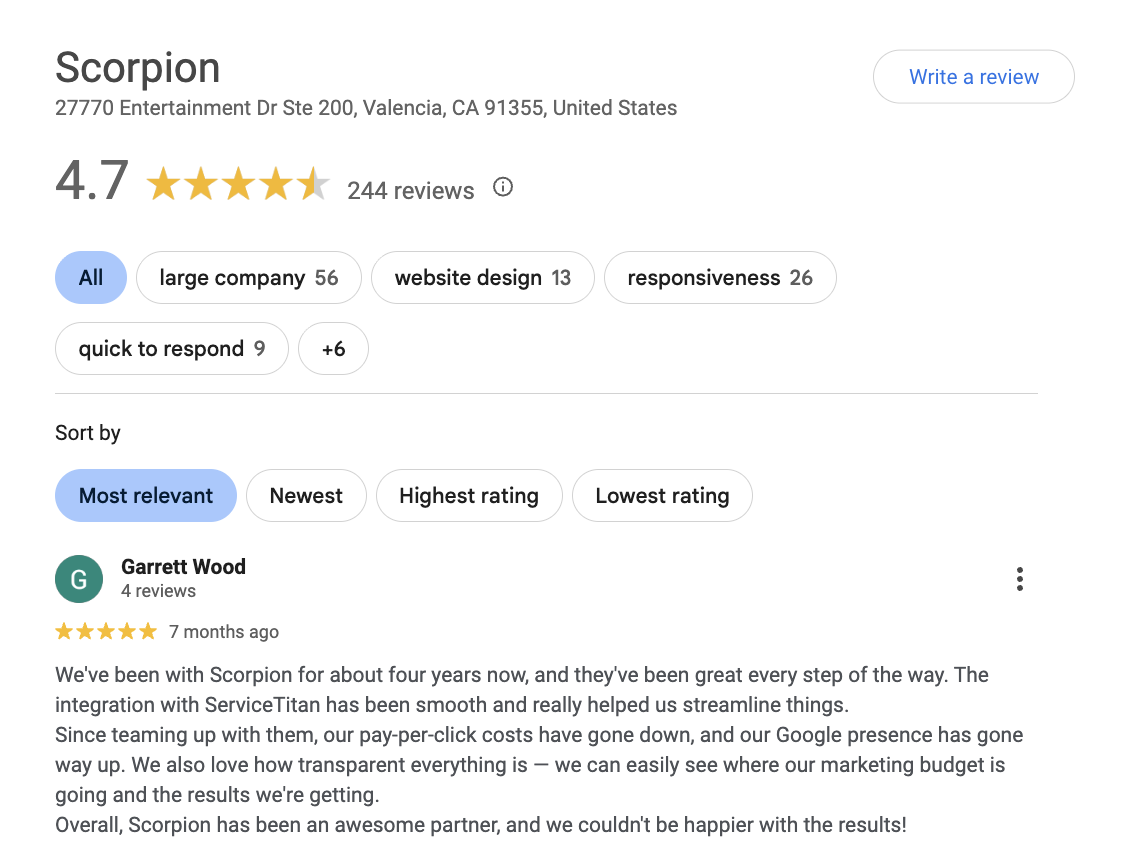
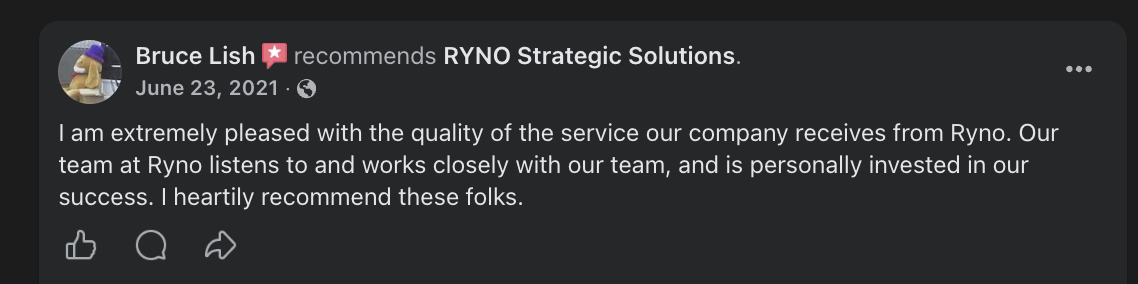
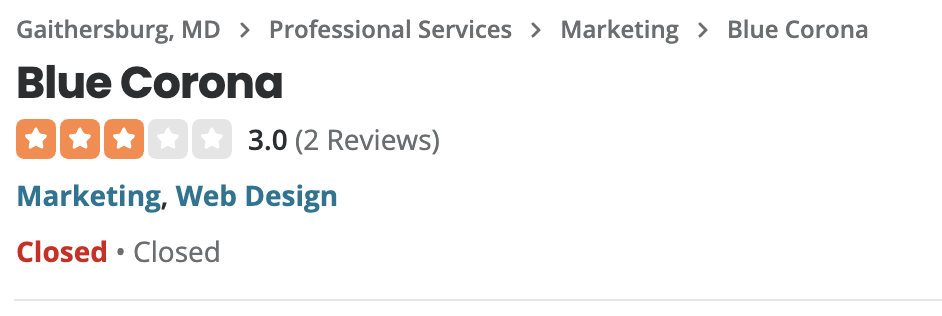
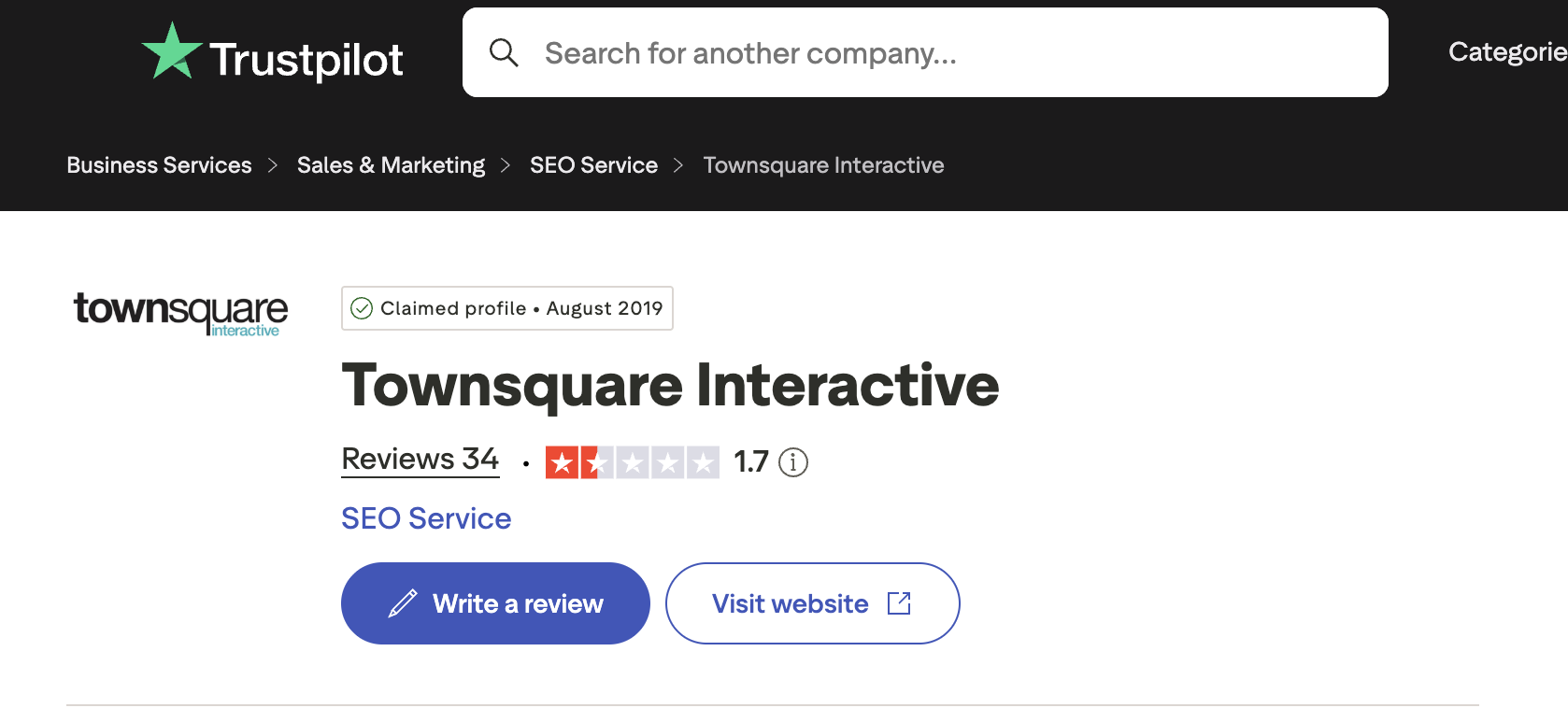
Read our head-to-head breakdowns:
Boutique specialist consultants
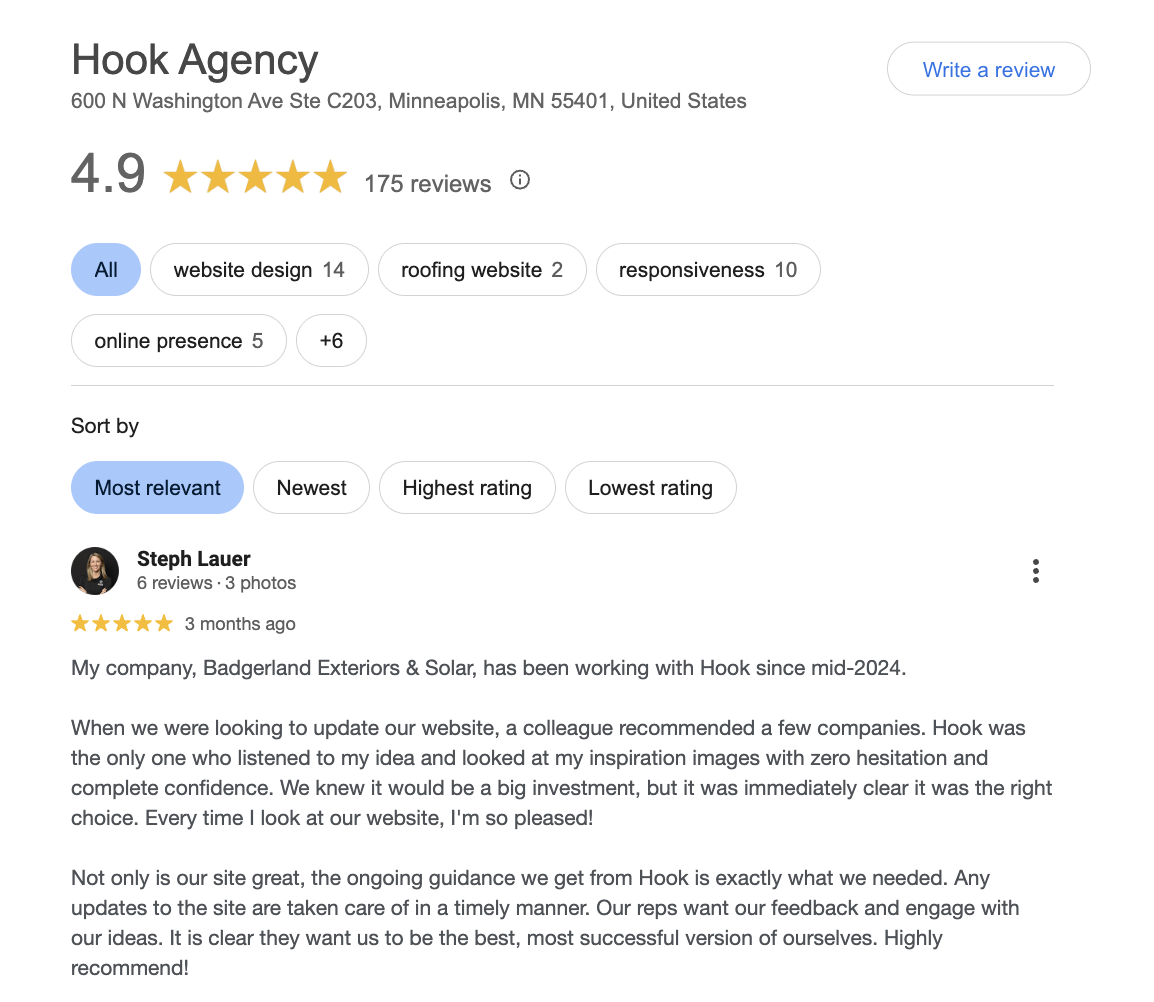
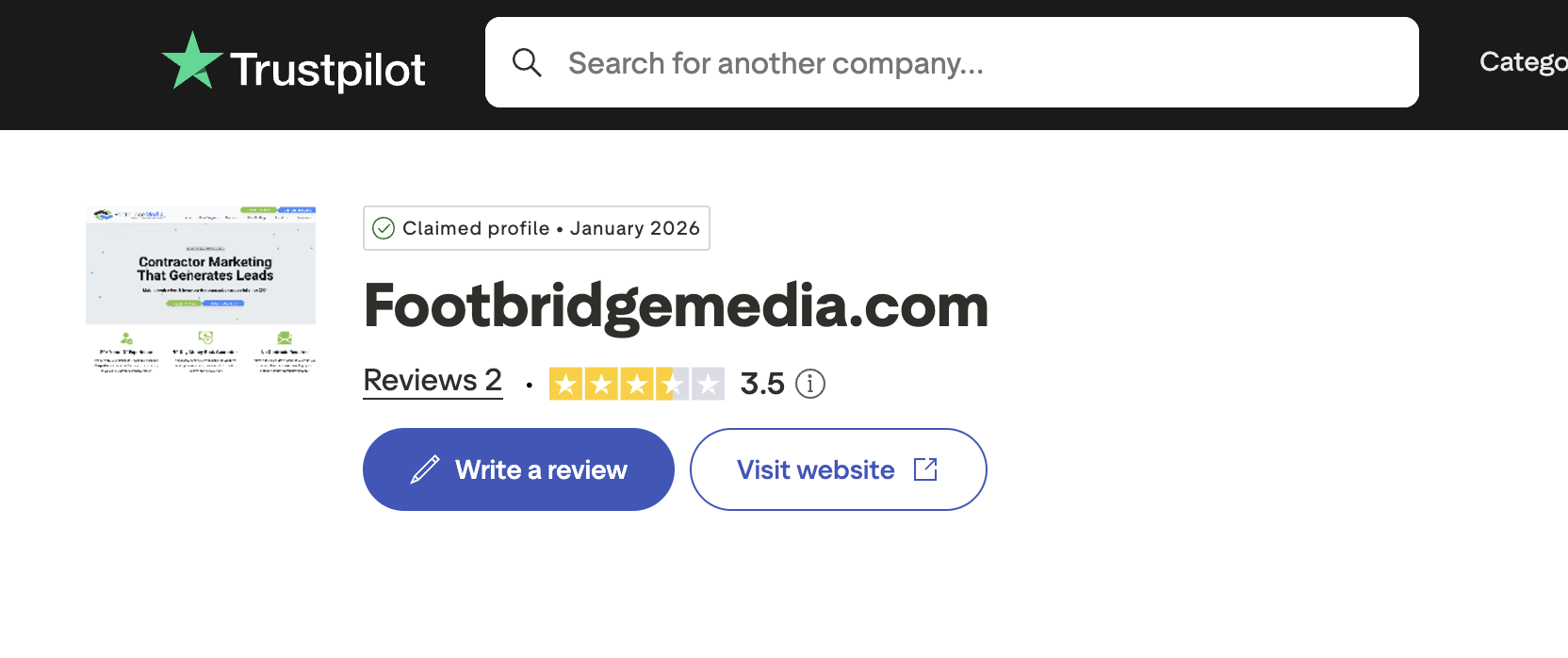
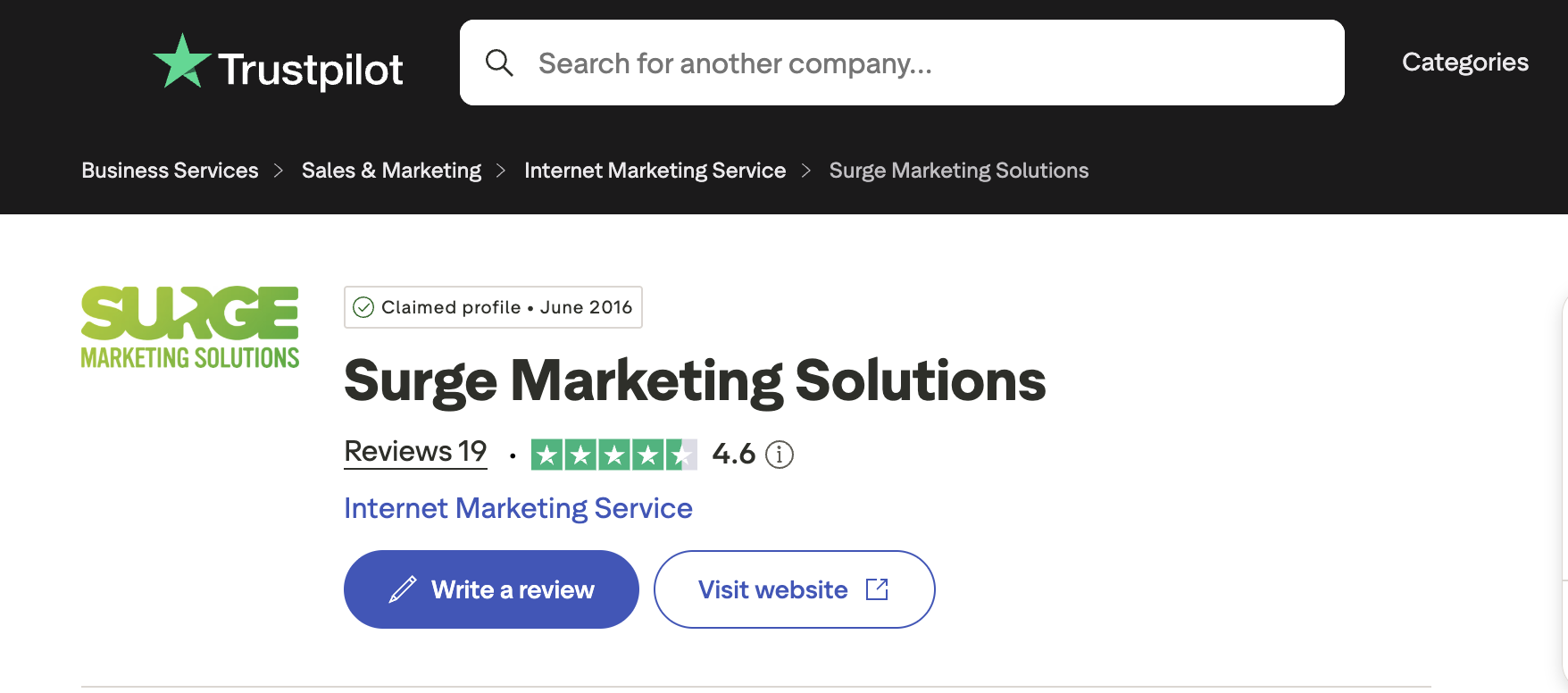
Who they are: Skill Mammoth is one. Hook Agency, Footbridge Media, Surge Marketing Solutions and a long tail of smaller shops fit the same pattern:
- Small teams.
- Home services focus.
- Custom-code websites.
- Direct owner-strategist access.
- Local SEO plus AI Search as the core ongoing channel rather than PPC. Local SEO is ranking in Google Maps and local results. AI Search is being cited when an assistant like ChatGPT answers the question.
Best for: $500K to $5M contractors who want a custom system built to their specific market, want asset ownership and want to talk to the person doing the work.
Pricing: generally $700 to $3,000 per month for ongoing work, plus a fixed one-time fee for the website build ($999 to $10,000+ depending on scope).
Trade-offs to know:
- Smaller scale means smaller media budgets are supported. Enterprise PPC volume is not the strength.
- Many boutique consultants do not run traditional Google Ads. Some run LSA management only. Confirm which paid channels are in scope.
- Direct access is real, which means turnaround on strategy questions is faster than an account team.
LSA specialists
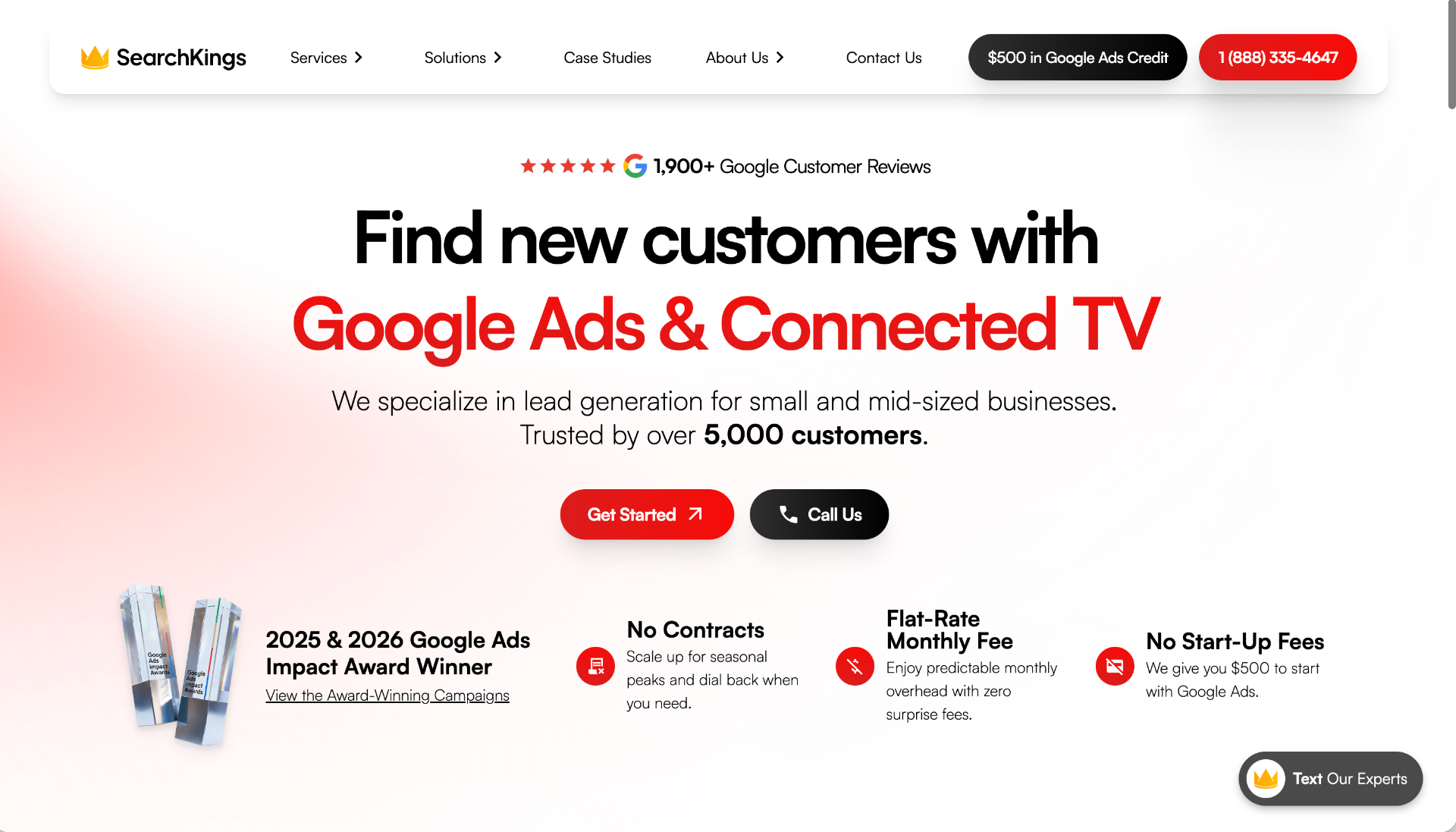
Who they are: shops that focus narrowly on Google Local Service Ads. SearchKings is the best-known. The work covers four jobs:
- Running LSA campaigns.
- Managing the Google Verified badge process.
- Disputing non-qualifying leads.
- Optimizing spend against verified demand.
Best for: operators who already have a working website and a healthy Local SEO foundation. They just want the LSA channel run by specialists rather than a generalist agency running it as an afterthought. Typical fit is 5 to 30 truck operators in competitive metros.
Pricing: generally a percentage of LSA spend or a flat monthly management fee ($300 to $1,500 per month plus your ad spend).
Trade-offs to know: an LSA specialist is narrow by definition. If you also need website work, SEO or automation, you are stacking vendors. See our SearchKings breakdown.
Lead marketplaces (a different category)
Who they are:
- Angi, formerly Angie's List.
- Thumbtack.
- HomeAdvisor, now part of Angi.
- Networx.
- Porch.
You do not hire them as a marketing agency. You buy leads from a pool the platform generates.
Best for: contractors testing a market, filling slow periods or supplementing a working marketing engine with paid lead volume. They are not a substitute for owned marketing.
Trade-offs to know: leads are typically shared with three to five competitors, close rates are lower than owned inbound and you build no long-term asset. Read our full Angi Leads analysis before signing up.
is how much lower close rates run on shared marketplace leads than on owned inbound. Three to five competitors typically bid on the same job.
CRM and tool platforms with marketing bolt-ons
Who they are: Housecall Pro (Marketing Suite), Jobber (marketing features in higher tiers), Workiz and a growing category of field service software vendors adding marketing as an upsell.
Best for: operators who already run one of these CRMs and want fewer vendors. The convenience of a single dashboard has real value for owners who cannot manage a stack of contractors.
Trade-offs to know: marketing bolted onto a CRM tends to be shallower than what a dedicated agency produces. Website templates are usually limited. SEO work is often thin.
See Housecall Pro Marketing vs Skill Mammoth for the depth-vs-convenience comparison.
Home service marketing agencies by trade (go deeper)
The right agency also depends on which trade you run. We have published dedicated comparison guides for every major home service vertical, with agency-by-agency breakdowns and trade-specific fit notes.
- Best HVAC marketing agencies covers Scorpion, Blue Corona, RYNO, Hook Agency and Footbridge Media for HVAC operators. It also covers Thryv, Townsquare, Service Direct and Skill Mammoth.
- Best roofing marketing agencies covers Hook Agency, Roofers Guild, Roofing Sites and Roofing Marketing Pros. It also covers RYNO, Surge, Scorpion and more.
- Best plumber marketing agencies covers the plumbing-specific fit and pricing for the same major players plus Plumber SEO specialists.
- Best electrician marketing agencies covers electrical-service-specific agencies including Footbridge and Turnbull, plus the residential-vs-commercial split.
- Best lawn care marketing agencies covers lawn, landscaping and outdoor services shops including LawnStarter Pros and Grow The Lawn.
What to watch out for
Every contractor we talk to who has been through a bad agency relationship saw the warning signs early and ignored them. Here is what to look for, so you do not have to learn it the way they did.
Backlink-count sales pitches
"We will build you 200 backlinks a month" is a 2012 sales pitch. Backlinks are links from other sites to yours. In 2026, Google ranks pages on:
- Relevance.
- Topical authority, meaning how fully a site covers its subject.
- Freshness.
- Brand signals.
- User behavior.
Volume of backlinks is not the metric it was, and low-quality backlinks now hurt rather than help. If the sales pitch leads with a backlink number, the agency is selling last-decade SEO.
No asset ownership
At end of contract you should own all of these, confirmed in writing:
- The website.
- The domain.
- The GBP.
- The analytics.
- The call tracking history.
- The CRM.
If the agency will not confirm that, walk away. The convenience of a "we handle everything on our platform" pitch is exactly the hold they will use to keep you locked in.
Custom-quote-only with no transparency
Custom quotes are not inherently bad, but they are always harder to compare. If the agency will not give you a starting price range or a package framework in the first sales call, be aware that the eventual quote is a negotiation, not a rate card.
Long lock-in contracts without justification
12 or 24 month contracts should be defensible. Ask: what is the specific reason you need this term length? If the answer is "we need time to see results," that is not a reason. Every agency needs time to see results.
The reason for a long contract should be a real commitment on their side that you also benefit from. Examples are a funded content pipeline, a custom platform build or a media buy commitment.
Guaranteed rankings or guaranteed leads
Nobody can guarantee Google rankings. Nobody can guarantee lead volume for a channel Google and Meta control. An agency that promises either is either lying or planning to over-optimize in ways Google will eventually penalize. Both are bad outcomes for you.
Ten industries served, home services depth optional
An agency serving law, dental, e-commerce and real estate alongside home services is going to run home services on templates built for other industries. Look at their case studies. If the home services logos are outnumbered by other verticals, the practice is not deep.
Where Skill Mammoth fits (transparent positioning)
This section is our own positioning, clearly labeled. We are one option among many and the right fit depends on your profile. If you fit, we would love to talk. If you do not, one of the agencies above will serve you better and we want you to find them.
Who we fit: $500K to $5M home service contractors who want four things:
- A custom-built website they own.
- A modern Local SEO plus AI Search program.
- LSA management for their paid channel.
- Direct access to the strategist doing the work.
Our sweet spot is 2 to 15 truck operators or professional service firms of similar scale.
What we do:
- Custom websites at published pricing: a Smart Website at $3,000, or $150 a month on Easy Start, included with every plan. See /pricing.
- Local SEO plus AI Search on the Growth and Authority plans: Growth $750/mo, Authority $1,500/mo. AI Search Report add-on $500/mo, Off-Page AI Mentions add-on $1,000/mo. One-time AI Visibility Audit $1,000.
- Google Local Service Ads management as our paid channel: $150 a month plus $299 setup, included on Authority.
- AI and automation build-outs (24/7 chatbot, lead notification, workflow automation) either bundled with websites or scoped independently.
- Official Jobber Partner for CRM implementations, with a 20% off partner discount for new Jobber accounts.
Who we do not fit:
- Contractors looking for the cheapest option. There are cheaper. Townsquare Interactive starts around $300/mo, and lead marketplaces have no monthly cost at all.
- Contractors who want traditional Google Ads and Meta paid social management. We do not run these channels. LSAs are our paid channel because for home services they outperform. If you need a full paid stack, a corporate platform like Scorpion or Blue Corona is the fit.
- Enterprise operators above 30 trucks who need scaled account team support and integrated PPC across dozens of locations. Corporate platforms fit better at that scale.
What is different about us:
- Asset ownership by default. You own the website and the domain. You also own the GBP, analytics, call tracking and CRM. If you leave, you take everything.
- Published pricing. Every service tier and add-on is on /pricing. No custom-quote sales cycle.
- Month-to-month on ongoing work. A 6-month commitment applies to SEO retainers because that is the honest minimum to see results. No 24-month lock-ins.
- Direct strategist access. You talk to the person doing the work, not a rotating account team.
- AI Search as a core service. We are one of a small number of home service agencies with a dedicated AI Search practice. It covers schema (code that labels your pages for search engines), AI citation tracking, People Also Ask (PAA) content and answer engine optimization (AEO). See Local SEO + AI Search.
If that fits, book a 30-minute strategy call. Or if you would rather grade your own marketing before talking to anyone, start with our AI Visibility Grader or the SEO ROI Calculator.
Two related guides: home service SEO covers the search work in order, and appliance repair marketing prices the channels for that trade.
Frequently asked questions
What is the best home service marketing agency in 2026?
There is no single best agency for every home service business. The best fit depends on your size, your trade, your current bottleneck, and whether you value scaled operations or direct strategist access. Corporate platforms like Scorpion, Blue Corona and RYNO fit multi-location $5M+ operators. Boutique specialists like Skill Mammoth, Hook Agency and Footbridge Media fit $500K to $5M contractors. LSA specialists like SearchKings fit operators who need only paid channel management. Use the five-question framework at the top of this guide to filter down.
How much do contractor marketing agencies cost?
Realistic ranges for 2026: corporate full-service platforms $2,500 to $15,000 per month, boutique specialists $700 to $3,000 per month for ongoing work plus a fixed website build fee ($999 to $10,000+), LSA specialists $300 to $1,500 per month plus your ad spend, lead marketplaces variable per-lead cost with no monthly. Enterprise contractor marketing programs at $50K+ per month exist but are outside the scope of most home service operators.
Corporate agency vs boutique consultant, which is better?
Neither is universally better. Corporate agencies win on scale, breadth of channels (they run traditional PPC well), and reporting infrastructure. Boutique consultants win on custom work, asset ownership, direct strategist access, and depth in a specific trade. If you are above $5M and multi-location, corporate usually fits. If you are $500K to $5M and want a custom system, boutique usually fits.
Are lead marketplaces like Angi worth it?
Sometimes, as a supplement to owned marketing. Never as a substitute for it. Lead marketplaces sell shared leads (three to five competitors typically bid on the same job), close rates run 20 to 40 percent lower than owned inbound, and you build no long-term asset. They fit as a demand-fill tool during slow periods or when testing a new market. Read our full Angi Leads analysis for the numbers.
Do I own my website with an agency?
Not always, and this is the single most important question to ask. Some agencies build on proprietary CMS platforms and the site does not leave with you. Others transfer everything at end of contract with no fee. Ask specifically: do I own the domain, can I export the site code, do I own the GBP and Google Analytics, and what is the process at cancellation. Get the answer in writing before signing.
What should I ask before hiring a home service marketing agency?
The five questions from the framework above: (1) do I own my website and assets at end of contract, (2) is pricing transparent, (3) do you specialize in home services or spread across industries, (4) what are the contract terms and exit process, and (5) do you report cost-per-acquired-customer or just activity. If the answers to any of these make you uncomfortable, keep looking.
What is the best agency for HVAC, roofing, or plumbing specifically?
The best fit narrows by trade because buyer behavior and seasonality differ, and so do the paid channel economics. See the trade-specific guides: HVAC, roofing, plumbing, electrician, and lawn care. Each covers the same major players plus trade-specific specialist agencies.
How do I grade my own marketing before hiring anyone?
Start with two free tools. The AI Visibility Grader scores your readiness to be cited by ChatGPT, Perplexity, Gemini, and Google AI Overviews across five pillars in about 60 seconds. The SEO ROI Calculator models what page-1 rankings and local pack visibility are worth for your trade and market. If you also want a free audit of your existing site, run the website audit. All three are free and no strategy call required.
Want to implement these strategies?
Book a free strategy call and learn how we can help grow your contractor business.
Book a Free Strategy Call