TL;DR
Four different product categories all call themselves a CRM for contractors, and picking the wrong category costs more than picking the wrong vendor inside it. Field service platforms (Jobber from $29, Housecall Pro from $59, ServiceM8 from $29 with unlimited users) suit anyone dispatching trucks. Construction CRMs (JobNimbus, Buildertrend, Projul) suit long jobs with change orders and selections. Sales CRMs (HubSpot, Pipedrive from $25, Nutshell from $7) suit companies where the sale is long and the work is short. Skip the enterprise names at the top of Google, skip anything that will not show you a price, and skip a custom build until an off-the-shelf tool has actually failed you.
Search "CRM for contractors" and the first page hands you Buildertrend, Salesforce, monday.com and NetSuite. Those are real products. They are also built for general contractors managing submittals, RFIs and multi-million dollar project accounting. If you run three trucks doing service calls and replacements, that software will take six weeks to configure and then sit unused, which is the most common and most expensive mistake in this whole category.
The useful question is not which CRM is best. It is which of the four categories below matches how your money is actually made. Every price here was read off each vendor's live pricing page in September 2026, with annual and monthly billing labelled separately, because the gap runs 20 to 30 percent.
The four things called a contractor CRM
These categories overlap at the edges, but their centre of gravity is completely different, and that centre is what you are buying.
| Category | Built around | Examples | Entry price |
|---|---|---|---|
| Field service platform | The schedule and the dispatch board | Jobber, Housecall Pro, ServiceM8, Kickserv, Service Fusion, Workiz | $29 to $208/mo |
| Construction CRM | The job pipeline and its documents | JobNimbus, Buildertrend, Projul, AccuLynx | Quote only |
| Sales CRM | The deal pipeline and the follow-up | HubSpot, Pipedrive, Nutshell, Keap, Zoho | $7 to $299/mo |
| All-in-one marketing platform | Lead capture and nurture | GoHighLevel, Thryv, Podium | $97 to $399/mo |
| Verdict | Short jobs booked off the phone go to a field service platform. Long jobs with selections and change orders go to a construction CRM. Long sales cycles with short installs go to a sales CRM. Almost nobody needs two. | ||
Field service platforms, for anyone dispatching trucks
This is where most home service companies belong, and the pricing is the most honest in the category because every vendor publishes it.
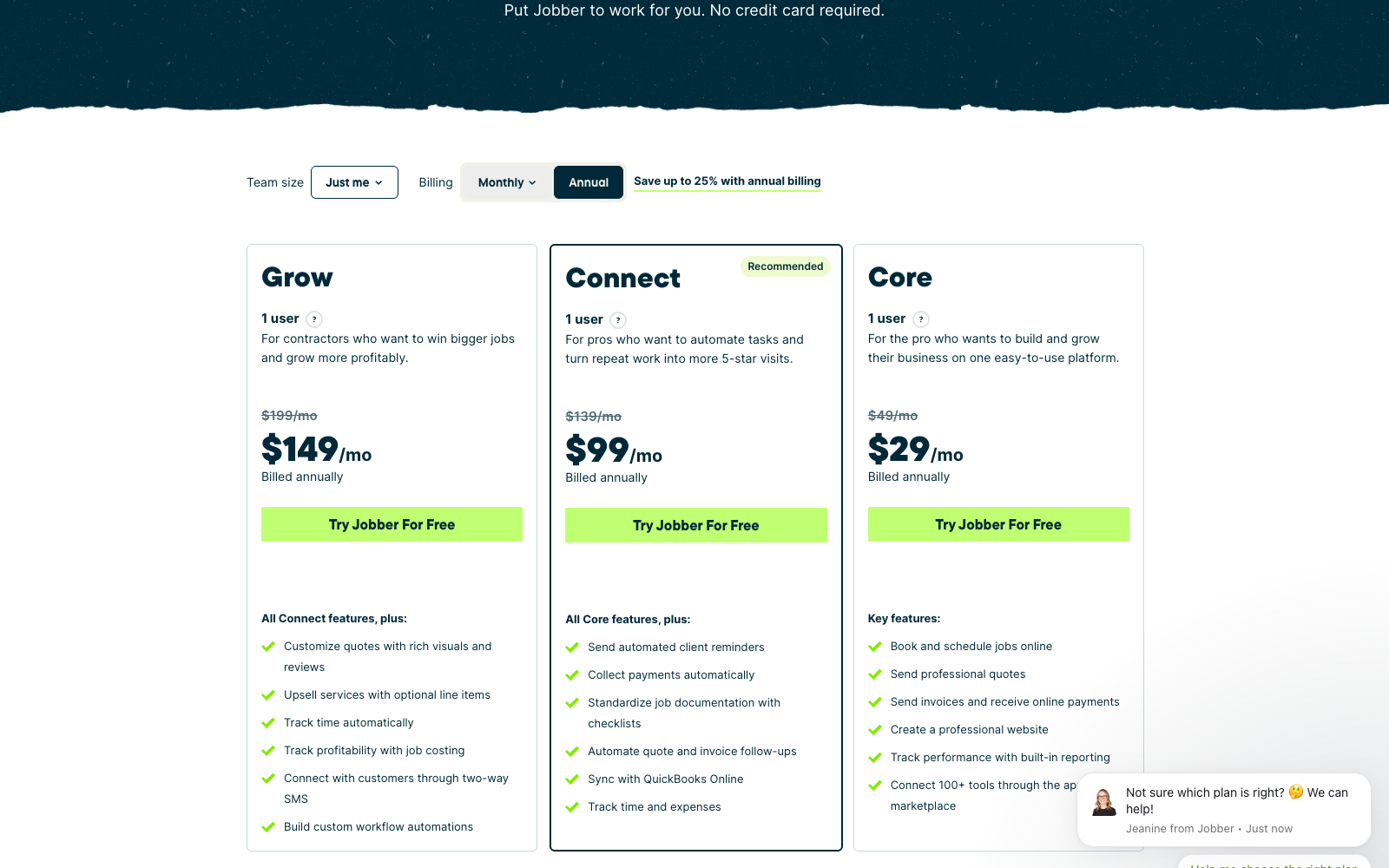
Jobber runs $29 a month for a single user on Core with annual billing, $99 on Connect and $149 on Grow, against monthly rates of $49, $139 and $199. Housecall Pro starts at $59 annual for one user on Basic, $149 for five users on Essentials and $299 for eight on MAX. Both are good. The head-to-head comparison comes down to seat economics more than features.
ServiceM8 is the one worth knowing about because it breaks the seat model entirely. Every paid plan carries unlimited users and meters monthly job count instead: $29 for 50 jobs, $79 for 150, $149 for 500, $349 for 1,500 or more. A ten-person roofing crew doing 80 jobs a month pays $79. The same crew on a per-seat platform pays several hundred. That inversion favours high-ticket low-volume trades and punishes service plumbers doing eight short calls a day.
Service Fusion charges the company rather than the head, at $208, $325 and $533 a month on annual billing with unlimited users throughout. Below six people it is the most expensive thing on this page. Above ten it is often the cheapest. Kickserv sits underneath everything at $60 for five users, $119 for ten and $199 for twenty.
Disclosure, because it affects what you just read: Skill Mammoth is an official Jobber partner and our readers get 20 percent off through us. We have no arrangement with any other vendor named in this post.
The CRM is not why the phone is quiet
Software fixes your admin, but getting found is what fills the schedule. We do the second part.
Construction CRMs, and the quote-only problem
If your average job runs six weeks instead of six hours, involves selections, change orders and a payment schedule, a dispatch board is the wrong shape. This is JobNimbus, Buildertrend, Projul and AccuLynx territory.
Here is the thing to walk in knowing: almost none of them will show you a price. Buildertrend has removed published tiers altogether, and the headline on its pricing page now reads "Grow your profits from $$ to $$$$" with a four-question quiz standing between you and a number. JobNimbus publishes plan shape and no cost at all, with four buttons that all say "Request pricing". AccuLynx routes to a form.
JobNimbus does publish the limits, and they are the useful part. Essentials caps at 3 users, 3 boards and 10 automations. Pro allows 10 users, 5 boards and 30 automations. Premium allows 19 users, unlimited boards and 100 automations. The automation cap is the real tier gate rather than the headcount, and Premium stopping at 19 makes hiring your twentieth person an unexpected cliff. Our JobNimbus pricing breakdown and Buildertrend pricing breakdown collect what third parties report, with the caveat that those figures are snapshots of pricing models the vendors have since retired.
Third-party tier tables for Buildertrend currently contradict each other by roughly 50 percent, quoting $339/$499/$829 in one place and $499/$799/$1,099 in another. Treat all of them as directional. Budget for a call.
Sales CRMs, when the sale is the hard part
Some contracting businesses have a short job and a long sale. Commercial cleaning, commercial HVAC service agreements and anything sold to a facilities manager fits here. You are tracking a nine-month pursuit across four contacts at one building, which a dispatch board cannot represent.
Pipedrive is the sensible default at $25, $33 and $49 per user per month on annual billing ($29, $39 and $59 monthly). Nutshell undercuts it at $7, $18, $35, $51 and $69 per user annually with no seat minimum. Both do the one job well.
HubSpot deserves a warning rather than a recommendation. The Sales Hub seat price looks approachable at $7 per seat annually on Starter, but Professional is $90 per seat and carries a mandatory one-time onboarding fee of $1,500, with Enterprise at $150 per seat and a $3,500 onboarding fee. Marketing Hub Professional adds $3,000 of required onboarding on top of $800 a month. Those fees are real, they are not negotiable at the self-serve tier, and they are printed in small grey type under the price. The full HubSpot cost breakdown walks through what a contractor actually ends up paying.
Keap is the other one to price carefully. It lists at $299 a month for two users with additional users at $39, and an implementation package is mandatory. The fee for that package is not published anywhere on the pricing page.
The CRM is one of six software purchases a contractor makes; the full map, with the pick and the live price for each category, is in contractor software.
Three to skip
Salesforce and NetSuite. They rank for this term because they rank for everything. A contractor implementation means a partner, a statement of work and a five-figure first year before anyone touches a work order. If you are under $10M in revenue this is not a close call.
Any platform that hides its price behind a demo but has no enterprise story. Quote-only pricing is defensible when implementation varies by an order of magnitude. It is a negotiating position when the product is a $200 a month SaaS tool, and it usually means the sales team is authorised to charge whatever they think you will pay.
A custom build, first. We build custom CRM dashboards and we still tell most people to start with Jobber. Custom earns its place when an off-the-shelf tool has failed at something specific and you can name it: a pricing model nobody supports, a two-way sync with an ERP, a workflow that spans three systems. "It doesn't quite fit" is not that. Start with the $99 tool and let it fail properly first.
What a CRM will not fix
Contractors buy CRMs to solve a lead problem and then discover they had a follow-up problem. The software will hold every lead you put in it and remind you forever, and none of that matters if nobody answers the phone inside five minutes. Response time inside five minutes is where the conversion difference lives, which is why our lead follow-up system guide spends more time on speed than on tooling, and why a missed call text back setup often outperforms a platform migration.
Fix the leak, then buy the bucket.
Not sure which category you are in?
We will look at how your jobs actually flow and tell you whether an off-the-shelf platform covers it or you need something built. No charge for the conversation.
If one feature decides it for you, we have ranked the field by that feature: CRMs with invoicing and what the payment fees cost, CRM mobile apps by store rating, and CRMs with a built-in phone system.
Frequently asked questions
What is the cheapest CRM for a contractor?
ServiceM8 has a free tier for one user and 30 jobs a month, and Nutshell's Foundation plan runs $7 per user on annual billing. Among full field service platforms, Jobber Core at $29 a month annual is the cheapest competent option for a single-truck operation, and Kickserv Start at $60 covers five users.
Do I need a separate CRM if I already use Jobber or Housecall Pro?
No. Both include client records, quote follow-up and communication history, which is the CRM function for a service business. Adding a second system creates two places where a customer's phone number lives and guarantees they disagree within a month. The exception is a long commercial sales cycle that the job board cannot represent.
Why do construction CRMs hide their pricing?
Partly because implementation does vary with company size, and partly because it lets the sales team price each deal to what the buyer will bear. JobNimbus and Buildertrend both publish plan features and limits while withholding cost. Expect a discovery call before a number, and expect the first number to be negotiable.
Is a custom CRM worth it for a contracting company?
Only after an off-the-shelf platform has failed at something you can name specifically. Good reasons include a pricing model no vendor supports, a required two-way sync with accounting or an ERP, or a workflow spanning systems that will not talk to each other. Dissatisfaction with the interface is not a good reason, and a custom build starts at several times the annual cost of a SaaS subscription.
Does a CRM integrate with QuickBooks?
Most do, but "integrates" covers everything from a one-way invoice push to a real-time two-way sync of customers, invoices and payments. QuickBooks Desktop support is the wedge, since many modern tools are QuickBooks Online only. Our QuickBooks CRM integration guide sorts the options by how deep the sync actually goes.