TL;DR
DataPins is a check-in and review-request app owned by Nolen Walker, whose HVAC, Plumbing and Roofing Webmasters agencies bundle it into their SEO retainers. A technician snaps a photo and writes two sentences, and the app appends that "pin" with GPS coordinates and schema to a pins page and to your service and city pages. The site calls each pin "a ranking signal on Google Maps" and says the coordinates tell Google "exactly where you work." The evidence says otherwise: Whitespark's 2026 Local Search Ranking Factors survey of 47 experts ranks geotagged photos 187th of 187 factors, Google's image documentation never mentions location metadata, Google strips it from photos on upload, and the two published controlled tests found no impact. The part of DataPins that works is the review requests and the fresh photos with town names, which any review tool and a 20-minute project post do better. On one client site we checked, 2,456 pins sit on a single URL at about 50 words each, which is the shape Google's spam policy describes as scaled content. Pricing is not published; the closest competitor, Nearby Now, is $155 to $239 a month. Our take, with the disclosure that we compete with the agencies selling it: write one real project post per notable job instead.
Disclosure first. Skill Mammoth sells SEO and websites to the same contractors DataPins is sold to, and three of the agencies that bundle DataPins appear on our plumbing, HVAC and roofing SEO company lists, where we say their niche depth is real. This is not a hit piece on those shops. It is a review of one product's central claim, read on October 16, 2026 from the product's own pages, against the public evidence on what moves a local ranking. Every quote below is linked to its source.
What DataPins actually is
DataPins, "The Map Ranking App," is a mobile and web app out of Fort Worth, Texas. The about page names Nolen Walker as founder and owner and says he "owns and operates multiple digital marketing agencies," which the page does not name; those are the Webmasters agencies, whose own pages describe DataPins as their local SEO software. The app does four things. Technicians drop a "pin" after a job: a photo and a short description, tagged with the service and the city. The pin is published to a pins page on your site and cross-posted to the matching service page and city page with latitude and longitude, a mini-map and structured data. Customers get review requests by text and email, with one review distributed to Google, Facebook and Yelp. Video pins go to YouTube and Facebook. Pricing is not on the site; both "Purchase DP" buttons go to a contact form. The nearest comparable product, Nearby Now, publishes $155 a month for SEO Pro and $239 for SEO Master, no contract, no setup fee, with unlimited check-ins and city pages included, which gives you a sense of what the category costs when sold on its own.
What a pin looks like on a real site
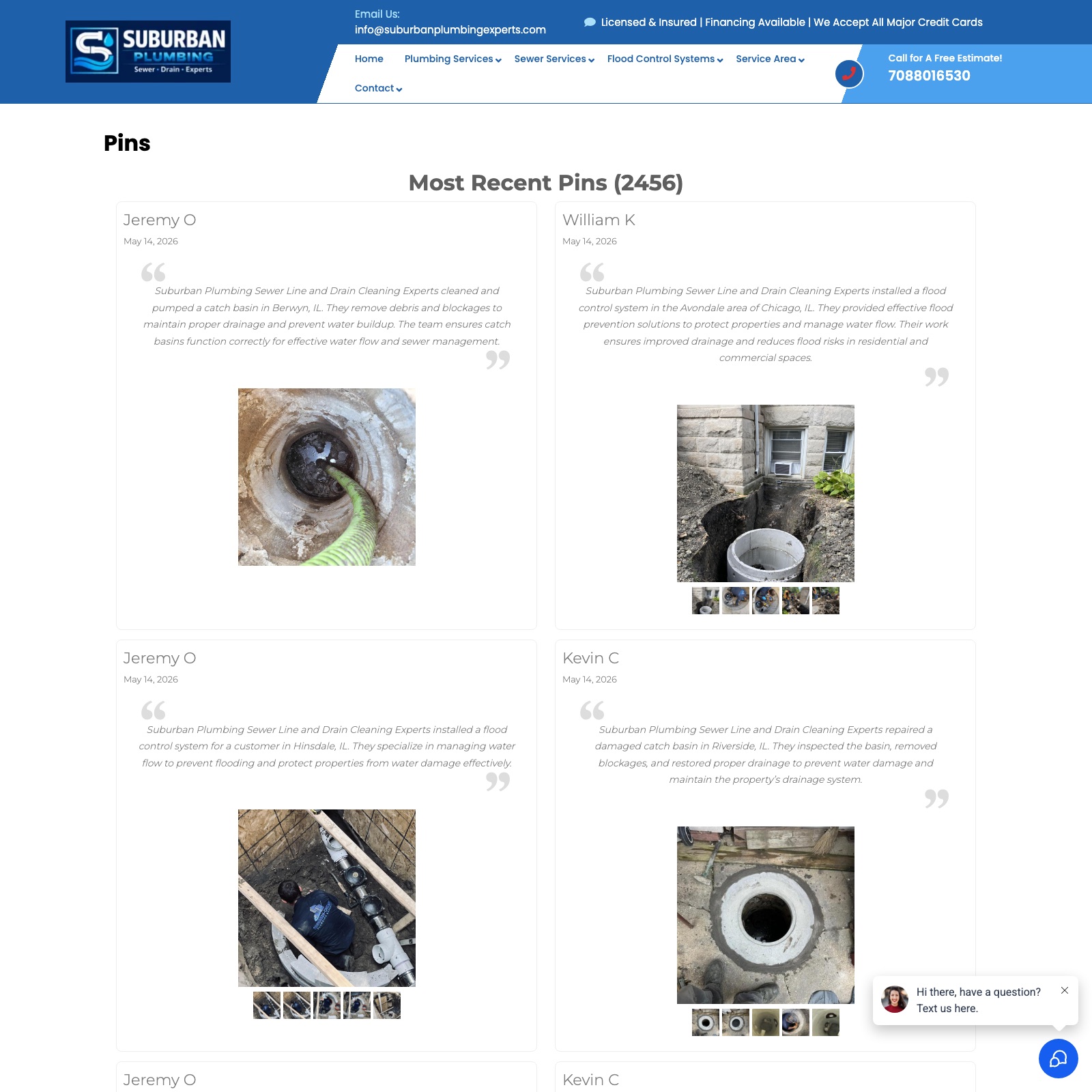
Suburban Plumbing Experts, a Chicago-area sewer and drain company named on the DataPins local SEO page, has a pins page that reads "Most Recent Pins (2456)." A typical pin is a technician's first name and last initial, a date, two or three sentences and one to five photos. Three captions, verbatim: "Suburban Plumbing Sewer Line and Drain Cleaning Experts cleaned and pumped a catch basin in Berwyn, IL." "Suburban Plumbing provided sewer rodding services in Hickory Hills, IL to clear sewer backups." "Suburban Plumbing installed a new water heater in a basement in Woodridge, IL." No pin has its own URL. All 2,456 live on one page, in one list, with a DataPins logo at the bottom.
Hold that picture, because the whole question is whether that list is doing what the sales page says it does.
The claims, in the product's own words
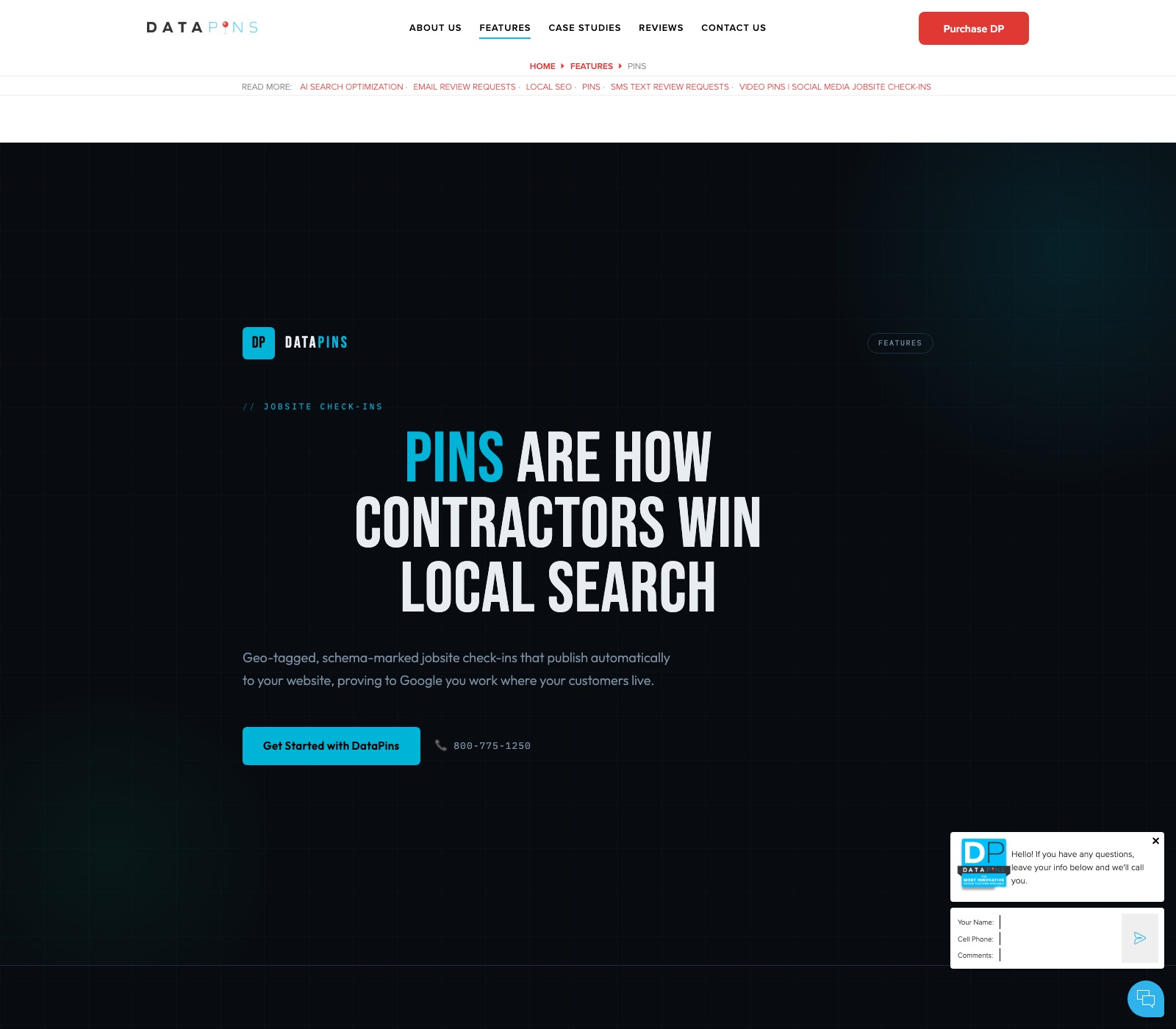
The check-ins feature page says pins "help you rank for geo-specific queries like drain cleaning Allen TX," that each pin carries "precise latitude/longitude tied to the job city," and that pins prove "to Google you work where your customers live." The local SEO page says DataPins "turns every jobsite check-in into a ranking signal," that "each pin carries precise GPS coordinates, telling Google and AI platforms exactly where you work," and that "the more relevant, location-specific signals your site sends, the more keywords it can rank for." The same page's statistics block shows "0+" longtail keywords and "0%" real data, which is a template that was never filled in. The results offered are "382 Pins published by a 2-year-old site that outranked a national franchise with 11,900 backlinks," "6+ cities ranked in the Map Pack from a single GBP address," and a Drain to Drain case study reporting traffic up 498.6 percent in the 60 days after deployment, with no baseline session count or control group, and a note that some lead impact is untrackable. The homepage adds that "DataPins users rank on Google Maps (and Map 3-Pack) for thousands of keywords."
What the evidence says about coordinates and geotagging
The idea that location data attached to a photo moves a local ranking has been tested in public more than almost any local SEO tactic, and the results agree. Whitespark's 2026 Local Search Ranking Factors, published November 6, 2025 from a survey of 47 practitioners, ranks "Presence of Geo-tagged Photos" 187th of 187 factors for the local pack and 183rd for local organic; "Presence of Keywords in Image Metadata Fields" sits at 182nd. Darren Shaw's October 28, 2024 post, titled Geotagging Photos is a Local SEO Myth, says "it's been shown multiple times that Google strips the metadata in photos that have been uploaded to Google," invites you to download a photo from any profile and check, and reports that the Joy Hawkins and Tim Kahlert tests found "absolutely no impact on rankings." Hawkins' Sterling Sky test ran on five Google Business Profiles in January 2024 and saw no measurable increase over several weeks; Kahlert's 2020 test on the Local Search Forum ended with Hawkins' summary that "it has no impact on ranking." Google's John Mueller has been quoted saying there is "no need to geotag images for SEO," and Google's own image SEO documentation never mentions EXIF, coordinates or location data at all; it says alt text is "the most important attribute," that filenames give "very light clues," and that Google reads the subject of an image "from the content of the page."
One study dissents, and it is worth reading because it is the best case for the tactic. Jake Hundley at Evergrow Marketing tested EXIF coordinates on about 27 lawn care profiles over roughly ten weeks ending in December 2024 and found a statistically significant improvement on "near me" queries for the targeted towns, alongside a worse result for "lawn care [town]" queries and for the business's own address, with non-targeted towns losing rank. His own conclusion was that it is not worth the effort. That study is about Google Business Profile photos, which is where a coordinate could at least be read before Google strips it. A pin's coordinates live in your website's HTML, where Google has never said it reads them for anything.
Two of the three things DataPins publishes with a pin, the coordinates and the mini-map, have no evidence behind them. The schema is LocalBusiness-style structured data, which your site should already carry once, on its contact and service pages; a thousand copies of it do not add a thousand signals. That leaves the third thing.
The part that works, and why it is not the pin
Credit where due: a DataPins client gets two things that do move rankings. Reviews, because the app asks every customer by text and email and routes the review to Google, and review quantity, velocity and responses sit in the top twenty of Whitespark's list. And fresh content on the city pages that mentions real towns and real services, with real photos, which is the on-page relevance Google reads from text and context rather than from coordinates. Both are real. Neither needs a pin. A $20-a-month review tool, or the request automation in Jobber or Housecall Pro, does the first; the review playbook covers the timing. The second is the thing a project post does better, and the reason it does better is the one place DataPins' architecture is weakest.
The risk nobody on the sales page mentions
Google's spam policies define scaled content abuse as "when many pages are generated for the primary purpose of manipulating search rankings and not helping users," focused on "creating large amounts of unoriginal content that provides little to no value to users, no matter how it's created," and list "using generative AI tools or other similar tools to generate many pages without adding value for users." DataPins' feature page says descriptions are "edited with AI." Nearby Now's homepage says its AI rewrites tech notes into "keyword-rich checkins." We are not saying Google has penalized a DataPins site; we have no evidence of that and the pins we read are about real jobs. We are saying that 2,456 near-identical paragraphs stamped onto service and city pages, each written to carry a town name and a service name, is the shape that policy describes, that the value to a homeowner reading "installed a new water heater in a basement in Woodridge, IL" is close to zero, and that a site whose city pages are mostly pin feed has bet its relevance on a format Google has told everyone it discounts. The grid ranking guide shows what moves a map pack instead: the profile and the reviews, the service pages and the proximity you cannot buy.
Want to know what your city pages are actually ranking for?
Fifteen minutes on your site, your profile and your map grid, and we will tell you whether the pins are doing anything, including when the answer is "keep them."
Why a simple project post beats a pin
| A DataPins pin | A project post | |
|---|---|---|
| Own URL | No; one block in a list of thousands | Yes; a page Google can rank and a homeowner can be sent to |
| Length | About 50 words, AI-edited | 300 to 600 words: the problem, the fix, the materials, the result |
| Title | None | "Apartment Building Mansard Roof Replacement in Lorain, OH" |
| Photos | One to five, one angle | Four to eight: before, during, after, the detail that sold the job |
| What it can rank for | Nothing on its own | Product names, materials, the town plus the job, the question the homeowner asked |
| Internal links | Automatic, to the same two pages | To the service page, the city page, the estimate tool |
| Google Business Profile | Separate | Same post, same photos, as a GBP update in two minutes |
| Who writes it | The tech, in the truck | The office, from the tech's photos, once a week |
| Cost | Not published; Nearby Now $155 to $239 a month | $0 on a site with a projects section built in |
| Verdict | The pin optimizes for volume and the post optimizes for a page that can rank. One post a week for a year is 52 pages with real nouns on them. 2,456 pins is one page. | |
Here is one. M&T Roofing in Lorain, Ohio, a client of ours, publishes a project page for notable jobs: a title with the job and the town, two to four photos, then the problem, the solution, the materials, the process and the result in plain paragraphs. The mansard roof page below is about 500 words. Two months after launch, one of its project pages already ranks on page one for a shingle product query ("gaf barkwood hdz"), which is small, and which a pin can never do, because a pin has no title, no URL and no sentence a homeowner would search for. Whitespark's list puts photo and video quality 45th and photos matching the target keyword 74th; a project post is the format that gives Google both, in context, on a page about one job.

The 20-minute project post
Pick one job a week, the one with the best photos or the most unusual problem. Title it with the job and the town. Open with where the house is and why the owner called. Write the problem in four sentences, the fix in four, and name the materials and products, because product names are searches: the shingle line or the furnace model, the water heater brand, the pest species. Close with the result and what it cost, in a range if you prefer. Add four to eight photos with alt text that says what the photo shows. Link the service page and the city page. Then post the first photo and two sentences to your Google Business Profile with a link to the page. That is the whole recipe, and it beats a pin because every one of those elements is something Google has documented that it reads: titles, body text, alt text, internal links and the page's own words. Our contractor sites ship with a projects section for exactly this, and the contractor SEO guide covers where the posts fit in the 90-day plan.
When DataPins or Nearby Now still makes sense
Three cases. A franchise or a 30-truck shop whose office will never write a weekly post, where 50 words from the truck beats nothing, and the review routing alone is worth a tool. A company already on a Webmasters site where the app is bundled and the marginal cost is zero; keep it, but do not confuse the pin feed with the SEO program. And a service area business with no storefront in the towns it serves, where fresh town names on the city pages help and the alternative is a city page that never changes; the profile guide covers the part that matters more. In every case, buy it as a review and photo tool and judge it on reviews gained, not on coordinates. For AI search, where DataPins now pitches pins as "structured, location-specific content," the same rule holds: what gets a local business cited is a page with a clear answer on it, not a list of check-ins.
Frequently asked questions
Does DataPins help with SEO?
The review requests help, because reviews are a top-twenty local ranking factor. The fresh photos and town names on city pages help a little, as any fresh relevant content would. The coordinates, mini-maps and per-pin schema that the product presents as its ranking mechanism have no published evidence behind them: Whitespark's 2026 survey of 47 experts ranks geotagged photos last of 187 factors, Google strips location metadata on upload, and the controlled tests by Sterling Sky and Tim Kahlert found no impact.
How much does DataPins cost?
DataPins does not publish a price; both purchase buttons lead to a contact form, and it is typically bundled into HVAC, Plumbing and Roofing Webmasters retainers, which start with a "$99 to start" banner and an unpublished setup fee and monthly rate. Nearby Now, the closest comparable product, publishes $155 a month for SEO Pro and $239 for SEO Master with no contract or setup fee.
Who owns DataPins?
Nolen Walker, per the DataPins about page, which lists a Fort Worth, Texas address and says he owns and operates multiple digital marketing agencies. HVAC Webmasters, Plumbing Webmasters and Roofing Webmasters share the same Fort Worth address and describe DataPins as their local SEO software.
Do geotagged photos help local SEO?
No, on the evidence. Google removes photo metadata on upload, John Mueller has said there is no need to geotag images for SEO, and the published tests found no ranking effect. The one dissenting study, Evergrow's 2025 lawn care test, found a small gain on "near me" queries and losses on city and address queries, and its author concluded it was not worth the effort. Photo quality and relevance do matter, which is a different claim.
Can check-in pages hurt a website?
We have no evidence of a penalty on any DataPins or Nearby Now site. Google's scaled content policy describes many auto-generated pages with little user value as abuse, and thousands of AI-edited 50-word blurbs stamped onto service and city pages fit that description in shape if not in intent. The practical risk is smaller than a penalty: a site whose city pages are mostly pin feed has spent its content budget on a format Google discounts.
What should a contractor do instead of pins?
One project post a week with its own URL, a title that names the job and the town, 300 to 600 words covering the problem and the fix with the materials and the result, four to eight photos with alt text, links to the service and city pages, and the same photo posted to the Google Business Profile. Keep a review request tool running separately. That is 52 rankable pages a year instead of one long list.
Find out what your city pages are worth, free.
Send us your website. The 10-minute audit shows which pages rank, which are pin feed, and what one post a week would change, within 48 hours.