TL;DR
Facebook ads for real estate run under Meta's Housing special ad category, which removes age, gender, ZIP code, lookalike, exclusion and saved-audience targeting and expands any city or pin-drop radius. That sounds like a handicap and is in practice the reason the numbers are good: LocaliQ's 2026 benchmarks put real estate lead campaigns at a 4.17 percent click-through rate, $1.27 a click, a 9.95 percent conversion rate and $13.74 a lead, against $27.39 a lead across all industries. The catch is what a $13.74 lead is: a name on a home-valuation form or a listing-alert signup, months from a transaction, and 43 percent of buyers still pick their agent by referral. Three campaign types work (seller valuation, listing alerts, open house), one follow-up rule decides the return (text inside five minutes), and the ad copy has to pass the Fair Housing Act before it passes Meta.
Disclosure: Skill Mammoth manages Meta campaigns at $1,000 a month or 15 percent of spend when bundled with Google Ads, per our paid ads page, and we build sites for agents and brokerages on our real estate page. The benchmarks below are LocaliQ's 2026 Facebook advertising report; the policy language is Meta's own help center as read on October 12, 2026; the buyer statistics are the National Association of Realtors' 2025 Profile of Home Buyers and Sellers. Nothing here is legal advice on fair housing.
The Housing special ad category, in Meta's words
Any ad that promotes a home for sale or rent, a mortgage, homeowners insurance or real estate services has to be declared a Housing special ad category campaign in Ads Manager. Meta's help page states what that removes, for advertisers based in or reaching the US, Canada and parts of Europe: "age, gender, ZIP code or postal code, exclusion targeting, lookalike audiences and saved audiences" are limited or unavailable, "some interests will also be unavailable," and "audiences based on city or pin drop locations will include an expanded radius." Advantage+ catalog ads (the old dynamic ads) carry the same limits. In practice the expanded radius is 15 miles around a city or a dropped pin, which is why a farm-area campaign cannot be drawn around a subdivision. The rules trace to Meta's 2022 settlement with the Department of Justice, after which Meta also introduced a system that adjusts delivery so the audience that sees a housing ad matches the eligible audience by sex and estimated race or ethnicity.
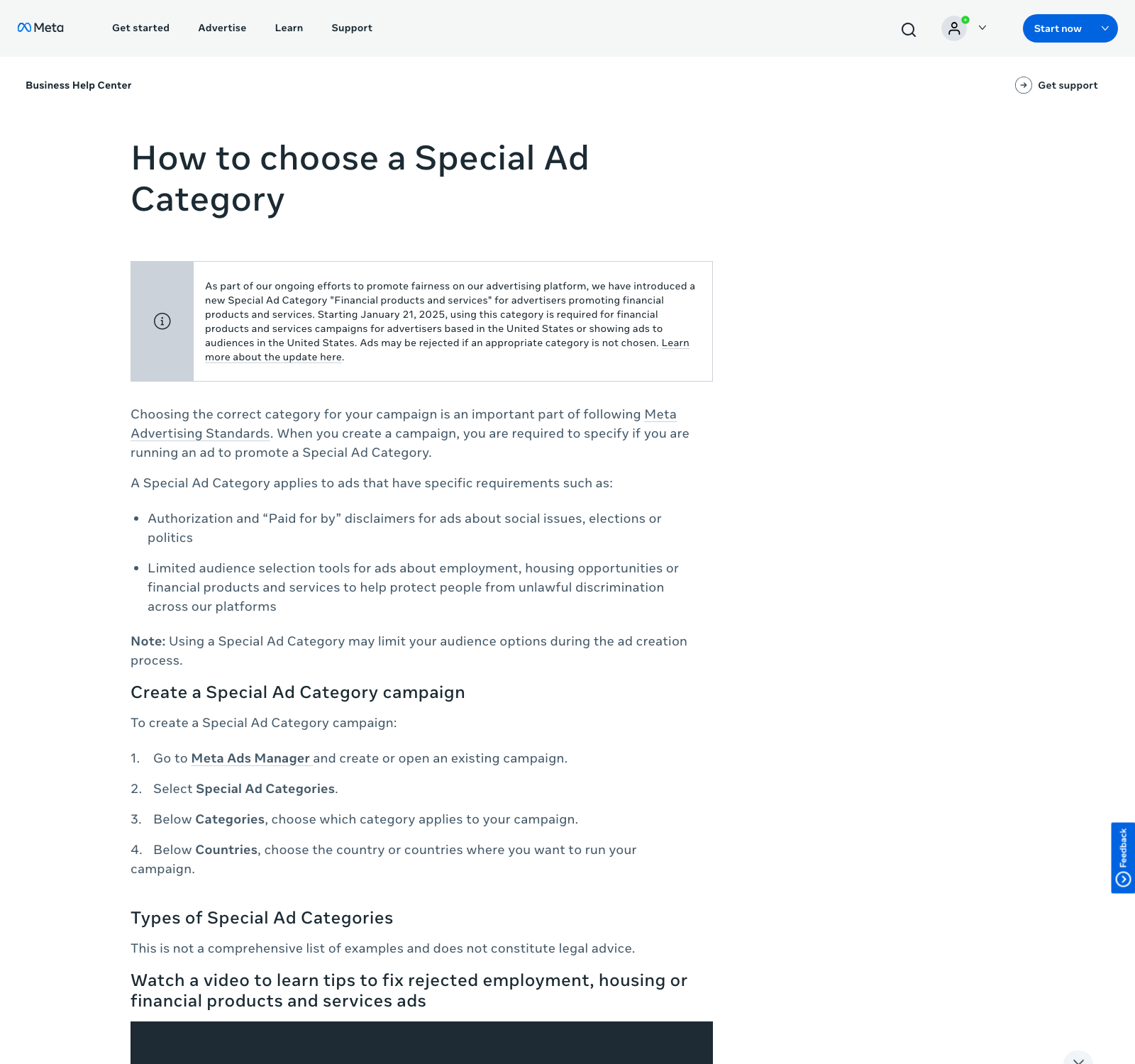
What survives: location by city, address pin or region at the expanded radius, broad interest categories Meta has not restricted, custom audiences built from your own list and site visitors, and the creative. That last one is where the targeting now lives. A video walkthrough of a $600,000 colonial in a named school district selects its own audience from the first three seconds in a way no age slider ever did, and Meta's delivery system rewards the ad that gets the right clicks.
The 2026 benchmarks, real estate against everyone
| Metric (LocaliQ, 2026) | Real estate | All industries |
|---|---|---|
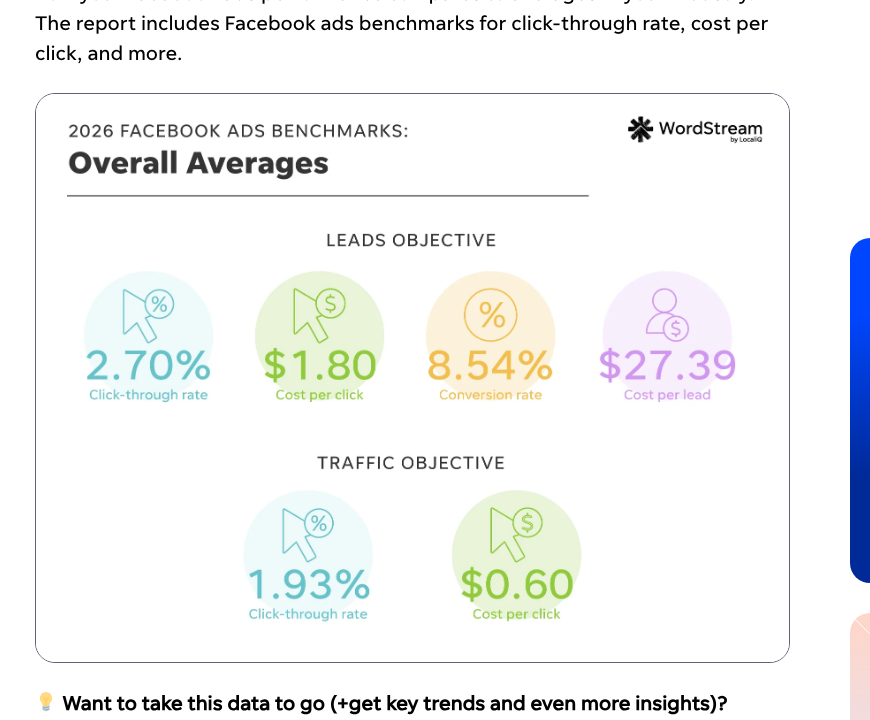
| Lead campaign click-through rate | 4.17% | 2.70% |
| Lead campaign cost per click | $1.27 | $1.80 |
| Lead campaign conversion rate | 9.95% | 8.54% |
| Cost per lead | $13.74 | $27.39 |
| Traffic campaign click-through rate | 2.37% | 1.93% |
| Traffic campaign cost per click | $0.55 | $0.60 |
| Verdict | Real estate is the cheapest lead on the Facebook benchmark, half the cross-industry average, because houses are the one product people scroll for on purpose. Price the lead against what it is: a contact, not a client. | |
Run the math the way a brokerage should. At $13.74 a lead, $1,500 a month buys about 109 leads. If 1 in 40 valuation leads lists with you inside twelve months (a rate the agents we work with would call good), that is 2.7 listings a month from the campaign, and at a $9,000 average side that is $24,000 of commission for $18,000 of annual ad spend plus the time to work 1,300 contacts. The campaign is profitable at that close rate and a money pit at 1 in 150, which is where most of them land, because the follow-up is a drip email nobody reads.
Who the buyers are, from NAR's 2025 Profile
The National Association of Realtors' 2025 Profile covers buyers and sellers who closed between July 2024 and June 2025. The numbers that matter for an ad budget: 88 percent of buyers purchased through an agent, 46 percent started their search online and 20 percent started by contacting an agent, every buyer used the internet and 70 percent used a phone or tablet, and 43 percent found their agent through a friend, neighbor or relative (49 percent of first-time buyers). Two more: 67 percent of first-time buyers and 76 percent of repeat buyers interviewed only one agent, and 91 percent would use or recommend their agent again. Read together, that is the whole strategy. Nearly half of buyers begin on a screen, which is why the ads convert; nearly half choose by referral and most never interview a second agent, which is why the ad has to put you in the conversation before the referral does, and why the follow-up has to be a person.
Three campaigns that work
The seller valuation campaign is the one that pays. A lead form or landing page offering a home value estimate for a named area ("What is your Lake Nona home worth in 2026?"), with a short form and an instant answer, aimed at a 15-mile radius around the farm area. Sellers are the scarce side of the market and a valuation lead is a listing appointment six to eighteen months out. Budget $30 to $50 a day; Meta requires the daily budget to be at least five times any cost-per-result goal you set, so do not set one until you have a month of data.
The listing-alert campaign fills the buyer side. "New homes under $500K in the north suburbs, delivered weekly" as an Instant Form, then a real weekly email built from the MLS feed. It is the cheapest lead on the platform and the slowest to close, so it only works with a system that scores engagement and texts the people who open three in a row. The third is the open house or just-listed video: a 20-second walkthrough with the address, the price and the showing window, run as a traffic or engagement campaign at $10 to $20 a day for the four days before. It rarely sells the house by itself. It does tell the neighborhood which agent is working the street, which is the referral you need six months later.
Want the campaign built with the follow-up already wired?
We set up the valuation funnel, the five-minute text, and the CRM handoff. Flat management fee, no contract, and we will tell you if your site cannot carry the traffic yet.
The follow-up is the campaign
A Facebook lead is a person who gave a phone number to see a number. The window to reach them is minutes, not days, and the mechanism is a text, not an email: the same lesson our contractors learned with missed-call text-back applies with a Realtor's name on it. The sequence that works is a text within five minutes that delivers the valuation and asks one question ("Thinking of selling this year or just curious?"), a call the same day from the agent if they answer, and a monthly market update by text thereafter. Anyone who replies "just curious" goes into a twelve-month nurture; anyone who replies with a timeline gets an appointment request. Without that, the 9.95 percent conversion rate converts into nothing, and the $13.74 lead was a $13.74 donation to Meta.
The Fair Housing Act is stricter than Meta
Meta's category removes the targeting that could discriminate; the Fair Housing Act governs the words. Copy that describes the buyer instead of the property is the common failure: "perfect for young families," "ideal for empty nesters," "walking distance to the church," "safe neighborhood," "exclusive community." Describe the house, the lot, the price and the location, and let the reader decide whether they are the buyer. The same rule applies to the images, which should show the property and not a curated set of people. An ad that passes Meta's review can still be a complaint to HUD, and a complaint is a worse outcome than a rejected ad. Most brokerages have a compliance checklist; run every ad through it before it runs through Ads Manager.
Three things to skip
Skip boosted listing posts with no form, no landing page and no pixel; the $0.55 traffic click is cheap for a reason, and a boosted post produces likes from people who will never call. Skip the national lead-gen vendors who resell the same Facebook lead to three agents; you are paying a markup for a shared contact and the first agent to text wins anyway, which you can be for $13.74. And skip retargeting as a first campaign; custom audiences from site visitors still work inside the housing category, but a site with 300 visits a month cannot feed one, so build the valuation campaign first and the retargeting layer in month three.
Where Facebook sits next to Google for an agent
Google captures intent ("homes for sale in Winter Park" is a buyer in motion) at a higher click price and a higher close rate; Facebook creates intent at a lower price and a lower close rate. The side-by-side benchmarks for both platforms are in our Google Ads vs Facebook Ads comparison, and the contractor version of this playbook, with the same follow-up mechanics, is in Facebook ads for contractors. The order for a solo agent with $1,500 a month: a site that converts, Google Business Profile with 50-plus reviews, the valuation campaign on Facebook, then Google Search when the Facebook funnel is producing appointments and you have proof the site can close a higher-intent click.
Frequently asked questions
Do Facebook ads work for real estate agents?
Yes, with the lowest cost per lead on the platform: $13.74 in LocaliQ's 2026 benchmarks against $27.39 across industries, with a 4.17 percent click-through rate and a 9.95 percent conversion rate on lead campaigns. The leads are early-stage contacts, so the return depends on texting within five minutes and nurturing for six to eighteen months.
How much do Facebook ads for real estate cost?
About $1.27 a click and $13.74 a lead for lead campaigns, and $0.55 a click for traffic campaigns, per LocaliQ's 2026 report. A working seller-valuation campaign needs $30 to $50 a day, so $900 to $1,500 a month in spend, plus management if you hire it out (ours is $1,000 a month or 15 percent of spend when bundled with Google Ads).
What is the special ad category for real estate on Facebook?
The Housing special ad category. It must be selected for any ad about homes for sale or rent, mortgages, homeowners insurance or real estate services. Meta's help center says it removes age, gender, ZIP code, exclusion targeting, lookalike audiences and saved audiences, limits some interests, and expands city and pin-drop radii (15 miles in practice). Advantage+ catalog ads carry the same limits.
Can I target by ZIP code or neighborhood for real estate ads?
No. ZIP code targeting is unavailable in the Housing category, and city or pin-drop audiences get an expanded radius of about 15 miles. Name the neighborhood in the creative and the offer instead; the ad will find its audience through the people who click on it.
What is the best type of Facebook ad for real estate?
A seller home-valuation lead campaign aimed at a 15-mile radius around your farm area, because sellers are the scarce side and a valuation lead becomes a listing appointment. Listing-alert signups fill the buyer side cheaply, and short just-listed videos build neighborhood recognition. All three depend on a text within five minutes of the form.
Check whether your site can carry a $13.74 lead before you buy one.
Send us your agent or brokerage site. The 10-minute audit shows where the valuation form, the follow-up and the tracking are missing, within 48 hours.