 ChatGPT
TL;DR
- Order of work: pick residential or commercial, qualify for your state's license, form and insure the company, file, then buy the truck and tools.
- Cash to start: about $39,276 at the low end and $79,783 with a new truck and three months of your own pay.
- State fees to license the company run from $0 in Texas to $650 in California, which also wants a $25,000 bond.
- Price from a $70 billable hour for a carpenter, about $106 an hour charged after 24 percent overhead and 10 percent profit.
- A one-truck remodeler breaks even near $20,190 a month with your pay inside, about 1.3 bathroom remodels at the $15,000 median.
- First customers: the free Google Business Profile and a simple website first. Lead sites last.
Here is how to start a construction company in 2026: decide what you will build, qualify for your state's license, form the company and get an EIN, insure it, file the license, then buy the truck and tools. Budget $39,276 to $79,783 in cash, close to half of it the truck.
This guide is for a carpenter, site lead or project manager about to leave an employer and open a general contracting or remodeling company. Each step carries its cost and its time, with the rules as Minnesota, California, Florida and Texas print them today.
We build websites and run marketing for contractors, so weigh the customer section with that in mind. We read every source below on November 25, 2026.
How to start a construction company in eight steps, with the cost and time of each
| Step | What it costs | How long it takes |
|---|---|---|
| 1. Qualify for the license | $0 in Texas to $650 in California | Four years of experience in California |
| 2. Entity, EIN, bank and books | EIN free, books $38 a month | One afternoon |
| 3. Insurance and bond | About $6,025 a year | Before the license application |
| 4. Lead-safe firm certification | $300 for five years | One to two weeks |
| 5. Truck and tools | $30,389 to $52,290 | Before the first job |
| 6. Price the first jobs | A $70 billable hour | Before the first estimate |
| 7. Win the first 20 customers | Profile free, website $3,000 | The first 90 days |
| 8. Make the first hire | $45.75 an hour, loaded carpenter | Once you turn work away |
| Verdict | Your state's license rules set the calendar. Read them first. | |
Steps one to four overlap. Minnesota will not approve a license without the insurance certificate and proof of workers' compensation, so line them up before you file.
The year's biggest quarter for this search is late summer. July to September carried 31 percent of a year's US searches for "how to start a construction company," and September was the top month at 2,900.
We summed DataForSEO's 12 monthly Google volumes by quarter, pulled November 25, 2026. Google groups the "company" and "business" wordings, so they count once.
Searches for "general contractor license" run about five times higher, at 9,900 a month. The license is the bigger question, so the guide starts there.
The license costs $0 in Texas and $650 in California
No two of these four states license a construction company the same way. We put each board's printed fees side by side, since none of the ranking pages we read does.
| State | What the state licenses | State fees for the company | Bond or fund |
|---|---|---|---|
| Minnesota | Residential building contractor or remodeler | $500: $180 license, $320 recovery fund | Recovery fund replaces the bond |
| California | B general building, four years' experience | $650: $450 application, $200 license | $25,000 bond |
| Florida | Certified building or residential contractor | $535: $335 exams, $200 certification | Homeowners' recovery fund |
| Texas | No general contractor license | $0 at the state | City registration, as in Austin |
| Verdict | Read your own board's page before you give notice | ||
Sources: Minnesota's Department of Labor and Industry (DLI), California's Contractors State License Board (CSLB) and Florida's construction industry board. Florida's figures come from its fee rule, 61G4-12.009, last amended in 2017, so check the current application.
Minnesota: a qualifying person and a recovery fund
Minnesota licenses any company that contracts directly with the owner of a one to four unit home for work in more than one skill. A remodeler works only on existing structures. A residential building contractor can also build new ones.
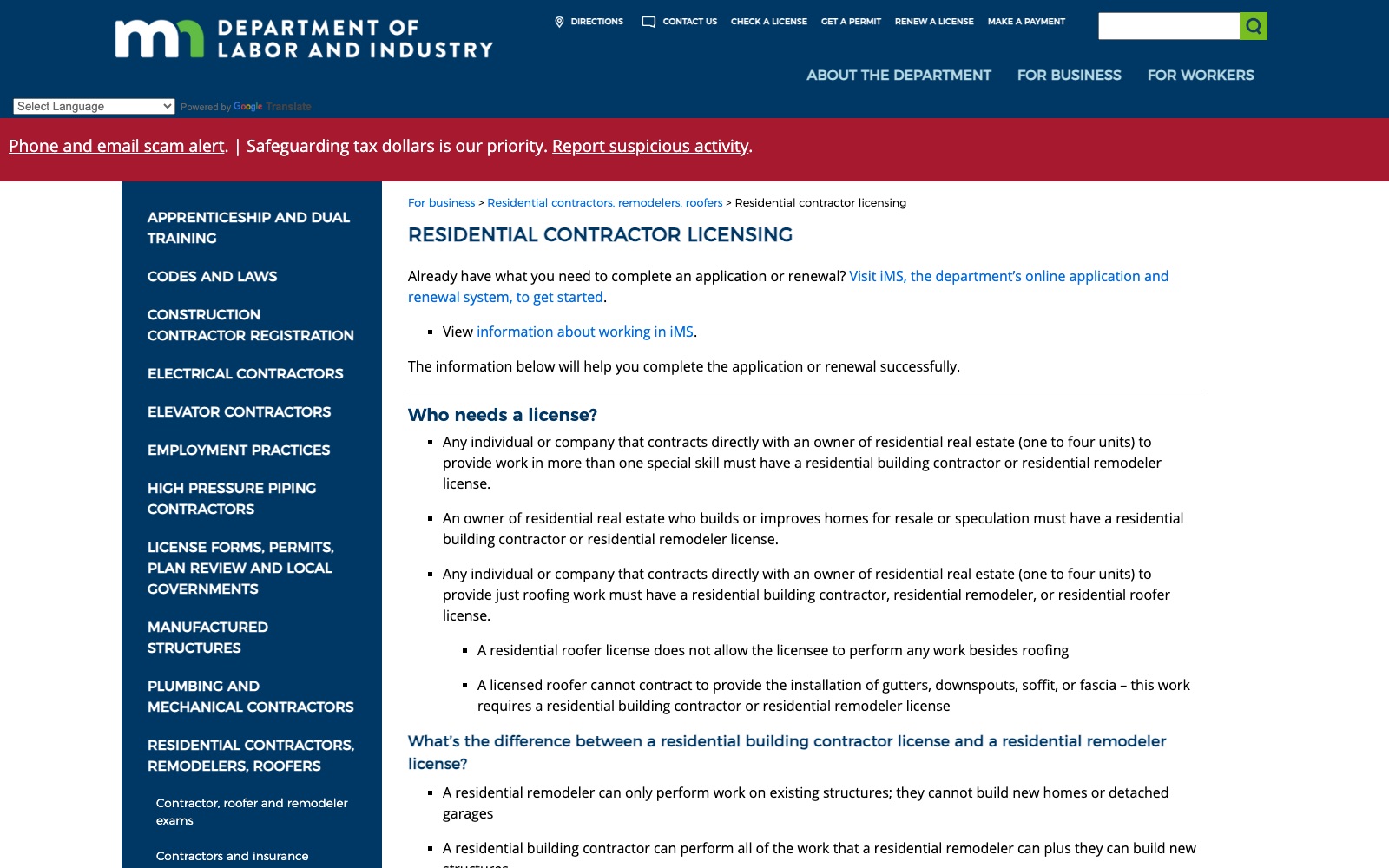
The company names a qualifying person, who passes a written DLI exam and then completes 14 hours of continuing education every two years. The DLI pages we read print no exam fee, so ask DLI for it.
Liability cover must reach $100,000 per occurrence, $300,000 aggregate and $25,000 of property damage. A company with gross receipts under $15,000 a year can hold a certificate of exemption instead.
The $320 recovery fund fee takes the place of a bond. The fund pays homeowners who lose money to a licensed contractor, up to $550,000 per licensee, and a contractor who triggers a payout needs a $40,000 bond to come back.
California, Florida and Texas
California's CSLB requires a license when a project's labor and materials reach $1,000, or when it needs a permit or employees. The B general building license needs four years of journey-level experience, with up to three years of credit for training.
Florida's certified license works statewide. A building contractor may build up to three stories, a residential contractor one to three family homes up to two stories. Both need four years of experience, one of them supervisory, and a credit score of 660 or a 14-hour course.
Texas has no state general contractor license. Its residential construction commission was abolished on September 1, 2009, and Austin's contractor page says "a state license is not required." Some cities register you, Austin among them, and trades such as electrical need a state license.
Pre-1978 homes need the lead-safe firm certificate
The EPA says anyone paid to disturb paint in housing or child-occupied facilities built before 1978 must be certified, "even sole proprietorships." That covers most remodeling in older neighborhoods.
The firm certificate costs $300 and lasts five years. Each job also needs a certified renovator assigned to it, so someone on your crew takes the renovator course. EPA prints no course price.
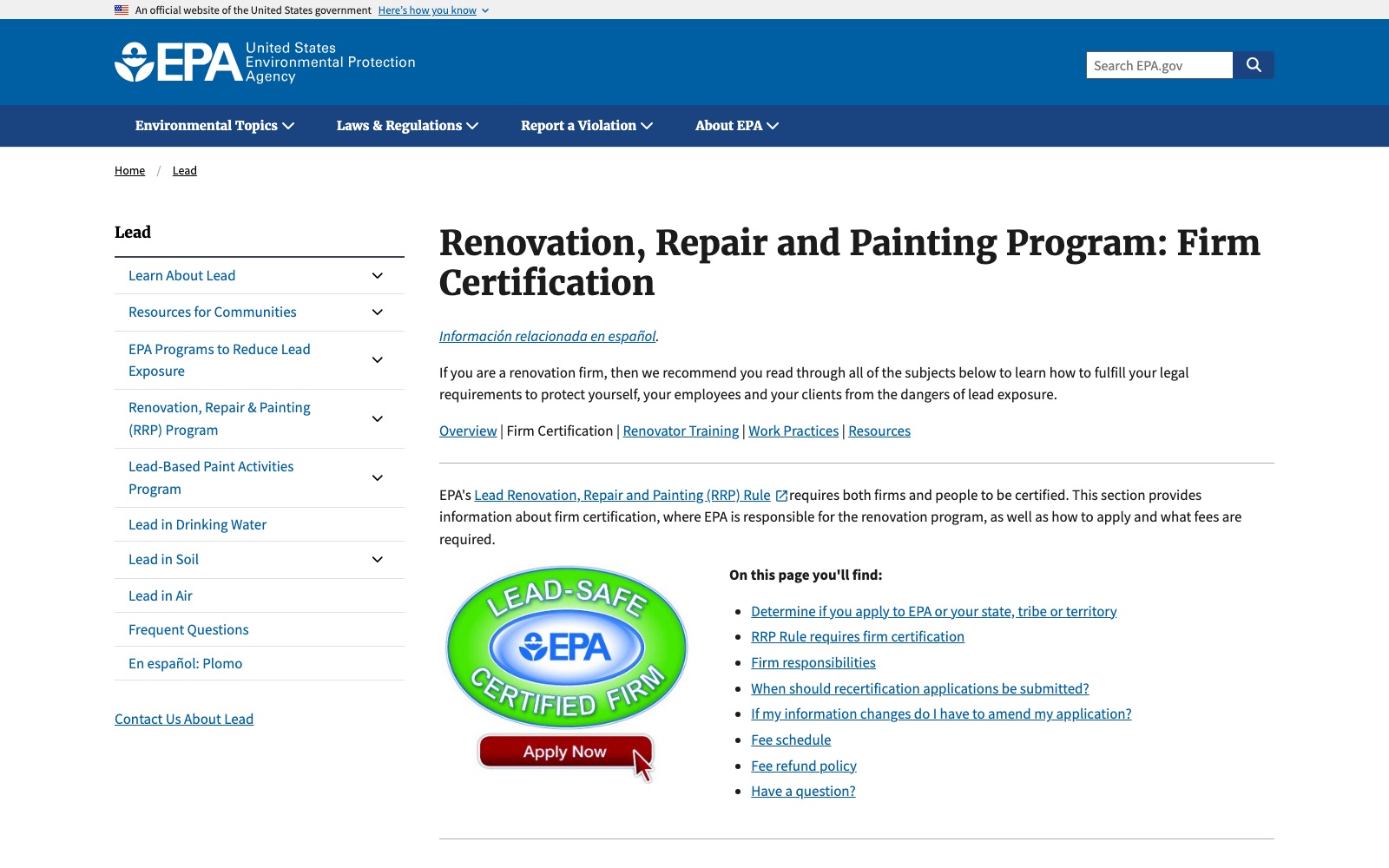
Fifteen states run their own program instead, among them Wisconsin, Georgia and Oregon. EPA's get certified page lists them all.
Entity, EIN, bank account and books in one afternoon
Form the LLC or corporation with your secretary of state first. Minnesota will not renew a license unless the state business filing is active, and the license, insurance and bank account all carry the company name. Read your state's own filing fee.
Then get an employer identification number (EIN), the federal tax ID for the business. The IRS says "you never have to pay a fee for an EIN" and issues it online right away if approved. The session expires after 15 minutes idle.
Open a business checking account with the EIN, so deposits from customers never sit in your personal account. Books start small: QuickBooks Online Simple Start lists at $38 a month.
For estimates and schedules, Contractor Foreman's Basic plan is $49 a month billed yearly, for one user. JobTread starts at $199 a month. Our remodeling estimating software guide compares the rest, and construction company names helps before you file.
Insurance and bonding run about $6,025 a year before the first hire
States set the minimums. Insurers set the price. Insureon prints what small general contractors paid through it, most with under five employees, on a page updated July 31, 2026.
| Policy, a month | Insureon, general contractors | NEXT Insurance |
|---|---|---|
| General liability | $162 | $56 to $227 |
| Commercial auto | $287 | Not printed |
| Tools and equipment | $42 | $32 to $64 |
| Surety bond | $10 | Not printed |
| Builder's risk | $136 | Not printed |
| Workers' compensation | $196 | Not printed |
| Verdict | Quote two insurers to your state's limits | |
Insureon's yearly figures for the first four lines add up to $6,025, and the truck's policy is more than half of it. NEXT Insurance prints monthly ranges for general contractors on its November 2026 page.
Builder's risk covers the structure while it is being built. Insureon's workers' comp figure matters once you hire, and Minnesota asks for proof of workers' comp compliance on a DLI form before it licenses you.
A bond is a promise a surety company makes for you, and you pay a yearly premium for it. California requires a $25,000 bond before it licenses you. Florida's homeowners' fund caps a Division I claim at $100,000 for contracts signed since July 1, 2024.
Licensed, insured and ready for the phone to ring?
Skill Mammoth builds websites and runs marketing for contractors and home service businesses, from $350 a month. One call gets you a real monthly figure for the marketing line, and every step on this page works without us.
What it costs to start your construction company: $39,276 to $79,783
The Small Business Administration (SBA) splits startup costs into one-time costs and monthly ones, and says to count at least a year of the monthly ones. The calculator covers the one-time cash, with the first year of insurance paid up front.
The typical column is a Minnesota remodeler with a new truck. The reserve holds three months of software, plus your own pay in the typical column. Drag the slider to the cash you have.
Added up, the low column is $39,276 and the typical column $79,783. Already own a truck you can work from? Take it out and the totals fall to $10,887 and $42,493.
The new truck is 47 percent of the typical total, so it is the line to question first. Rent the big equipment by the day until a booked job pays for it.
Three published ranges, $9,100 to $125,000
Companies that sell to contractors publish their own startup ranges.
- Jobber, August 2026: $10,000 to $125,000 or more.
- ZenBusiness, February 2026: $40,000 to $50,000 for a small start.
- Connecteam, August 2025: $9,100 to $23,700 for a solo operator, $41,300 to $125,000 for a small team.
Our low column sits inside Jobber's range, and the typical column above ZenBusiness's. The truck explains most of the gap, since Jobber puts a vehicle at $10,000 to $60,000.
Remodeling, new homes and commercial work are three different businesses
Pick one for year one. The license, the margin and the payment calendar all change with it. The National Association of Home Builders (NAHB) studies the first two every year.
| Measure | Remodelers, 2024 | Single-family builders, 2023 |
|---|---|---|
| Average revenue | $2.7 million | $11.3 million |
| Gross profit margin | 29.9% | 20.7% |
| Operating expenses, share of revenue | 23.6% | 12.0% |
| Net profit margin | 6.3% | 8.7% |
| Verdict | Remodeling needs less cash. Building needs land. | |
The remodeler figures come from NAHB's remodelers' study, posted April 8, 2026. The builder figures come from its builders' study, posted March 11, 2025, where cost of sales includes land.
Commercial work adds bonding. Under the federal Miller Act, any federal construction contract over $150,000 needs performance and payment bonds. Start residential, and bid public work once you have a few years of finished jobs to show a surety.
In Minnesota the line between the first two is the license itself. A remodeler license cannot build a new home or a detached garage.
Cash flow: deposits, draws and California's $1,000 cap
Construction pays in stages. A deposit at signing, then draws, payments released as each phase of work is done. The gap between paying for lumber and collecting the draw is where new companies run out of cash.
California caps the deposit. CSLB's November 2022 bulletin requires every home improvement contract to say "the down payment may not exceed $1,000 or 10 percent of the contract price, whichever is less."
Later payments there may not run ahead of the work or materials delivered, and breaking the rule is a misdemeanor. None of the other three states' pages we read prints a cap, so read your own contract law.
Write the draw schedule into every contract, tied to milestones an owner can see: demolition done, rough-in inspected, cabinets set. Our change order template covers the work that grows after signing.
Subcontractors, 1099s and lien waivers, handled carefully
Most general contractors hire out plumbing and electrical. How you pay the people you bring in decides your taxes and your risk.
The IRS asks whether you have the right to control how the work is done. It weighs behavior, money and the relationship, and Form SS-8 asks it to rule on a case.
Employees get a W-2. A subcontractor you pay $2,000 or more in 2026 gets a Form 1099-NEC by the end of January.
Minnesota goes further. Under statute 181.723, a person doing construction work in your trade is presumed to be your employee. To count as a subcontractor they must run a business that meets all 14 conditions, including a written contract signed within 30 days.
Misclassify a worker there and the penalty runs up to $10,000 per person. Collect a W-9, a certificate of insurance and any trade license before a sub starts.
Liens come next. A lien is a claim against the owner's property for unpaid work. A lien waiver is the sub's signed release once paid. Minnesota's pre-lien notice law makes you put a notice in the contract, or deliver it within 10 days of agreeing on the work.
Skip that notice and you lose your own lien rights. Subs must send their own notice within 45 days of starting, so collect a waiver from each one with every payment you make.
Price the first jobs from a $70 billable hour
A billable hour is one a customer pays for. Drive time, supply runs and estimating are paid hours nobody is billed for. The rate starts from five inputs:
- Wage: $31.55 an hour, the BLS mean for carpenters, May 2025.
- Burden, what an employer pays on top of the wage: 45 percent, from BLS employer cost data for construction occupations, June 2026.
- Billable share: 65 percent of paid hours, from Field Promax's study of 300 HVAC companies. No construction figure is published.
- Overhead: 24 percent of revenue, rounded from NAHB's 23.6 percent for remodelers, owner pay included.
- Profit goal: 10 percent. NAHB's remodelers averaged 6.3 percent, so this is a goal.
Multiply $31.55 by 1.45 and divide by 0.65, and a billable hour costs $70.38.
Our estimate template rounds that to $70. Divide by 0.66, the share left after overhead and profit, and the rate to charge is $106.06 an hour.
The calculator keeps the cents and lands near $107. Set your own wage and shares below.
Price from what you will actually pay, yourself included. If you leave a site supervisor job, the same math at that $41.56 mean asks about $140 an hour.
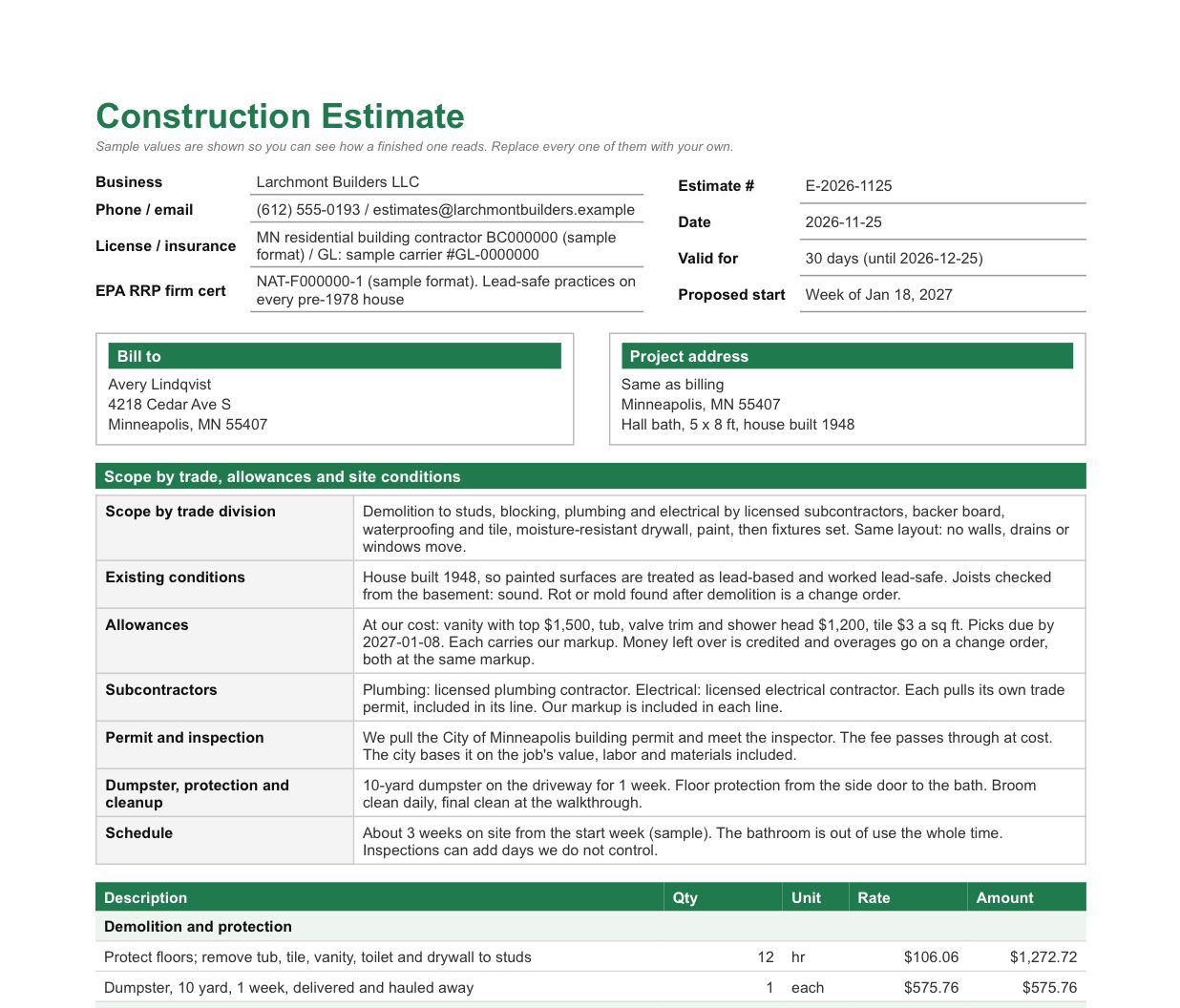
Turn the hour into a full price with our construction estimate template. It prints the license number, the lead-safe firm number, allowances and each trade on its own line.
Subcontractor markup is the other number you set. We found no published figure for it today, so set your own and keep it the same on every estimate.
Break-even: $20,190 a month covers the company and your pay
This sample assumes you run the jobs and a crew or subs do most of the field labor. That fits NAHB's 29.9 percent gross margin, which is what remodelers kept after labor, materials and subs.
Fixed costs are $588 a month: Insureon's liability, auto, tools and bond lines plus QuickBooks and Contractor Foreman. Owner pay is $5,469, the BLS mean carpenter wage of $65,630 a year divided by 12.
At a 30 percent margin that shop breaks even at $20,190 a month.
The 2026 Houzz and Home Study puts the median primary bathroom remodel at $15,000, so that is 1.3 jobs, two once rounded up. Swap in your own figures below.
Smaller jobs need more of them. At the $7,000 guest bathroom median, the same shop needs three jobs a month.
The $588 leaves out fuel, a phone and any truck payment, so your real line sits higher. Once you add them, the calculator gives you the count to hold yourself to.
How to start a construction company with the first 20 customers already calling
No source we read measures which channel brings a new construction company its first customers. This ranking is ours, built on what each channel costs and what Google prints about it. We sell websites, so read number two with that in mind.
- Google Business Profile. Google says creating one "is free." Add your service area, hours and photos of finished rooms, then ask every customer for a review.
- A simple website. One page per service, your license and lead-safe numbers, the towns you cover and a phone number above the fold.
- Referrals and past contacts, where allowed. Read your employment agreement before calling a former employer's customers. Then tell the suppliers, realtors and trades you already know.
- Neighborhood and property manager outreach. A finished job is a sign in the yard and a note to the neighbors. A property manager who trusts you can send repair and turnover work all year.
- Local Services Ads. Google's pay-per-lead listings include general contractors, and you "only pay for customers, not clicks" after Google screens your business.
- Lead sites. Ask each one for a current price and how many contractors get the same request. Track what each lead turns into before you add a second site.

Copy the two buttons. A homeowner planning a remodel wants a price before a visit, so a Price My Project button and a Text Us button give them two easy ways to start.
The full channel plan is in how to get remodeling leads. If you would rather hire it out, the best construction marketing agencies compares firms, us included.
The first hire costs $45.75 an hour once burden is added
A carpenter at the BLS mean of $31.55 an hour costs $45.75 once the 45 percent burden is added. Workers' comp adds $196 a month at Insureon.
Billed at the calculator's rate, that carpenter's 1,352 billable hours bring in about $144,174 a year. Hire when you have turned away a full month of work.
Expect a steady market for that hire. BLS projects carpenter jobs to grow 4 percent from 2025 to 2035, with about 62,800 openings a year.
BLS also counts 25 percent of carpenters as self-employed, so the person you want may be running a company of their own.
Your own path has room too. BLS counts 38 percent of construction managers as self-employed and projects 9 percent growth for the job.
Five mistakes that sink first-year construction companies
- Quoting below cost. Matching the old employer's prices without knowing your own $70 billable hour hands every job's margin to the customer.
- A break-even without owner pay. The sample's line drops from two jobs to one, and you become an unpaid employee.
- Deposits that do not cover materials. In California the deposit stops at $1,000, so the draw schedule has to carry the lumber.
- A sub with no paperwork. No W-9, insurance certificate or lien waiver means the tax bill, the injury claim or the lien lands on you.
- The new truck and the full tool wall on day one. The truck alone is 47 percent of the typical start. Rent until a booked job pays for the purchase.
Your first 90 days, as a checklist to copy
- Days 1 to 7: read your state board's contractor page and decide between remodeling and new homes.
- Days 1 to 7: register the qualifying person for the exam where your state has one.
- Days 1 to 7: form the LLC or corporation with your secretary of state.
- Days 1 to 7: get the EIN on IRS.gov, free, in one sitting.
- Days 8 to 14: open the business bank account and set up QuickBooks or your ledger.
- Days 8 to 14: quote liability, auto, tools cover and any bond from two insurers.
- Days 15 to 30: file the license with the insurance certificate and fees attached.
- Days 15 to 30: apply for the EPA lead-safe firm certificate and book the renovator course.
- Days 15 to 30: write a contract with a deposit, a draw schedule and the pre-lien notice your state requires.
- Days 15 to 30: build your estimate from a $70 billable hour.
- Days 31 to 45: claim the Google Business Profile and add photos of your own work.
- Days 31 to 60: launch a simple website with your license number on every page.
- Days 31 to 60: collect a W-9, insurance certificate and license from every sub you plan to use.
- Days 61 to 90: ask every finished customer for a review the same day.
- Day 90: compare jobs booked against the break-even count and decide on paid leads.
Want the website built while the license comes through?
Founded in 2023, Skill Mammoth builds websites and runs marketing for contractors and home service businesses. Plans start at $350 a month. A website costs $3,000, or $150 a month over 24 months. We are one option, and every step above works without us.
Frequently asked questions
How much does it cost to start a construction company?
About $39,276 at the low end and $79,783 for a typical Minnesota remodeler with a new truck and three months of owner pay, on prices read November 25, 2026. The truck is the biggest line: a used 2020 Ford F-150 averaged $28,389 on Cars.com, and a new 2026 XL starts at $37,290. Published ranges run from $9,100 to $125,000.
Do you need a license to start a construction company?
It depends on the state. Minnesota licenses residential building contractors and remodelers for $180 plus a $320 recovery fund fee. California requires a license once a project reaches $1,000 in labor and materials, plus a $25,000 bond. Florida certifies building and residential contractors. Texas has no state general contractor license, though cities such as Austin require registration.
How do I get a general contractor license?
Read your state board's page first. California's B general building license needs four years of journey-level experience, an exam, $650 in fees for a sole owner and a $25,000 bond. Florida wants four years of experience, one supervisory, and a 660 credit score or a course. Minnesota has its qualifying person pass a DLI exam.
Does Texas require a general contractor license?
No. Texas has no state license for general contractors, and its residential construction commission was abolished on September 1, 2009. The City of Austin says anyone can be a general contractor there, but general contractors must register with the city before permitted work. Trade work such as electrical and air conditioning still needs a state license from TDLR.
What insurance does a new construction company need?
General liability first, then commercial auto for the truck and cover for tools. Insureon's July 2026 figures for general contractors are $162 a month for liability, $287 for auto, $42 for tools and $10 for a surety bond, about $6,025 a year together. Builder's risk runs $136 a month, and workers' comp $196 once you hire.
How many jobs does a new construction company need to break even?
With $588 of monthly fixed costs, $5,469 of owner pay and a 30 percent gross margin, a one-truck remodeler breaks even at $20,190 a month. At the $15,000 median primary bathroom remodel that is two jobs a month, rounded up. At the $7,000 guest bathroom median it is three.