TL;DR
Lawn care software in 2026 runs from free (Yardbook, LawnPro Solo) to $648 a month (LMN Professional), and the right pick is set by crew size, not features. A solo mowing route needs free or $29 (Jobber Core); a three-to-ten-person maintenance company needs $99 to $199 (Jobber Connect, LawnPro Grow, GorillaDesk Pro, Service Autopilot Pro); a design-build or commercial maintenance firm with job costing needs $297 or more (LMN) or a quote (Aspire). Eight products are priced below from their own pages on October 9, 2026. Two things to check that the feature grids hide: whether recurring service contracts can be level-billed across a season, and whether the route optimizer runs on the free tier or the $129 one.
Disclosure: Skill Mammoth builds websites and runs local SEO for landscaping and lawn care companies, and we are a Jobber partner (readers get 20 percent off through our link, and we earn a commission). We have no arrangement with any other vendor on this page. Every price below came from the vendor's own pricing page on October 9, 2026. One vendor's page returned a server error that day, and it is noted rather than guessed.
What makes lawn care software different from general field service software
A lawn care company's calendar is recurring, dense and seasonal, which breaks three things in a general-purpose scheduler. First, recurring visits: 80 mows every Thursday for 28 weeks need to be created once, routed as a batch and skipped as a batch when it rains. Second, routing: mowing margins live in drive time, and a route that saves 40 minutes a day across a 3-truck operation is worth $15,000 a year in labor. Third, billing: customers want one flat monthly payment across the season (level billing) while you want to invoice per visit, and the software has to hold both. Add chemical tracking for fertilizer and weed programs, and snow in the winter, and you have the checklist that the generic CRMs on the contractor CRM list mostly fail.
2026 prices, eight lawn care and landscaping products
| Product | Price (annual billing where offered) | Users included | Built for | Where routing arrives |
|---|---|---|---|---|
| Yardbook | Free | Not capped on the site | Solo and small residential routes; 20,000-plus companies per its homepage | Included |
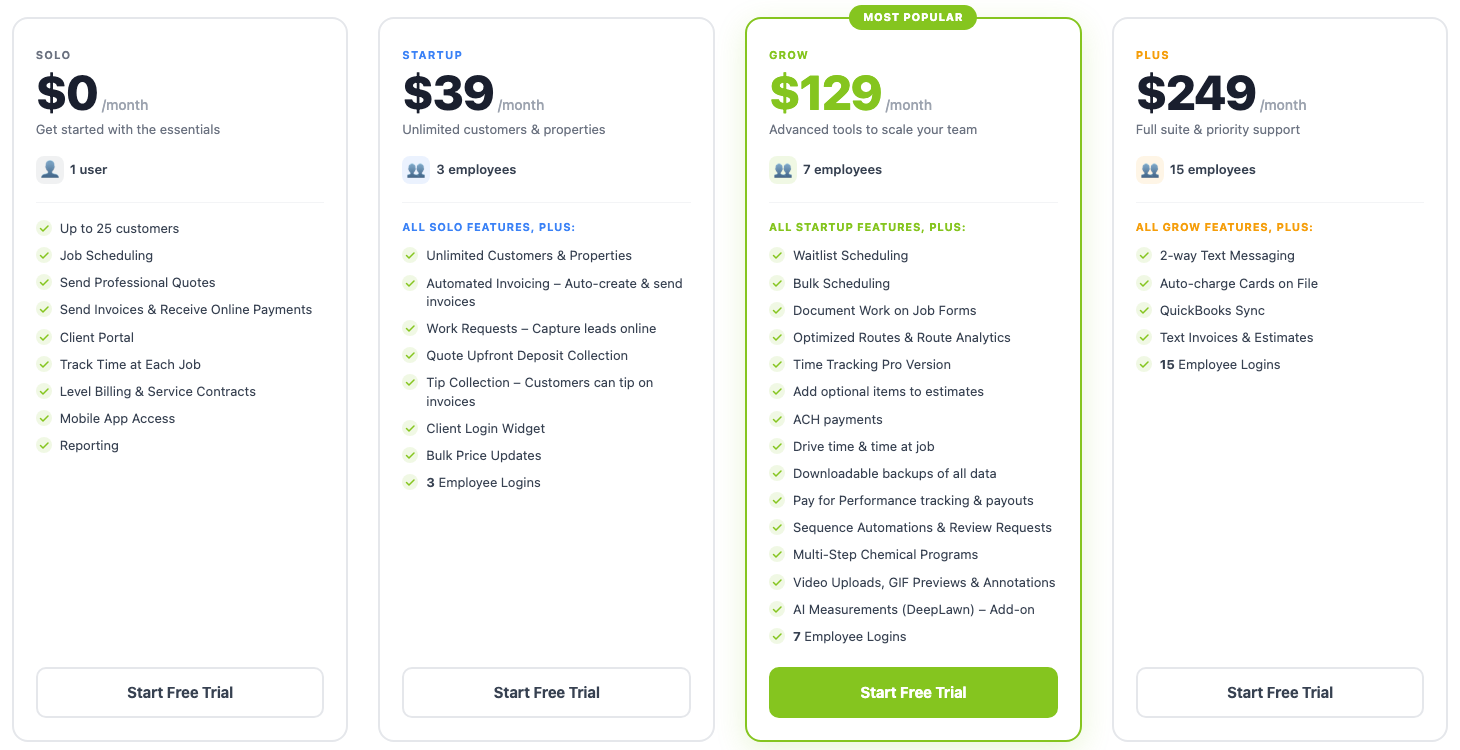
| LawnPro | Solo free (1 user, 25 customers); Startup $29 ($39 monthly); Grow $99 ($129); Plus $199 ($249) | 1, 3, 7, 15 | Residential lawn care, fert and squirt programs | Grow, $99 |
| Jobber | Core $29 ($49 monthly); Connect $99 ($139); Grow $149 ($199); plus $29 a user | 1, then 5 to 15 on bundled tiers | Any home service, strong on quoting and client communication | Connect, $99 |
| GorillaDesk | Basic $49; Pro $99; Growth $149 per route; yearly $539, $1,089, $1,639 | Unlimited admins; paid seat per scheduled route | Route-based recurring services; started in pest control | Basic, 25 stops; drive-time routing on Pro |
| Housecall Pro | $59, $149, $299 annual | 1, 5, 8 | Home services generally | Not on Basic; confirm the tier on the plan grid |
| Service Autopilot | Startup $49; Pro $199; Pro Plus $499; Elite by quote; each plus an unlisted sign-up fee | 1 office and 1, 2 or 5 mobile | Lawn and snow companies scaling past 10 people; automations | Pro, $199 |
| LMN (Granum) | Starter $297; Professional $648; Enterprise by quote; plus a one-time onboarding fee | 1 office and 5 crew; 3 office and 15 crew | Landscape construction and maintenance with budgeting and job costing | Included, with crew app |
| Aspire, SingleOps, RealGreen, FieldRoutes | Quote only | Quote | Commercial maintenance, multi-branch, enterprise lawn and pest | Included |
| Verdict | Free to $29 for one truck, $99 to $199 for a crew, $297 and up when you need to know the margin on each job rather than each month. TurfHop's pricing page returned a server error on October 9, 2026, so it is not priced here. | |||
Solo and two-person routes: free or $29
Yardbook is free, and it does the solo job: customer list, estimates, scheduling, invoices with card payments, routing and a public profile page. The site has no pricing page at all. The cost of free is support (community and email), a dated interface, and the knowledge that the product's revenue comes from somewhere other than you. For a one-truck mowing route it is hard to beat.
LawnPro's Solo plan is also free, capped at one user and 25 customers, and includes level billing and service contracts, which Yardbook does well and almost no other free tier does. The cap is the catch: 25 customers is about one day of mowing, after which Startup is $29 a month billed annually for three employees and unlimited customers.
Jobber Core at $29 annual is the paid alternative, and the reason to pay is the customer side: quotes with deposits, a client hub where customers approve and pay, and automated review requests. No routing on Core, though; that is Connect at $99. See Jobber pricing for the full ladder.
Three to ten people: $99 to $199
This is where the category earns its money, and four products compete for it.
Jobber Connect, $99 annual for one user and $149 for five
Online booking, automations, QuickBooks sync, route optimization and automated review requests. The lawn-specific gap is chemical tracking, which Jobber does with custom fields rather than a module. Strongest on customer communication of the four.
LawnPro Grow, $99 annual for seven employees
Waitlist and bulk scheduling, optimized routes, drive-time tracking, multi-step chemical programs, sequence automations and review requests. Built for lawn care rather than adapted to it, which shows in the chemical programs and the pay-for-performance crew tracking. Two-way texting and QuickBooks sync are held back to Plus at $199.
GorillaDesk Pro, $99 a month for one route
The pricing unit is the route, not the user: administrators and unscheduled techs are free, and each scheduled route is a seat. Pro adds drive-time routing, online booking, subscription billing, review generation and QuickBooks. Note the conflict on its own pricing page: Growth is listed at $149 a month but the checkout link reads $299, so confirm before relying on either figure. Add $5 a month for a texting number and $50 per 1,000 SMS.
Service Autopilot Pro, $199 a month plus a sign-up fee the page does not state
Multi-day jobs, route optimization, dispatch calendar, job costing and asset tracking at Pro; automations at Pro Plus ($499). It is the deepest of the four and the most work to set up, and the unlisted sign-up fee is the first question to ask on the demo.
Not sure which tier your crew actually needs?
Bring your customer count, crew size and whether you do fert programs or snow. Fifteen minutes sorts out whether you need the $29 plan or the $199 one, and what the switch costs in setup time.
Design-build and commercial maintenance: $297 and up
Past ten people, the question changes from "did the crew show up" to "did we make money on that job," and the software changes with it. LMN by Granum starts at $297 a month for one office license and five crew licenses, and $648 for three office and 15 crew, each plus a one-time onboarding fee the page footnotes but does not price. What you get for the jump is budgeting with overhead recovery, estimating off your own price lists, real-time job costing at Professional, and a crew app with GPS punch-ins and efficiency scores. The pricing page quotes a customer going from $1 million with 30 employees to $3 million with 10, which is the pitch in one sentence: the software exists to price work correctly.
Aspire (owned by ServiceTitan) is the commercial maintenance standard and quotes only, as do SingleOps, RealGreen and FieldRoutes. Expect four-figure monthly bills and an implementation project measured in weeks. If you are asking whether you need one, you do not yet; the companies that do already know their revenue per crew hour.
The two checks the feature grids hide
Level billing across a season. A $45 weekly mow for 28 weeks is $1,260, and many customers want it as $105 a month for 12 months. The software must hold the service contract, invoice the flat amount, and still track the per-visit cost so you know the margin. LawnPro does this on the free tier, Jobber on Connect with recurring invoices, GorillaDesk on Pro with subscription billing, Service Autopilot and LMN natively. Yardbook does it. Housecall Pro has recurring service plans; confirm the flat-season setup on the demo.
Where the route optimizer lives. It is on Yardbook free, LawnPro Grow ($99), Jobber Connect ($99), GorillaDesk Basic (25 stops) and Pro (drive-time), Housecall Pro above Basic, and Service Autopilot Pro ($199). If the plan you are quoted does not include it, you are paying for a calendar, and the calendar is not where lawn care money is made. The lawn care lead guide covers the demand side; routing is the margin side.
Three to skip
A general CRM with a calendar bolted on. HubSpot, Zoho and the rest have no recurring-visit model, no routing and no level billing. They are fine for a landscape design firm selling $40,000 projects; they are the wrong tool for anyone who mows. The field service software roundup explains the split.
Enterprise software under ten people. LMN at $297 for a five-person crew is $3,564 a year plus onboarding for job costing you do not yet have the data discipline to use. Grow into it.
Any plan with an unpublished fee. Service Autopilot's sign-up fee and LMN's onboarding fee are both real costs that the pricing pages footnote. Ask for the number in writing on the demo, and ask what happens to it if you leave in six months.
The switch, in one week
Export customers and properties from the old system (or the spreadsheet) as CSV with the service address separate from the billing address. Import. Build the recurring services for the current season only, not history. Run one week of routes in both systems in parallel, then cut over on a Monday. Move card-on-file customers last, because the payment processor change is where the week goes. Every product above has a free trial or a free tier, so the parallel week costs nothing but attention.
Want more routes to fill before you buy the routing software?
We build the website and local SEO that puts a lawn care company at the top of the map in its own town, with the before-and-after grid to prove it. The software runs the crew; we fill the calendar.
Frequently asked questions
What is the best software for a lawn care business?
By crew size, from live prices on October 9, 2026: Yardbook (free) or LawnPro Solo (free, 25 customers) for one truck; Jobber Connect ($99 annual), LawnPro Grow ($99), GorillaDesk Pro ($99 a route) or Service Autopilot Pro ($199 plus a sign-up fee) for three to ten people; LMN ($297 to $648) or Aspire (quote) for design-build and commercial maintenance with job costing.
How much does lawn care software cost?
Free to $648 a month. Free: Yardbook, LawnPro Solo. $29 to $49: Jobber Core, LawnPro Startup, GorillaDesk Basic, Service Autopilot Startup. $99 to $199: Jobber Connect and Grow, LawnPro Grow and Plus, GorillaDesk Pro and Growth, Housecall Pro, Service Autopilot Pro. $297 and up: LMN. Aspire, SingleOps, RealGreen and FieldRoutes quote only.
Is Yardbook really free?
Yes. Yardbook has no pricing page and its homepage says over 20,000 companies use it free. It covers customers, estimates, scheduling, routing, invoicing with card payments and a public profile. The trade-offs are support, interface polish and the absence of the automations and texting the paid products add at $99 and up.
Which lawn care software has route optimization?
Yardbook (free), LawnPro Grow ($99), Jobber Connect ($99), GorillaDesk Basic (up to 25 stops) and Pro (drive-time matrix), Housecall Pro above its Basic plan, Service Autopilot Pro ($199) and LMN (all plans). Check the tier, not the product: on four of these the optimizer is absent from the entry plan.
Does lawn care software handle fertilizer and chemical tracking?
LawnPro has multi-step chemical programs on Grow ($99) and chemical tracking on all tiers. GorillaDesk tracks materials on Basic and came out of pest control, so application records are native. Jobber and Housecall Pro handle it with custom fields and line items rather than a module. For state application reporting, LawnPro and GorillaDesk are the two built for it.
What software do landscaping companies use for estimating?
LMN for budgeting and estimating from your own overhead recovery numbers ($297 and up), Aspire for commercial bids (quote), and Jobber or LawnPro for maintenance quotes. Design-build firms selling projects over about $20,000 need the LMN approach, which prices off labor and material calculators; maintenance companies need fast recurring quotes with deposits, which the $29 to $99 tier does.