TL;DR
A landscaping business plan has one reader who matters, the person deciding whether to lend you $30,000 for a mower and a trailer, and that reader looks at three things: whether the startup costs are real quotes, whether the revenue follows the season, and whether the winter is funded. The SBA's traditional plan has eight sections, SBA microloans top out at $50,000 with an average around $13,000, and a 7(a) small loan goes to $350,000. This guide walks through each section with the numbers a lender expects to see for a one-crew company, and the download at the bottom is the whole plan written out for a sample Minneapolis company, in Word and PDF, with every figure meant to be replaced.
Most business plan advice is written for software startups and padded to forty pages. A landscaping plan is eight to twelve pages, most of it tables, and it exists to answer the questions a lender, a landlord, an equipment dealer's finance desk or a partner will ask anyway. Write it once in January, update it each quarter, and it becomes the document you run the company from. The companion guides cover the operating detail: how to start a landscaping business for the install side and how to start a lawn care business for the mowing route.
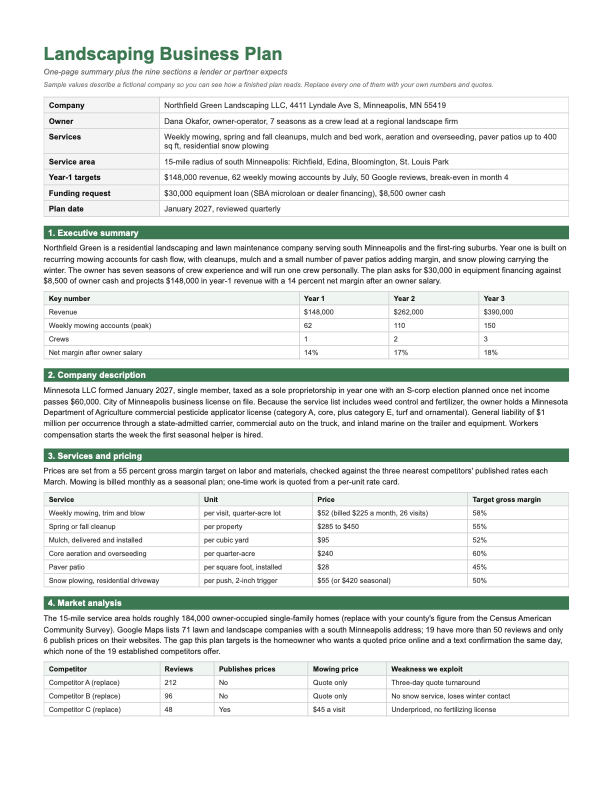
Download the landscaping business plan template
All nine sections written out for a sample one-crew company: pricing rate card with margin targets, competitor table, marketing budget by channel, seasonal revenue calendar, startup cost table, year-one profit and loss, and milestones with named risks. Word and PDF, free with your email.
What the lender actually reads
The SBA's own guide lists the sections of a traditional plan as executive summary, company description, market analysis, organization and management, service or product line, marketing and sales, funding request and financial projections, and notes that lenders and investors commonly request it. For a landscaping company the money comes from one of four places, and each one reads the plan differently.
| Funding source | What the SBA page says | What they look for in your plan |
|---|---|---|
| SBA microloan | Loans up to $50,000; average about $13,000; maximum term seven years; rates generally 8 to 13 percent | Equipment quotes with dealer names, a 12-month cash flow, your experience |
| SBA 7(a) small loan | Maximum $350,000; 85 percent guaranteed up to $150,000, 75 percent above; maturity ten years or less unless financing longer-lived assets | Two years of projections, a debt schedule, collateral |
| Dealer financing (Exmark, Scag, Kubota) | Promotional rates published by each manufacturer each season | Credit score and a down payment; the plan rarely gets read |
| Owner cash and family | Not applicable | Section 9, the risks, because it is their money in the truck |
| Verdict | Write the plan for the microloan officer. If it satisfies them, it satisfies everyone else. | |
The one-page summary
Every plan opens with a table a reader can absorb in a minute. The sample company in the template is Northfield Green Landscaping, a fictional one-crew operation in south Minneapolis; the structure is what to copy.
| Line | Sample entry |
|---|---|
| Company | Northfield Green Landscaping LLC, Minneapolis |
| Owner | Owner-operator with seven seasons as a crew lead at a regional firm |
| Services | Weekly mowing, cleanups, mulch and beds, aeration and overseeding, paver patios to 400 square feet, residential snow |
| Service area | 15-mile radius: Richfield, Edina, Bloomington, St. Louis Park |
| Year-one targets | $148,000 revenue, 62 weekly accounts by July, 50 Google reviews, break-even in month four |
| Funding request | $30,000 equipment loan against $8,500 owner cash |
The nine sections, with the numbers that belong in each
1. Executive summary
One paragraph and one table, written last. State what the company does, who runs it, how much you are asking for and what year one produces. The table shows revenue, accounts and crews for three years. Lenders read this page and the financials; the rest is supporting evidence. If the summary says $148,000 in year one, section 8 has to show how twelve months add up to it.
2. Company description
Entity type, ownership, location, licenses and insurance. This is where you prove you know the rules. Mowing needs no trade license in most states, but applying pesticides for hire does: Minnesota requires a commercial applicator license for anyone who charges for the service, Texas requires one for any pesticide on lawns or ornamentals, and Florida certifies fertilizer applicators separately through the $25 GI-BMP program. Installing irrigation or hardscape triggers a contractor license above a dollar threshold in California, Washington, Oregon and North Carolina. Name the license you hold, the one you are sitting for, and the insurance limits. The state table is in the landscaping startup guide.
3. Services and pricing
A rate card with a margin target next to each line. Lenders are not checking whether $52 a mow is right; they are checking that you priced from costs rather than from the cheapest competitor. The published 2026 benchmarks to anchor against: mowing averages $57 a visit (LawnStarter) or $60 (Lawn Love), professionally installed mulch runs $77 to $94 a cubic yard, a yard cleanup averages $169, and residential snow plowing runs $35 to $95 a push or about $700 for a seasonal contract.
| Service | Unit | Sample price | Target gross margin |
|---|---|---|---|
| Weekly mowing, trim and blow | Per visit, quarter-acre lot | $52, billed $225 a month over 26 visits | 58% |
| Spring or fall cleanup | Per property | $285 to $450 | 55% |
| Mulch, delivered and installed | Per cubic yard | $95 | 52% |
| Core aeration and overseeding | Per quarter-acre | $240 | 60% |
| Paver patio | Per square foot, installed | $28 | 45% |
| Snow plowing, residential driveway | Per push, 2-inch trigger | $55, or $420 seasonal | 50% |
| Verdict | Bill maintenance monthly and quote one-time work from the card. The margin column is what tells a lender you will still be here in March. | ||
4. Market analysis
Two numbers and a table. The first number is owner-occupied single-family homes in your radius, from the Census American Community Survey for your county. The second is how many landscaping companies Google Maps lists with an address in your area, how many have more than 50 reviews, and how many publish prices on their websites; in the sample, 71 companies, 19 with 50-plus reviews, 6 publishing prices. That last count is the opportunity, because the homeowner who wants a quoted price online has almost nowhere to get one. The table names three competitors with their review count, their mowing price if public, and the weakness you exploit, usually quote turnaround or no winter service. The national context, if the reader wants it: IBISWorld sizes landscaping services at $176.7 billion across about 556,000 businesses in 2026.
5. Marketing plan
Budget by channel by month, at 7 percent of revenue in year one. The first lines cost time rather than money: a Google Business Profile with a photo from every job, a review request by text after every visit, and a website that quotes a mow from the address. The paid lines fill April and May while those assets mature. Published costs to use: door hangers from $0.07 each at 2,000 on Vistaprint, yard signs at $20.50 on signs.com, Local Services Ads with landscaper and lawn care both eligible categories and a budget you set, Nextdoor plans from $3 a day, and GreenPal at 5 percent of the job for route density. Put the expected result next to each line, such as one account per 100 hangers or 12 to 18 LSA leads a month, so the quarterly review has something to check. The channel-by-channel detail is in landscaping advertising and where to buy landscaping leads.
6. Operations
The route, the week and the season. Four mowing days grouped by neighborhood, Friday for cleanups and installs, Saturday as the rain day. Then the seasonal revenue calendar, which is the table a lender studies longest because it is where landscaping plans fail. No trade group publishes clean monthly revenue data, so build it from your own rate card and account targets; the sample below is illustrative, and the vendor content that exists puts each peak summer month at roughly 12 to 15 percent of annual revenue.
| Month | Primary work | Share of annual revenue (sample) |
|---|---|---|
| April | Spring cleanups, first mows, mulch | 9% |
| May to August | Weekly mowing, patios, bed work | 52% |
| September to October | Aeration, overseeding, fall cleanups, final mows | 22% |
| November | Final cleanups, equipment service | 3% |
| December to March | Snow plowing | 14% |
| Verdict | Fourteen percent of revenue has to cover four months of truck payments and insurance. If the snow line is blank, the plan needs an operating reserve, and the lender will ask where it is. | |
7. Team and hiring
Who does what in year one, when the first hire happens and what triggers it. The sample plan hires a seasonal helper at $20 an hour the week mowing accounts pass 40, lays them off at the end of October unless snow volume supports a winter position, and names the crew-two trigger as three consecutive months of turning away work. Include your own background in a sentence; seven seasons as a crew lead is worth more to a microloan officer than any projection. Workers compensation starts the first shift, with a published median of about $150 a month for landscaping customers at Insureon.
Want the marketing section built rather than budgeted?
We build the quoting website, the Google profile and the review flow that section 5 describes, and run Local Services Ads under your brand. Flat monthly pricing you can put straight into section 8.
8. Financial plan
Three tables: startup costs with sources, a year-one profit and loss, and a 12-month cash flow. The startup table is where quotes replace guesses. Current list prices to build from: Exmark Turf Tracer 36-inch walk-behind $8,899, Exmark Lazer Z 60-inch zero-turn $12,399, Big Tex 6 x 12 landscape trailer $2,499, Stihl FS 91 R trimmer $379.99, Stihl BR 600 blower $549.99, and a 2019 F-150 XL SuperCrew at a Kelley Blue Book fair price of $14,450. Insurance from the insurer pages: general liability at a $63 monthly median and $36 to $55 for most Next Insurance landscaping customers. The sample plan totals $38,500, with $30,000 financed and $8,500 in owner cash for the truck.
| Year-one profit and loss (sample) | Amount | Percent of revenue |
|---|---|---|
| Revenue | $148,000 | 100% |
| Materials and subcontractors | $19,200 | 13% |
| Seasonal labor | $21,600 | 15% |
| Fuel, repairs, dump fees | $10,400 | 7% |
| Insurance and licenses | $5,900 | 4% |
| Marketing | $10,400 | 7% |
| Software, phone, accounting | $3,300 | 2% |
| Equipment loan payments | $8,100 | 5% |
| Owner salary | $48,000 | 32% |
| Net profit after owner salary | $21,100 | 14% |
Pay yourself a salary in the plan. A projection that shows 40 percent profit because the owner works free tells the lender you have not run a payroll before. Software costs come straight from vendor pricing pages: Jobber Core is $49 a month, Service Autopilot starts at $49 plus a signup fee, LMN Starter is $297. Disclosure: Skill Mammoth is a Jobber partner.
9. Milestones and risks
A dated list of what has to be true, and the two or three things that end landscaping companies in year one with a named response to each. The BLS survival tables say 79.6 percent of new businesses make it through year one and 50.2 percent through year five, across all industries. In this trade the two failures that account for most of the gap are a wet spring that pushes cash flow into June and an owner injury with nobody trained to run the route. The sample responses: a $6,000 operating reserve that is drawn rather than discounting, and a helper trained to run the route solo by mid-June. Add a fuel surcharge clause to every contract and the fuel risk disappears from the list.
Lawn care business plan: what changes
A mowing-only plan is shorter and the lender's questions shift. Startup capital drops to $12,000 to $27,000 because there is no excavator, no plow and often no new truck. Section 3 becomes a lot-size tier table instead of a rate card. Section 4 is about route density inside a 10-mile radius rather than competitor patios. Section 5 leans on GreenPal and Lawn Love for first-season density, at 5 percent and free respectively, with the plan to move those customers to direct accounts by year two. Section 8's revenue line is a multiplication: accounts times $57 times 26 visits, so 60 accounts is $88,920 and 110 is $163,020 before add-ons. The winter section matters more, not less, because the mowing season is exactly 26 weeks and the truck payment is 52. The operating detail is in how to start a lawn care business, and the same template works; delete the patio line and the excavator rental.
Mistakes lenders see in landscaping plans
- Revenue spread evenly across twelve months. Nothing says "has never done this" faster.
- Startup costs without quotes. "$10,000 for a mower" is a guess; "$8,899, Exmark Turf Tracer S-Series, dealer quote attached" is a plan.
- No owner salary in the projection.
- A marketing section that says "word of mouth and social media" with no budget and no expected result per channel.
- Licensing left out, or wrong. A plan that budgets a fertilizer program with no applicator license on page two gets a question you do not want.
- An unfunded winter. Either a snow line, another winter service or a reserve, with a number.
- Forty pages. Eight to twelve, mostly tables, with the quotes in an appendix.
Frequently asked questions
What should a landscaping business plan include?
The SBA's eight sections, which this guide renumbers to nine by splitting services and pricing from the market analysis: executive summary, company description, services and pricing, market analysis, marketing plan, operations, team, financial plan, and milestones and risks. For landscaping the sections a lender reads hardest are the seasonal revenue calendar, the startup cost table with quotes, and the winter plan.
How much money do I need to start a landscaping business?
About $12,000 to $27,000 for a maintenance crew (used truck, $2,499 trailer, 36-inch walk-behind at $8,899 new or far less used, trimmer and blower) and $30,000 to $40,000 with a 60-inch zero-turn at $12,399 and a plow. The sample plan totals $38,500, with $30,000 financed and $8,500 in owner cash.
Can I get an SBA loan for a landscaping business?
Yes. SBA microloans go up to $50,000 with an average around $13,000, terms up to seven years and rates generally between 8 and 13 percent, which fits a first mower and trailer. The 7(a) small loan reaches $350,000 for a second crew or a yard. Both lenders will ask for the plan, equipment quotes and a 12-month cash flow.
How profitable is a landscaping business?
The sample plan nets 14 percent after a $48,000 owner salary on $148,000 of revenue in year one, rising to 17 to 18 percent with a second crew. Gross margins run 55 to 60 percent on maintenance and about 45 percent on installs when priced from costs. The profit leaks are idle equipment, underpriced mowing and an unfunded winter.
Is a lawn care business plan different from a landscaping business plan?
Same structure, different numbers. Lawn care plans show lower startup capital ($12,000 to $27,000), a lot-size pricing tier instead of an install rate card, a route-density market section, and a revenue line built from accounts times visits times price. The winter section carries more weight because the mowing season is 26 weeks.
Is there a free landscaping business plan template?
Yes, the one in this guide: a Word document and PDF with all nine sections written out for a sample one-crew company, available on our contractor templates page in exchange for your email. Every number in it is a placeholder to replace with your own quotes.
Section 5, built for you.
The free website audit shows what a quoting site and a ranked Google profile would change in your market, with numbers you can drop straight into the plan.