 ChatGPT
TL;DR
- The moving company marketing that pays first costs $0: past customers, a Google Business Profile that gets a review on every move and referrals from realtors.
- Paid channels print from $15 for a shared lead (Network Leads) to $245 for a Google Ads lead (99 Calls). At a 39% close rate that is $38 to $628 per booked move.
- Mover payroll jobs rise 18% from January to June (BLS, 2026), yet searches to hire a mover put 32.8% of their year into November to February, the same share as May to August.
- Google lists Moving services for Local Services Ads but prints no price, and those ads move into Google Ads from August 2026.
- Built from printed prices, a one-truck plan costs $517.60 a month and a five-truck plan $3,558.70.
- Skip Google Ads before your quote page converts, paid reviews and a marketing push that stops in September.
Moving company marketing pays first on the channels you own: past customers, a Google Business Profile that collects a review on every move and referrals from realtors and apartment managers. Paid channels cost $38 to $628 per booked move at the prices we read today, from a $15 shared lead to a $245 Google Ads lead.
This guide is for the owner or office manager of a local or regional mover running one to fifteen trucks. Every price was read on November 28, 2026, and each one names the company that printed it. Search pages are covered in our moving company SEO guide and lead vendors in our moving leads guide.
Moving company marketing channels, ranked by cost per booked move
Cost per booked move is what a channel costs divided by the moves it books. Where a channel prints a price per lead, we divided it by 39 percent, the average close rate in SmartMoving's 2026 State of Moving survey of 484 movers. The survey does not say which leads that rate covers, so treat it as a placeholder.
| Rank | Channel | Printed price | Per booked move at 39% | Speed |
|---|---|---|---|---|
| 1 | Past customers and their referrals | $0 | $0 | This week |
| 2 | Google Business Profile and reviews | $0 | $0 | Weeks |
| 3 | Realtor and apartment partners | 10% referral fee | $59.30 on a $593 move | Months |
| 4 | Nextdoor page, then Nextdoor ads | Free, then $3 to $10 a day | Not printed | Weeks |
| 5 | Local Services Ads | Per lead, no price printed | Not printed | Days |
| 6 | Website with service and city pages | From $99 a month | Not printed | Months |
| 7 | Bought leads | $15 to $100 a lead | $38 to $256 | Days |
| 8 | Yelp Ads | $5 a day on average | Not printed | Days |
| 9 | Google Ads | $49 to $245 a lead | $126 to $628 | Days |
| Verdict | Owned channels first, paid channels to fill open trucks | |||
Partners rank above every paid channel because a referral fee is paid only when the move books. Shleppers, a New York mover, pays brokers a tenth of a local move. On Thumbtack's $593 national average for a 31 to 50 mile move, that is $59.30, and nothing is owed for quotes that never book.
Speed runs the other way. The free channels take weeks or months to build, and the paid ones can ring the phone this week. So the order is a plan: start the owned channels now, and buy only the moves your own channels cannot fill. The rest of this guide takes each one in turn.
The moving season shows in payrolls and truck rentals, not in mover searches
Moves bunch in summer. A Census Bureau study of its Survey of Income and Program Participation, using the 2008 panel, found June the most popular month with about 11 percent of moves. August came second, with about 10 percent.
The industry staffs for it. The Bureau of Labor Statistics counts payroll jobs at household and office goods movers every month. In 2026 the count rose from 84,800 in January to 100,000 in June, an 18 percent swing.
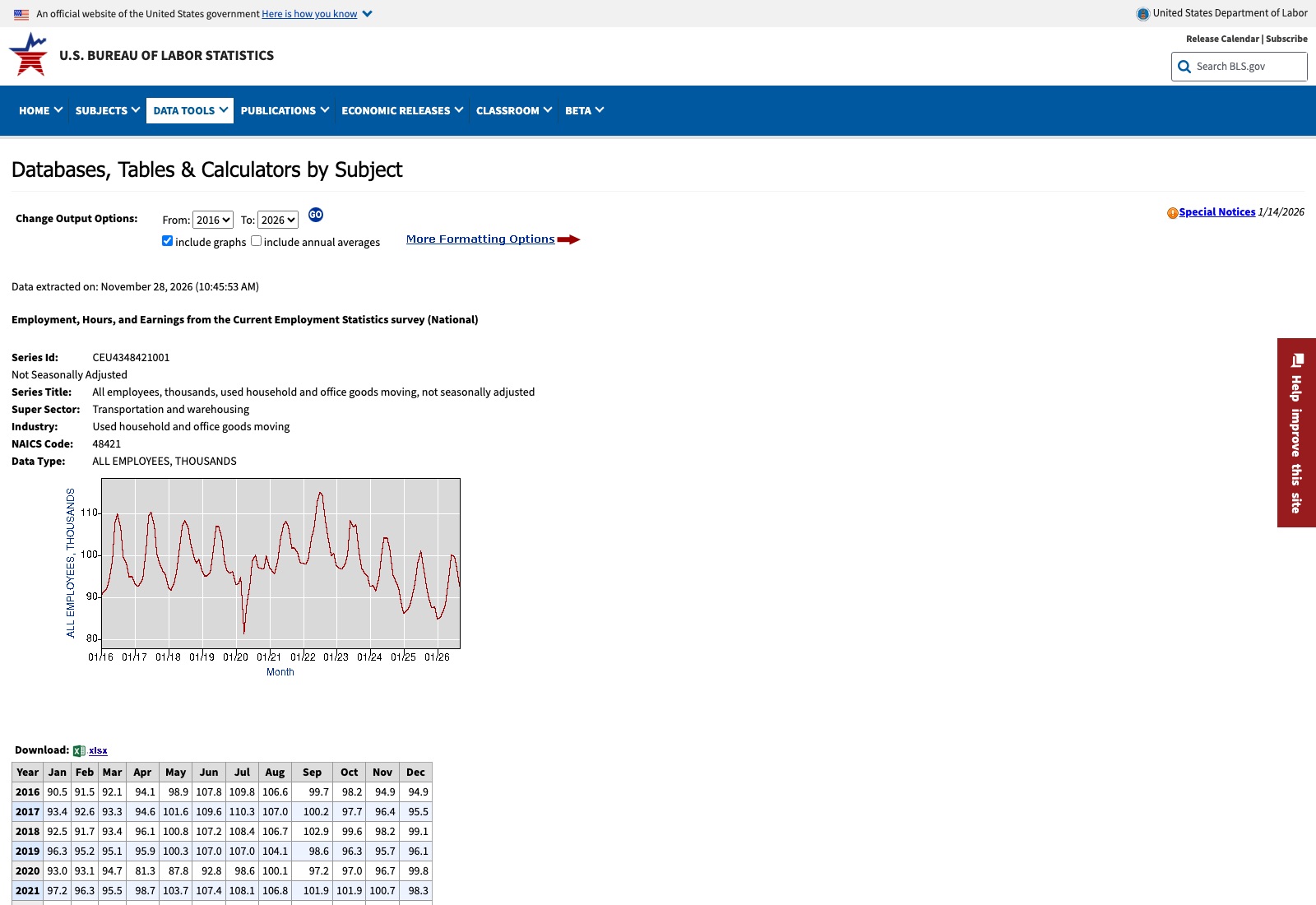
Truck rentals follow the same line. We pulled twelve months of US Google searches for 40 moving terms through DataForSEO today, running from November 2025 to October 2026.
"Moving truck rental" hit 301,000 searches in June, five times December's 60,500. It put 53.4 percent of its year into May through August.
Searches to hire a mover did not move with them. We added up the monthly searches for seven hiring terms, such as "movers near me", "local movers" and "moving quotes", then divided each four-month block by the year.
of the year's searches to hire a mover fell in May through August. November through February held the same 32.8%.
The hiring searches were highest in January, at 587,700, with October close behind. June ran at 75 percent of the January figure. The chart sets that line against the payroll jobs and the truck rentals.
So the move season and the search season are different things. June is when the industry carries its most payroll jobs. Winter is when payrolls sit at their low while the searches hold up, which makes it the season when marketing can fill a truck that would otherwise sit.
Read the data with three cautions. Google rounds volumes into buckets, and "movers near me" is most of the total. Pulls for several trades read high in October 2026, so treat October as one month of data. Monthly figures also cannot show the end-of-month rush owners describe, so we leave it out.
The summer customer is often moving themselves. "Moving labor", a search for loaders without a truck, went from 880 searches in December to 5,400 in July. A labor-only page priced by the hour catches the truck renters a full-service quote loses.
Open any search below to see its twelve months and its click price.
What a moving customer costs on each paid channel
Moving company advertising prices in different units: a lead, a click, a booked move or a month of ads. These are the printed prices we found for movers today:
- Network Leads: $15 for a local lead shared with up to four movers, $45 for an exclusive one, $20 and $85 for interstate. Prepaid, no contract.
- 99 Calls: $24.99 for an exclusive lead from its own search pages. Its Google Ads leads cost businesses $49 to $245, the 10th to 90th percentile nationwide.
- Unpakt, a booking site: a commission of 15 percent on your first 9 moves, rising to 27 percent from the 100th. On a $593 move, Thumbtack's average for 31 to 50 miles, that is $88.95 to $160.11.
- Google Ads clicks: $25.96 for "local movers", $28.58 for "movers near me" and $67.82 for "long distance movers".
Our moving leads guide prices every lead vendor with its return rules. The short version: buy leads only when someone can call each one inside five minutes. Drag the budget below to see which printed prices start inside it.
The mixed units are the point. One top-end Google Ads lead at $245 costs more than four referral fees on $593 moves, and the referral fee is owed only when the move books.
Want a second opinion on where your next moves should come from?
Skill Mammoth builds websites and runs marketing for contractors and home service businesses, with plans from $350 a month. A call with us is one way to test this plan. Running it yourself is another.
Reviews, a written estimate and a DOT number turn a search into a booked move
Most buyers compare movers before they call. Nextdoor's 2026 Moving Insights Report, published in August without a stated sample size, asked recent movers how they chose:
- 57% hired a professional moving company.
- Of those, 49% said the price quote drove the choice and 43% said online reviews did.
- 49% hired a mover about a month before the move.
- After the move, 59% used Google to find local businesses, 48% Nextdoor, 34% Facebook and 17% Yelp.
Reviews: recent, many and answered
BrightLocal's Local Consumer Review Survey 2026 asked 1,002 US adults how they use reviews. Five answers set the bar for a mover:
- 97% read reviews for local businesses.
- 47% won't use a business with fewer than 20 reviews.
- 74% care about reviews from the last three months.
- 31% will only use a business rated 4.5 stars or higher.
- 89% expect the owner to respond to reviews.
Movers already sit high. SmartMoving's survey sets the benchmark at 510 Google reviews, and puts the review capture rate, the share of jobs that leave one, at 18 percent.
Ask on move day, by text, before the crew leaves. Never buy one. The Federal Trade Commission's final rule, announced August 14, 2024, bans buying fake reviews and offering rewards that depend on a review being positive. Our guide to 100 Google reviews has the scripts.
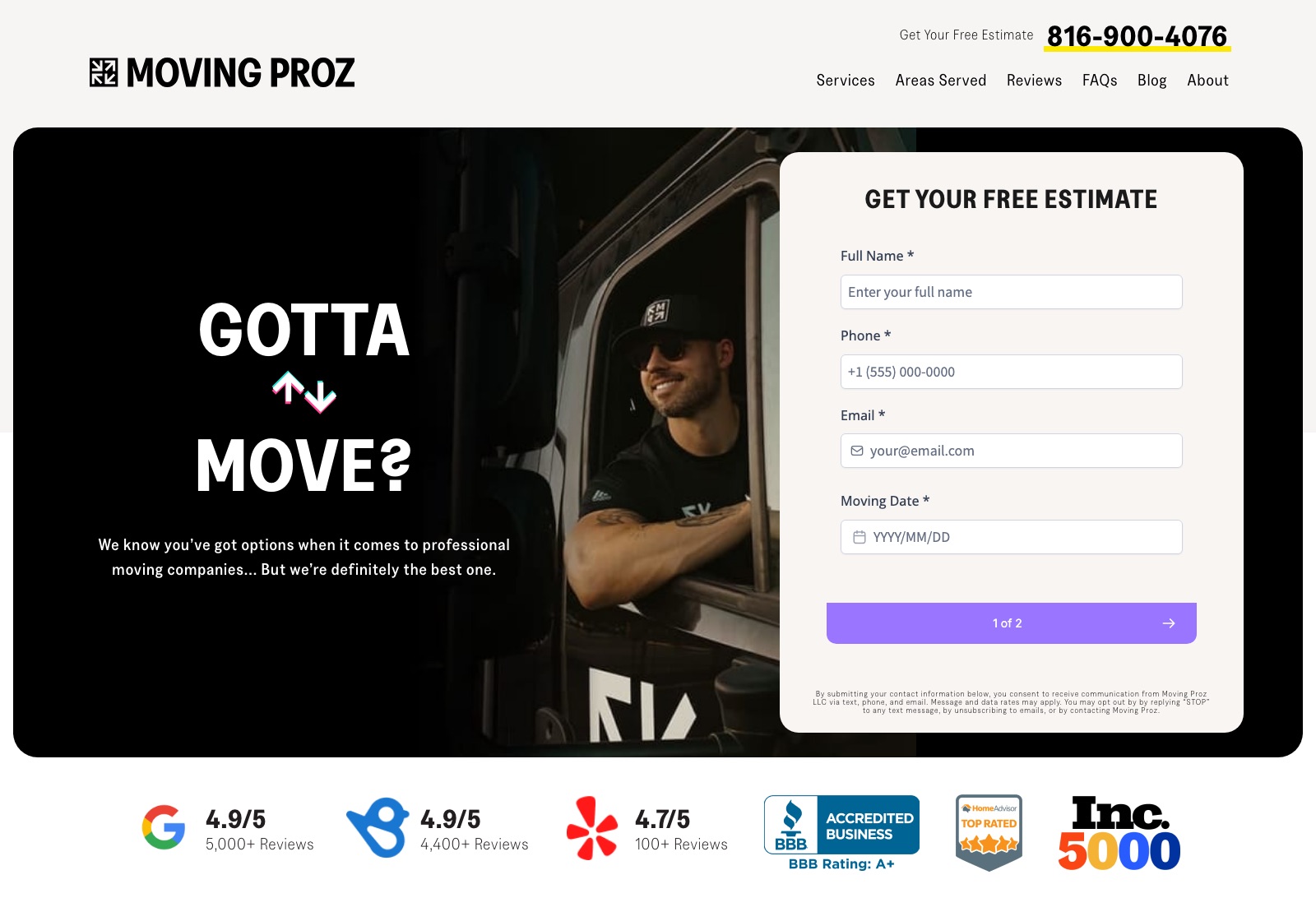
Copy the row. Put your rating and review count where the quote form is, so a buyer checking you never has to leave the page to do it.
The estimate rules buyers are told to check
For interstate moves, federal rules in 49 CFR Part 375 set what an estimate must say. We read them on Cornell's copy of the regulations:
- A binding estimate must be in writing. Once the goods are loaded, you "may not collect more than the amount of the original binding estimate," with listed exceptions.
- A non-binding estimate must be free, in writing and "reasonably accurate". It must state that the customer will not pay more than 110 percent of it at delivery.
- You must survey the goods before you estimate, unless the customer waives the survey in writing before loading.
- You must give each customer "Ready to Move?" and "Your Rights and Responsibilities When You Move". A mover with a website must link the first one prominently.
- Every ad must show your USDOT number in the form "U.S. DOT No." followed by the number.
Moves inside one state follow your state's rules instead. Where the DOT number and state permit go on the site is covered in our SEO guide.
The marketing use is plain. The ATA Moving and Storage Conference's April 30, 2026 release tells consumers to "Get at least three in-home estimates" and to beware of "too-good-to-be-true" prices. Say which estimate you give, binding or non-binding, on the quote form itself.

Copy the short list. Plain promises next to the headline answer what a buyer asks before the price. Use your own: the estimate type you give, your license and what you do if the crew runs late.
Realtors, apartments, senior living and offices send moves before anyone searches
Partners see a move coming weeks out. Nextdoor's report says 93 percent of its neighbors who bought or sold a home worked with a real estate agent. Agents, leasing offices and senior living staff all hear about a move before the customer types "movers near me".
Shleppers prints its partner terms. It pays brokers who refer a first-time customer 10 percent of a local move and 5 percent of a long-distance or international one. The referral has to arrive within seven days of the company's first contact with the customer.
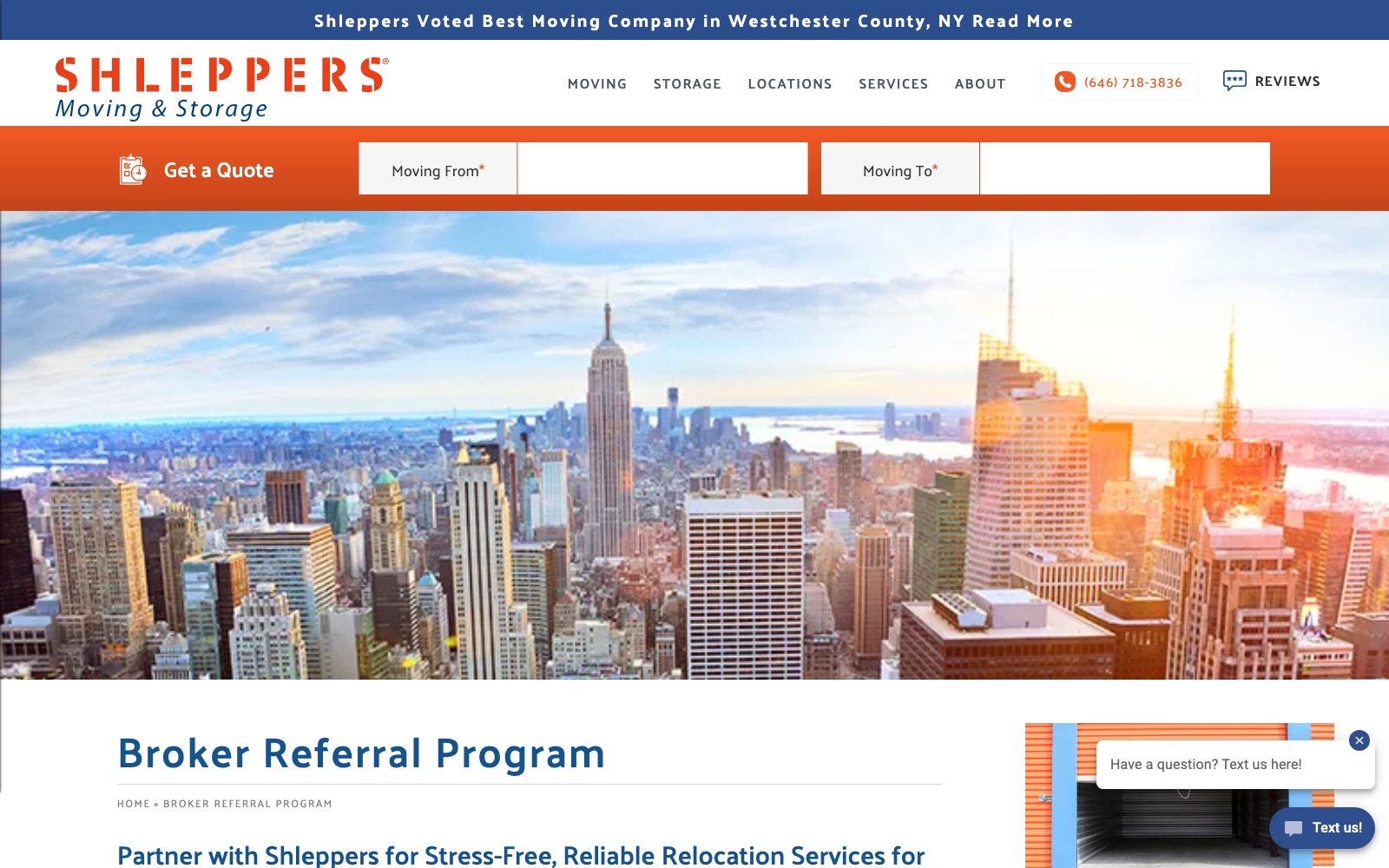
Copy the structure and set your own rate. A page of its own, a fee in writing and a rule for who gets credit prevent arguments later. Pay the fee only on booked moves, and set it against your margin.
These are the partners worth a call, with the US searches a month for the job each one sends:
- Real estate agents: buyers and sellers, about a month before the move. Give each agent a link that carries their name.
- Apartment leasing offices: renters moving in and out. "Apartment movers" draws 5,400 searches at $25.13 a click.
- Senior living communities: families planning a downsize. "Senior movers" draws 2,400 and "senior move management" 1,900.
- Storage facilities and other movers: jobs too big or too far for their own crews.
- Office managers: "office movers" draws 5,400 and "corporate relocation" 720. The work is steadier, and every job needs a site visit.
A name that tells an office manager you move offices helps with the last group. Our moving company names guide covers it. The job here is the referral itself: a named contact, a fee in writing and a thank-you after every booked move.
Past customers move again: more than one in ten every year
The Census Bureau's American Community Survey puts the share of people who moved in 2025 at 11.6 percent. If your past customers move like everyone else, a list of 1,000 of them holds about 116 moves this year.
That list is the cheapest one you own. SmartMoving's survey found email marketing in use at 46 percent of its top movers, against 33 percent of movers overall. A routine you can copy:
- Move day. Text the review link before the crew leaves.
- One week later. Email a thank-you with a referral offer they can pass to a friend.
- Every move anniversary. A short note with your number and nothing else.
- Each winter. Remind past customers and partner agents that people book about a month ahead, and that winter dates are open.
Google, Yelp and Nextdoor ads: what each one buys a mover
Local Services Ads
Google's Local Services Ads help page lists "Moving services" among its categories. You "pay only for leads related to your business and the services you offer", and eligibility depends on your area. Google prints no price.
Two changes matter now. Google says Local Services Ads are moving into Google Ads as a Performance Max campaign type, starting with select US home service advertisers in August 2026. Manual bidding, such as a maximum cost per lead, "is no longer supported in Google Ads."
No study we read prints a moving cost per lead. The 99 Calls estimator tracks charged leads by trade from its client campaigns and has no moving row. Set a budget you can afford to test for a month. Our Local Services Ads cost guide covers the bidding.
Google Ads
Google Ads charges per click, and moving clicks are expensive. 99 Calls, a company that sells leads and runs ads for contractors, prints what businesses paid per Google Ads moving lead:
- $49 a lead at the 10th percentile, or $126 per booked move at a 39% close rate.
- $245 a lead at the 90th percentile, or $628 per booked move.
LocaliQ's home services benchmarks, built from 3,211 search campaigns, put the median conversion rate at 7.33 percent, with no moving category. Our arithmetic at that rate turns a $25.96 "local movers" click into a $354 lead.
That estimate sits above the top of the 99 Calls range, so the two sources disagree. Either way, Google Ads costs the most per booked move of any channel here unless your quote page converts well. Agencies charge for management on top:
- Movers Development: $700 a month plus 10% of ad spend, with a $3,000 minimum budget.
- Muon Marketing: $97 a month per ad channel, plus a one-time $349 setup.
Our Google Ads cost guide covers budgets and bidding for any trade.
Yelp Ads
Yelp's ads page says you can "spend as little as $5 a day on average", and self-serve advertisers sign no term contract. It prints no price per click.

Yelp is a smaller door for movers than Google. In Nextdoor's report, 17 percent of recent movers used Yelp to find local businesses, against 59 percent for Google. BrightLocal found 24 percent of consumers wrote a Yelp review in the past year.
Run it for a month at the minimum and count booked moves before you raise it. Our Yelp ads cost guide has the rest.
Nextdoor
Nextdoor's Business Page is free. Its 2022 budget page suggests ads at $3 to $10 a day.
Its current ads page charges the daily budget times 30 up front and renews each month until you cancel. A month runs $90 to $300.
The timing suits a mover. Nextdoor's report says activity among movers spikes the week of the move and stays high for about eight weeks. Ask each customer for a Nextdoor recommendation while they are still posting about the new house. Our Nextdoor ads cost guide has the billing details.
A moving company marketing budget for one truck and for five
No source we read publishes what a mover of a given size spends on marketing. So here are two example budgets, built line by line from prices printed today. Change the quantities and keep the order.
| Line | One truck | Five trucks | Printed by |
|---|---|---|---|
| Google Business Profile and reviews | $0 | $0 | Google, free |
| Past-customer email | $0 | $0 | Your own list |
| Hosted website | $99 | In the agency plan | 99 Calls |
| Agency plan: site, reviews, local posts | None | $950 | Muon Marketing, Foundation |
| Nextdoor ads | $150, at $5 a day | $300, at $10 a day | Nextdoor |
| Shared leads | $150, 10 at $15 | None | Network Leads |
| Referral fees, paid on booked moves | $118.60, 2 moves | $889.50, 15 moves | Shleppers' 10% on a $593 move |
| Exclusive leads | None | $900, 20 at $45 | Network Leads |
| Google Ads test | None | $519.20, 20 clicks at $25.96 | DataForSEO click price |
| Local Services Ads | Set your own | Set your own | Google prints no price |
| Total a month | $517.60 | $3,558.70 | Before Local Services Ads |
The one-truck plan buys reach in the streets you already work, two partner referrals and a few leads for open days. The five-truck plan hands the site and reviews to an agency, pays for more referrals and exclusive leads, and keeps Google Ads to a small test.
The referral line is a forecast, since you pay it only when a move books. In the five-truck plan the agency, the referrals and the leads each take about a quarter. Drag your own budget below to split it the same way.
On Thumbtack's $593 average, the one-truck plan costs less than one move's revenue and the five-truck plan about six. What that costs in profit depends on your margin, and no source we read publishes one for movers.
What to do this month, while winter searches run as high as summer's
Winter carries as many hiring searches as summer, and the industry's payrolls are at their yearly low. Seven steps for the next four weeks:
- Reviews. Text the review link to every customer you moved since September, so your newest review is weeks old by January.
- The quote form. Name the estimate you give, binding or non-binding, and put your USDOT number beside it.
- Partners. Call five real estate offices and three apartment leasing offices with a one-page referral offer and a fee in writing.
- Nextdoor. Claim the free Business Page and ask your last ten customers for a recommendation.
- Local Services Ads. Check eligibility for your service area and set a test budget for January.
- Tracking. Start a sheet with the source of every booked move. SmartMoving's survey found 60% of movers track profit per job.
- Labor-only page. Publish it before spring, priced by the hour, for the summer truck renters.
What to ask a moving company marketing agency before you sign
Two agencies that sell marketing for moving companies, read today, print prices from Muon Marketing's $299 a month to Movers Development's $1,800 a month for SEO. Our moving company SEO guide compares more of them. We sell this work too: Skill Mammoth plans start at $350 a month. Ask any of us these questions:
- Who owns the website, the Google profile and the ad accounts if I leave? Movers Development's page says you own them, which is the answer to look for.
- How long is the commitment? Movers Development asks for six months. Muon Marketing runs month to month with 14 days' notice.
- Is ad spend inside the fee or on top, and is there a minimum?
- Do you work for another mover in my area?
- Will the report show booked moves by source, or only clicks and calls?
- What will you do in December and January, when searches hold up and payrolls are at their low?
- Will my USDOT number and estimate type appear on every page and ad?
Three to skip
- Google Ads before the quote page converts. At LocaliQ's median home services conversion rate, our arithmetic turns a $25.96 click into a $354 lead. Fix the page and the reviews first.
- Paid or rewarded reviews. The FTC's 2024 rule bans buying them and offering perks tied to a positive one. Ask on every move instead.
- A marketing push that stops in September. Searches to hire a mover put as much of their year into November through February as into the summer months. Stopping in the fall misses a third of them.
Not sure which channel to start with this winter?
Booking a call with us is one option. We build websites and run marketing for contractors and home service businesses, with plans from $350 a month and a website build at $3,000 or $150 a month for 24 months. The first four channels in the ranking above also work without us.
Frequently asked questions
What is the best marketing for a moving company?
The channels you own pay first: a Google Business Profile that gets a review on every move, past customers and referrals from realtors and apartment managers. They cost $0 to start. Paid channels come next. Prices printed on November 28, 2026 run from a $15 shared lead at Network Leads to a $245 Google Ads lead, the 90th percentile 99 Calls prints.
How much should a moving company spend on marketing?
No source we read publishes a figure for movers. Built from printed prices, a one-truck plan with a hosted website, Nextdoor ads, two referral fees and ten shared leads comes to $517.60 a month. A five-truck plan with an agency, fifteen referral fees, exclusive leads, Nextdoor and a small Google Ads test comes to $3,558.70. On Thumbtack's $593 average move, that is under one move and about six moves of revenue.
Can moving companies use Google Local Services Ads?
Yes, where Google offers them in your area. Google's help page lists Moving services as a category and charges per lead, with no printed price. From August 2026 Google is moving Local Services Ads into Google Ads as a Performance Max campaign type, and manual bidding, such as a maximum cost per lead, is no longer supported there.
When is the busy season for moving companies?
Summer, for the moves. A Census Bureau working paper on its 2008 survey panel found June the most popular month at about 11 percent of moves, and BLS counted 18 percent more mover payroll jobs in June 2026 than in January. Searches to hire a mover do not follow: seven hiring terms put 32.8 percent of their year into May through August and the same share into November through February.
How do realtor referral programs for movers work?
The mover pays an agent a fee on each referred move that books. Shleppers, a New York mover, prints its terms: 10 percent of a local move and 5 percent of a long-distance or international one, for first-time customers, with the referral sent within seven days of first contact. On a $593 local move, 10 percent is $59.30.
What should a moving company ask a marketing agency?
Ask who owns the website, the Google profile and the ad accounts if you leave, how long the commitment runs and whether ad spend sits inside the fee. Ask whether they work for another mover in your area, and whether the monthly report shows booked moves by source. Movers Development asks for six months, and Muon Marketing runs month to month.