TL;DR
The three tools charge for three different things. Zapier bills per action step (a task), Make bills per module that runs (a credit), and n8n bills per workflow run no matter how many steps it has (an execution). For a shop running 1,500 four-step automations a month, that is $89 to $133.50 on Zapier, $12 to $16 on Make, and $20 to $24 on n8n Cloud, all read from the vendors' pricing pages on October 29, 2026. Zapier wins on contractor apps: Jobber, Housecall Pro, ServiceTitan, JobNimbus, AccuLynx and Workiz are all native. Make has ServiceTitan and JobNimbus native and Housecall Pro only as a community app. n8n has none of the six as official nodes. Pick Zapier if your CRM is Jobber or Housecall Pro and you value your evenings; Make if you run ServiceTitan or JobNimbus and want ten times the volume for the price; n8n if someone on your team can run a server, or you are paying us to.
Every contractor who automates anything ends up at this fork. The missed call needs to become a text, the signed proposal needs to become a QuickBooks invoice, the finished job needs to become a review request, and some tool has to carry the data between apps. Three tools dominate: Zapier, Make and n8n. We use all three for clients, we pay for all three, and the right answer depends on one question most comparisons skip, which is what your field service software actually connects to. The prices below are from each vendor's pricing page on October 29, 2026, with the billing toggle noted, because two of the three publish different numbers on different pages of their own sites.
The only difference that matters is the billing unit
Forget the feature grids for a minute. Each tool meters a different thing, and that decides the bill more than the plan name does.
| Tool | Unit | What one unit means | A four-step run costs |
|---|---|---|---|
| Zapier | Task | One successful action step. Triggers, filters, formatters and delays are free. An errored step is free. | 3 tasks (trigger plus three actions) |
| Make | Credit | One module that runs, trigger included. Routers and error handlers are free. AI modules cost more. | 4 credits |
| n8n | Execution | One run of the whole workflow, "regardless of complexity." If it does not run, you do not pay. | 1 execution |
| Verdict | Long workflows punish Zapier and reward n8n. Short, high-volume workflows are cheapest on Make. | ||
Two traps hide in that table. On Make, a scheduled trigger that polls every 15 minutes spends a credit every time it checks, even when nothing is new, which is how a scenario with no work to do burns 2,880 credits a month. Use webhooks where the app offers them. On Zapier, an iterating step that creates 40 line items spends 40 tasks, and a Zapier MCP tool call spends two. On n8n a workflow that runs every five minutes counts about 8,600 executions a month whether or not it finds anything, by n8n's own FAQ, so the "one execution" rule cuts both ways on polling.
What each one costs on October 29, 2026
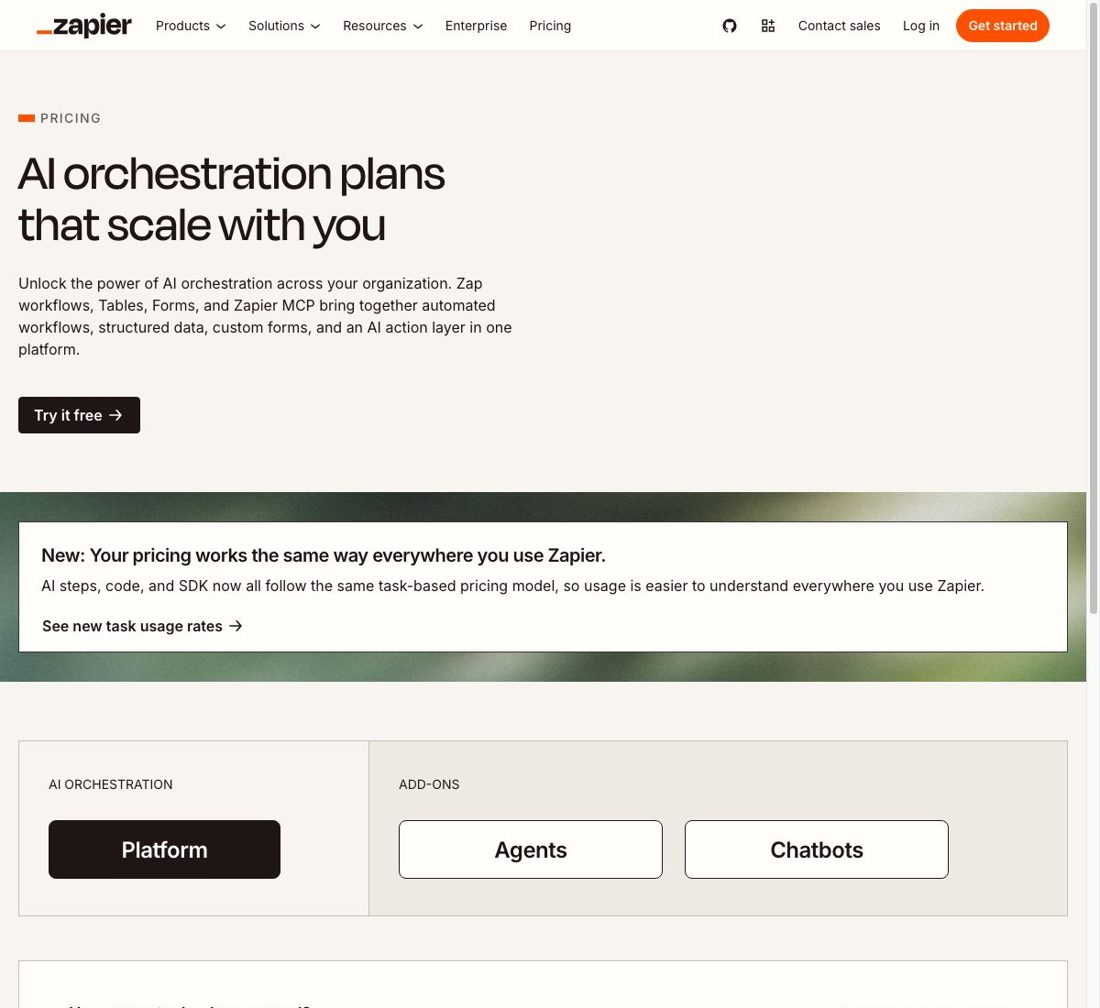
| Plan | Billed annually | Billed monthly | Volume included | Notes |
|---|---|---|---|---|
| Zapier Free | $0 | $0 | 100 tasks | Two-step Zaps only, 15-minute polling, one user |
| Zapier Professional | $19.99 (750 tasks) to $129 (10,000) | $29.99 to $193.50 | 750 to 10,000 tasks, higher tiers available | Multi-step, 2-minute polling, premium apps, one user |
| Zapier Team | $69 (2,000 tasks) to $169 (10,000) | $103.50 to $253.50 | 2,000 to 10,000 tasks and up | 25 users, 1-minute polling, shared connections, SSO |
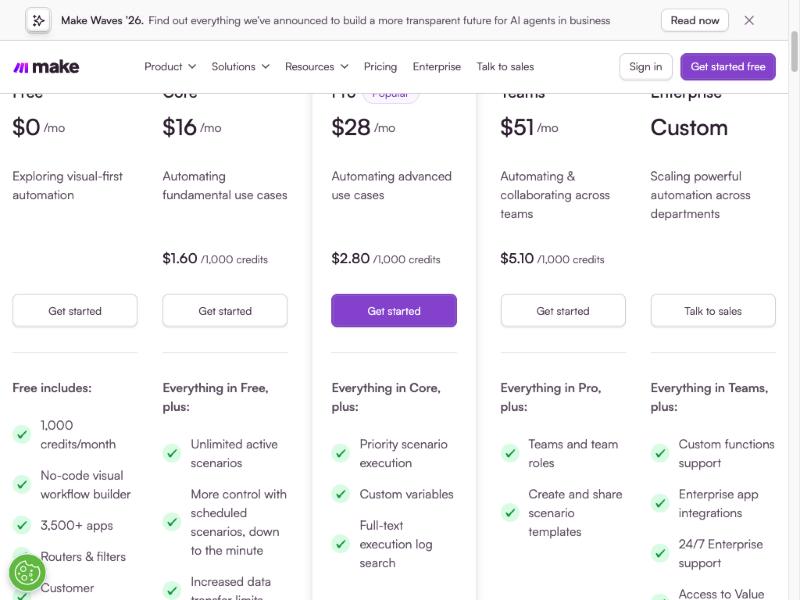
| Make Free | $0 | $0 | 1,000 credits | 15-minute minimum interval |
| Make Core | $12 | $16 | 10,000 credits | 1-minute interval, unlimited active scenarios; $1.20 per extra 1,000 credits on annual |
| Make Pro | $21 | $28 | 10,000 credits | Priority execution, custom variables, bring your own AI key |
| Make Teams | $38 | $51 | 10,000 credits | Team roles and shared templates |
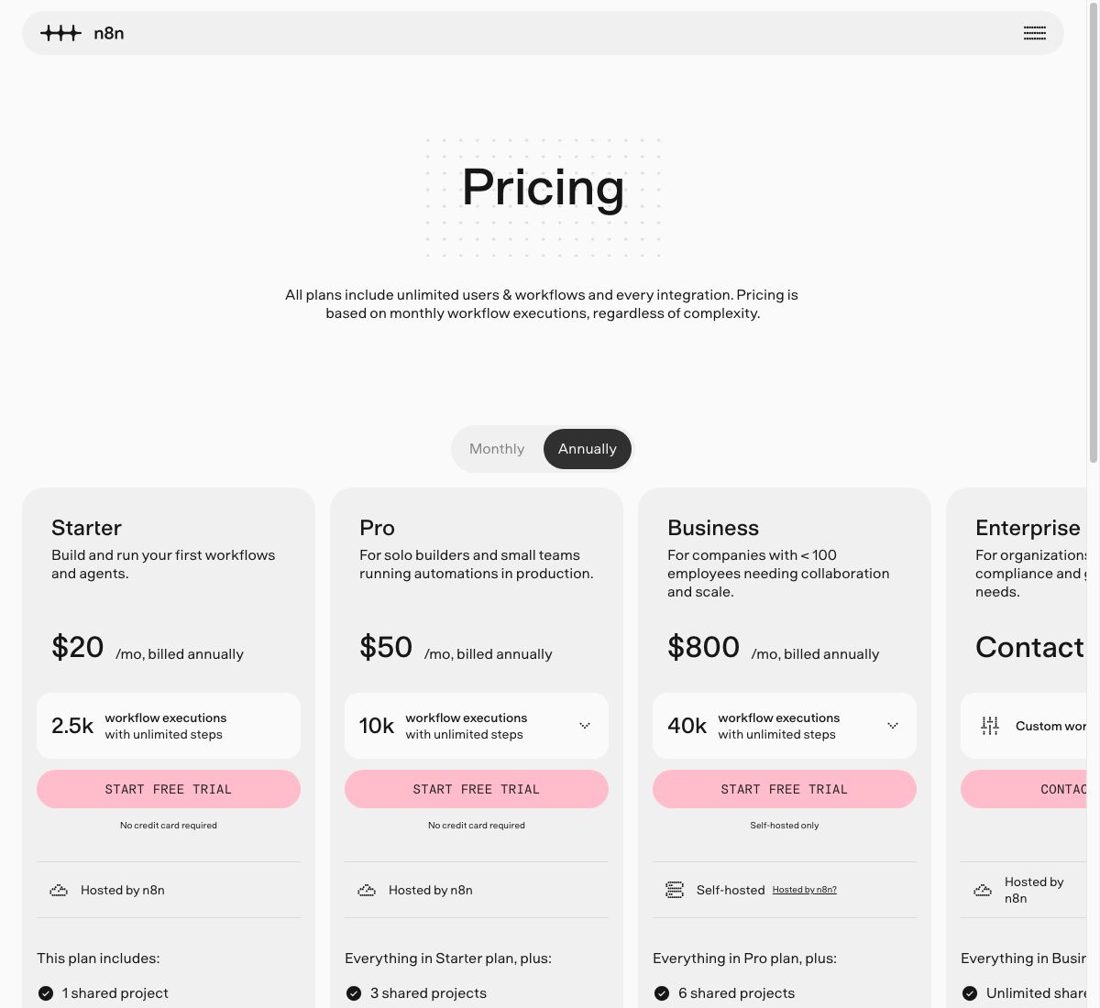
| n8n Starter | $20 | $24 | 2,500 executions | Unlimited users and steps, 5 concurrent runs, hosted in Frankfurt |
| n8n Pro | $50 | $60 | 10,000 executions | Up to 50 concurrent, 30 days of logs, admin roles |
| n8n Community Edition | $0 | $0 | Unlimited | Self-hosted on your own server; license allows internal business use |
| Verdict | Make is the cheapest hosted plan by a wide margin at the same volume. Zapier is the most expensive and the only one that connects to every contractor CRM out of the box. | |||
Overage rules differ too. Zapier lets Zaps keep running at a higher per-task rate up to three times your plan, then stops them. Make sells extra credits and expires unused ones at the end of the term. n8n keeps workflows running past the quota and bills a capped overage. None of the three will quietly run you into a four-figure bill, but Zapier is the one where a runaway loop costs the most before it hits the ceiling.
The worked example: 1,500 automations a month
Take a plumbing company that runs one real workflow 1,500 times a month: a Jobber job closes (trigger), the customer gets a review-request text, a row lands in a Google Sheet, and the office gets a Slack message. Four steps.
| Tool | Units used | Plan it lands on | Monthly cost |
|---|---|---|---|
| Zapier | 4,500 tasks (three paid actions per run) | Professional, 5,000-task tier | $89 annual, $133.50 monthly |
| Make | 6,000 credits (four modules per run) | Core, 10,000-credit tier | $12 annual, $16 monthly |
| n8n Cloud | 1,500 executions | Starter, 2,500 executions | $20 annual, $24 monthly |
| n8n self-hosted | 1,500 executions | Community Edition | $0 plus a $6 to $20 server |
At ten times the volume the gap widens. 15,000 runs is 45,000 Zapier tasks, which is past the 20,000 tier and into pricing the page does not print at the top level; 60,000 Make credits, which is Core at 60,000 credits (roughly $72 on annual billing at the $1.20 rate); and 15,000 n8n executions, which is Pro at $50 to $60. But the Make price assumes Jobber connects, and it does not.
Which one actually connects to your CRM
This is the table that decides it for most contractors, and no vendor publishes it. "Native" means the vendor maintains the app or node. "Community" means someone else built it and the vendor does not support it. "Not listed" means you are on the HTTP module and reading API docs, which is fine for us and a bad weekend for you.
| App | Zapier | Make | n8n |
|---|---|---|---|
| Jobber | Native (premium app) | Not listed | Not listed; three community nodes on npm |
| Housecall Pro | Native (premium) | Community app only | Not listed |
| ServiceTitan | Native | Native | Not listed; one community node |
| JobNimbus | Native (premium) | Native, 3 triggers and 7 actions | Not listed; one community node |
| AccuLynx | Native | Not listed | Not listed; one community node |
| Workiz | Native (premium) | Not listed | Not listed |
| QuickBooks Online | Native (premium) | Native, 74 actions | Native |
| GoHighLevel | Native, as LeadConnector | Native | Native, as HighLevel |
| Google Sheets | Native | Native | Native |
| Twilio | Native | Native | Native |
| Verdict | Jobber and Housecall Pro shops: Zapier, full stop. ServiceTitan and JobNimbus shops: Make is the value play. n8n is for the shop with a builder on staff. | ||
"Premium app" on Zapier means a paid plan, which every contractor needs anyway for multi-step Zaps. The practical reading: Zapier's real price for a Jobber shop is $19.99 to $89 a month, and that buys you the only officially supported Jobber connection among the three. We cover the CRM side of this in Jobber reviews and QuickBooks CRM integration.
Want it wired without learning three tools?
Fix one thing from $1,000, scoped up front and done in 2 to 4 weeks, or the Systems Sprint at $2,500 a month for three months. You own every workflow we build.
AI agents inside each tool
All three now sell an "agent" layer, and all three meter it differently. Zapier Agents is a separate product: free for 400 activities a month, then $33.33 a month on annual billing for 1,500, with Copilot and MCP drawing from your task pool at two tasks per MCP call. Make AI Agents are available on every plan, but using your own AI key with them needs Pro or higher, and AI modules cost more than one credit. n8n includes the AI Agent node, MCP server and client, and human-approval steps from Starter up, built on LangChain, which is the most capable of the three if you can build it and the easiest to break if you cannot. For a contractor the honest use today is narrow: an agent that reads an inbound email, decides whether it is a lead, and creates the CRM record. Our AI agents for business post covers what is real and what is a demo.
Three things to skip
Skip n8n self-hosting if nobody on staff has run a server. The Community Edition is free under n8n's Sustainable Use License for your own business, and that is a real saving, but a $6 VPS that nobody patches is how your review-request workflow silently stops in March. Skip Make's Free plan for anything scheduled; 1,000 credits is 250 four-step runs or one polling trigger for ten days. And skip Zapier's pay-per-task overage as a safety net; turn it off and let the Zap pause, because a looping Zap at the metered rate is the most expensive mistake on this page.
Which one to pick, by shop
One to three trucks on Jobber or Housecall Pro. Zapier Professional at the 750-task tier, $19.99 a month on annual billing. Start with missed-call text back and the review request; both fit inside 750 tasks.
Five or more trucks on ServiceTitan or JobNimbus. Make Core or Pro. Both CRMs are native, the volume is ten times cheaper than Zapier, and the one-minute interval covers lead response. Use webhooks, not scheduled polling.
Anyone with a developer, or an agency on retainer. n8n, hosted at $20 or self-hosted at $0. Unlimited users and steps, a code step in JavaScript or Python on every plan, and the only one of the three you can run inside your own network. This is what we run our own back office on and what the Systems Sprint hands you at the end, with the keys.
If the honest answer is "I do not want to learn any of them," that is the point at which an AI automation agency earns its fee, and the scoped build should still leave you owning the workflows.
Frequently asked questions
Is n8n cheaper than Zapier?
Almost always, because n8n charges per workflow run and Zapier charges per action step. The same 1,500 four-step runs a month cost $20 to $24 on n8n Cloud and $89 to $133.50 on Zapier, on October 29, 2026 prices. Self-hosted n8n is free under its license for your own business.
Is Make cheaper than Zapier?
Yes, by a wide margin at the same volume. Make Core is $12 a month on annual billing or $16 monthly for 10,000 credits; Zapier's 10,000-task Professional tier is $129 or $193.50. The catch is that Make has no native Jobber, Housecall Pro, AccuLynx or Workiz app.
Does Zapier work with Jobber?
Yes. Jobber is a native Zapier app, flagged premium, so it needs a paid plan from $19.99 a month. Make does not list Jobber, and n8n has only community-built nodes.
Does n8n work with Housecall Pro or ServiceTitan?
Not officially. Neither has an n8n node as of October 29, 2026. ServiceTitan has a community node on npm and an open feature request; Housecall Pro has neither, so you connect through the HTTP Request node and the Housecall Pro API.
What counts as a task, a credit and an execution?
A Zapier task is one successful action step; triggers, filters and formatters are free. A Make credit is one module that runs, including the trigger, with routers and error handlers free. An n8n execution is one run of the whole workflow regardless of steps.
Can I self-host Make or Zapier?
No. Neither offers a self-hosted edition. n8n's Community Edition runs on your own server under the Sustainable Use License, and its Business plan ($800 a month billed annually) is a license key for self-hosted instances.
Which is best for a small contractor?
Zapier if your CRM is Jobber, Housecall Pro, AccuLynx or Workiz, because it is the only one with native connections to all four. Make if you run ServiceTitan or JobNimbus and want the lowest bill. n8n if someone will own the server.
Not sure what to automate first?
The free AI readiness scorecard takes 20 questions and tells you which of your five areas is leaking the most time, and whether a $20 Zap or a built system is the fix.