TL;DR
After-hours coverage is a different purchase from a full-time receptionist, and pricing it like one is how contractors overpay. You are buying 128 standby hours a week to catch maybe a quarter of your call volume, which means per-minute plans win and per-seat plans lose. Specialty Answering Service publishes the cleanest ladder at $44 a month plus $1.54 a minute with nothing included, rising to $269 for 220 minutes. ReceptionHQ starts at $25 a month plus $1.99 per call answered. An AI receptionist like Rosie covers the same hours for $49. Settle your on-call rotation before you shop, because no vendor can fix a rotation that does not exist.
A trade business runs on a 168-hour week. An office that answers the phone from eight to five, Monday through Friday, covers 45 of them. The other 123 hours go to voicemail, and that is where the whole after-hours conversation starts.
Here is the part the vendor pages leave out. Those 123 hours are 73 percent of the week, but they generate nowhere near 73 percent of your calls. For most residential trades the after-hours share lands somewhere between 20 and 35 percent of total volume. You are buying three quarters of the clock to catch a quarter of the calls, and the pricing model you pick decides whether that is cheap or ruinous.
The hours you are actually buying
Run your own numbers before you take a quote. A five-truck company taking 150 calls a month, with 30 percent of them outside office hours, is looking at 45 after-hours calls. At a four-minute average that is 180 minutes. One hundred eighty minutes spread across 123 hours a week.
That ratio is why after-hours is the one case where per-minute billing is on your side. A live receptionist priced per seat or per month of availability charges you for the standby. A per-minute service charges you for the 180 minutes and nothing else. The standby is free because the operator is sitting on someone else's calls the rest of the night.
Pro tip
Pull your call log before you shop, not after. Most VoIP systems and every mobile carrier will export inbound calls with timestamps. Sort by hour and you will know your real after-hours percentage in ten minutes, which turns every quote you receive into arithmetic instead of a guess.
What after-hours coverage costs in 2026
Every figure below came off the vendor's live pricing page in September 2026. The effective column assumes 180 after-hours minutes a month, which is the five-truck example above.
| Service | Entry | How it bills | Cost at 180 minutes |
|---|---|---|---|
| Specialty Answering Service | $44/mo, 0 minutes included | $1.54/min on Economy, $1.44 above that | About $321 on Economy, $269 on the 220-minute plan |
| ReceptionHQ | $25/mo | $1.99 per call answered, message taking | About $115 for 45 calls |
| PATLive | $99 for 50 minutes | Per minute, $2.09 to $2.99 overage | $349 on the 200-minute plan |
| Posh | $130 for 50 minutes | Per minute, $2.10 to $2.30 overage | $420 on the 200-minute plan |
| Rosie (AI) | $49 for 250 minutes | Flat, minutes included | $49 |
| Verdict | ReceptionHQ is the cheapest live option if message taking is enough. Specialty publishes the most honest ladder for real conversations. Rosie undercuts every live service by a factor of five and never sleeps. | ||
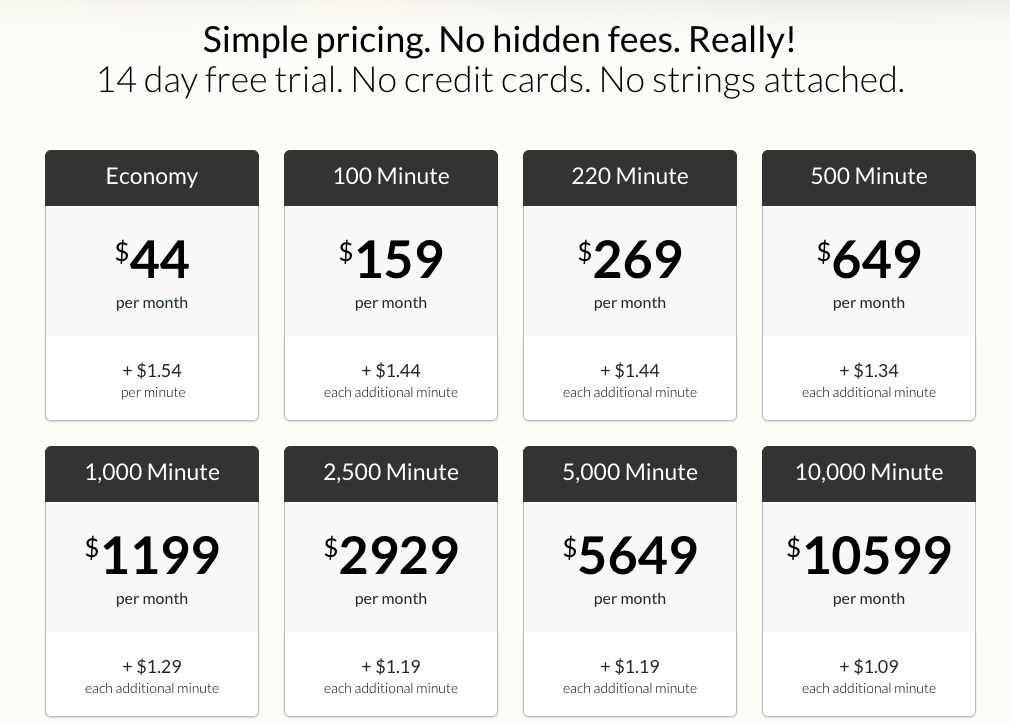
That page is worth looking at for a second reason. Specialty runs a 14-day trial capped at 200 minutes with no credit card, which is roughly one month of after-hours volume for the company in our example. You can measure your actual usage on their dime before you pick a tier.
Who will not show you a price
AnswerForce publishes plan names and a "See Prices" button that routes to a registration form. Nexa lists three tiers by voice minutes, Nexa 100, Nexa 300 and Nexa 500, with no dollar figure anywhere and a Get Started button that opens a contact form. AnswerConnect uses a quote form; third-party reports put it near $325 for 200 minutes.
Quote-only pricing is defensible when implementation varies by an order of magnitude. It is a negotiating position on a product that bills in minutes. ReceptionHQ, to its credit, says the quiet part on its own pricing page: most providers charge $100 to $350 at entry level, and it starts at $25.
Not sure how many calls you are actually missing?
We will pull your call data and tell you what after-hours is costing you before you sign with anyone. No charge for the look.
Per minute or per call, after dark
The billing unit matters more after hours than it does during the day, because the call mix is different. Daytime calls include suppliers, schedulers and people confirming appointments. Night calls skew toward two extremes: a genuine emergency that will take six minutes to qualify properly, or a wrong number that takes twenty seconds.
Per-call pricing charges the same for both. At ReceptionHQ's $1.99 that hardly matters. At Smith.ai's $8.50 to $11.50 a call it matters a great deal, because every robocall that reaches a human is a line item.
Per-minute pricing charges you for the twenty-second wrong number at twenty seconds, which is the right answer, and charges you properly for the six-minute emergency, which is also the right answer. Ask any vendor you are considering whether they bill in one-minute or six-second increments, and whether hold time and transfer time count. The answers vary and they change the bill by 20 percent.
Three things to settle before you sign
An answering service is a switchboard with a script. It cannot invent the things below, and every bad experience we have seen traces back to one of them being undefined.
Who is on call, and on what rotation. The service reaches a human or it does not. If your rotation is "whoever picks up," you will pay for a service that leaves voicemails on three phones at 2am. Write the rotation down, give the service the escalation order, and give it a fallback number that always answers.
What counts as an emergency at your company. No heat in January is not the same as a dripping faucet, and the operator has no way to know your threshold. Give them three or four concrete examples in each bucket. Vague scripts produce either a tech woken up for nothing or a real emergency sitting in a message queue until morning.
Who quotes the after-hours rate. Someone has to tell the caller that a 1am visit carries a premium. If the operator does it, they need the number and the exact wording. If the tech does it on arrival, you will eat cancellations at the door. Decide, then script it.
The overflow product is not the same product
Vendors sell after-hours and daytime overflow from the same page, and they solve different problems. Overflow catches the second and third caller while your office is on the line, which is a capacity problem you can also fix by hiring. After-hours catches the only caller there is, at a time when nobody is there to hire.
If you buy overflow when you needed after-hours, your nights stay uncovered. If you buy 24/7 coverage when your daytime office is already answering, you are paying a live service to duplicate work your staff already does well. Most contractors want nights, weekends and holidays only, which is a narrower and cheaper ask than the quotes usually assume. Say so explicitly when you ask.
What voicemail actually costs
Work the other side of the ledger before you decide anything. Take the five-truck company above: 45 after-hours calls a month, a $450 average ticket, and a 45 percent close rate on calls that get booked live.
in monthly revenue sitting in 45 unanswered after-hours calls at a $450 ticket
Roughly 20 of those 45 calls should become jobs. Against that, a $115 to $349 monthly bill is not a close decision. The decision only gets interesting below about a $150 ticket, where the margin on a single job stops covering a meaningful share of the subscription. A carpet cleaner at $180 a job and a commercial mechanical contractor at $4,000 a call are not making the same purchase.
One caution on that arithmetic. It only holds if the calls you answer at night get worked in the morning, and plenty do not. A booked slot nobody confirms turns into a no-show, which is the same lost job with an extra bill attached. Our lead follow-up system guide covers the confirmation step that protects the number above.
The cheaper first move, if you are not ready to pay anyone, is an automatic text on every missed call. Our missed call text back guide prices that across GoHighLevel, Podium, Weave, Jobber and Twilio, and it starts around $30 a month. It does not book anything, but it stops the caller dialling the next company while they wait.
Three to skip
Offshore services priced under a dollar a minute. The saving is real and so is the reason for it. Home service calls turn on local knowledge, and a caller who has to repeat their street name twice has already decided about you.
Any plan where appointment booking is an add-on you did not price. Smith.ai lists it at $1.50 a call on top of the per-call rate. If booking is the entire reason you are buying, put it in the comparison before you sign rather than after.
A 24/7 contract when you need nights and weekends. The coverage window is negotiable at almost every vendor on this page, and nobody volunteers that.
We build the follow-up, not just the phone answer
Answering the call is step one. Booking it, confirming it by text and getting it onto the real dispatch board is where the job actually happens.
Frequently asked questions
How much does an after-hours answering service cost?
Between $115 and $420 a month for a typical trade company handling 45 after-hours calls. ReceptionHQ is the cheapest live option at $25 a month plus $1.99 per call answered. Specialty Answering Service runs $44 a month plus $1.54 a minute, or $269 for a 220-minute plan. An AI receptionist covers the same hours from $49.
Can I buy nights and weekends only, instead of 24/7?
Yes, and you usually should. Most services will scope the coverage window to your actual gap, but very few advertise it, so you have to ask directly. If your office already answers well from eight to five, paying a live service to sit behind those hours duplicates work you are already doing.
Is per-minute or per-call billing better for after-hours?
Per minute, in most cases. Night calls split between genuine emergencies that need six minutes of qualifying and wrong numbers that take twenty seconds, and per-call pricing charges the same for both. Ask whether the vendor bills in one-minute or six-second increments and whether hold time counts, because those two answers move the bill by around 20 percent.
Will an answering service wake up my technician?
Only if you tell it who and when. The service follows the escalation list you give it, so an undefined on-call rotation produces either nobody being reached or everybody being called. Write the rotation down, set the order, and give them a fallback number that always answers.
Should I use an AI receptionist instead after hours?
For overnight coverage the case is strong. An AI answers on the first ring at 3am with no shift premium, and Rosie starts at $49 a month for 250 minutes against $269 for a comparable live plan. The trade is handling of angry callers and anything needing judgment. Our live versus AI comparison works through where each one gives out, and there are two unedited recordings of an integrated agent taking real calls on our AI phone agent page.
Does Jobber or Housecall Pro answer calls after hours?
Jobber sells an AI Receptionist as a $29 a month add-on that answers and books inside the Jobber calendar. Housecall Pro and the other field service platforms include appointment reminders and missed-call texting rather than live answering. The Jobber pricing breakdown covers where that add-on sits against the plan tiers.