TL;DR
An answering service for contractors costs $99 to $1,725 a month for a live human plan at 2026 rates (PATLive from $99 for 50 minutes, Ruby $250 for 50 minutes up to $1,725 for 500, Posh $130 for 50 minutes, Smith.ai $300 for 30 calls), which works out to $2 to $10 a call before add-ons. AI receptionists run $29 to $349 a month for minutes-based plans (Dialzara, Goodcall) or $29 a month inside Jobber, and a fully integrated AI phone agent that books on your real calendar runs about $1,500 a month. The question that should decide it is what happens after "hello": a service that takes a message has answered the phone and lost the job, because the homeowner with water on the floor calls down the list until someone books them. Pick the option that books, and put missed-call text back behind it as the backstop.
Every contractor knows the number is bad. The widely cited 411 Locals figure puts unanswered calls to small businesses at 62 percent, and CallRail's January 2025 analysis of 1.1 million leads found a 14 percent missed-call rate in home services even among companies that had paid to generate the call. Roughly 85 percent of those callers do not call back. That is the problem an answering service is sold to fix. This piece is the honest comparison: live human services with their real 2026 prices, the AI receptionists that undercut them, what each one still misses, and the math for a plumbing or HVAC company deciding this month.
What an answering service actually does, and what it does not
A live answering service is a call center that answers in your company name, follows a script you approve, takes a message or fills in a form, and forwards urgent calls to your on-call number. It is billed by the minute or by the call, 24 hours a day. What it typically does not do is look at your schedule, quote a price, or put the job on the calendar, because the agent is answering for two hundred businesses and does not have your dispatch board open.
That gap is the whole story for a trade contractor. An HVAC company's inbound call is worth booking on the spot: the homeowner wants a time, not a callback. A message that says "Mrs. Patel, no heat, call back" delivered at 6:40 am is better than voicemail and worse than a 9:00 am appointment already on the board. Our own data from an AI phone agent deployment: $425 in booked revenue per answered call and $79,037 booked in 90 days, and almost all of that came from calls that ended with a time on the calendar rather than a note in an inbox. The full system view is in contractor lead follow-up.
Live answering services: 2026 prices
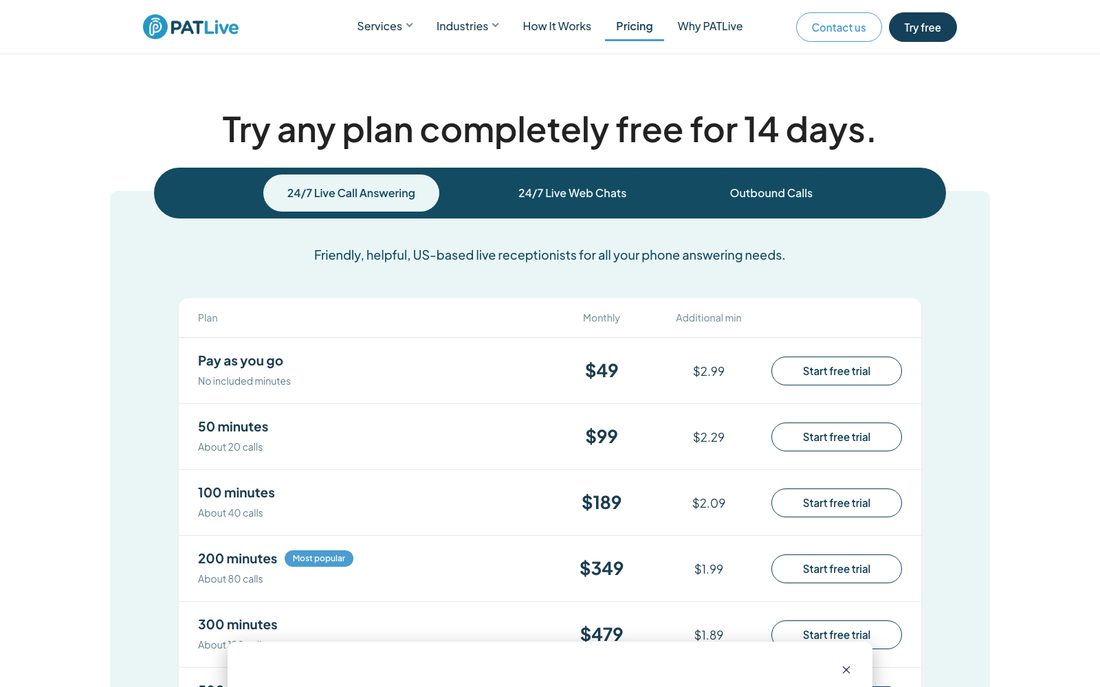
Published prices, checked in September 2026. Every vendor bills the time an agent spends on your calls, including spam and wrong numbers, unless the plan says otherwise.
| Service | Entry plan | Mid plan | Overage | Effective cost at 100 minutes |
|---|---|---|---|---|
| PATLive | $99 for 50 minutes ($49 pay as you go) | $189 for 100 minutes, $349 for 200 | $2.09 to $2.99 a minute | $189, about $1.89 a minute |
| Posh | $130 for 50 minutes ($65 with none included) | $215 for 100 minutes, $420 for 200 | $2.10 to $2.30 a minute | $215, about $2.15 a minute |
| Ruby | $250 for 50 minutes | $395 for 100 minutes, $720 for 200, $1,725 for 500 | Reported around $4.70 a minute | $395, about $3.95 a minute |
| Smith.ai | $300 for 30 calls | $810 for 90 calls, $2,100 for 300 | $8.50 to $11.50 a call | $300 buys 30 calls, so roughly $10 a call |
| AnswerConnect | Quote form only; third-party reports put it near $325 for 200 minutes | Reported | Reported $1.65 a minute | Not published, confirm directly |
| Verdict | Budget $2 to $4 a minute, or $8 to $12 a call, and expect a four-minute average. A trade company taking 150 calls a month is at $400 to $800 before appointment-booking add-ons. | |||
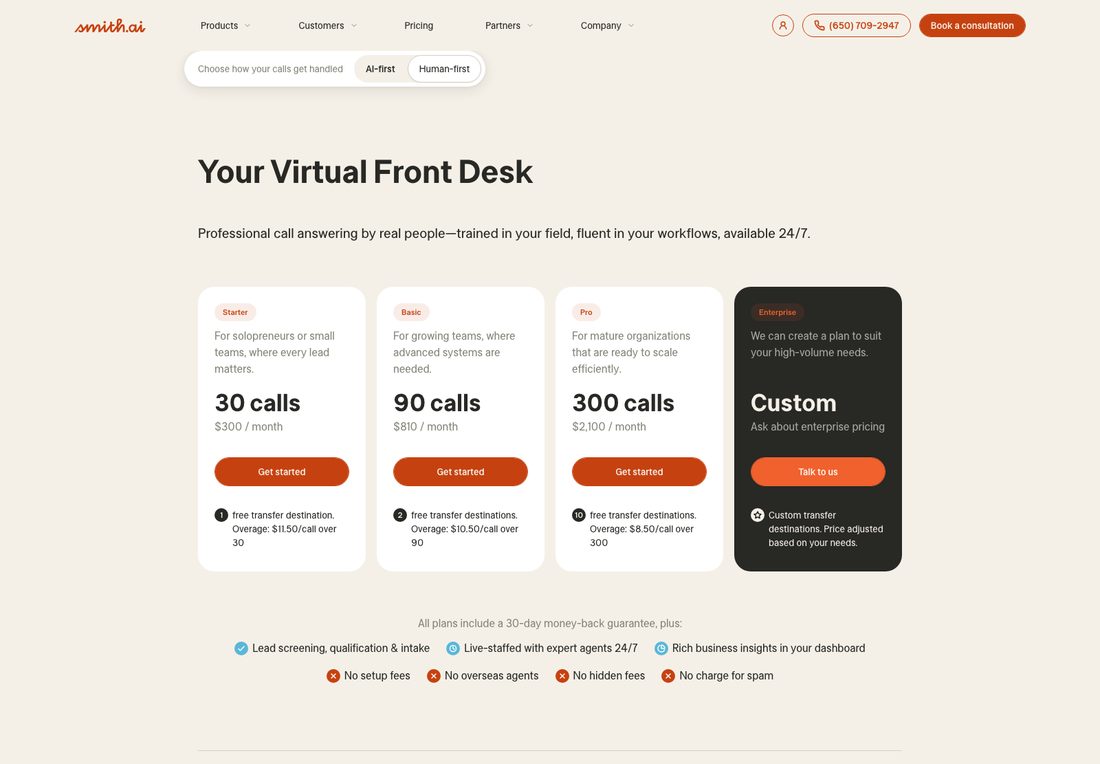
Two line items to ask about before you sign. Appointment booking is an add-on at most services (Smith.ai lists it at $1.50 a call) and it means the agent reads a calendar you share, which is not the same as your dispatch software. And per-minute billing means every robocall and every supplier calling about an invoice is on your bill, so a plan sized to your real inbound volume will run over in the first month.
AI receptionists: 2026 prices
The AI category splits into two products that get sold under one name. Minutes-based AI receptionists answer and qualify the caller, then take a message or book against a shared calendar, and cost a tenth of a live service. Integrated AI phone agents are wired into your scheduling software and phone system, book on the real calendar, text the confirmation, and cost about what a part-time office employee's Friday would. Nine of them are priced side by side, with the same 120 calls costed on each, in the AI receptionist price guide.
| Product | Price | What is included | Where it fits |
|---|---|---|---|
| Dialzara | $29 for 60 minutes, $99 for 220, $199 for 500, $349 for 1,000 | AI receptionist, overage $0.35 to $0.48 a minute, 7-day trial | Cheapest way to stop losing calls to voicemail |
| Goodcall | $79, $129, or $249 a month per agent | Unlimited minutes; priced on unique customers (100, 250, 500) at $0.50 each beyond | High call volume, simple flows |
| Jobber AI Receptionist | $29 a month on top of a Jobber plan | Answers, qualifies, and books inside Jobber's calendar | Jobber shops that want one bill; see Jobber pricing |
| Skill Mammoth AI phone agent | $1,500 a month; setup normally $3,000 to $15,000, $750 on the founding offer | Answers every call, qualifies, books on your real calendar, texts the confirmation, alerts the on-call tech, logs to your CRM | Trades where a booked call is worth $300 or more |
| Verdict | A minutes-based AI receptionist beats a live service on price and on availability. An integrated agent beats both on what matters, which is the job on the calendar. | ||
Two recordings of an integrated agent taking real calls, unedited, are on the AI phone agent page. Listen before you decide; the difference between "AI receptionist" products is audible in the first ten seconds.
Want to hear what a booked call sounds like?
Two unedited recordings of the AI phone agent qualifying a caller and putting the job on a real calendar, plus the founding-offer pricing while it lasts.
What a live service misses
The booking
The agent can read a calendar you share but cannot see the dispatch board, the tech's location, or the two-hour window that opened when a job cancelled. The message goes to the office, the office calls back, and by then the emergency caller has booked whoever answered second.
The script ceiling
Live agents work from your approved script. When the caller asks whether you service a Bosch tankless or whether the estimate is free, the answer is "someone will call you back." Every callback is a chance for the lead to go cold.
The billing
Per-minute pricing means spam calls, supplier calls, plus existing customers asking about an invoice all cost the same as a new lead. Most trade companies run 30 to 40 percent over the plan they bought in month one.
The CRM
Most services email or text a message. Getting it into Jobber or ServiceTitan as a lead with a source is your problem, which means the attribution is usually lost.
What an AI receptionist misses
The angry call
A homeowner whose basement is flooding for the second time this year wants a human who can escalate. A good AI agent recognizes that and transfers; a cheap one loops.
The multi-step job
Commercial accounts, insurance claims plus warranty questions have too many branches for a minutes-based receptionist. Route those to a person.
A bad calendar integration
The whole value is the booking. An AI receptionist that "books" by emailing you a preferred time has not booked anything. Ask to see the appointment land in your software during the demo.
Both options share one requirement: a call-tracking number in front of them so you can see what was answered and what was booked, plus what it cost per booked job. Without it, you are choosing on price alone, and price is the least important number here.
The math for a plumbing company
Take a five-truck plumbing company with 150 inbound calls a month, 35 percent of them outside office hours, an average service ticket of $450, and a close rate of 45 percent on calls that get booked on the spot. That is 52 after-hours calls, and about 23 of them should become jobs worth roughly $10,500 a month.
| Option | Monthly cost | After-hours calls answered | Booked on the call | Likely outcome |
|---|---|---|---|---|
| Voicemail | $0 | 0 of 52 | 0 | About 8 of 52 call back; most book elsewhere |
| Live service, message only | $400 to $800 | 52 | 0 | Messages returned in the morning; roughly half still available |
| AI receptionist, shared calendar | $29 to $349 | 52 | Most, at calendar-slot accuracy | Booked, with some rescheduling when the slot conflicts with dispatch |
| Integrated AI phone agent | $1,500 | 52 | Most, on the real board | Booked, confirmed by text, tech alerted, lead in the CRM |
| Verdict | At $450 a ticket the integrated agent pays for itself on four jobs a month. Below about $150 a ticket the math gets thin and the minutes-based receptionist wins. | |||
The ticket size is the variable. A carpet cleaner at $180 a job should buy the $29 receptionist. A roofer whose after-hours call is a $14,000 storm claim should not be deciding this on a $1,400 difference. Coverage for nights and weekends only is a narrower and cheaper purchase than a full 24/7 contract, priced out in our after-hours answering service guide. The plumbing-specific version of this, including the shutoff script that decides whether a 2am call becomes a dispatch or a flood, is in our plumbing answering service guide. The trade-level lead economics are in how to get more plumbing leads and speed to lead for roofing.
How to choose
- Under $150 average ticket, or under 50 calls a month: a minutes-based AI receptionist (Dialzara or Goodcall) plus missed call text back. Total under $150 a month.
- Jobber shop, 50 to 200 calls a month: Jobber's $29 AI Receptionist, because it books in the calendar you already run.
- Emergency trade with a $300-plus ticket, 100-plus calls a month: an integrated AI phone agent, with a live transfer path for the calls it should not handle.
- Commercial, insurance, or warranty-heavy work: a live service for the complex calls and AI for the rest. Size the live plan to the complex volume only, or the per-minute bill will surprise you.
- Every option: a call-tracking number in front, missed-call text back behind, and the booked-job count reviewed monthly.
Not sure which one your call volume justifies?
A 30-minute call with your call log open. We will tell you which option fits, including the ones we do not sell.
An answering service catches the call you missed. Reminders stop the appointment you booked from turning into a wasted drive, and our appointment reminder software guide covers what that costs, starting at $29 a month for 400 reminders.
Frequently asked questions
How much does an answering service cost for a contractor?
Live services run $99 to $1,725 a month depending on minutes: PATLive from $99 for 50 minutes, Posh from $130, Ruby from $250, and Smith.ai $300 for 30 calls. Effective cost is $2 to $4 a minute or $8 to $12 a call, and appointment booking is usually an add-on. AI receptionists run $29 to $349 a month on minutes plans, $29 inside Jobber, or about $1,500 a month for an integrated agent that books on your calendar.
Is an answering service or an AI receptionist better for contractors?
For most trade companies the AI option wins, because it costs a tenth as much and can book the job rather than take a message. A live service still wins for complex commercial, insurance, or warranty calls that need a human with judgment. Many companies run both: AI first, live transfer for the exceptions.
What is the cheapest way to stop missing calls?
Missed call text back, which sends an automatic text within seconds of a missed call and costs nothing extra inside most CRMs and a few dollars a month on a standalone tool. It does not answer the phone, but it keeps the caller from dialing the next company. Add a $29 to $99 AI receptionist on top and the phone is covered around the clock.
Does an answering service book appointments?
Most live services can book against a calendar you share with them, usually as a paid add-on at $1 to $2 a call. They do not see your dispatch board or your techs' locations. Integrated AI phone agents book on the real calendar in your scheduling software and text the confirmation, which is the difference that decides whether the job is actually yours.
Will callers know it is an AI?
Increasingly, yes, and it matters less than it did. The measure is whether the caller got what they wanted: a time, a confirmation, and a person on the way. Two unedited recordings on the AI phone agent page show what that sounds like. Poor AI receptionists are obvious in ten seconds; listen before you buy.
What should I ask before signing with any answering service?
Whether spam and wrong numbers count against your minutes. Whether booking writes to your scheduling software or to a shared calendar. What the transfer path is for calls the service cannot handle. Whether you get a call-tracking number and a per-call log. And what the overage rate is, because that is the number you will actually pay.