TL;DR
Plumbing is the most emergency-weighted trade in home services, and the value of an answering service sits almost entirely in one question asked in the first twenty seconds: is water still running right now. Get that asked and the rest is scheduling. Miss it and you have a message, not a dispatch. ReceptionHQ is the cheapest live option at $25 a month plus $1.99 a call. Specialty Answering Service publishes $269 for 220 minutes with no contract. Rosie covers the same volume for $49 to $149. Whoever answers, write the shutoff script yourself, because no vendor ships one and water damage is the one mistake that costs more than the missed call.
A burst supply line at 2am is worth roughly ten times a Tuesday drain clean, and it is the call most likely to reach voicemail. That asymmetry is the entire argument for answering the phone at night, and it is also why plumbing buys this product differently from every other trade.
Most answering service marketing is written for clinics and salons, where a missed call costs an appointment. In plumbing a missed call can cost a floor. Below is what the services cost, what the script has to contain, and where a live operator stops being able to help.
The question that decides everything
Before the operator takes a name, a number or an address, they need to ask whether water is actively running and whether the caller can reach the shutoff. Everything downstream branches from the answer.
If water is running and the customer can reach the main, the operator walks them to it. That call just changed from a flood claim to a repair appointment, and it took forty seconds. If water is running and they cannot reach or turn the main, it is a dispatch now at whatever premium you charge. If water is off, or the problem is a slow drain, no hot water, or a running toilet, it is a morning slot and nobody needs to wake up.
Almost no stock script leads with this. They lead with name and callback number, which is the correct order for a dentist and the wrong order for you.
Pro tip
Write the shutoff walkthrough as four plain sentences the operator can read cold: where the main valve usually sits in your region, which way it turns, what to do if it will not budge, and what to do about the water heater. A non-plumber reading four clear sentences prevents more damage at 2am than a technician forty minutes out.
What plumbing answering services cost in 2026
Every figure below came off the vendor's live pricing page in September 2026. The effective column assumes 45 after-hours calls a month at a four-minute average.
| Service | Entry price | Billing unit | At 45 calls a month |
|---|---|---|---|
| ReceptionHQ | $25/mo, message taking | $1.99 per call answered | About $115 |
| Specialty Answering Service | $44/mo plus $1.54 a minute | Per minute, no contract | $269 on the 220-minute plan |
| PATLive | $99 for 50 minutes | Per minute, $2.09 to $2.99 over | $349 on the 200-minute plan |
| Smith.ai | $300 for 30 calls | Per call, $8.50 to $11.50 | Roughly $450, plus $1.50 a call to book |
| Rosie (AI) | $49 for 250 minutes | Flat, minutes included | $49, or $149 to book on your calendar |
| Verdict | ReceptionHQ if a message is enough and you will call back fast. Specialty if the operator needs to hold a real conversation. Rosie if you want the shutoff script read the same way every time at a fifth of the price. | ||
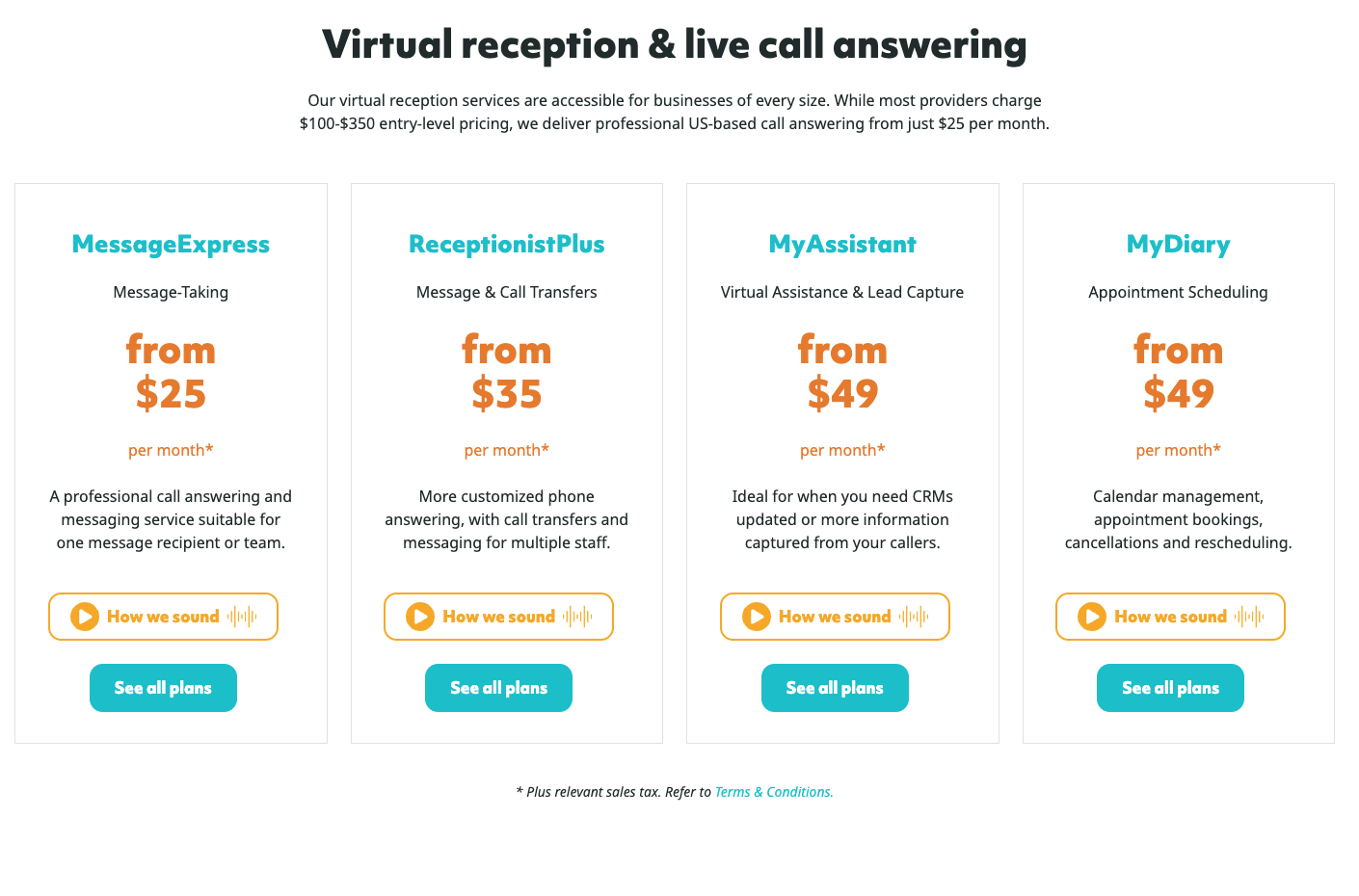
Read that four-way split before you price it. MessageExpress at $25 takes a message. MyDiary at $49 manages the calendar. If you want the 2am caller both talked through the shutoff and booked for 7am, you are shopping at the upper tier, not the advertised entry price.
Per call or per minute, for emergency work
Plumbing skews the math away from per-call pricing, because a properly handled emergency is a long call. Walking someone to a basement shutoff while they panic takes five or six minutes. A per-minute service bills that honestly. Smith.ai's $8.50 to $11.50 a call bills it the same as a wrong number.
The flip side is that per-minute billing punishes a chatty operator. Ask two questions of any vendor: do you bill in one-minute or six-second increments, and does hold time count. Six-second increments on a 4.2-minute average call save about 8 percent against rounding up, and hold time can add 15 percent on its own.
Somebody has to quote the after-hours rate
This is where plumbing answering services most often fall down, and it is not a vendor failure. Your premium for a 1am visit is a number only you know, and the caller needs to hear it before a truck rolls.
If the operator quotes it, they need the exact figure and the exact wording, including what the dispatch fee covers and whether it applies to the repair. If the technician quotes it at the door, expect cancellations on the doorstep and a review about it. Decide which, then put it in the script in the words you want used. A caller who agreed to $189 on the phone does not argue at 2am.
The call is half of it. The dispatch is the other half.
We wire the after-hours call into your real board so the job is on the schedule before your first coffee, not sitting in an inbox.
On-call rotation, and what breaks it
An answering service escalates down a list you provide. It cannot improvise. Three failures account for most of the bad nights we have seen.
An undefined rotation. "Whoever picks up" means the service leaves voicemails on three phones and the customer hears nothing back. Name the order, week by week, and give the service a fallback that always answers.
No second tier. The on-call tech is in a crawlspace with no signal often enough that it needs a plan. Give the service a second name and the number of minutes to wait before moving to it.
A rotation nobody told the service about. Rotations change with holidays and vacation. If updating the escalation list is a phone call to a vendor rather than something your office can do in a portal, it will not get done. Ask to see the portal during the demo.
What a live service will not do
Be clear on the ceiling before you buy. An operator is reading your script into a shared calendar, and there are four things they cannot do.
They cannot see your dispatch board, so the slot they book is one you set aside rather than the real next opening. They cannot judge whether a job is a two-hour repair or a repipe, so the time booked is a guess. They cannot take payment or a deposit. And they cannot tell an angry repeat caller anything beyond what is written down, which is the moment a live human was supposed to be worth the premium and often is not.
If those limits are the problem, the fix is a system wired into your actual schedule rather than a better call centre. That is what an integrated agent does, and it is also what your field service platform may already include. Our live versus AI comparison prices the whole ladder, and the plumbing CRM breakdown covers which platforms hold the dispatch board the service would need to read.
Three to skip
Message-only plans if nobody is returning messages before 7am. A message sitting unread until morning is voicemail with a monthly bill attached. Either staff the callback or buy a plan that books.
Generic scripts supplied by the vendor. Every service offers to write one, and every one of those starts with name and callback number. The shutoff question has to be first and you have to insist on it.
Paying for 24/7 coverage when your office answers well all day. The gap is nights, weekends and holidays. Most vendors will scope to that window and almost none advertise it, so ask directly. The broader channel economics are in our guide to getting more plumbing leads, and the cheapest first move is still an automatic missed call text back at around $30 a month.
Want the script written before you sign anything?
We will draft the triage tree and the shutoff walkthrough for your market, then help you pick the cheapest vendor that can actually run it.
Frequently asked questions
How much does a plumbing answering service cost?
Between $115 and $450 a month for about 45 after-hours calls. ReceptionHQ starts at $25 a month plus $1.99 per call answered, Specialty Answering Service publishes $269 for 220 minutes, and PATLive runs $349 for 200 minutes. An AI receptionist covers the same volume for $49, rising to $149 if you want it booking directly on your calendar.
What should a plumbing answering service ask first?
Whether water is actively running and whether the caller can reach the shutoff valve. That question sorts a flood from a repair appointment inside forty seconds and decides whether anyone gets woken up. Almost every stock script opens with name and callback number instead, so you have to specify the change yourself.
Can an answering service walk a customer through shutting off the water?
Yes, if you write it for them. Give the operator four plain sentences covering where the main valve usually sits in your area, which way it turns, what to do if it will not move, and what to do about the water heater. They are not plumbers, so the script has to work read cold.
Who quotes the emergency call-out fee?
Decide before you sign and put it in the script. If the operator quotes it they need the exact figure and wording, including whether the dispatch fee applies to the repair. If your technician quotes it on arrival you should expect cancellations at the door and a review about the surprise.
Is an AI receptionist good enough for plumbing emergencies?
For triage and booking, yes, and it reads the shutoff script identically every time, which a tired operator at 3am does not. Where it gives out is the angry callback, the multi-step commercial job and the caller who refuses to speak to a machine. Many plumbing companies run AI overnight and people during business hours.
Will the service book onto my real dispatch board?
Not usually. Most live services write into a calendar you share with them, which is not the same as your dispatch software, so the slot is one you set aside rather than your true next opening. Booking on the real board requires an integration, which is either an AI agent wired into your platform or an in-platform option like Jobber's $29 AI Receptionist.