TL;DR
HVAC call volume is weather-driven, which breaks every minutes-based plan on the market. The first hard freeze or the first 95-degree week produces three to five times normal volume inside 48 hours, and that is exactly when a 220-minute plan spills into overage at $1.19 to $2.99 a minute. Buy for your peak week, not your average month, or buy a flat-rate AI that does not meter. Rosie runs $49 for 250 minutes and $149 for 1,000. Specialty Answering Service publishes a live ladder from $44 plus $1.54 a minute. Jobber's AI Receptionist is $29 on top of your plan and books inside your existing calendar. The script matters more than the vendor: a no-heat call and a filter-light call cannot share one.
Every answering service sells the same promise, which is that somebody picks up. For HVAC that promise is worth the most on about fourteen days a year and close to nothing on the other three hundred and fifty. Pricing built for a flat month is the wrong shape for a business that runs on weather.
This is the part of the buying decision that the category never addresses, because the vendors sell to dentists and law firms where Tuesday looks like every other Tuesday. Below is what the plans cost, what happens to them in August, and the triage script that decides whether the call was worth answering at all.
Why HVAC breaks the pricing model
A residential HVAC company running 200 calls in a normal month does not run 200 calls in July. It runs 200 in May, 200 in September, and then 600 in the week the heat index passes 100. The annual total looks smooth. The weekly total does not.
Put that against a 220-minute plan at $269. At a four-minute average that plan covers 55 calls. A normal month of after-hours traffic fits inside it comfortably. The week of the first freeze does not, and the overage rate is where the bill goes strange.
Five months of the year sit above the line. June through August is where the damage concentrates, and November and December do it again on the heating side. Buy the plan that fits May and you will pay overage in six separate months.
What the plans cost when August happens
Prices read off each vendor's live pricing page in September 2026. The peak column models 600 minutes, which is what a bad heat week does to a mid-sized residential shop.
| Service | Type | Normal month (220 min) | Peak month (600 min) |
|---|---|---|---|
| Specialty Answering Service | Live | $269 on the 220 plan | $649 on the 500 plan, plus $1.34 a minute over |
| PATLive | Live | $349 for 200, then $2.09 a minute | Roughly $1,185 |
| Posh | Live | $420 for 200, then $2.10 a minute | Roughly $1,260 |
| Rosie | AI | $49 for 250 minutes | $149 for 1,000 minutes |
| Jobber AI Receptionist | AI, in-platform | $29 on top of your Jobber plan | $29 |
| Verdict | A live service costs four to eight times an AI in a normal month and ten to twenty times in a peak one. Buy live only where the call genuinely needs a human, and size the plan for July. | ||
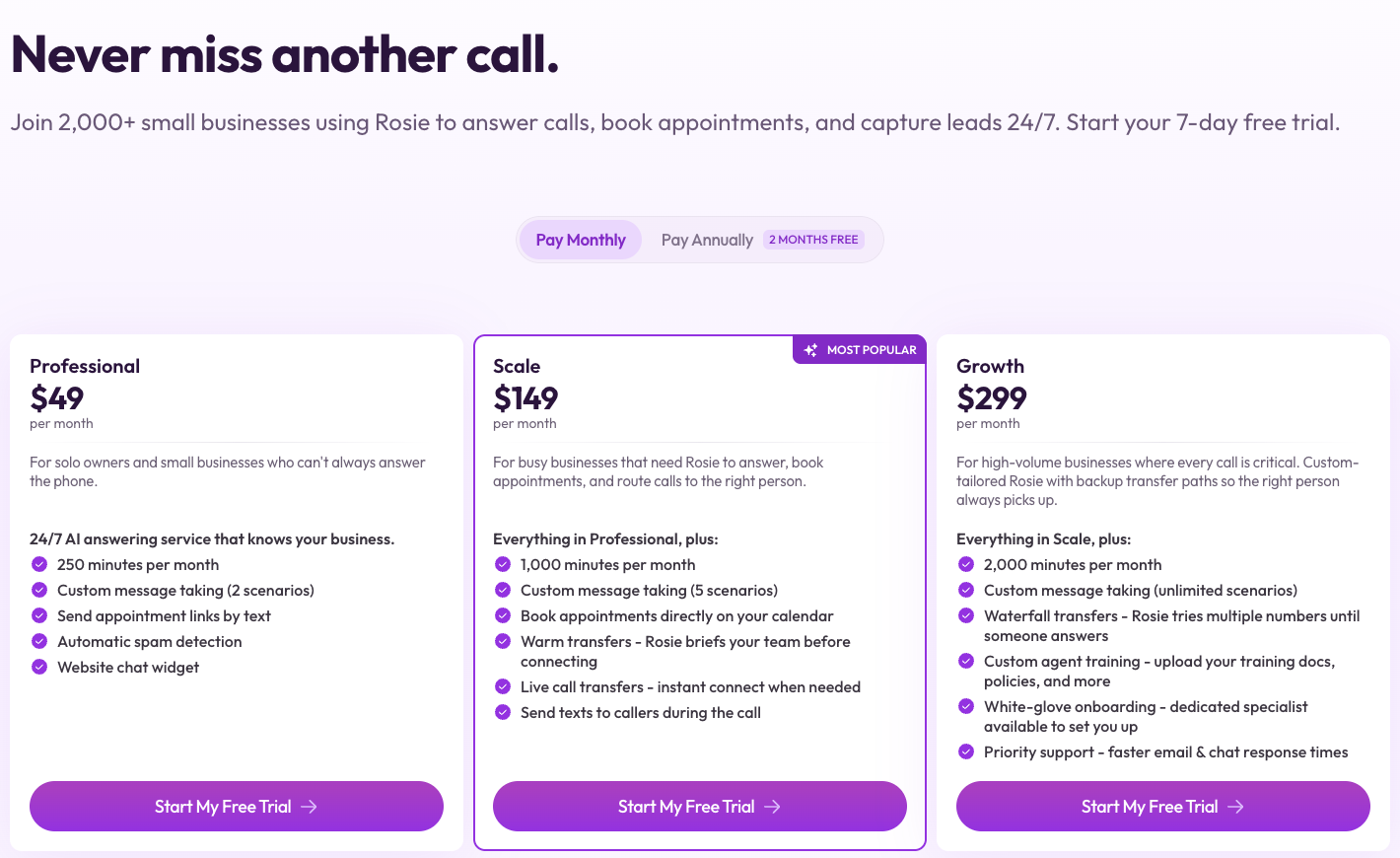
That gap between tiers is the thing to read carefully. At $49 Rosie takes the call and texts the caller a booking link, which still leaves the customer to do the work. Booking straight onto your calendar starts at $149, and so do warm transfers and the Zapier connection that puts the lead anywhere else. Annual billing takes two months off.
The triage script is the whole product
Whoever answers, live or synthetic, is running a decision tree you wrote. HVAC needs four branches and most scripts ship with one.
A no-heat call in February with an elderly customer in the house is a dispatch tonight. A no-cool call in July with a working window unit is a dispatch tomorrow morning. A maintenance agreement member gets the earliest slot either way because you sold them that. A new-system quote request is not an emergency at all and should land in a callback queue, because sending a tech out at 11pm to quote a changeout costs you a premium visit and earns nothing.
Give the service those four buckets with concrete examples in each. Vague thresholds produce a tech woken for a filter light, which happens once before they stop answering the phone at night.
Pro tip
Add one question to the front of every no-heat script: is anyone in the home under two or over seventy, and is the indoor temperature below 55. That single question separates the genuine welfare dispatch from the one that can wait until seven, and it is the difference between a justified overtime call and a resented one.
Your script is worth more than your vendor choice
We write the triage tree, wire it to your dispatch board, and make sure the after-hours call lands where your morning starts.
Maintenance members are the reason to bother
The clearest return on answering the phone at night is not the one-off repair. It is the maintenance agreement holder who was promised priority service and finds out at 9pm whether that was true.
A member who reaches a human, gets a time, and sees a truck when promised renews. A member who reaches voicemail in January calls the company on the fridge magnet, and you lose the agreement at renewal along with the two tune-ups a year it carried. Price your answering service against agreement churn rather than against the single repair, and the numbers change shape. Our HVAC CRM breakdown covers which platforms actually track membership tiers and renewals, because the answering service can only flag a member if something tells it who the members are.
Check what you already own
Before buying anything standalone, look at your field service platform. Jobber sells an AI Receptionist at $29 a month that answers, qualifies and books inside the Jobber calendar, which removes the sync problem entirely. Housecall Pro, ServiceTitan and Workiz all include missed-call texting and reminders, which is not live answering but does stop the caller dialling the next company.
A standalone service earns its place when your scheduling lives somewhere the vendor cannot reach, or when call volume justifies a human. Otherwise you are buying a second customer database that will disagree with the first one inside a month. The field service software roundup has the platform detail.
Three to skip
Any plan sized on your average month. You now know why. Size it on July, or buy flat-rate.
Medical-style per-provider pricing. Answering services built for clinics charge by practitioner because a practice has four. You have fourteen techs sharing one schedule, and per-provider pricing turns a $269 problem into a four-figure one.
An AI receptionist as your first automation if nobody answers during the day either. Fix the business-hours leak first. Response time inside five minutes moves booking rates further than any after-hours coverage, which is the argument in our lead follow-up system guide, and the cheaper starting point is the missed call text back setup at around $30 a month.
Getting quoted for a season you do not have yet?
We will look at your real call pattern by month and tell you which plan shape fits, including when the answer is the $99 add-on you already own.
Frequently asked questions
How much does an HVAC answering service cost?
A live service runs $269 to $420 a month for roughly 220 minutes, which is about 55 calls. Specialty Answering Service publishes $269 for 220 minutes, PATLive $349 for 200 and Posh $420 for 200. An AI receptionist covers the same volume for $49 to $149, and Jobber's in-platform AI Receptionist is $29 on top of your subscription.
Why do answering service bills spike in summer?
Because HVAC call volume is weather-driven and minutes-based plans are not. A heat wave can produce three to five times normal volume inside 48 hours, pushing you past the plan allowance and into overage at $1.19 to $2.99 a minute. Size the plan for your peak week rather than your average month, or pick a flat-rate AI plan that does not meter.
Should an HVAC company use a live service or an AI receptionist?
AI for overnight and overflow, live for anything needing judgment. An AI answers on the first ring at 3am with no shift premium and costs a fraction of a live plan. A live operator handles the angry callback, the multi-step commercial job and the customer who will not talk to a machine. Plenty of shops run AI after hours and humans during the day.
What should the after-hours script ask an HVAC caller?
Four branches at minimum: no heat, no cool, maintenance agreement member, and new system quote. Add the welfare question to the no-heat branch, asking whether anyone in the home is under two or over seventy and whether the indoor temperature is below 55. That separates the dispatch-tonight call from the one that waits until morning.
Does Jobber answer HVAC calls?
Jobber sells an AI Receptionist as a $29 a month add-on that answers, qualifies and books directly inside the Jobber calendar. That removes the calendar sync problem a standalone service creates. See the Jobber pricing breakdown for how the add-on stacks against the Core, Connect and Grow tiers.
Will an answering service book the job or just take a message?
It depends on the tier, and this is where vendors are slippery. Rosie's $49 plan sends the caller a booking link by text, while booking directly on your calendar starts at $149. Smith.ai charges $1.50 per call extra for appointment booking. If booking is the reason you are buying, confirm it is in the plan you are quoting rather than an add-on above it.