TL;DR
An HVAC service agreement needs nine sections: parties and equipment covered, visit schedule, the exact tune-up checklist, priority-service terms, the repair discount, exclusions, price and renewal terms, liability language, and cancellation. The template below covers all nine. The business case is bigger than the paperwork: maintenance agreements smooth the brutal seasonality of HVAC revenue, turn one-time repairs into recurring relationships, and make your company sellable, since buyers price HVAC businesses largely on agreement count. Price residential plans at $180 to $300 a year for two visits and stop underpricing the second truck roll.
Every HVAC owner knows the shape of the year: slammed in July, slammed in January, quiet enough to hear the shop clock in April and October. Service agreements are the fix, and the agreement document itself is the easy part. Here is the template, the pricing math, and the clauses that prevent the arguments.
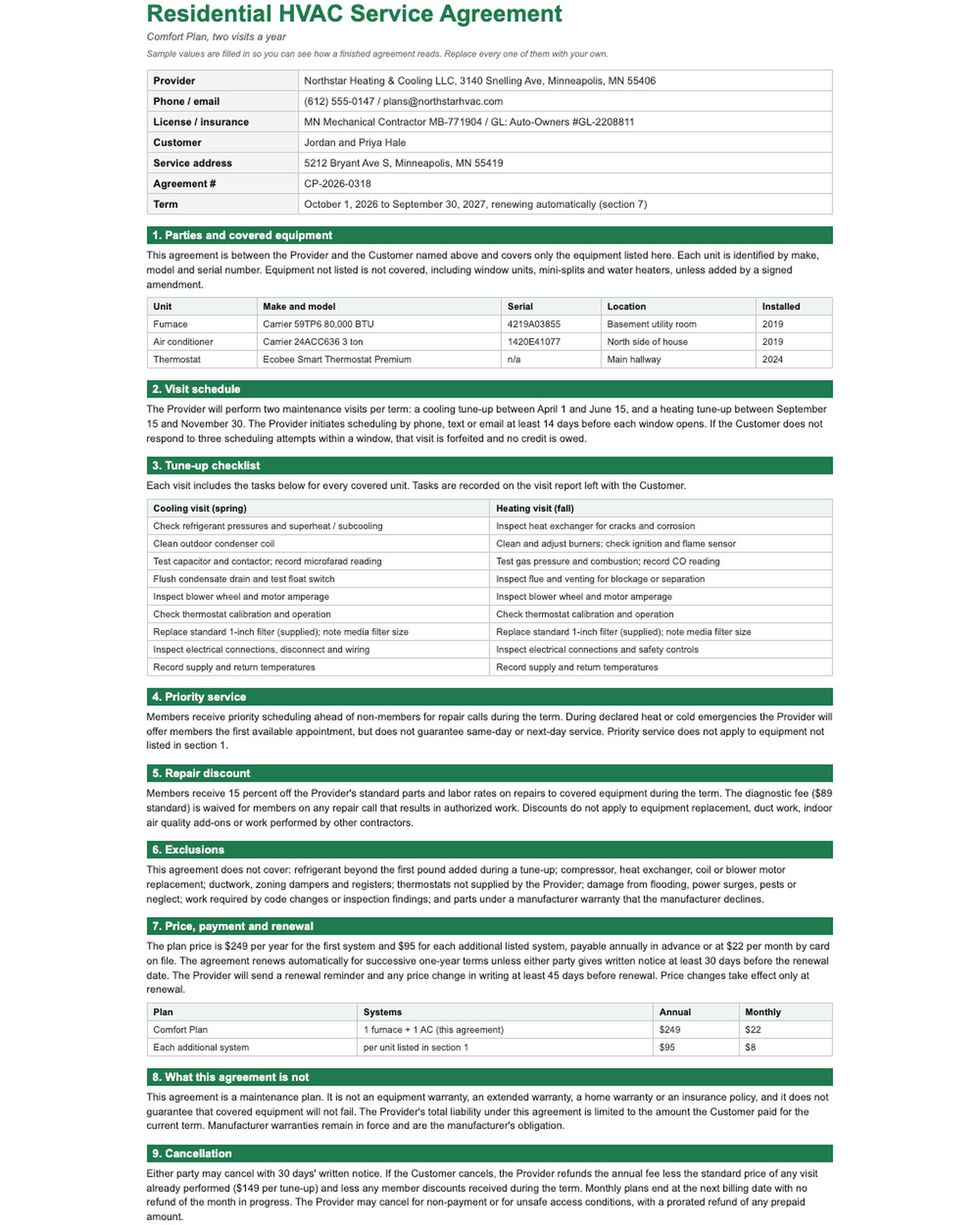
Download this HVAC service agreement template. All nine sections below are written out as an editable Word document and a print-ready PDF, with a sample two-visit Comfort Plan filled in, free in the contractor templates pack alongside the invoice and estimate templates for five other trades.
The nine sections your agreement needs
1. Parties and covered equipment. Customer, address, and every covered unit listed by make, model, and serial number. "The air conditioner" becomes a dispute the day a second window unit appears. This section is also where multi-system homes justify a higher tier.
2. Visit schedule. The residential standard is two visits: cooling tune-up in spring, heating in fall. Say who initiates scheduling (you do; plans where the customer must call have a no-show rate that quietly kills renewal value) and the window for completing each visit.
3. The tune-up checklist, itemized. The most skipped and most valuable section. List the actual tasks: check refrigerant pressures, clean condenser coil, test capacitors, inspect heat exchanger, flush condensate drain, replace standard 1-inch filter, and so on. Specificity is what makes the plan feel worth $250 to a homeowner and what protects your tech when "you never checked the blower" comes up in February.
4. Priority service. Members jump the queue in peak season. Define it honestly: "same-day or next-day response" is a promise you'll be held to during a heat wave; "priority scheduling ahead of non-members" is one you can always keep.
5. Repair discount. 10 to 20% off parts and labor is standard. Decide whether diagnostics are free for members (a strong selling point that costs you little, since members' systems are ones you already know).
6. Exclusions. Refrigerant recharges, compressor and heat exchanger replacements, ductwork, thermostats the customer bought online, and anything required by code changes. Every exclusion written here is an argument you don't have later.
7. Price and renewal. Annual prepaid or monthly. Auto-renewal with a 30-day rate-change notice keeps the book stable; check your state's auto-renewal notice requirements, since several states now require an explicit reminder before renewal.
8. Liability language. A maintenance plan is not an equipment warranty and not insurance; say so in plain words, and cap liability at amounts paid under the agreement. Have a lawyer skim the final version; this article is experience, not legal advice.
9. Cancellation. 30-day notice either direction, with refund math that accounts for visits already delivered at full tune-up value. That last clause prevents the customer who uses the spring visit and cancels in June.
the going annual range for a two-visit residential plan. Below $150 you're funding two truck rolls out of goodwill; the discount side of the plan is where member loyalty gets built, never the visit price.
Pricing math most owners get backwards
A tune-up visit honestly costs $80 to $120 in loaded labor and drive time, so a $199 two-visit plan roughly breaks even on the visits alone. The plan profits three other ways: repair revenue captured because your tech is standing in front of the failing capacitor first, the 15 to 25% of members who convert to replacements you quote without competition, and the enterprise value of the book itself, because acquirers price HVAC companies partly per active agreement. Price the plan to break even on visits and stop there; the margin lives downstream.
Sell it at three moments: at the end of every repair ("today's visit would have been covered"), in the fall and spring booking rushes, and as a line item on every replacement quote, where the first year included is standard practice. The first of those moments is really an invoicing habit: every service invoice should carry the plan line, either showing the member discount applied or the offer, and our HVAC invoice template builds it in as a standing field.
Want the agreement working on your website too?
We build HVAC sites where the maintenance plan has its own page, its own signup flow, and its own follow-up automation, so the book grows while the crew works.
Using the template
Start from the Word download rather than a blank page: the nine sections are written out with a sample plan filled in, so your version is an edit, not a draft. Then have your attorney adapt it to your state, especially the auto-renewal and liability sections. Load it into your field software so techs can sell it from the driveway; the CRMs that handle agreement tracking well are covered in our HVAC CRM comparison. If you're building the whole business system around it, start with how to start an HVAC business and the demand side in HVAC marketing ideas. The same document logic applies across trades; our cleaning contract template and lawn care contract template follow the identical spine.
On the commercial side, the buyers, the bid package, and per-unit pricing are covered in how to get commercial HVAC contracts.
Frequently asked questions
What should an HVAC service agreement include?
Nine sections: parties and covered equipment by serial number, the visit schedule, an itemized tune-up checklist, priority-service terms, the member repair discount, exclusions, price and renewal terms, liability language, and cancellation rules. The itemized checklist and the exclusions do the most work, because they prevent the two most common disputes.
How much should I charge for an HVAC maintenance agreement?
$180 to $300 a year for a two-visit residential plan on one system, adding $75 to $125 per additional system. Price to roughly break even on the visits; the profit arrives through captured repairs, replacement conversions, and the resale value of the agreement book itself.
Are HVAC maintenance agreements profitable?
Not on the visits, and that's fine. The plan smooths seasonal revenue, keeps your techs busy in shoulder months, captures repairs at the moment of discovery, and converts members to replacements without competitive bids. Acquirers also value HVAC companies partly on active agreement count, so every signed plan adds enterprise value beyond its annual fee.
Should agreements auto-renew?
Yes, with a 30-day advance notice of renewal and any rate change. Auto-renewal is what makes the book compound instead of resetting every spring. Check your state's rules first: several states require specific renewal reminders, and violating them can void the term or worse.
What's the difference between a service agreement and a warranty?
A warranty promises to fix failures; a service agreement promises scheduled maintenance plus preferential treatment when failures happen. Your agreement should say this explicitly in the liability section, because the customer who believes they bought insurance is the customer who leaves an angry review in January.
Selling plans but the website doesn't mention them?
Send us your site. The free 10-minute audit shows what a homeowner comparing maintenance plans actually sees, delivered within 48 hours.