 ChatGPT
TL;DR
- In the ten searches we pulled, homeowners did 95.5% of the searching: 323,500 US searches a month for five residential terms, 15,220 for five commercial ones (DataForSEO, November 27, 2026).
- The money is closer to even. The Census Bureau puts private residential building at $848.8 billion a year and nonresidential at $790.6 billion (September 2026).
- Our homeowner terms more than doubled from November 2025 to January 2026. Have residential pages live by December.
- Agency entry prices printed today run from $1,500 a month (WebFX's construction band) to $3,750 (Hook Agency). Doing it yourself with tools starts at $29 a month.
- WebFX and Blue Corona both print three to six months for results, and up to a year in competitive markets.
Construction SEO is the work of getting a building company's Google Business Profile and website in front of the people who hire builders. In the ten construction searches we pulled, homeowners did almost all of it: five residential terms drew 323,500 US searches a month, against 15,220 for five commercial ones.
This guide is for the owner or marketing lead of a general contractor, a remodeler or a commercial builder, and for the office manager who ends up doing the marketing. If you searched "seo for construction companies", "general contractor seo" or "seo for builders", this is the same work. Every figure was read on November 27, 2026.
The local search basics are in our contractor SEO guide, and new homes have their own playbook in home builder SEO. This guide covers what changes when one company sells to homeowners, building owners and other contractors at once.
Construction SEO serves three buyers, and each one searches differently
A construction company usually sells to more than one kind of buyer. Each types different words into Google and wants a different page when it lands.
- Homeowners search the room or the job with "near me": "kitchen remodel near me", "general contractor near me".
- Building owners, developers and property managers search the project type: "tenant improvement contractor", "design build contractor", "metal building contractor".
- Other contractors search for each other. General contractors look for subs, and subs look for bids: "concrete subcontractors", "construction bids".
- Job seekers search too, and "subcontractor jobs" draws 1,900 searches a month. They are not customers, so leave those terms to a careers page.
A site built for only one of these buyers loses the other two. The fix is a separate section for each buyer you sell to, with its own pages and its own words.
Homeowners out-search building owners 21 to 1, yet commercial work is half the dollars
Start with the money. The Census Bureau's construction spending release of November 2, 2026 puts private residential construction at a seasonally adjusted annual rate of $848.8 billion for September. Private nonresidential construction ran at $790.6 billion.
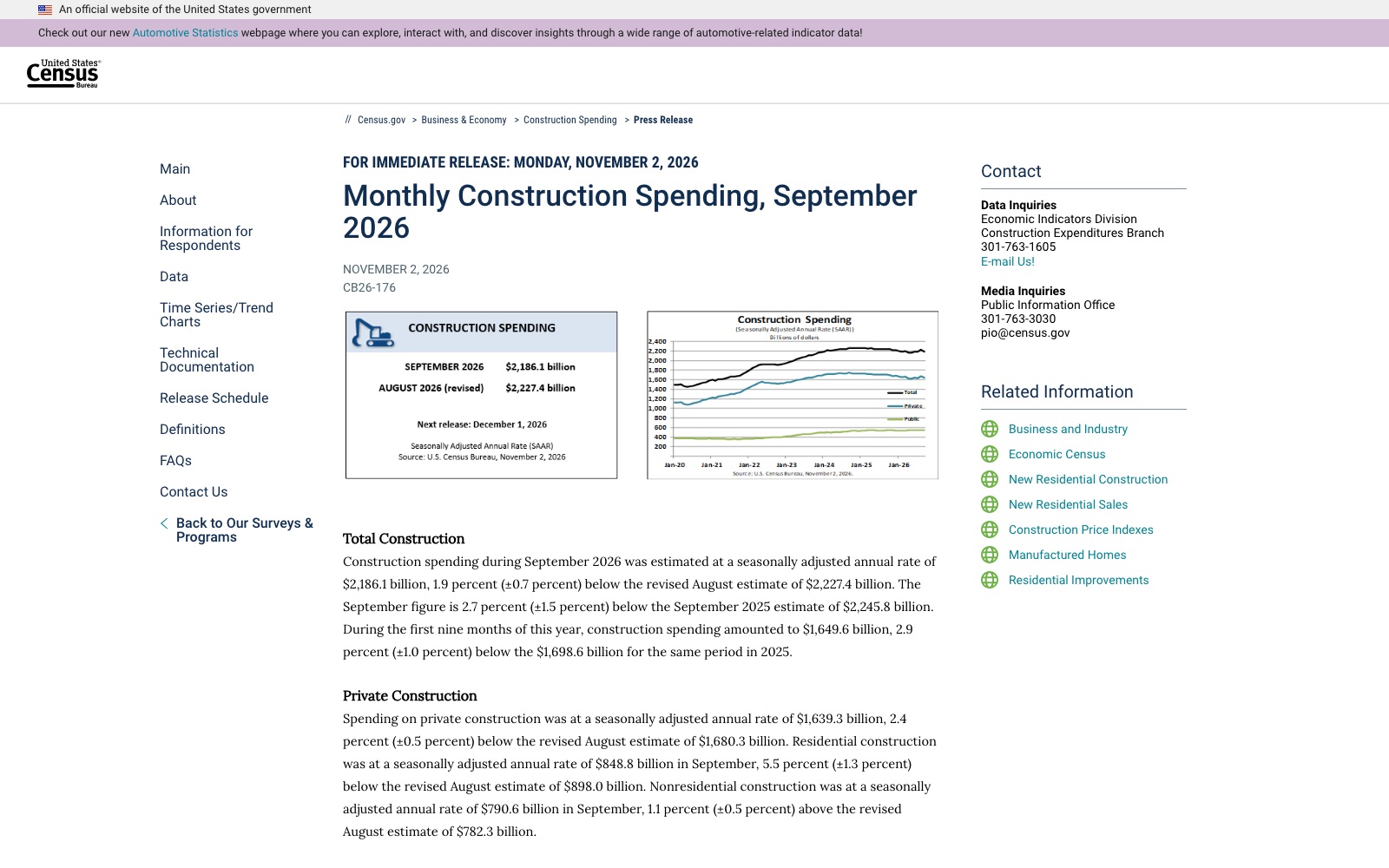
So the two sides of private building are close to even in dollars. The searches are nothing like even.
We pulled US search volumes for five homeowner searches and five commercial searches. The homeowner five drew 323,500 searches a month. The commercial five drew 15,220. That is 21 searches from homeowners for every one from a building owner.
How we computed it: we summed DataForSEO's monthly US volumes for each group, then set each group's share of searches beside each side's share of Census private spending. Without October, the jumpiest month, the ratio is still 20 to 1. The basket is ours, and Census nonresidential covers far more work than five searches.
Commercial buyers spend nearly as much and search far less. Our read is that they hire through bid lists and referrals first. So commercial SEO wins on proof for a small audience, and residential SEO wins on volume.
What construction buyers search, and when
The month-by-month figures add a second finding. Across the five homeowner searches, November 2025 was the slowest month at 144,100 searches. January 2026 more than doubled it at 342,000.
The commercial five barely moved over the same winter, from 10,280 in November to 13,520 in January. The trade-to-trade searches stayed between 1,670 and 3,160 all year.
That is one year of data, and all five homeowner terms end in "near me" while the commercial ones do not. Still, a new page is not ranked the day it goes live, and Google's starter guide says some changes take "several months". Publish residential pages by early December.
The click prices tell you what each buyer is worth to advertisers. Weighted by volume, a homeowner click across the five residential terms averaged $22.06, and "bathroom remodel near me" alone ran $37.03. A commercial click averaged $10.57.
Pick a buyer below to filter the list, choose a search to see its 12 months, or set a share of the searches to see what the same clicks would cost as ads.
a click on "construction seo", which has 170 US searches a month. That click is what agencies pay to reach you (DataForSEO, November 27, 2026).
The Google Business Profile for a construction company
The Google Business Profile is the free listing that shows in the map pack, the block of three businesses on a map above the regular results. It decides "general contractor near me", which drew 90,500 searches a month.
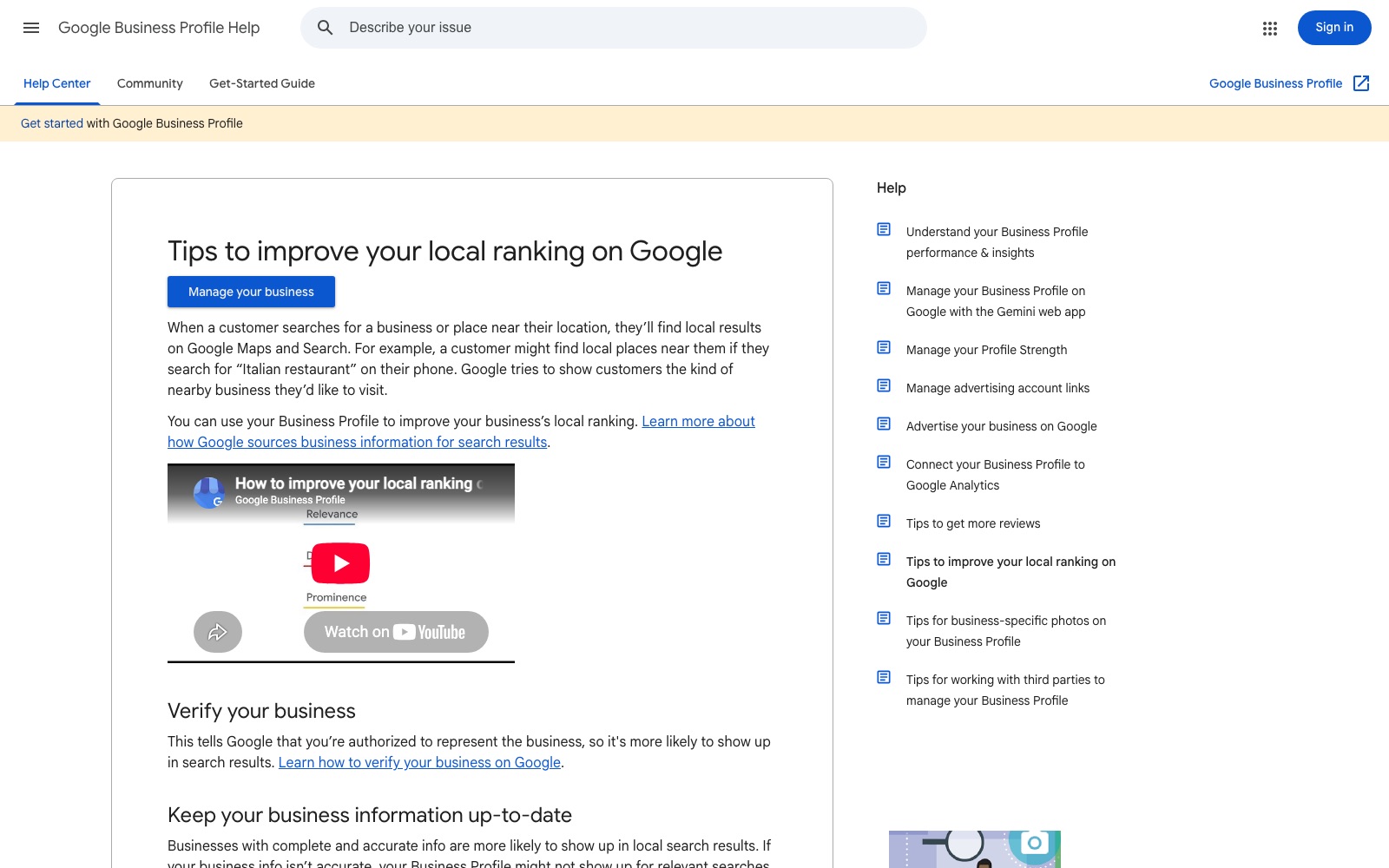
Google's help page on local ranking names three inputs. "Relevance is how well a Business Profile matches what someone is searching for." Distance is how far you are from the searcher. "Prominence means how well-known a business is." It also says "There's no way to request or pay for a better local ranking on Google."
For categories, Google says to pick ones that complete the sentence "This business IS a", and to "Use as few categories as possible to describe your overall core business." It also asks for categories "as specific as possible, but representative of your main business." Type your trade into the category box and pick the most specific match.
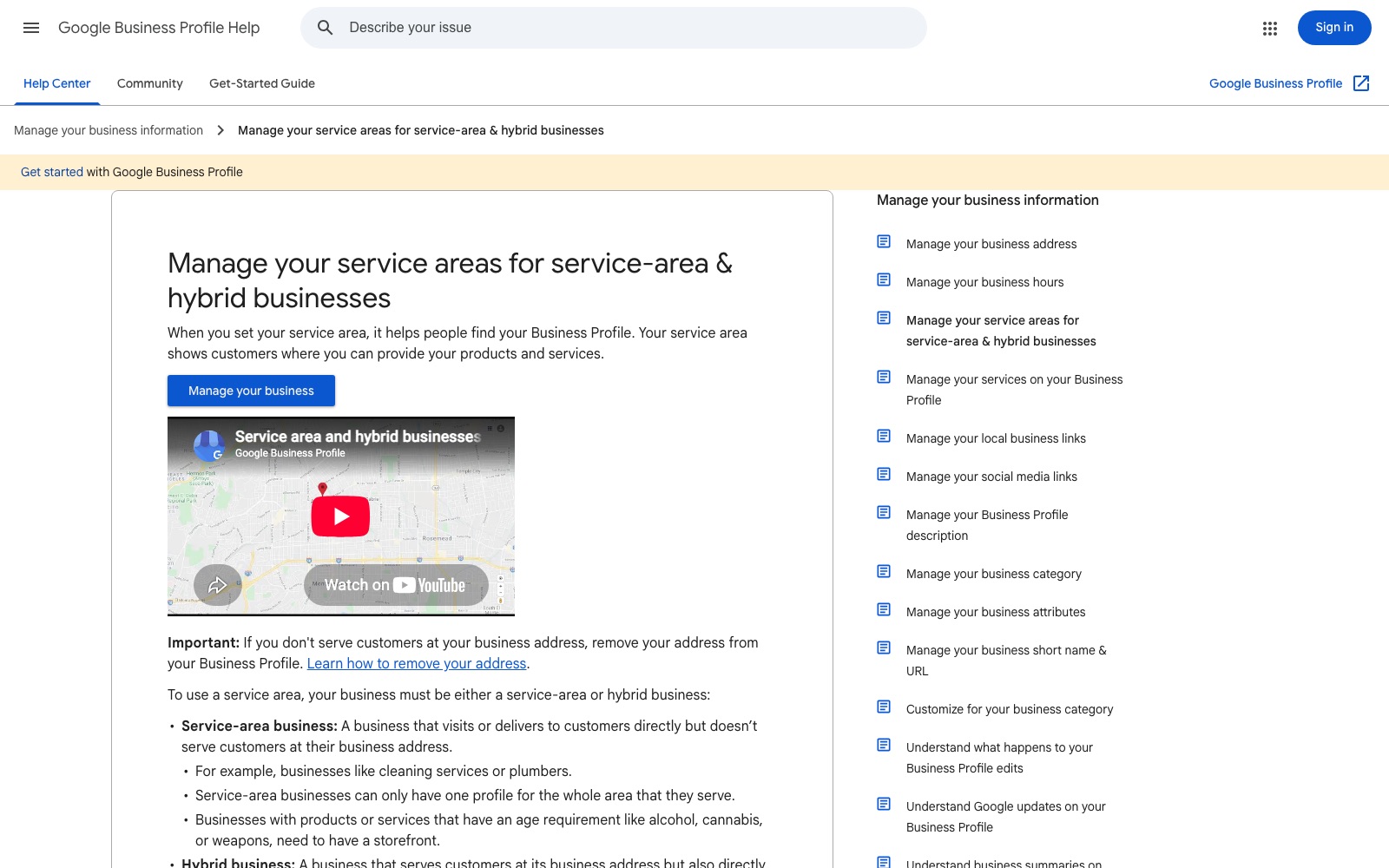
Most construction companies do not take customers at the office, which makes them what Google calls a service-area business. Google's service area page sets the rules:
- "You can have up to 20 service areas."
- The whole area "shouldn't be more than about 2 hours of driving time from where your business is based."
- You cannot set the area as a radius around the business.
- "If you don't serve customers at your business address, remove your address from your Business Profile."
Then fill the rest of the profile with what a buyer checks. Add each project type as a service. Upload photos of finished jobs every month, with your crew and equipment in frame. Put your license number in the description where your state issues one.
Service, project type and city pages: the construction SEO page set
A page ranks for the search it answers. A single Services page that lists remodels, additions, tenant improvements and steel buildings answers none of them well. Build one page per job, grouped by buyer.
| Buyer | Page to build | Search it answers | US searches a month |
|---|---|---|---|
| Homeowner | Kitchen remodeling | kitchen remodel near me | 90,500 |
| Homeowner | Home additions | home addition contractors near me | 5,400 |
| Building owner | Commercial general contracting | commercial general contractor | 4,400 |
| Building owner | Design-build | design build contractor | 3,600 |
| Building owner | Tenant improvements | tenant improvement contractor | 720 |
| Other contractors | Bid with us | construction bids | 1,300 |
| Verdict | One page per project type, one section per buyer | ||
The homeowner pages carry the volume. The commercial pages carry fewer searches from buyers with bigger budgets per job. The "Bid with us" page is for subs: list the trades you hire, how to get on your bid list and your prequalification steps.
Each page should open with the job in the buyer's words, then show proof and a way to reach you. A homeowner wants a price range and a button. A building owner wants project size, schedule and bonding, plus your license and insurance on the page. Both want photos of your own work.
City pages come after the project pages. Build one for each town where you have finished work, and keep the list inside the 2-hour line Google sets for a service area. Each city page needs something true of that city only:
- a finished job there, with photos and the neighborhood
- the permit office or inspection quirks you deal with
- a review from a customer in that town
- your drive time from the yard
Last, mark up the site so search engines can read it. Schema is code that labels a page for search engines, and schema.org lists a GeneralContractor type under HomeAndConstructionBusiness. Put your name, address, phone and hours in it, and show the same details in the footer.
Score your own site against the pieces in this guide below. The weights are our judgment of what moves first.
Want to know which of these pages your site is missing?
Skill Mammoth builds websites and runs marketing for contractors and home service businesses. On a call we look at your profile, your project pages and who ranks in the towns you build in, and tell you what we would fix first.
Project case studies are the construction SEO content competitors skip
A case study is a page about one finished job. For a commercial builder it is the most persuasive page on the site, because building owners hire on proof of similar work. It also ranks for long searches nobody else targets, such as a project type in a named town.
Most builder sites keep finished work in a photo gallery with no text, which gives Google nothing to read. Copy this outline for each job you want more of:
- Title with project type and place. "Tenant improvement for a dental office in [City]" beats "Project 14".
- The client's problem. Two sentences on what they needed and why the schedule mattered.
- Scope and size. Square feet, floors, the trades involved and what you self-performed.
- Schedule and budget outcome. Start and finish dates, and whether it landed on the bid. Leave out any figure the client would not want public.
- Photos with names. Before, during and after, with alt text that says what each shows.
- A quote from the owner or architect, with their written permission.
- Links out and in. Link the case study to its project-type page and its city page, and link both back to it.
Write one case study a month and you have twelve indexed proof pages by next December. Each one is also a reason for a supplier, an architect or the local paper to link to you.
For a remodel, use the homeowner's first name and a price range. The remodeling SEO guide covers the cost-guide pages that pair with it.
Reviews: ask at handover, and ask the commercial owner too
Google's ranking page says "More reviews and positive ratings can help your business's local ranking." Its reviews page says customers can leave one by visiting "a Google link or scan a QR code".
Ask at the moment the work is handed over. For a homeowner that is the final walkthrough. For a commercial job it is the day the owner gets the keys or the certificate of occupancy, and the person to ask is the owner's representative or the property manager.
A commercial builder finishes fewer jobs than a remodeler, so every review has to be asked for. Put the review link on a card in the closeout binder and in the final invoice email, so the ask happens on every job.
Links construction companies can actually earn
A link from another website to yours counts toward prominence. Google's ranking page says prominence is "also based on info like how many websites link to your business." Its starter guide adds that "Google primarily finds pages through links from other pages it already crawled."
Work down this list before you pay anyone for links:
- Suppliers and manufacturers. Ask your rep whether the brand lists installers or dealers on its site, and how to get on it.
- Your AGC chapter. The Associated General Contractors of America says it "is comprised of 87 chartered Chapter affiliates", and you join AGC through a local chapter. Its site lists a Member Directory.
- Your home builders association. NAHB says "More than 600 state and local home builders associations make up the NAHB Federation", and its directories cover local associations and NAHB Remodelers members.
- Local news on your projects. Send the paper the facts and photos for a groundbreaking or a ribbon cutting, and ask that the story link to your site.
- The chamber of commerce, the architects and engineers you work with, and the subs whose sites list the GCs they build for.
We would take one link from your chapter's directory or the local paper over a pile of listings bought in bulk. Each link above comes from someone who knows your work.
Track calls and form fills before you judge construction SEO
You cannot judge construction SEO without a count of the calls and forms it brings. Two free tools give you most of it.
The Business Profile shows a performance report. Google defines its calls figure as "The number of times a customer clicked on the call button on your Business Profile." It also counts website clicks, direction requests and the search terms people used to find you.
On the website, Google Analytics can mark any action as a key event, which it defines as "an event that measures an action that's particularly important to the success of your business." Mark the quote form and the click on your phone number as key events. Then you can see which pages bring them.
Call tracking fills the gap for people who dial from a page. CallRail's Lead Tracking plan is $50 a month with five numbers and 250 minutes. Lead Tracking Complete adds form tracking for $95 a month.
Add one question to the estimate form
Put "How did you hear about us?" on every quote form and in the first call script. Commercial jobs can take months to sign, and the answer recorded on day one is the only way to credit the job to search when the contract lands.
How long construction SEO takes
The agencies that print a timeline mostly agree. WebFX's construction SEO page says it "takes three to six months to start seeing measurable results" and in competitive markets "can take up to a year". Blue Corona's page says results appear "between 3-6 months", and up to a year where keywords are competitive.
Helium SEO's construction page is the outlier: "We typically see results within the first month." Google's own starter guide is more careful: "Some changes might take effect in a few hours, others could take several months."
In practice the profile and review work moves first, because it changes the map pack. Project pages and case studies take longer, and commercial leads take longest of all, because the buyer is months from signing. Judge the first quarter on calls and forms counted, and judge the year on jobs won.
What to do this week
Five jobs, in this order, take an afternoon each and cost nothing but time:
- Set the profile category with the "This business IS a" test, enter your service areas town by town and remove the address if nobody visits the office.
- Build one page for the project type you most want more of.
- Make a review link and send it to your last five finished customers.
- Mark the quote form and the phone click as key events in Google Analytics.
- Write the first case study from your best job this year.
What construction SEO costs: yourself, a freelancer or an agency
There are three ways to pay for construction SEO. You can do it yourself with tools, hire a freelancer by the hour or sign with an agency. Here is what each one prints.
| Route | Printed price | Who printed it |
|---|---|---|
| Do it yourself: local rank and listings tool | $41 to $65 a month | BrightLocal |
| Do it yourself: keyword tool | $29 to $449 a month | Ahrefs |
| Do it yourself: call tracking | $50 to $195 a month | CallRail |
| Freelancer: most common hourly rate | $75 to $100 an hour | Ahrefs survey of 439 providers |
| Agency: ongoing construction SEO | $2,000 to $10,000 or more a month | Blue Corona |
| Agency: SEO plans | $2,900 to $9,200 a month | WebFX |
| Agency: marketing retainers | $3,500 to $7,500 a month | Builder Funnel |
| Verdict | Price the hours before you price the agency | |
The Ahrefs survey, updated August 15, 2024, puts the average freelancer retainer at $1,348.63 a month against $3,209 for agencies. Both averages assume each provider charges the top of its price band.
Two pairs of printed figures disagree, so here are both. WebFX's construction page prints a $1,500 to $3,000 band for local foundation work, while its pricing page starts plans at $2,900 on a 6-month commitment.
The Construction Marketing Association's agency roundup lists Builder Funnel at $2,000 to $8,000 a month. Builder Funnel's own page prints $3,500 to $7,500.
Here is a first year worked out from those printed prices. Copy the arithmetic with your own numbers:
- Yourself. BrightLocal Track at $41 plus CallRail Lead Tracking at $50 is $91 a month, or $1,092 a year, plus your evenings.
- A freelancer. Say you buy 10 hours a month at the survey's $75 to $100 band. That is $750 to $1,000 a month, or $9,000 to $12,000 a year.
- An agency. WebFX's Silver plan at $2,900 on its 6-month commitment is $17,400 before you can leave. Builder Funnel's Build retainer at $3,500 plus technology from $540 is $4,040 a month, or $48,480 a year.
Helium SEO prints "Campaigns starting at" $3,000 a month. Hook Agency prints $3,750 a month for Local SEO + AEO, and says most clients invest "$5,000 to $8,000 a month" across search, ads and the website.
We sell this work too. Skill Mammoth plans start at $350 a month, and a website build is $3,000 or $150 a month for 24 months.
Drag the budget below to see which printed starting prices fit it.
If you are still setting up the company itself, how to start a construction company covers the licensing and the first customers. For lead sources beyond search, see how to get remodeling leads.
Questions to ask before you hire anyone for construction SEO
Google publishes its own list of questions for anyone hiring an SEO. Three of them fit a builder word for word:
- "Can you show me examples of your previous work and share some success stories?"
- "What kind of results do you expect to see, and in what timeframe? How do you measure your success?"
- "Will you share with me all the changes you make to my site, and provide detailed information about your recommendations and the reasoning behind them?"
Add five of your own, and get each answer in writing:
- Who owns the website, the domain and the Business Profile if I leave?
- Can you show me a construction client's project page or case study you wrote?
- Will you build separate pages for my residential and commercial work?
- How will you count calls and form fills, and will I see the raw numbers?
- What is the term, and what does it cost to leave early?
Google's same page warns "No one can guarantee a #1 ranking on Google." Walk away from anyone who promises one.
Be wary of statistics in a pitch. The Construction Marketing Association post that ranks for this search dates from 2017 and lists ten SEO statistics. Six name no source, including the claim that SEO is "85% more likely to improve site traffic than PPC." Ask for the survey behind any number before you weigh it.
When the site itself needs work before any of this, start with construction website design.
Frequently asked questions
What is construction SEO?
Construction SEO is the work of ranking a building company's Google Business Profile and website for the searches its buyers type. Homeowners search the job with "near me", building owners search the project type, and other contractors search for subs and bids. The profile wins the map pack. Project-type pages, city pages and case studies win the rest.
How much does construction SEO cost?
Agency pages read November 27, 2026 print these entry prices: WebFX's construction band from $1,500 a month (its plans start at $2,900 on a 6-month commitment), Blue Corona from $2,000, Helium SEO from $3,000, Builder Funnel retainers from $3,500 and Hook Agency at $3,750. Doing it yourself with tools starts at $29 a month for Ahrefs Starter or $41 for BrightLocal Track.
How long does construction SEO take?
WebFX and Blue Corona both print three to six months for measurable results, and up to a year in competitive markets. Helium SEO says it typically sees results within the first month. Profile and review work moves first. Commercial leads take longest, because building owners are often months from signing when they first search.
Is commercial construction SEO different from residential?
Yes. Homeowners search the job with "near me", such as "kitchen remodel near me" at 90,500 US searches a month. Building owners search the project type, such as "design build contractor" at 3,600. Commercial searches run about a twentieth of residential ones, so commercial pages win on proof: case studies with scope, size, schedule and photos.
What keywords should a construction company target?
Target the jobs you want more of, in the words each buyer uses. For homeowners that means "bathroom remodel near me" at 110,000 US searches a month and "general contractor near me" at 90,500. For building owners it means "commercial general contractor" at 4,400 and "tenant improvement contractor" at 720. Figures are from DataForSEO, November 27, 2026.
Can a general contractor run Google Local Services Ads?
Yes. "General contractor" is on Google's list of eligible Local Services Ads categories, read November 27, 2026, along with Kitchen remodeling and Bathroom remodeling. Local Services Ads are pay-per-lead listings that sit above the map pack. They reach homeowners searching now, and they work alongside the profile, the project pages and the case studies this guide covers.
Rather hand the profile and the pages to someone?
Skill Mammoth builds websites and runs marketing for contractors and home service businesses, with plans from $350 a month. A call is one honest option. The plan above also works without us.