TL;DR
Concrete contractors have a lead problem that most marketing advice ignores: Google Local Services Ads, the best paid channel in home services, has no concrete category. A flatwork or driveway contractor cannot buy the $20 to $80 pay-per-lead listing a roofer or a landscaper can. So the stack is different. The highest-return concrete leads come from the job itself, a yard sign at every pour and a door hanger on the block, because a new driveway is on display for thirty years and the neighbors see it cure. After that: a Google Business Profile with a photo of every pour, project pages on the site that rank for "stamped concrete patio" plus your city, a capped Google Search campaign at the $75 to $275 a lead 99 Calls publishes for concrete, and Facebook for stamped and decorative work where the photo sells. Lead vendors exist for concrete, from 99 Calls at $33.99 an organic lead to ConcreteNetwork's fixed monthly listing to Networx's $10 to $120 shared and exclusive leads, and the math on each is below. Winter is the season to build all of it, because pour season starts in April and the contractor with twelve project pages and a hundred reviews by then books the spring.
Skill Mammoth builds websites and runs Google and Meta ads for contractors, concrete included, so this is a vendor's guide and says so where it matters. Prices are read from each vendor's own pages on October 20, 2026 and linked. The guide covers residential flatwork, driveways, patios, stamped and decorative work, and foundations where it differs; commercial concrete runs on bid lists and relationships, which is a different article.
Why concrete leads are harder than roofing leads
Three reasons. First, the Local Services Ads gap. Google's eligible home services list includes foundations pro, countertop pro, flooring pro and general contractor, but no concrete, flatwork, driveway or paving category, which means a concrete contractor's only route into LSAs is the foundations or general contractor category, and only if the work matches. Second, the ticket is mid-sized. A $6,000 driveway cannot carry a $250 Google lead the way a $15,000 roof can, so the paid math is tighter. Third, the search demand is split across a hundred phrasings, "concrete driveway cost," "stamped concrete patio near me," "concrete contractor," "cement contractor," which rewards a site with a page for each and punishes one with a single services page.
Concrete lead channels, ranked
| Channel | Cost | Cost per lead | Time to first lead |
|---|---|---|---|
| Yard sign at every pour, hangers on the block | About $20 a sign; 7 cents a hanger at 2,000 | A few dollars | Days |
| Google Business Profile with a photo per pour | $0 | $0 | 8 to 12 weeks |
| Project pages on your site (one per job, city in the title) | $0 plus the site | $0 | 8 to 16 weeks |
| Builder, GC, pool and landscaper referrals | Lunch and reliability | $0 | Months, then steady |
| Google Search Ads | $8.33 a click home improvement average (LocaliQ 2026) | $75 to $275 for concrete (99 Calls); $90.92 home improvement average | Days |
| Facebook, decorative and stamped work | $2.18 a click (WordStream 2025) | $42.95 home improvement average | Days |
| Nextdoor | $0 | $0 | Weeks |
| Lead vendors (99 Calls, Networx, ConcreteNetwork, Angi) | $33.99 to $120 a lead or a fixed monthly fee | Shared leads close at 8 to 15% | Days |
| Local Services Ads | Pay per lead | $20 to $80 home services average | Only via foundations pro or general contractor; no concrete category |
| Verdict | The free channels are the strong ones in concrete because the product sits on the street for decades. Build those over the winter, buy a capped Search campaign in April, and use vendors only to fill a week. | ||
1. The pour is the ad
A new driveway or stamped patio is visible from the street for thirty years, and the week it goes in, a mixer, forms and a finishing crew are the most interesting thing on the block. The yard sign goes in the morning the forms are set, about $20 for a 4mm corrugated sign with stakes extra, the phone number larger than the name. The door hangers go on the twenty nearest houses the same morning, from 7 cents each at 2,000 from Vistaprint, with a photo of a finished driveway, "we are pouring on your street this week," the review count, and a neighbor offer: "block pricing on any driveway quoted while our crew is here." Concrete has a cost structure that makes the neighbor offer honest: a second driveway on the same street the same week shares the mobilization, the pump and the truck minimum, so you can quote it 10 percent lower and make more on it. Say that in the hanger.
2. A Google Business Profile with every pour on it
Most "concrete contractor near me" searches end in the map pack, and the map pack ranks on reviews, photos and proximity. The habit that wins it is one photo and one short post per pour, with the city and the type of work in the caption: "Broom-finish driveway, Blaine." Ask for the review the day the forms come off, when the homeowner is standing on a new driveway and happy, and the review guide has the text message that gets it. Fill in every service Google offers in the category: driveways, patios, sidewalks, foundations, stamped, repair. A profile with a hundred reviews and three hundred photos of local pours will out-rank a profile with a logo and twelve reviews in every suburb you work, and it costs nothing but the habit. If you have been sold a geotagged photo-pin tool for this, the DataPins review explains why the plain project post does the same job for free.
3. Project pages that rank for the job you want
The split search demand is the opportunity. A site with one page per type of work and one page per notable job can rank for "stamped concrete patio Maple Grove" and "concrete driveway replacement Plymouth" and fifty phrases like them, each with a few searches a month and a homeowner ready to get quotes. Each project page needs five photos, the city in the title, two sentences about the job (what was there before, what the homeowner wanted) and a price range. Publish the price range. "Driveway replacements in the Twin Cities typically run $X to $Y for a two-car drive" is the single most-clicked line a concrete site can carry, because every competitor hides it. The contractor SEO guide covers the page structure and the 90-day plan, and winter is when to build the pages, from the photos already on the crew's phones.
Want the project pages and the profile built before pour season?
Fifteen minutes on your market, your average ticket and which of these channels should carry April. We will tell you what to build this winter, including when the answer is nothing paid.
4. Referrals from the trades that need you
Every pool builder, deck builder, landscaper, fence company and home builder in your area needs a concrete sub who shows up on the day and finishes flat. That is a lead channel most concrete contractors run by accident. Run it on purpose: a list of twenty companies, a lunch with each over the winter, a one-page sheet with your lead times and a photo of your best flatwork, and a referral fee or a reciprocal referral for residential work they do not want. The landscaping marketing guide describes the same channel from the landscaper's side; the landscaper building a patio base is the person who recommends the concrete guy to the homeowner.
5. Google Search, capped
Search is the paid channel that works for concrete, and it is expensive enough to cap. LocaliQ's 2026 home improvement average is $8.33 a click and $90.92 a lead; 99 Calls publishes $75 to $275 a lead for concrete at the 10th to 90th percentile of what businesses paid nationwide. At $150 a lead and a 30 percent close, a $6,000 driveway carries $500 of acquisition, which is fine at a 40 percent gross margin and not fine at 25. Run it on the specific jobs, "concrete driveway replacement," "stamped concrete patio," "concrete contractor" plus the city, send each click to the matching project page with the price range on it, and cap the month at the number of jobs the crew can pour. The ad is four lines: the keyword in the headline, the review count, the price range, the phone number. Google is offering $500 to $4,500 in credit for new accounts that spend $500 to $3,000 in 60 days as of October 2026.
6. Facebook for the decorative work
A broom-finish driveway does not stop anyone's thumb. A stamped patio with a fire pit does. WordStream's home improvement benchmark is $2.18 a click and $42.95 a lead, and a before-and-after carousel of stamped and decorative pours, a radius on the neighborhoods where the patios are, an instant form and a text within a minute of the submission will book site visits in March and April from homeowners who were not searching yet. Skip it for plain flatwork. The build is in the Facebook ads for contractors guide.
7. Lead vendors, with the math
Concrete has more lead vendors than most trades, and each sells a different thing.
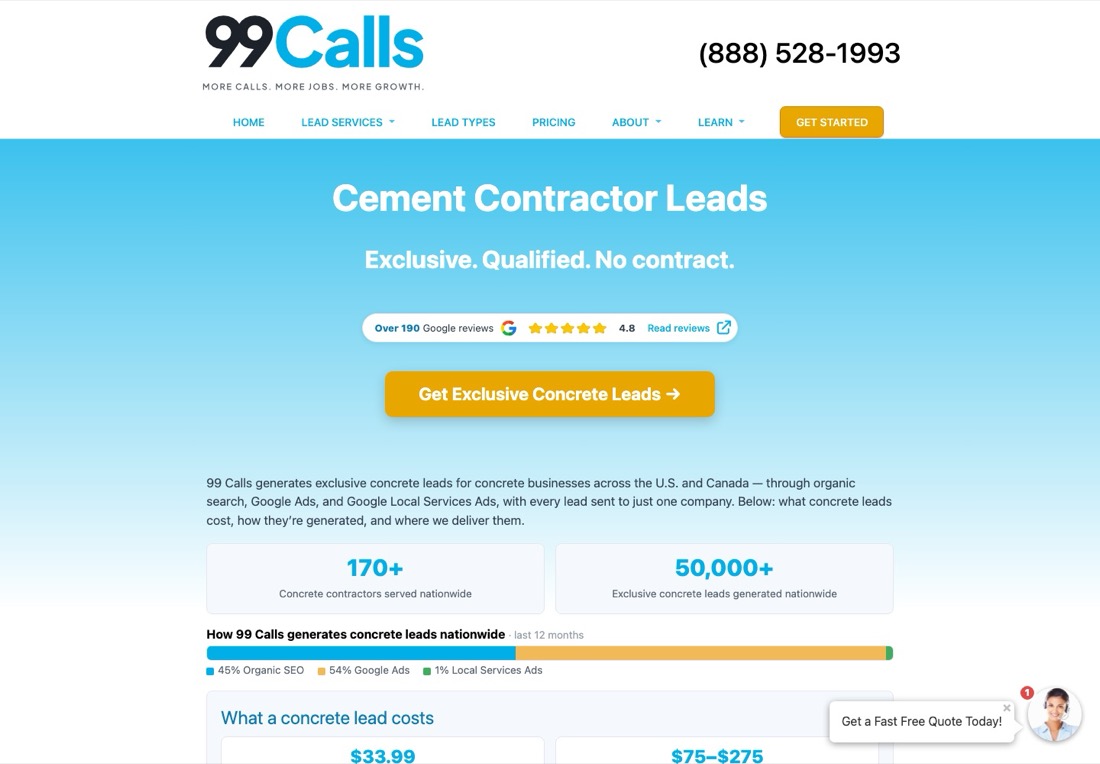
- 99 Calls sells exclusive organic leads at a flat $33.99 each, builds and hosts a site for $99 a month, and manages Google Ads with leads it benchmarks at $75 to $275, no contract. The organic lead is the interesting one: it is what a good site produces on its own, rented.
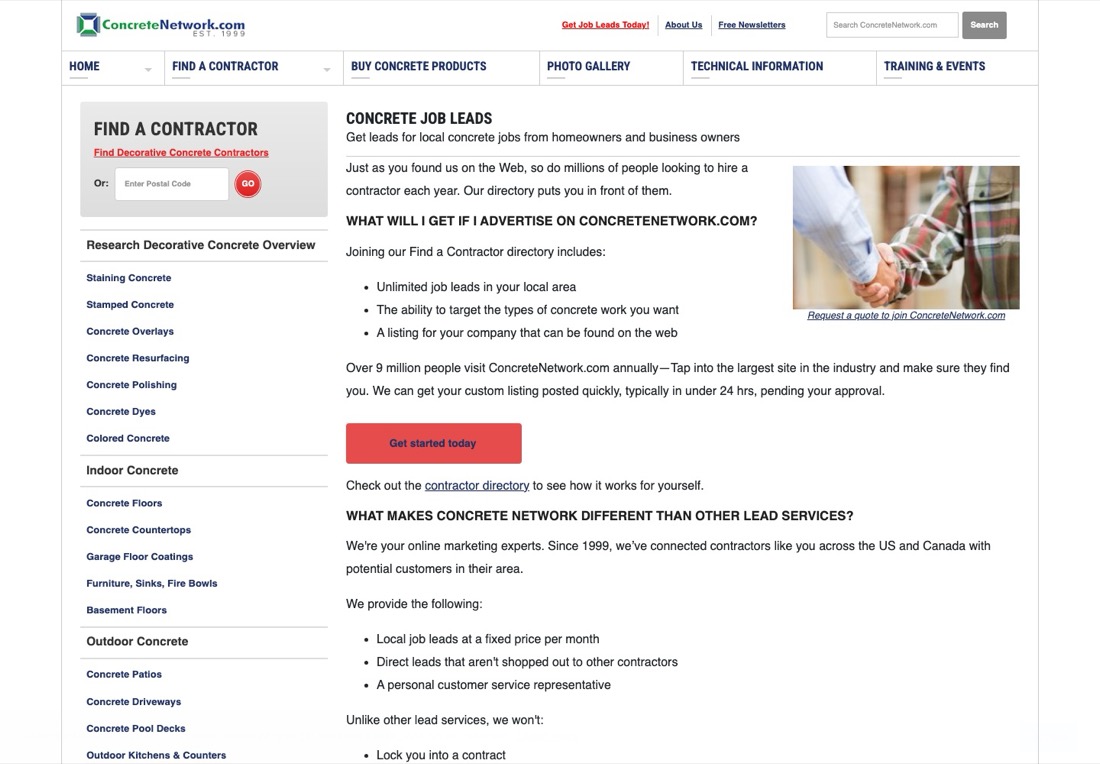
- ConcreteNetwork sells a listing for a fixed monthly price it does not publish, with "unlimited job leads in your local area," not shared, and cites 9 million visitors a year. It has run since 1999. Ask for the price and the lead count for your county in writing before you sign, and ask for the last six months of leads a current member received.
- Networx sells shared leads at $10 to $100-plus and exclusive leads at $15 to $120-plus by its own help center, and its worked example on October 9 was a concrete lead at $58. Shared means up to four contractors. The Networx review has the credit policy and the close-rate math.
- Angi and Thumbtack sell shared leads at a reported $15 to $100-plus, the same homeowner to three to eight contractors, and the Thumbtack review covers the arithmetic.
The math that applies to all of them: a shared lead at $58 that closes at 10 percent is $580 per job. An exclusive lead at $34 that closes at 30 percent is $113. Your own project page that ranks is $0. Vendors fill a gap week; they are a bad place for the first marketing dollar.
The winter plan
Pour season in the northern half of the country runs April to October, and the contractor who books April does it in January. The winter list, in order: publish the price ranges on the site; build one project page a week from last season's photos; post one photo a week to the Google Business Profile and text every 2026 customer for a review; have lunch with twenty pool, deck and landscape companies; order the signs and the hangers; build the Search campaign and leave it paused until the first thaw. A concrete contractor who does those six things has a spring that does not depend on anyone's lead marketplace.
Frequently asked questions
How do concrete contractors get leads?
The highest-return channels are the free ones: a yard sign and door hangers at every pour, a Google Business Profile with a photo of every job, project pages on the website with price ranges, and referrals from pool, deck and landscape companies. Paid channels are a capped Google Search campaign at $75 to $275 a lead and Facebook for decorative work.
Can concrete contractors use Google Local Services Ads?
Not directly. Google's eligible home services list has no concrete, flatwork, driveway or paving category as of October 2026. Foundation contractors can enroll as foundations pro, and some concrete companies qualify as general contractor, but driveway and patio work has no LSA route, which is why Search and the free channels matter more in this trade.
How much do concrete leads cost?
99 Calls sells exclusive organic leads at $33.99 and benchmarks Google Ads concrete leads at $75 to $275. Networx's shared leads run $10 to $100-plus with a published concrete example at $58; exclusive leads $15 to $120-plus. ConcreteNetwork charges a fixed monthly fee it does not publish. A shared lead closing at 10 percent costs about $580 per job.
Is ConcreteNetwork worth it for contractors?
It can be, for a contractor who gets the price and the monthly lead count for their county in writing first. It sells unlimited unshared leads for a fixed monthly fee and claims 9 million visitors a year, but publishes no price, so the only way to judge it is against the leads a current member in your area received.
What is the best advertising for a concrete company?
The pour itself, with a sign and hangers on the block, because a driveway is on display for thirty years. Then project pages that rank for the specific job and city, then a capped Google Search campaign. Facebook works for stamped and decorative work where the photo sells.
When should a concrete contractor start marketing for spring?
January. Project pages take 8 to 16 weeks to rank, Google Business Profile changes take 8 to 12, and a Search campaign should be built and paused before the first thaw. The contractor with a hundred reviews and twelve project pages by April books the season.
See how your site stacks up against the concrete contractors in your map pack, free.
Send us your website. The 10-minute audit grades your project pages, your profile and your rankings for the jobs you want, within 48 hours.