 ChatGPT
TL;DR
- A solo house cleaning start costs $1,360 to $5,940 on published prices, before a cash reserve.
- Price from a loaded hour: the BLS cleaner wage of $17.83 becomes $23.18 with employer costs and bills $35.66 a cleaner-hour.
- Sales tax is the state rule that varies. Texas taxes the charge to clean a home, while Florida taxes only nonresidential cleaning.
- Insureon prints $51 a month for house cleaning liability cover and $9 a month for a janitorial bond.
- About 40 clients cleaned every two weeks cover costs and owner pay in our sample plan. The free Google Business Profile comes first.
- Skip pricing from the bare wage, and skip paying cleaners as contractors when you set their hours and methods.
How to start a cleaning business comes down to five steps in order: choose the work, register, insure, price from a loaded hour and win recurring clients. On published prices, a solo house cleaning start costs $1,360 to $5,940 before a cash reserve.
This guide is for someone about to open: a cleaner leaving an employer, or a solo operator going full time. Each step carries its cost and the week it happens, and a 90-day checklist to copy sits near the end.
Skill Mammoth builds websites and runs marketing for home service businesses, so read the section on first customers as a vendor's view. Every source was read on November 23, 2026.
How to start a cleaning business in 2026: nine steps, with the cost of each
The steps run in this order because each one feeds the next. You cannot quote an insurance policy before you know the work, and you should not quote a client before you know your hour.
| Step | Cost, as printed | When, in our 90-day plan |
|---|---|---|
| 1. Choose house or commercial work | $0 | Day 1 |
| 2. Register the business | $90 to $300 for an LLC | Week 1 |
| 3. Get an EIN from the IRS | $0, issued in minutes | Week 1 |
| 4. Sales tax permit, if your state taxes cleaning | No fee printed in Texas | Week 1 |
| 5. Liability insurance and a janitorial bond | $720 a year, Insureon | Week 2 |
| 6. Equipment kit and opening supplies | $295 to $1,375 | Week 2 |
| 7. Price sheet and estimate form | $0 with our template | Week 2 |
| 8. Google Business Profile and a website | Free profile, site from $150 a month | Weeks 2 to 4 |
| 9. The first 20 recurring clients | $150 to $350 a month of marketing | Weeks 3 to 12 |
| Total start | $1,360 to $5,940 before a cash reserve | |
The timing column is our plan, since no agency prints one. Every cost has a source in the sections below.
Interest in this question is steady. Google Ads data through DataForSEO, pulled the day we wrote this, shows 3,600 to 4,400 US searches a month for it over most of the past year, then 6,600 in October.
House cleaning or commercial janitorial: two different starts
Decide this first. A house cleaning company sells visits to households and collects at each visit. A commercial company, also called a janitorial company, cleans offices and other buildings under a monthly agreement and sends an invoice.
| Measure | House cleaning | Commercial janitorial |
|---|---|---|
| How it is priced | Per visit, by home size | Per square foot, per visit |
| Printed price | $140 to $220 a standard visit | $0.10 to $0.20 a square foot |
| Who printed it | Housecall Pro, its customers' data | Housecall Pro, from national cost guides |
| Startup range | Often under $1,000 | $2,000 to $5,000 or more |
| Liability insurance, Insureon | $51 a month | $60 a month |
| Verdict | Start residential solo, add commercial once you have a crew | |
Housecall Pro's house cleaning price guide, updated in October, draws its $140 to $220 range from 1,559,209 cleaning entries its customers logged in the 12 months to September.
Its commercial pricing guide works one office: 1,000 square feet cleaned three times a week at $150 a visit, or $1,950 a month over 13 visits.
Commercial pays in larger invoices, but you carry the wages until the client pays. That is why this guide starts a solo cleaner with homes and adds an office account later. Searches for starting a commercial cleaning business climbed from 390 in November 2025 to 880 in October 2026 on the same DataForSEO pull.
Solo or a crew: 94.6% of cleaning businesses have no employees
The Census Bureau files house cleaners and janitorial firms under one industry code, 561720. Its 2023 Nonemployer Statistics count 1,095,927 cleaning businesses with no employees, averaging $20,785 in receipts.
Its 2022 Statistics of U.S. Businesses count 62,970 cleaning firms with employees. Put the two together and 94.6% of cleaning businesses have no employees. The files are a year apart, so read that share as close, never exact.
Most no-employee shops stay small. Only 2.6% of the no-employee businesses took in $100,000 or more.
Employer firms in the next band up, $100,000 to $499,999, average $237,904 of revenue with about 4.5 employees. That is roughly two teams of two plus the owner.
We split the same nonemployer file by legal form. Sole proprietors are 97.8% of no-employee cleaning businesses and average $18,648. S-corporations average $132,440, about 7.1 times as much.
We divided each legal form's receipts by its count of businesses. The gap does not show that the form causes the revenue. Larger operators may simply be the ones who choose an S-corporation, so read the chart as who files which form.
The practical read: start solo if you want to, but set up the price, the insurance and the books as if a crew is coming.
Licensing and sales tax: what Minnesota, Texas, Florida and Ohio print
The state pages we read for these four states set tax rules for cleaning and name no cleaning license, no exam and no experience rule. The Small Business Administration, or SBA, says to check your Secretary of State and your city or county for licenses. Housecall Pro puts a local business license at $50 to $100 a year.
Sales tax is where cleaning differs from the trades. Each state draws its own line between homes and buildings, and the lines below are copied from the state pages as they read on November 23, 2026.
| State | House cleaning | Offices and buildings | Rule to note |
|---|---|---|---|
| Minnesota | Some tasks taxed | Taxed | 6.875% state rate, plus local taxes |
| Texas | Taxed | Taxed | 6.25% state, up to 2% local |
| Florida | Not taxed | Taxed | Homes, apartments and condos exempt |
| Ohio | Taxed | Taxed | Under $5,000 a year in sales is excluded |
| Verdict | Read your state's page before you print a price | ||
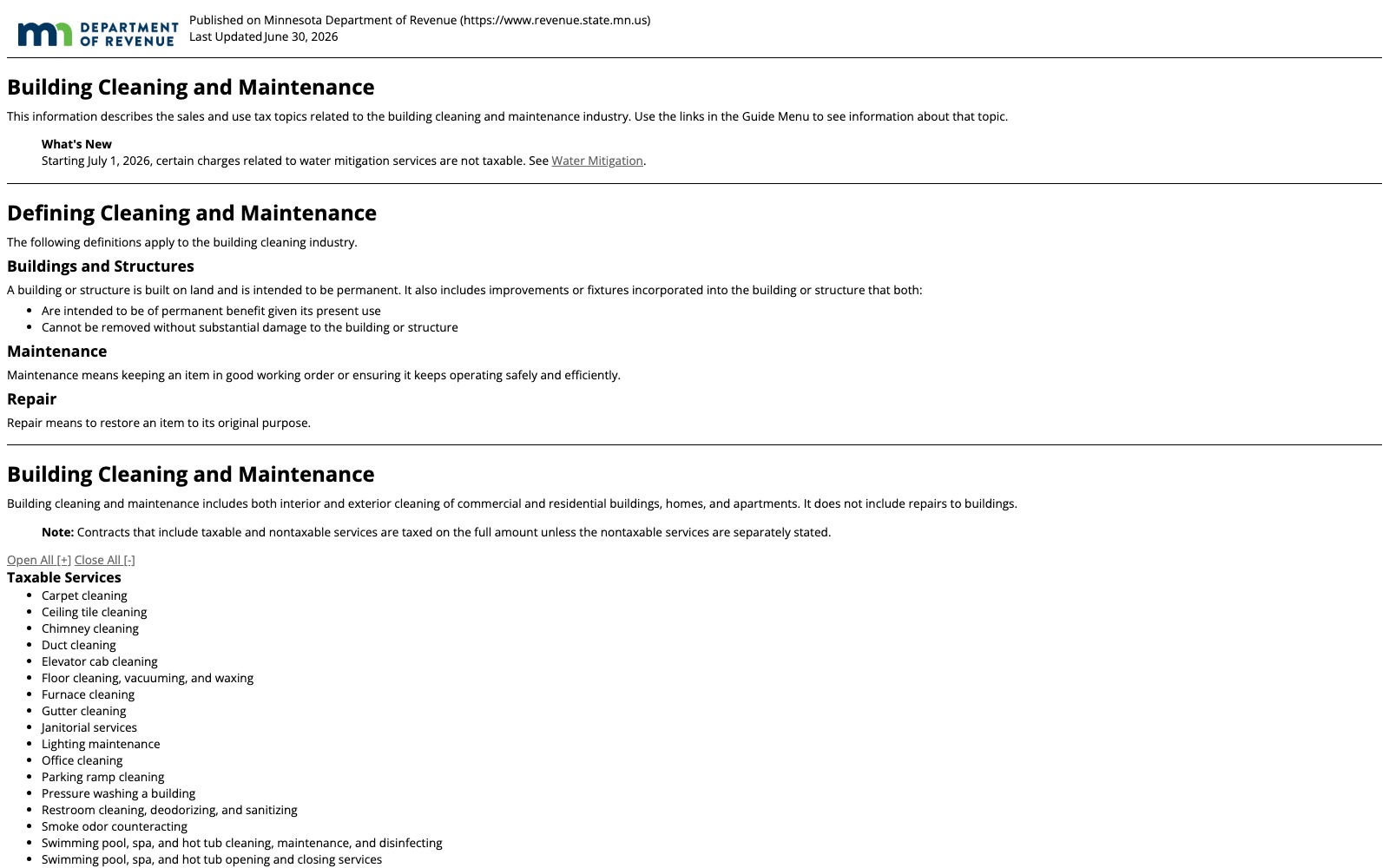
Minnesota's building cleaning guide covers homes and apartments. It taxes floor cleaning, vacuuming and restroom cleaning, and leaves washing dishes, making beds and room straightening untaxed. A contract that mixes both is taxed in full unless the untaxed work is billed separately.
The Texas Comptroller says tax is due on the charge to clean a home, an office or any other building. It exempts a self-employed person doing traditional household services as an employee of the household, never as a subcontractor.
Florida's rule 12A-1.0091 taxes nonresidential cleaning and exempts single-family homes, apartments, condominiums and the common areas of residential buildings.
Ohio's statute, section 5739.01, taxes cleaning the inside or outside of a building and excludes a provider with under $5,000 of such sales in a year. A 2015 information release from the state's tax department names houses.
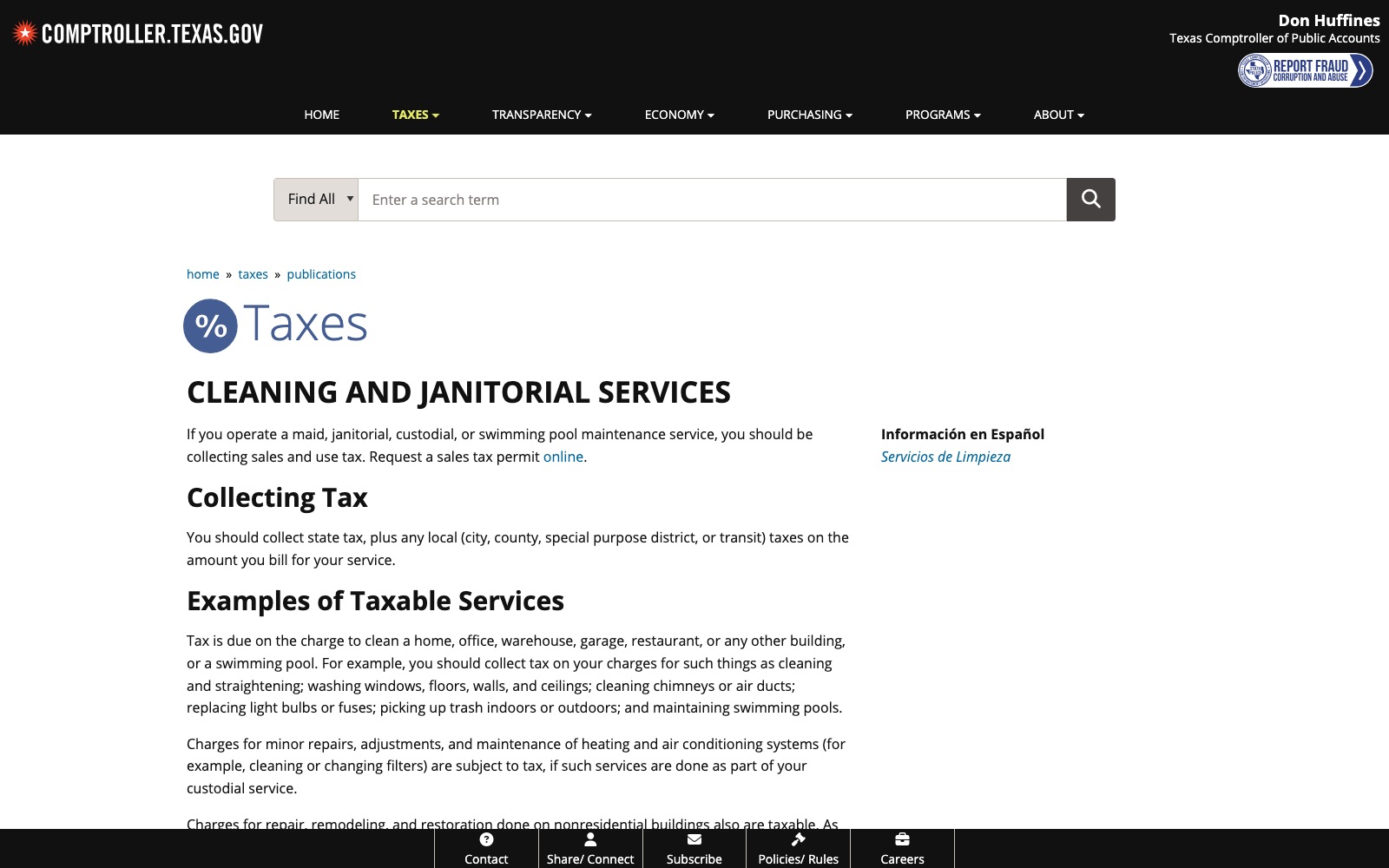
Minnesota and Texas print opposite answers on room straightening. Texas lists cleaning and straightening as taxable, while Minnesota leaves room straightening untaxed. Copy your own state's list into your price sheet.
Business setup: entity, EIN, bank account and books
SBA says a sole proprietor working under their own legal name does not need to register anywhere, and most registrations cost less than $300. An LLC adds a state filing: $70 plus a $20 statement in California, $300 in Texas.
SBA's structure page says an LLC protects you from personal liability in most instances, while a sole proprietor can be held personally liable for business debts. LLC members still pay self-employment tax. You work inside other people's homes, so the LLC is worth the filing fee.
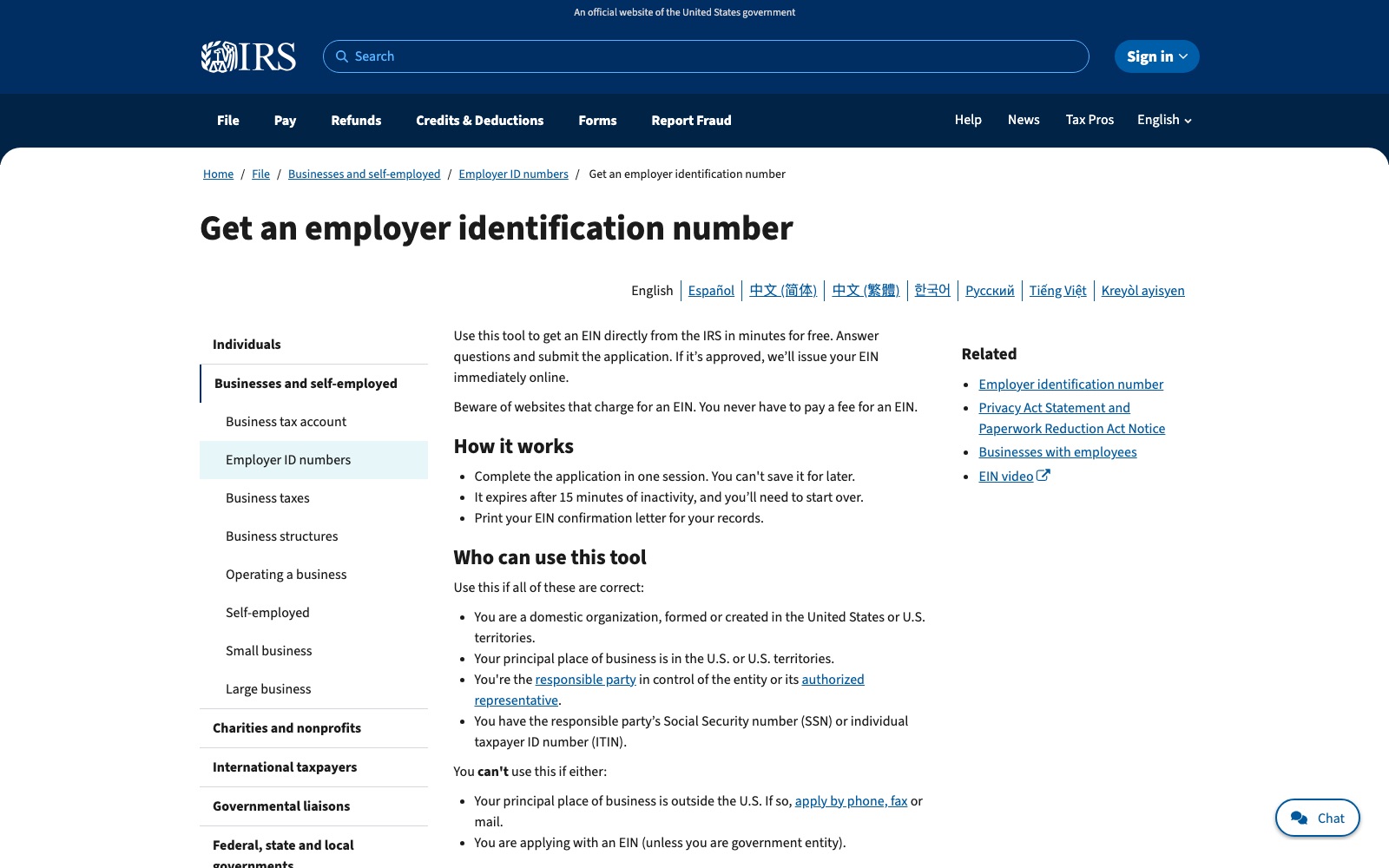
Then get an employer identification number, or EIN, the business's federal tax ID. The IRS application is free and issues the number online at once if approved. The page warns about sites that charge for it.
With the EIN and your filing in hand, open a business bank account so every client payment and supply run sits apart from personal money. Your bank sets what it asks for, so call ahead.
Books come last. QuickBooks Online Simple Start lists at $38 a month on Intuit's pricing page, and the page also lists a free plan. Record mileage as you go: the IRS business rate is 76 cents a mile from July 1, 2026.
Insurance and bonding, from the insurers' own pages
General liability pays when you damage a client's property or someone is hurt on the job. A janitorial bond pays a client back if a cleaner steals from them, and office clients may ask to see one. Workers' compensation covers your employees' injuries once you hire.
| Policy, a year | Insureon, house cleaning | Insureon, janitorial | NEXT, janitorial |
|---|---|---|---|
| General liability | $608 | $725 | $456 to $600 for 51% of customers |
| Janitorial bond | $112 | $120 | No price printed |
| Workers' compensation | $1,204 | $1,362 | $1,512 median |
| Commercial auto | $3,218 | $2,810 | No price printed |
| Business owner's policy | $945 | $919 | No price printed |
| Start with | Liability and a bond: $720 a year at Insureon's house cleaning figures | ||
Insureon's house cleaning page (updated September 1, 2026) and its janitorial page draw on small customers, most with under five employees. Both pages call the figures medians in one place and averages in another.
NEXT uses its active customers over the past 12 months, with data updated in October 2026. Its starting general liability price is $41.67 a month, the Texas minimum. NEXT prints monthly figures, so its column is multiplied by 12.
Skip commercial auto while you drive your own car to your own jobs, but ask your agent how your personal policy treats business use. A business owner's policy bundles liability with property cover, which matters once you store equipment somewhere other than home.
Startup costs for a cleaning business: tools, supplies and software
Low is the bottom of each printed range. Typical is the top, which is close to what our cleaning business plan sample budgets. Insurance is a full first year here, and software is a first month.
| Line | Low | Typical | Source |
|---|---|---|---|
| Equipment kit: vacuum, mop, microfiber, gloves, caddy | $195 | $875 | Housecall Pro ranges |
| Opening supplies | $100 | $500 | Housecall Pro |
| LLC filing | $90 | $300 | California and Texas filing offices |
| Local business license, a year | $50 | $100 | Housecall Pro |
| General liability, first year | $456 | $608 | NEXT, Insureon |
| Janitorial bond, first year | $112 | $120 | Insureon, house cleaning and janitorial |
| Scheduling software, first month | $19 | $49 | ZenMaid Starter, Jobber Core |
| Bookkeeping software, first month | $38 | $38 | QuickBooks Simple Start |
| Website | $150 | $3,000 | Skill Mammoth, monthly or paid up front |
| Marketing, first month | $150 | $350 | Housecall Pro, citing SBA |
| Vehicle | $0 | $0 | Your own car, 76 cents a mile |
| Cash reserve | No published figure, set your own | Housecall Pro: 1 to 3 months | |
| Total | $1,360 | $5,940 | Before the reserve |
The kit lines come from Housecall Pro's startup cost guide, updated October 28, 2026:
- Vacuum: $100 to $500 or more.
- Mop, bucket and broom: $30 to $100.
- Microfiber cloths: $20 to $75.
- Gloves and protective gear: $25 to $100.
- Caddy or storage bins: $20 to $100.
The low liability line is NEXT's $38 a month times 12. The software lines come from the ZenMaid and Jobber pricing pages, both billed monthly. The website line is our own price, so get other quotes.
Set your own budget in the calculator below. Lines whose low price fits stay lit.
Housecall Pro says a residential company can often launch for under $1,000 and a commercial one needs $2,000 to $5,000 or more. Our low column runs higher because it pays a full year of liability cover up front.
Price the first job from a $35.66 cleaner-hour
BLS puts the mean wage for maids and housekeeping cleaners at $17.83 an hour in May 2025, across 860,670 jobs. Even if you clean alone, pay yourself at least that, because the price has to survive your first hire.
A wage dollar costs an employer more than a dollar. BLS employer cost data for June 2026 puts service occupations at $23.73 of total pay for $18.26 of wages, a ratio of 1.30.
At that ratio the cleaner wage becomes a loaded rate, meaning the full hourly cost with taxes and benefits, of $23.18.
Divide the loaded rate by 0.65 to leave 20% for overhead and 15% for profit. That gives $35.66 for every paid cleaner-hour, the rate our cleaning estimate template uses. Neither share has a published source, so set your own in the calculator below.
At the defaults the rate is $35.66. Lower the billed share to 89% and it rises to about $40, which is what happens when drive time goes unpriced and the cleaning hours have to carry it.
A first visit, priced line by line
Here is the sample visit from our cleaning business plan, a home of about 2,000 square feet cleaned every two weeks. Housecall Pro says a home that size takes 1.5 to 2 hours with two cleaners. The Labor Department's Fact Sheet 22 counts job-to-job travel as paid time.
| Line | Per visit | Source |
|---|---|---|
| Cleaning: two cleaners, two hours | $92.72 | Housecall Pro hours, BLS wage |
| Drive time: 15 minutes each | $11.59 | No published figure, set your own |
| Supplies | $8.00 | Housecall Pro example |
| Mileage: 10 miles at 76 cents | $7.60 | IRS rate, your own miles |
| Cost of the visit | $119.91 | Sum of the lines above |
| Price: cost divided by 0.65 | $184.48, leaving $64.57 | |
Then check the price against three published guides:
- Housecall Pro, written for cleaning business owners: $140 to $220 a standard visit.
- Thumbtack, updated November 19, 2026: $165 to $284 a visit for cleaning every two weeks.
- Fixr, updated January 31, 2025: $160 to $200 for a basic clean of a 2,000 square foot home.
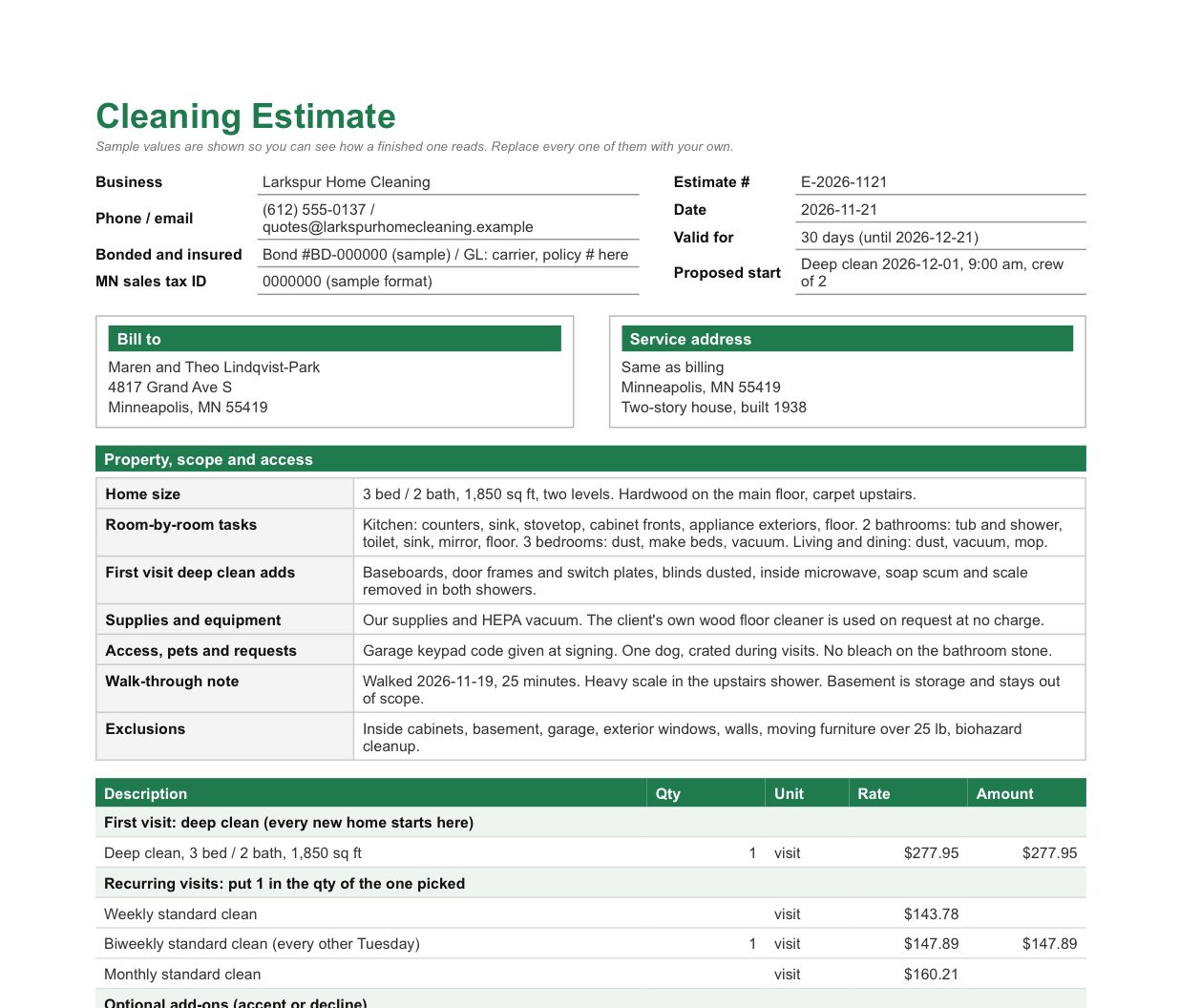
The template prices a smaller home, 1,850 square feet with three cleaner-hours on site, at $147.89 every two weeks. Price the first visit as a deep clean, then the recurring visit. Our cleaning estimate template guide walks the form, and how much to charge for house cleaning covers deep cleans and recurring discounts.
The break-even: about 40 recurring clients
Our cleaning business plan works the full financial plan. At $184.48 a visit, the sample needs $16,120 a month to cover its fixed costs and the owner's pay. That is 88 visits, or about 40 clients cleaned every two weeks.
Adding six clients a month, the sample breaks even in month 7 and needs an $18,000 reserve to get there. Read the plan for the 12-month build and the loan math before you set your own reserve.
Want the first 20 clients to find you on Google?
We build websites and run marketing for contractors and home service businesses, with plans from $350 a month. A call tells you what a first-year budget buys in your area. The setup steps above need no agency.
Winning the first 20 customers, in the order to work the channels
One biweekly client at $184.48 brings in $4,796.48 a year. Twenty of them bring in about $95,930, which is why the first 20 recurring clients matter more than any one-time job. Here is the order we would work the channels in.
- Google Business Profile. Google says creating a profile is free. Add the service area, hours, real photos of your work and a booking link, then ask every client for a review after the second visit.
- Referrals and past contacts, where allowed. They already know your work. Read any non-solicitation clause in your old employment agreement before you call your old employer's clients.
- A simple website. One page with your phone number, service area, prices or a quote form and proof you are insured and bonded. It answers what a client wants to know before handing over a key.
- Local Services Ads. Google lists house cleaning services as a category, and you pay only for leads related to your services. Turn them on once your profile has reviews.
- Lead sites. They send one-time jobs. Use them to fill a slow week, and convert the good ones to a recurring schedule.
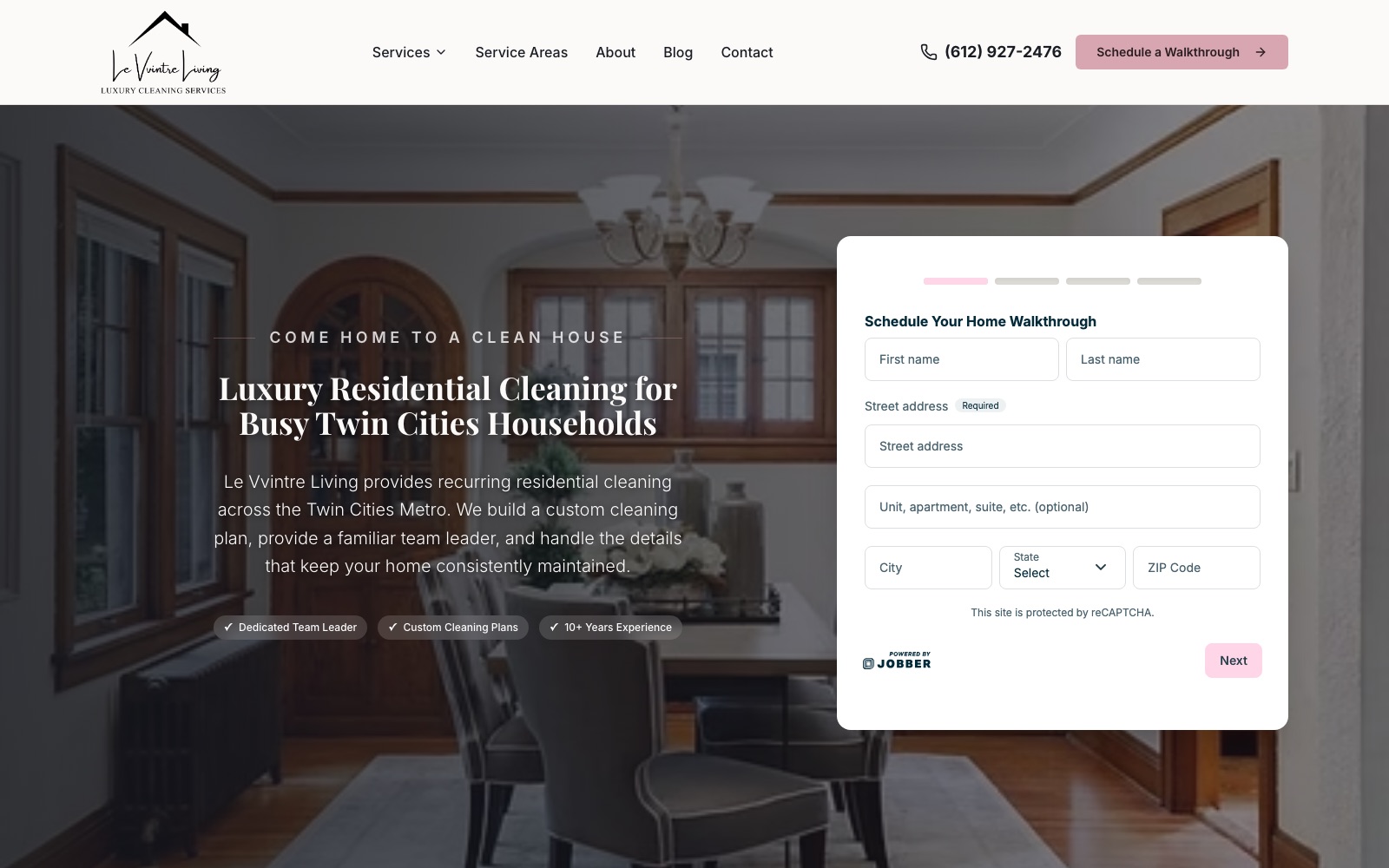
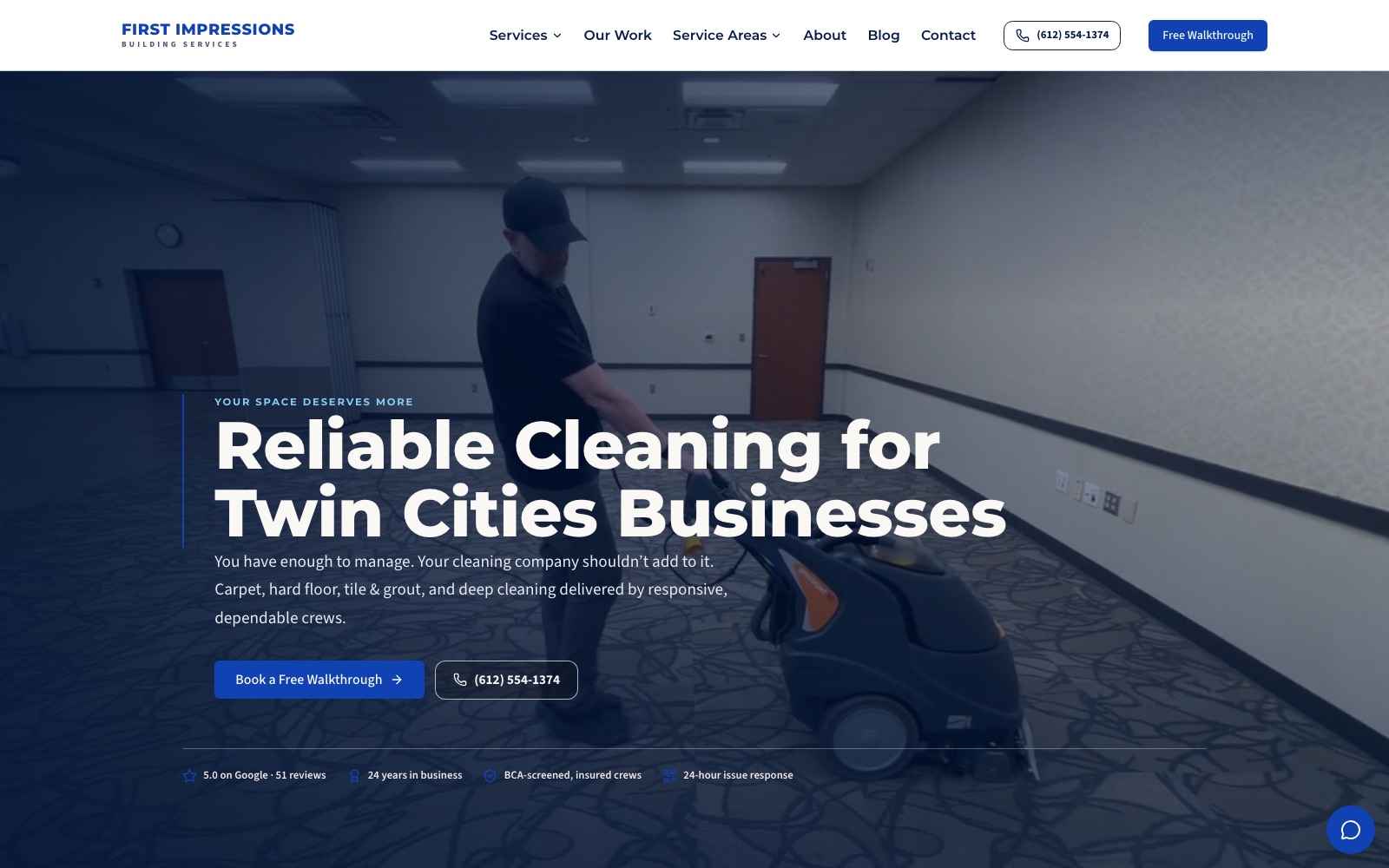
Copy two things from that page. Put the walkthrough request above the fold, since every recurring client starts with one. Then add three short badges under the headline that answer what a homeowner worries about. Our guide to getting cleaning clients ranks the channels in more depth.
Pick the name before the profile and the site, since both carry it. Our cleaning business names guide covers the checks to run before you file.
The first hire: when the schedule is full, and how to do it legally
Hire when your own week is full of recurring visits and you are turning work away. In the sample plan one team handles three visits a day, so a solo cleaner tops out well below the 88 visits a month that break-even needs.
Hire an employee, and skip the contractor shortcut. The IRS test turns on your right to direct and control the work. If you set the schedule, the checklist and the products, you are controlling it.
The IRS hiring page lists what to collect for each employee:
- Form I-9, to verify identity and work authorization.
- The employee's name and Social Security number, for the W-2.
- Form W-4, kept on file for withholding.
Add a workers' compensation policy before the first shift. Insureon prints it at $100 a month for house cleaners.
Two more rules shape the job. Pay drive time between homes, since the Labor Department counts it as hours worked. And under OSHA's hazard communication standard, employers with hazardous chemicals need labels, safety data sheets and training for exposed workers.
Plan to replace people. BLS projects about 321,800 openings a year for janitors and building cleaners against 2,432,600 jobs, or 13.2% of the jobs each year, mostly from workers leaving the occupation.
Five mistakes that sink first-year cleaning shops
BLS business survival data for administrative and waste services, the sector that holds cleaning, shows 77.3% of establishments opened in the year to March 2021 still open a year later. After five years, 46.4% were. Each mistake below breaks the math in this guide.
- Pricing from the bare wage. A $17.83 hour costs $23.18 loaded and bills $35.66. Price at the wage and every visit loses money.
- Leaving drive time unpriced. The Labor Department counts it as paid time. The sample prices it at $11.59 a visit.
- Skipping sales tax where the state charges it. In Minnesota a mixed contract is taxed in full unless the untaxed work is billed separately.
- Paying cleaners as contractors. If you control the work, the IRS test points to an employee.
- A break-even with no owner pay. The plan's sample falls from 88 visits to 19 without it, and the owner works for nothing.
The first 90 days: how to start a cleaning business, week by week
Copy this list into your notes and tick it off. The days are our plan, built from the steps above.
- Day 1: choose house or commercial work, and solo or a small crew.
- Day 2: pick a name and check it with your state's business search.
- Week 1: file the LLC and get the free EIN, then register for sales tax if your state taxes cleaning.
- Week 1: open a business bank account and set up bookkeeping.
- Week 2: buy general liability cover and a janitorial bond, and keep the certificates as PDFs.
- Week 2: buy the equipment kit and opening supplies, and keep a safety data sheet for every chemical.
- Week 2: build a price sheet from your loaded hour and fill in the estimate template.
- Week 2: write a service agreement with your cancellation and lockout fees, using our cleaning contract template.
- Weeks 2 to 4: publish the Google Business Profile and a one-page website with your phone number.
- Weeks 3 to 6: tell past clients and neighbors, and book the first five recurring homes.
- Weeks 6 to 10: ask every client for a review after the second visit, and turn on Local Services Ads once reviews are live.
- Weeks 10 to 12: reach 20 recurring clients, compare your real visit hours to your price sheet and set the visit count that triggers your first hire.
Are you ready to take your first paying client?
Score yourself before the first booking. The weights are our editorial judgment, heaviest for the items that protect you and the client on day one.
Anything unticked with a weight of five comes before the first booking.
Opening this season?
Skill Mammoth, founded in 2023, builds websites and runs marketing for contractors and home service businesses. Plans start at $350 a month, and a website build is $3,000 or $150 a month for 24 months. Registration, insurance and pricing need no agency.
Frequently asked questions
How much does it cost to start a cleaning business?
On prices read November 23, 2026, a solo house cleaning start costs $1,360 to $5,940 before a cash reserve. That covers the kit and opening supplies, an LLC filing and local license, a year of liability cover and a bond, plus the first month of software and marketing. The website is $150 a month or $3,000 up front. Housecall Pro says a residential company can often launch for under $1,000.
Do you need a license to start a cleaning business?
The Minnesota, Texas, Florida and Ohio pages we read set tax rules for cleaning and name no state cleaning license. SBA says to check your Secretary of State and your city or county, and Housecall Pro puts a local business license at $50 to $100 a year. Commercial clients may also ask for a janitorial bond and proof of insurance.
Do cleaning businesses charge sales tax?
It depends on the state. Texas says tax is due on the charge to clean a home or office. Florida taxes nonresidential cleaning and exempts homes and apartments. Minnesota taxes tasks such as floor and restroom cleaning but not making beds or room straightening. Ohio excludes providers with under $5,000 a year of such sales. Read your own state's page.
What should I charge for my first cleaning jobs?
Build the price from a loaded hour. The BLS mean wage for maids and housekeeping cleaners, $17.83, becomes $23.18 at the BLS employer cost ratio of 1.30. Divided by 0.65 for 20% overhead and 15% profit, that bills $35.66 a cleaner-hour. Our sample biweekly visit to a 2,000 square foot home costs $119.91 and prices at $184.48.
How much insurance does a cleaning business need?
Start with general liability and a janitorial bond. Insureon prints $51 a month for house cleaning liability cover and $9 a month for the bond. Janitorial companies pay $60 and $10. NEXT says 51% of its janitorial customers pay $38 to $50 a month for liability. Add workers' compensation when you hire, which Insureon puts at $100 a month.
Should I start a house cleaning or a commercial cleaning business?
This guide starts solo cleaners with homes. Housecall Pro says a residential company can often launch for under $1,000 and a commercial one needs $2,000 to $5,000 or more. Homes pay at each visit, from $140 to $220 a standard clean. Offices pay a monthly invoice, priced at $0.10 to $0.20 a square foot, and you carry the wages until it is paid.