 ChatGPT
TL;DR
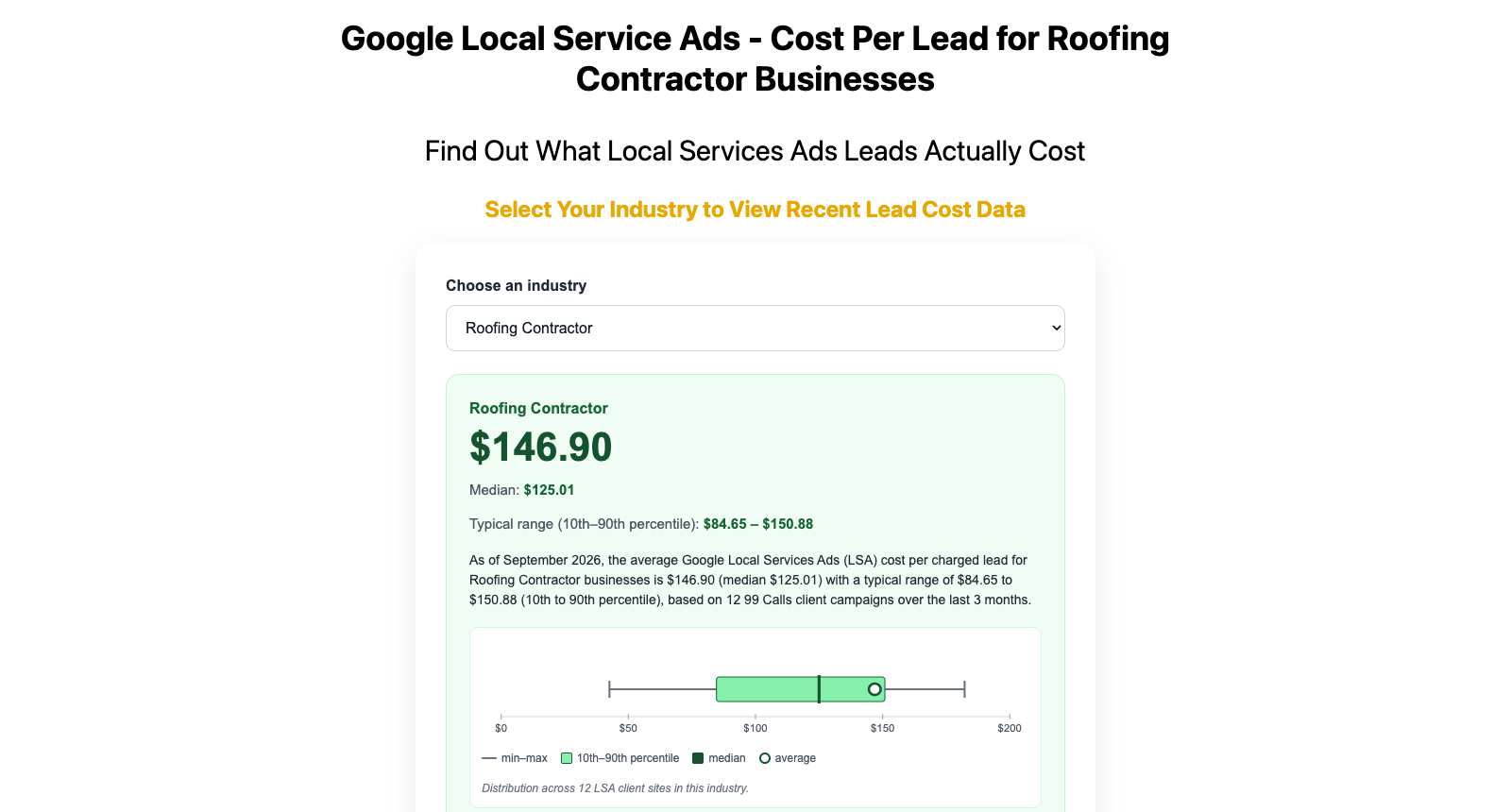
- A roofing lead from Google Ads cost between $124 and $310 in 2026 depending on whose data you read and whether branded searches are counted. Local Services Ads run about $147 a lead.
- The click itself runs $10 to $26.
- Those numbers only work because a replacement ticket runs to five figures. At a 25 percent close rate a $250 lead is $1,000 of acquisition on a $15,000 job.
- The campaign that keeps a lead under $200 runs LSA first and search second, and splits repair and leak searches from replacement searches into separate campaigns with separate bids.
- Cut the budget in storm season rather than raising it. That is when out-of-state restoration companies push metro clicks past $600 a lead.
- We manage Google Ads for contractors at $600 a month or 12 percent of spend, and the pricing is on the page.
Roofing PPC means paying Google for each click on a search ad, and roofing is the trade where pay-per-click is most defensible and most abused.
Defensible because a single sold roof pays for a month of ads. Abused because the same arithmetic lets an agency charge 20 percent of a $10,000 spend and call a $600 lead a success.
This guide is the numbers, from two datasets that disagree with each other in a useful way, and the campaign structure that produces the lower one. It covers Google Search and Local Services Ads (LSA), Google's pay-per-lead listings.
For how search fits beside LSA, Facebook and the physical campaign, see the roofing advertising guide. Meta, storm-chasing door knocks and the lead marketplaces are elsewhere: how to get roofing leads ranks every channel, and where to buy roofing leads covers the shared-lead sellers.
What a roofing PPC lead costs on Google in 2026
Two firms publish tracked data rather than estimates, and a third figure covers LSA:
- 99 Calls. Tracked 105 roofing advertisers, $1.75 million in spend and 7,500 phone and form leads from January 2024 to mid-June 2026.
- The Valley Marketing Group. Tracked 15 contractors and $310,000 in the first quarter of 2026.
- The LSA figure. 99 Calls' September 2026 estimator, built on 12 campaigns over three months.
| Source | What it measures | Cost per lead | Cost per click |
|---|---|---|---|
| 99 Calls, 2024 to mid-2026 | All Google Ads leads, 105 advertisers | $235 to $310 typical; $130 to $180 for top performers | $25.65 in 2026 |
| Valley Marketing Group, Q1 2026 | Non-branded search only, 15 contractors | $124 average, $125 median | $10.25 |
| Valley Marketing Group, Q1 2026 | Branded search | $44 | Not stated |
| 99 Calls, September 2026 | Local Services Ads, charged leads | $146.90 average, $125.01 median; $84.65 to $150.88 for the middle 80 percent | Per lead, not per click |
| Verdict | LSA is the cheaper, more predictable lead; Search runs on top. | ||
Search is worth running on top of LSA, at a cost that depends almost entirely on your market and your month. The spread inside each search source shows how much:
- 99 Calls puts the hardest metros at $400 to $600+ a lead.
- Valley Marketing Group's non-branded leads, from searches that do not name a company, run $80 at the 25th percentile and $256 at the 75th.
Why the two search numbers are so far apart
The datasets do not contradict each other. They count different things.
Valley's $124 excludes branded searches. It reflects a small group of managed accounts in the first quarter, the cheapest quarter of the year.
99 Calls' $235 to $310 is every lead across 105 accounts over two and a half years. That includes:
- The accounts run badly.
- The metros where storm restoration franchises bid.
- April and May, when 99 Calls' monthly median jumped from $234 in March to $311 and $301.
Read them together and the picture is consistent. A well-run non-branded campaign in a normal month lands a lead between $125 and $180.
A poorly targeted one, or a good one in a competitive metro in storm season, lands it between $250 and $600. The gap is not luck. It is targeting and timing, which is the rest of this guide.
Clicks got cheaper and converted worse
One more number from 99 Calls is worth holding onto. Click-to-lead rate, the share of clicks that become a call or a form, fell while cost per click drifted down.
| 99 Calls measure | 2024 | 2026 |
|---|---|---|
| Click-to-lead rate | 13.6 percent | 10.1 percent |
| Cost per click | $27.94 | $25.65 |
Clicks got a little cheaper and converted worse. That is what a problem with the landing page, the page an ad click opens, looks like at industry scale.
The roofing website design review covers what the pages that convert have in common.
Local Services Ads first
LSA differs from a search ad in three ways:
- It charges per lead rather than per click.
- It shows above the search ads with the Google Verified badge.
- It lets you dispute leads that were not leads.
average Local Services Ads lead for a roofer, against $235 and up for a lead from search.
At $147 average against $235 and up for search, it is the first dollar of paid spend for a roofer. There is no argument for running search without it.
The gap has widened since. When we re-read the same estimator on November 11, 2026, the average had dropped to $112.76 a lead.
The application takes six to eight weeks because of the background and license checks. The Google Verified guide walks through it week by week, and the bidding and budget mechanics are in the Local Services Ads cost breakdown.
The catch with LSA for roofing is volume. Google caps how many leads it sends based on your reviews, your responsiveness and your budget.
In a metro with forty verified roofers, the cap arrives before your crews are full. That is what search is for: the demand LSA cannot reach, bought at a higher price.
The search campaign structure that keeps a lead under $200
The mistake that produces a $400 lead is one campaign with "roofing" in it. Homeowners searching for roofing are not one audience, and 99 Calls' job-type breakdown makes the point.
The generic term is the second most expensive and the least specific, and it is the one most campaigns spend most on.
Three campaigns, three bids
Split it into three campaigns with their own budgets and bids:
- Repair, leak and emergency. The intent is urgent and the ticket is small, so bid to a lower target cost per lead. Run call-only ads, which dial your number instead of opening a page, with a phone number that is answered.
- Replacement and installation. The ticket is five figures and a $250 lead is fine, so bid higher and send the click to a page with a price range on it.
- Material terms: metal, tile and flat. 99 Calls prices these at $230 to $298 a lead. They need their own landing pages, because a metal roof buyer will not convert on a shingle page.
What the clicks cost by search term
Ahrefs' click estimates for the core terms in September 2026 show the same split.
The cheap clicks on the broadest terms are cheap because they convert worst. Real auction prices run above Ahrefs' estimates, and 99 Calls measured $25.65 average across its accounts.
Pro tip
Build the negative keyword list, the searches you tell Google never to show your ad for, before the first ad runs. Do not wait for the first bad month. The list:
- Jobs
- Salary
- Hiring
- DIY
- How to
- Shingles price
- Home Depot
- Lowe's
- Calculator
- Every neighbouring city you do not serve
Half of a bad roofing campaign's spend goes to people who are not homeowners, and every one of those searches is predictable.
Want the campaign built this way from day one?
We run Google Ads for contractors at $600 a month or 12 percent of spend, whichever is higher, with LSA management at $150 a month plus a $299 setup. Weekly optimisation, call tracking and a cost-per-lead report you can read in a minute.
The storm season trap
Every roofer knows a hail event is the best week of the year for demand. Fewer know it is the worst week for the auction, the live bidding that sets the price of each click.
When the storm hits, search volume spikes and out-of-state restoration companies switch on national budgets in your metro. Cost per click jumps within hours.
Valley describes markets going past $600 a lead in the most competitive metros during April and May. 99 Calls' high-cost line for those months sits at $551 and $609.
The counterintuitive move is to hold or cut the search budget in the storm week. Let LSA, reviews and the trucks in the neighbourhood do the work, because those channels do not get more expensive when a franchise from three states away starts bidding.
The people who want a roof after a hailstorm are calling everybody. Being the company that answers in two minutes matters more than being the company at the top of the ad stack, and the speed-to-lead numbers make that case with figures.
Roofing PPC budget, and what management should cost
Valley puts the minimum viable search budget at $2,000 a month and a competitive-metro budget at $3,000 to $8,000.
Below $2,000 the campaign does not get enough clicks to learn, and the cost per lead you see in month one is noise. The math at the minimum:
| At the minimum budget | Number |
|---|---|
| Monthly search budget | $2,000 |
| Cost per lead | $150 |
| Leads | 13 |
| Close rate | 25 percent |
| Roofs sold | Three |
Whether that is worth it is a question about your average ticket, not about the ads.
The same budget-floor logic for every other trade, with the planner click prices behind it, is in PPC for contractors.
What a roofing PPC agency charges
Management fees are where roofing PPC gets expensive quietly. The industry standard is 15 to 20 percent of spend.
On $5,000, that is $750 to $1,000 a month before a single click.
We charge 12 percent or $600, whichever is higher. We publish it on the paid ads page, which is more than most of the agencies in the roofing marketing agencies roundup will do before a sales call.
Whoever you hire, ask for the fee as a number and the cost per lead as a number, monthly, in writing.
Three roofing PPC mistakes to skip
- One campaign, one ad group, "roofing" as the keyword. An ad group is the set of keywords that share one ad. Run a single group and a $265 generic lead becomes the average instead of the ceiling.
- Raising the budget when the storm hits. Demand is up, but so is every competitor's bid, and the extra dollars buy clicks from homeowners who called four other roofers before yours picked up. Hold the budget and win on response time.
- Running search without LSA. The cheaper, more disputable lead is sitting above your ad with a badge on it. If the application is the obstacle, start it today. It takes six to eight weeks, and search can run in the meantime, but not instead.
Getting quoted a percentage of spend and no cost-per-lead number?
Send us the last three months of your campaign and we will tell you what each lead cost by job type, what the fee should be and whether the storm-week spend was worth it.
Frequently asked questions
How much does a roofing lead cost on Google Ads?
Between $124 and $310 in 2026 depending on the dataset. 99 Calls, tracking 105 advertisers from 2024 to mid-2026, reports a typical range of $235 to $310 with top performers at $130 to $180. The Valley Marketing Group's first-quarter 2026 data, excluding branded searches, averages $124 with a median of $125. Both agree that competitive metros in storm season run $400 to $600 or more.
How much does a roofing lead cost on Local Services Ads?
99 Calls' September 2026 estimator puts the average charged lead for roofing contractors at $146.90, the median at $125.01, and the middle 80 percent of advertisers between $84.65 and $150.88. LSA charges per lead rather than per click, and the cost has stayed between roughly $80 and $170 a lead across the last 24 months.
What is the cost per click for roofing keywords?
99 Calls measured $25.65 average across its roofing accounts in 2026, down from $27.94 in 2024. Valley's first-quarter data puts it at $10.25. Ahrefs' September 2026 estimates run lower still, at $8 to $11 for repair, emergency and inspection terms and $1.50 for the broad "roofers near me" and "roofing companies near me" searches, which convert worst.
Should a roofer run Google Ads or Local Services Ads?
Both, in that order. Local Services Ads deliver the cheaper lead, show above the search ads with the Google Verified badge, and allow disputes on bad leads. Google caps LSA volume based on reviews, responsiveness and budget, so search is for the demand LSA cannot reach. Running search without LSA means paying more for the same homeowner.
How much should a roofing company spend on PPC?
At least $2,000 a month on search for the campaign to get enough clicks to optimise, and $3,000 to $8,000 in a competitive metro, per the Valley Marketing Group's 2026 benchmarks. At $2,000 and a $150 lead that is 13 leads a month, or about three sold roofs at a 25 percent close rate. Management fees of 15 to 20 percent of spend are standard; we charge 12 percent or $600 a month.
Why does roofing PPC get so expensive during storm season?
Because search volume spikes and out-of-state restoration companies switch on national budgets in the affected metro at the same time, pushing clicks and leads up within hours. 99 Calls' high-cost monthly figures for April and May 2026 were $551 and $609 a lead. Holding the search budget and relying on LSA, reviews and response time during the storm week is usually the better return.