TL;DR
Contractor marketing is four jobs, and most companies are only doing two of them. Get found, get contacted, get answered, get repeated. Almost everyone buys the first two and neglects the last two, which is why more traffic so often produces the same number of booked jobs.
The order that works: fix what happens after a lead arrives, then get your Google Business Profile right, then build the site, then add paid channels. Reversing that order is the most expensive mistake in this industry.
Realistic budget for a $500K to $5M contractor: $1,000 to $8,000 once for a site that converts, then $350 to $1,500 a month. Paid leads on top of that if you need volume this quarter.
The short version
Marketing gets the phone to ring. Systems decide whether the ring becomes revenue. The average company takes 42 hours to answer a web lead, so the second half is usually where the money is.
Want a read on your own setup? The free website audit covers your site, your lead paths, and what happens after someone hits submit. Ten-minute Loom, written report inside 48 hours.
The four jobs, and where contractors actually lose
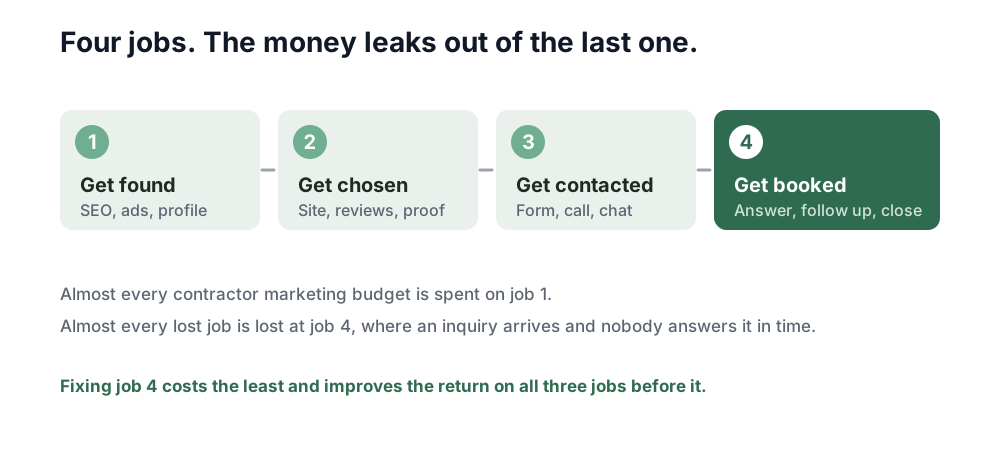
Every marketing decision belongs to one of four stages. Naming them is useful because it shows you which one is actually broken.
| Stage | What it means | Where it usually breaks |
|---|---|---|
| Get found | Local search, maps, AI answers, paid placement | Profile half-filled, no service-area pages |
| Get contacted | A site that gives a number instead of a form | Contact form as the only path |
| Get answered | Response inside minutes, every channel | Almost everyone. This is the gap. |
| Get repeated | Reviews, reactivation, referrals | No system, so it depends on memory |
| Verdict | Stages one and two get the budget. Stages three and four decide the revenue. | |
Harvard Business Review audited 2,241 US companies and found the average first response to a web lead took 42 hours, with 23% never responding at all. A 2021 study of 5.7 million inbound leads found conversion runs 8x higher inside five minutes than at six minutes or later. Those two numbers explain more lost revenue than any channel choice.
Start where the return is fastest
The sequence below is ordered by return per dollar, not by what agencies like selling.
1. Response speed, before anything else
Costs almost nothing and beats every channel decision. Every form submission fires an SMS to whoever is on call. Missed calls trigger an automatic text back within 60 seconds. Somebody owns a five-minute clock.
Drift found only 7% of tested companies replied within five minutes. Hitting that standard puts you ahead of roughly 93% of the businesses your customer is also calling. The full build is in contractor lead follow-up.
2. Google Business Profile
Free, and for a homeowner who wants somebody today it is the primary battleground. Complete every field, list each service separately, keep photos current, post weekly.
Reviews are the compounding part. Target 50 in year one and keep a steady rate rather than collecting a burst and stopping. Our 100 reviews playbook has the sequence, and if you have duplicate listings, fix those first because they split your ranking signal.
3. A website that converts, not just exists
The job of a contractor site is to turn a visitor into a phone call. Tappable number in the header on every page, proof of work in your own photos, service pages per trade and per town, and a price range somewhere.
Instant estimate tools outperform contact forms when your pricing is predictable enough to give a range. We built one for a roofing client and they saw 2x qualified leads within 60 days, covered in the estimate tool case study. Budget guidance is in what contractor websites actually cost.
4. Local SEO
The compounding channel. Slower than paid, cheaper per lead forever after. Service pages, service-area pages that say something true about each town, and the internal linking that ties them together.
This deserves its own read rather than a summary here. Start with SEO for contractors: the complete 2026 guide, then the version for your trade: plumbing, roofing, HVAC, electrical or pest control.
Want the systems built rather than described?
We build the site, the local search presence, and the follow-up underneath it, then report on booked jobs instead of sessions.
5. Local Service Ads
Pay per lead rather than per click, with the Google Verified badge attached. Cost per lead runs roughly $10 to $40 for lawn care at the low end and $50 to $150 for water damage restoration at the high end, with most trades landing between $20 and $80. Real figures by trade are in what Local Service Ads cost, and the badge process is in the Google Verified guide.
This is the fastest way to buy demand while the SEO matures. Dispute bad leads every week, because that is where DIY and managed accounts diverge most.
6. AI search visibility
Homeowners increasingly ask ChatGPT and Perplexity for a recommendation before they open Google. Getting cited is a different discipline from ranking, and it is still cheap because most competitors have not noticed. See GEO vs SEO and how to get ChatGPT to recommend your business.
Budget, honestly
| Stage | Typical spend | What it buys |
|---|---|---|
| Under $500K revenue | $0 to $300/mo | Profile, reviews, answering the phone fast |
| $500K to $1M | $1,000 site + $350/mo | Real site, local SEO foundation, follow-up |
| $1M to $5M | $3,000 site + $750/mo | Content cadence, review automation, attribution |
| $5M+ | $8,000 site + $1,500/mo | Off-page work, multi-location, deeper reporting |
| Plus | Paid leads on top when you need volume this quarter rather than next year. | |
Model it against your own numbers with the contractor funnel calculator. At a $9,000 average job closing one in four, a $12,000 year needs about five extra booked jobs to break even.
Four things to skip
Naming what does not work is the only way the rest of the advice means anything.
Skip buying more leads while your close rate is unknown. If 100 leads produce 18 jobs, doubling spend gets 36 jobs at double the cost. Lifting close rate to 30% gets you 30 jobs on leads you already paid for. One needs budget, the other needs a phone that answers faster.
Skip social media as a lead channel. It works for recruiting and for reminding past customers you exist. As a source of homeowners who need a water heater today, it loses to search every time.
Skip lead marketplaces as a strategy. Fine as a stopgap when the schedule is thin. As a permanent foundation you are renting demand at rising prices, competing on speed with four other contractors who bought the same lead.
Skip the rebrand while the pipeline leaks. A new logo on a broken follow-up process just wastes better-looking leads. Fix the process, then spend on brand if it still matters.
What changes by trade
The four stages hold everywhere. The channel mix and the calendar do not, and getting the timing wrong wastes a season.
| Trade | Demand pattern | Where the budget should go |
|---|---|---|
| Roofing | Storm-driven spikes, long quiet stretches | Capacity to answer during a surge, plus year-round SEO so you are not starting cold when hail lands |
| HVAC | Two peaks, first heat and first freeze | Maintenance plans between peaks, paid leads during them |
| Plumbing | Emergency-led, steady year-round | Answering speed above all, because burst pipes go to whoever picks up |
| Electrical | Steady, with project work on longer cycles | Service pages for panel upgrades and EV chargers, which are researched before they are bought |
| Lawn care | Spring signup decides the whole year | Front-load everything into the six weeks before the season |
| Pest control | Species-specific windows | Recurring plans, with pages published a season ahead |
| Verdict | Publish and spend ahead of your season, not during it. Google needs months of lead time. | |
The trade-level playbooks go deeper on each: roofing, HVAC, plumbing and electrical.
Agency, in-house, or a mix
Three of the four stages can be run without hiring anyone, and it is worth knowing which.
Do yourself: the Google Business Profile, the review requests, and the decision that somebody owns a five-minute response clock. All free, none requiring outside help, and together they are the majority of the available gain for a company under $1M.
Bring somebody in for: the website build, the local SEO structure, and the automation wiring between your forms, phone and CRM. These take specific skill and a block of uninterrupted time, which is exactly what an owner running crews does not have.
Be careful hiring for: paid media, unless the person doing it is a specialist. A generalist retainer that includes ads usually means ads run at the level of attention a generalist can give them. It is why we kept ads out of generalist retainers ourselves: our ad management runs as its own dedicated service with its own fee, never as a retainer line item running on leftover attention.
If you are shortlisting, the honest agency comparison covers what to ask and which firms fit which size of company.
The 90-day sequence
| Window | What gets built |
|---|---|
| Days 1 to 14 | Speed-to-lead routing, missed-call text back, call tracking so you know which channel produced what |
| Days 15 to 30 | Google Business Profile completed, review automation live, duplicates removed |
| Days 31 to 60 | Website rebuilt or fixed: tappable number, service pages, proof, estimate tool if pricing allows |
| Days 61 to 90 | Service-area pages, Local Service Ads if you need volume now, reporting on booked jobs |
| Expect | Response-time gains inside weeks. Local pack movement in 6 to 9 months, not days. |
How to tell if your marketing is working
Most contractors are handed the wrong numbers. Sessions and rankings go up regardless of whether you booked anything, which is exactly why agencies report them.
Ask for four instead: median response time to a new lead, percentage of leads that got a second touch, booked-job rate by channel, and cost per acquired customer. If nobody can produce those, nobody is measuring the thing that pays you. More on the tracking setup in marketing attribution for home service contractors.
Related reading
- Contractor SEO: the complete 2026 guide, the deep version of stage one
- Contractor lead follow-up: the 2026 system
- The contractor sales funnel and your real revenue math
- The best home service marketing agencies
- Why your business is not getting leads
When the site itself is the problem, website redesign cost shows what a rebuild should run and what to demand in the quote.
For kitchen, bath, and addition work specifically, remodeling marketing reranks these channels for a six-month sales cycle.
Most of the platforms sold as contractor marketing systems are CRMs with a funnel builder attached. Our CRM for contractors guide explains the four product categories, and the GoHighLevel alternatives guide covers what to do when a marketing company hands back an account you now have to run yourself.
FAQ
How much should a contractor spend on marketing?
Between $500K and $5M in revenue, a workable range is a one-time $1,000 to $8,000 for a site that converts plus $350 to $1,500 a month ongoing, with paid leads on top if you need volume this quarter. Under $500K, spend nothing until your Google Business Profile is complete and you answer the phone inside five minutes.
What is the highest-return contractor marketing channel?
Response speed, which is not a channel at all. Conversion runs 8x higher inside five minutes than at six minutes or later, and most companies take 42 hours. After that, Google Business Profile, then local SEO, then Local Service Ads.
How long does contractor marketing take to work?
Response-time changes show inside weeks. Google Business Profile improvements show in weeks to a couple of months. Local pack and organic rankings take 6 to 9 months in a mid-competition market. Local Service Ads produce leads within days.
Do contractors need social media marketing?
For recruiting and for staying visible to past customers, yes. As a source of new homeowners with an urgent job, no. Search intent beats social reach in this industry, and the budget is better spent on local visibility.
Should I hire an agency or do it myself?
Do the Google Business Profile and the response-time work yourself, because both are free and neither needs an agency. Bring somebody in for the website, the local SEO structure, and the automation wiring, which are the parts that take specific skill and time you do not have.
What marketing metrics actually matter for contractors?
Median response time, second-touch rate, booked-job rate by channel, and cost per acquired customer. Sessions, impressions and keyword rankings move whether or not you made money, which is why they get reported.
Is SEO or paid advertising better for contractors?
They do different jobs. Local Service Ads deliver leads within days at roughly $20 to $80 per lead for most trades. SEO takes months and then costs nothing per lead. Most contractors should run paid while the SEO matures rather than choosing.
Find out which stage is actually broken
Free website audit: a 10-minute Loom on your site and lead paths, plus a written report in 48 hours. No pitch deck.